The Russian Orthodox Church warned Friday that it would sever ties with the leader of the worldwide Orthodox community if he grants autonomy to Ukraine's Orthodox Church.
The stern warning follows Ecumenical Patriarch Bartholomew I's promise to allow the Orthodox Church in Ukraine to be autocephalous, or ecclesiastically independent. The Russian church, the world's largest Orthodox communion, fiercely opposes the decision by Bartholomew, who is considered the "first among equals" of Orthodox leaders.
Moscow Patriarchate spokesman Vladimir Legoyda warned Friday it will "break the Eucharistic communion" with the Istanbul-based Ecumenical Patriarchate if it makes the Ukrainian church autocephalous.
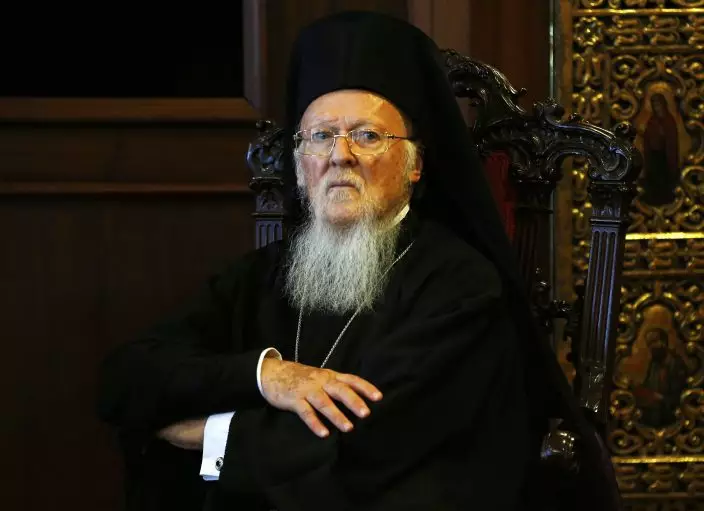
FILE - In this Friday, Aug. 31, 2018 file photo, Ecumenical Patriarch Bartholomew I, the spiritual leader of the world's Orthodox Christians, looks on at the Patriarchate in Istanbul. The Russian Orthodox Church warned Friday, Sept. 28 that it would sever ties with the leader of the worldwide Orthodox community if he grants autonomy to Ukraine’s Orthodox Church. The warning follows Ecumenical Patriarch Bartholomew I’s promise to allow the Orthodox Church in Ukraine to be autocephalous, or ecclesiastically independent. (AP PhotoLefteris Pitarakis, file)
The church in Ukraine has been tied to the Moscow Patriarchate for hundreds of years, although many parishes have split off over the past two decades to form a schismatic church. Calls for independence have increased since Moscow's 2014 annexation of the Crimean Peninsula from Ukraine.
Legoyda said that the plans for autocephaly "threaten a fragile religious peace in Ukraine," and charged that they have been driven by "political ambitions of the Ukrainian leaders."
Ukrainian President Petro Poroshenko, who is running for re-election next March, has pushed Bartholomew to grant independence to the Ukrainian church.
His efforts received a fillip earlier this month when the Ecumenical Patriarchate announced that it was sending two bishops to Ukraine as a step toward declaring ecclesiastical independence for the church there.
The Russian Church responded by declaring that it would not participate in events headed by the Ecumenical Patriarchate and would not even remember Bartholomew in its prayers.
Father Nikolai Balashov, a deputy head of the church's foreign relations department, pointed at Friday's seizure of a church in the Ivano-Frankivsk region western Ukraine by supporters of the Ukrainian church's autonomy as a sign of what might happen if Bartholomew grants it ecclesiastical independence.
"It's a sad harbinger of possible tragic developments in Ukraine if the government organs continue meddling in the church affairs in Ukraine," he said. "If politics continue to intervene in the religious life it could lead to tragic consequences across Ukraine."
WASHINGTON (AP) — U.S. forces boarded another oil tanker in the Caribbean Sea on Friday, the U.S. military said, as the Trump administration targets sanctioned tankers traveling to and from Venezuela as part of a broader effort to take control of the South American country's oil.
The predawn raid was carried out by Marines and Navy sailors launched from the aircraft carrier USS Gerald R. Ford, part of the extensive force the U.S. has built up in the Caribbean in recent months, according to U.S. Southern Command, which declared “there is no safe haven for criminals” as it announced the seizure of the tanker called the Olina. The Coast Guard then took control of the vessel, officials said.
Southern Command and Homeland Security Secretary Kristi Noem both posted unclassified footage on social media Friday morning of a U.S. helicopter landing on the vessel and U.S. personnel conducting a search of the deck and tossing what appeared to be an explosive device in front of a door leading to inside the ship.
In her post, Noem said the ship was “another ‘ghost fleet’ tanker ship suspected of carrying embargoed oil” and it had departed Venezuela “attempting to evade U.S. forces."
The Olina is the fifth tanker that has been seized by U.S. forces as part of the effort by President Donald Trump’s administration to control the production, refining and global distribution of Venezuela’s oil products, and the third since the U.S. ouster of Venezuela President Nicolás Maduro in a surprise nighttime raid.
In a post on his social media network later in the day, Trump said the seizure was conducted “in coordination with the Interim Authorities of Venezuela” but offered no elaboration.
The White House did not immediately respond to requests for more details.
Venezuela’s government acknowledged in a statement that it was working with U.S. authorities to return the tanker, “which set sail without payment or authorization from the Venezuelan authorities,” to the South American nation.
“Thanks to this first successful joint operation, the ship is sailing back to Venezuelan waters for its protection and relevant actions,” according to the statement.
Samir Madani, co-founder of TankerTrackers.com, said his organization used satellite imagery and surface-level photos to document that at least 16 tankers left the Venezuelan coast in contravention of the quarantine U.S. forces have set up to block sanctioned ships from conducting trade. The Olina was among that flotilla.
U.S. government records show that the Olina was sanctioned for moving Russian oil under its prior name, Minerva M, and flagged in Panama.
While records show the Olina is now flying the flag of Timor-Leste, it is listed in the international shipping registry as having a false flag, meaning the registration it is claiming is not valid. In July, the owner and manager of the ship on its registration was changed to a company in Hong Kong.
According to ship tracking databases, the Olina last transmitted its location in November in the Caribbean, north of the Venezuelan coast. Since then, however, the ship has been running dark with its location beacon turned off.
While Noem and the military framed the seizure as part of an effort to enforce the law, other officials in the Trump administration have made clear they see it as a way to generate cash as they seek to rebuild Venezuela's battered oil industry and restore its economy.
In an early morning social media post, Trump said the U.S. and Venezuela “are working well together, especially as it pertains to rebuilding, in a much bigger, better, and more modern form, their oil and gas infrastructure.”
The administration said it expects to sell 30 million to 50 million barrels of sanctioned Venezuelan oil, with the proceeds to go to both the U.S. and Venezuelan people. But the president expects the arrangement to continue indefinitely. He met Friday with executives from oil companies to discuss his goal of investing $100 billion in Venezuela to repair and upgrade its oil production and distribution.
Vice President JD Vance told Fox News this week that the U.S. can “control” Venezuela’s “purse strings” by dictating where its oil can be sold.
Madani estimated that the Olina is loaded with 707,000 barrels of oil, which at the current market price of about $60 a barrel would be worth more than $42 million.
Associated Press writers Dánica Coto in San Juan, Puerto Rico, Josh Boak in Washington, and Regina Garcia Cano in Caracas, Venezuela, contributed to this report.
This story has been corrected to reflect that the United States has seized three tankers, not five, since Nicolás Maduro was ousted as Venezuela’s president.
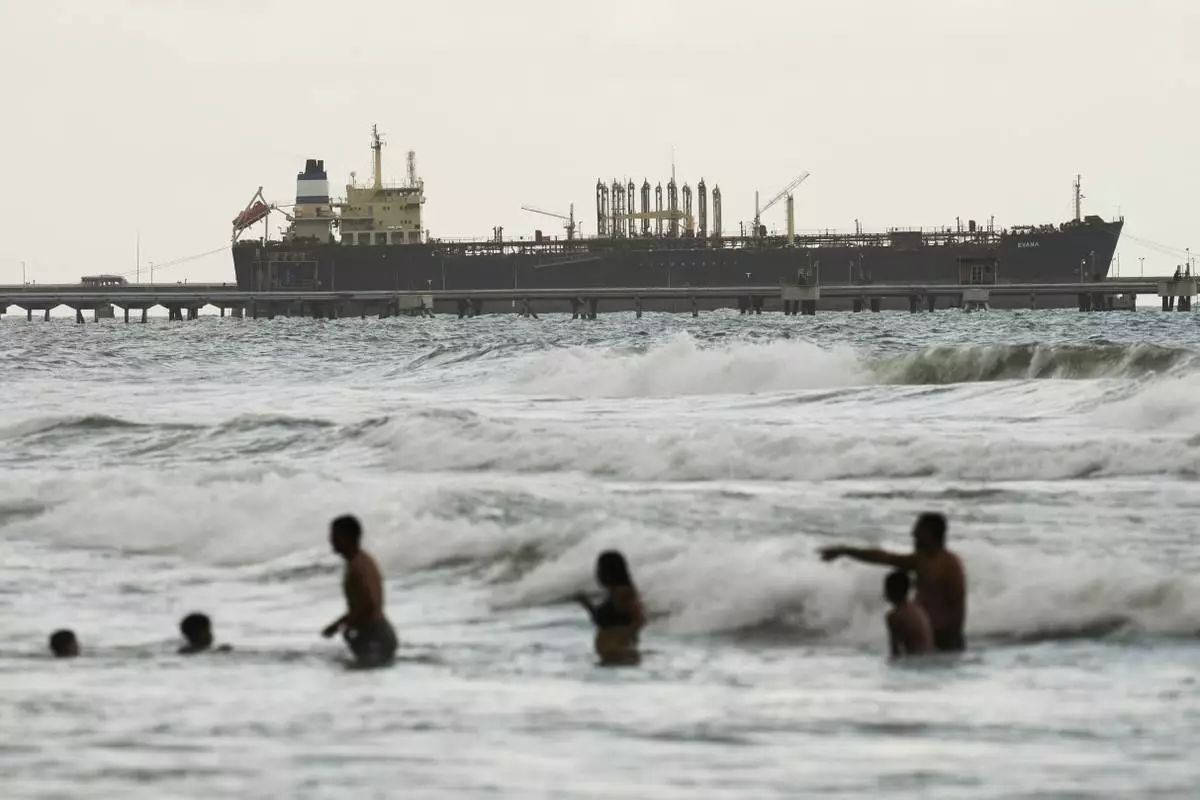
FILE - Evana, an oil tanker, is docked at El Palito Port in Puerto Cabello, Venezuela, Dec. 21, 2025. The U.S. military says U.S. forces have boarded another oil tanker in the Caribbean Sea. The Olina is the fifth tanker seized by U.S. forces. (AP Photo/Matias Delacroix, File)