Images of a tiny red bird that barely fills the palm of one's hand appear everywhere in Venezuela — printed on money, labels of craft beer bottles and the cover of children's school books.
But the finch-like red siskin is vanishing from the wild at an alarming rate, falling prey to a century of shrinking forests and poachers cashing in on their brilliant red feathers, prized around the world by breeders of exotic birds.
Click to Gallery
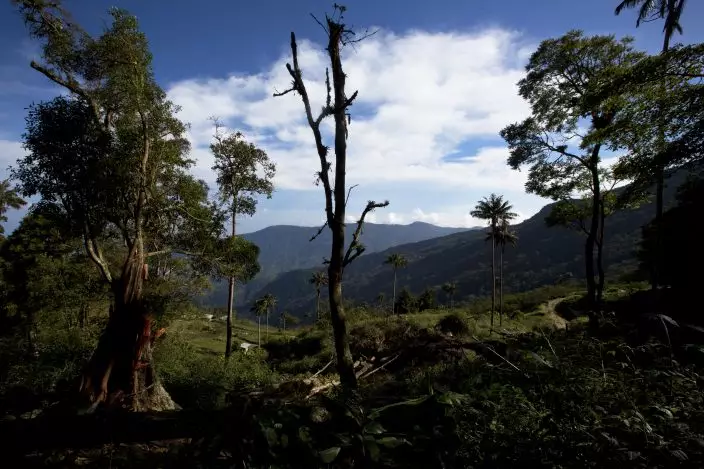
In this Oct. 10, 2018, farmers cut trees to grow fruit and vegetables in the coastal area of Carayaca on the outskirts of Caracas, Venezuela, where the finch-like red siskin bird is vanishing from the wild. There is a trend among farmers boosting coffee bean production by thinning coffee groves for more sunlight, or ripping them out altogether to plant vegetables that turn a quicker profit. (AP PhotoFernando Llano)
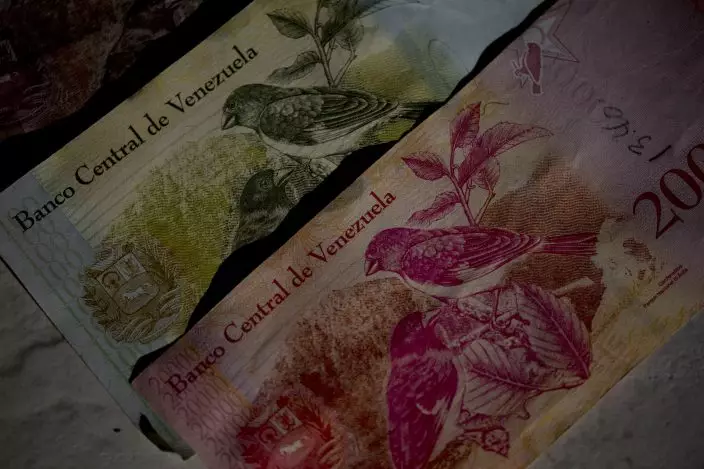
This Oct. 20, 2018 photo shows Bolivar bank notes decorated with images of Venezuela's red siskin bird, as part of rescue program in Caracas, Venezuela. Images of a tiny red bird that barely fills the palm of one's hand appear everywhere in Venezuela _ printed on money, labels of craft beer bottles and the cover of children's school books. (AP PhotoFernando Llano)
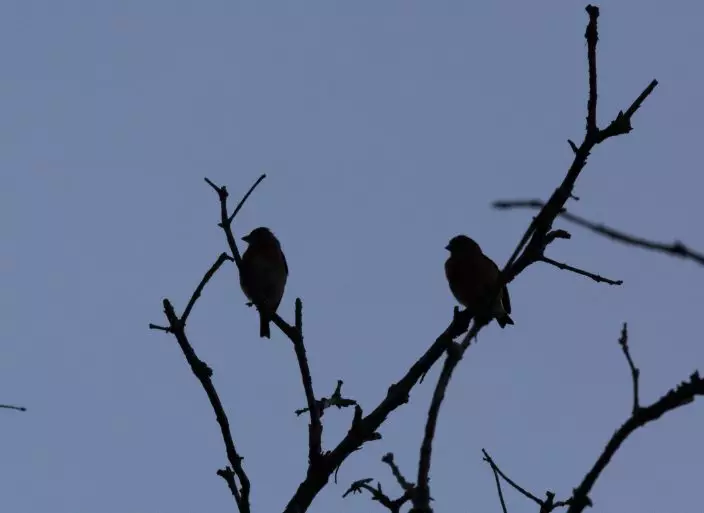
In this Oct. 23, 2018 photo, Venezuelan female red siskin birds perch on a branch in Vargas, Venezuela. The "Cardenalito," or "Little Cardinal" as it is affectionately called, holds a special place in Venezuelan culture, the poster child of some 1,400 bird species _ from the Amazon to the Andes _ that live in one of the world's most biodiverse landscapes. (AP PhotoFernando Llano)
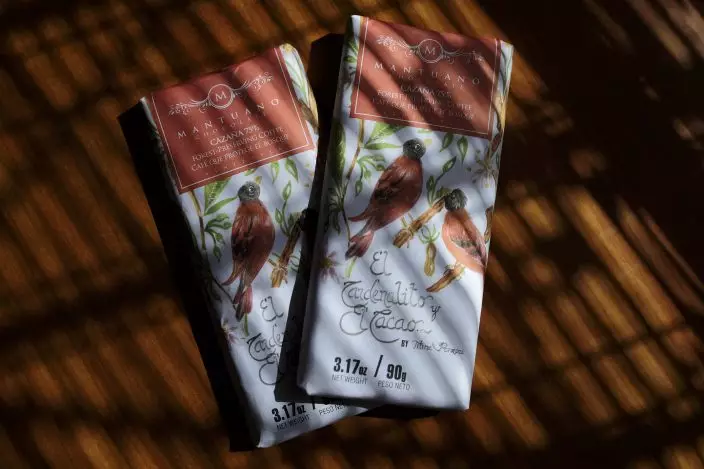
In this Oct. 20, 2018 photo, the wrapping of chocolate bars, brand "El Cardenalito and Cacao," is decorated with images of Venezuela's red siskin bird, and the message "Forest-Preserving Coffee," as part of a campaign to rescue the bird from extinction in Caracas, Venezuela. Farmers who meet The Red Siskin Initiative project's strict standards will win the right to market their coffee beans with "Bird Friendly" labels and take advantage of a loophole in Venezuelan law to set prices for premium products, sometimes five-times higher than price caps set by the socialist government. Eventually they hope to export the coffee. (AP PhotoFernando Llano)
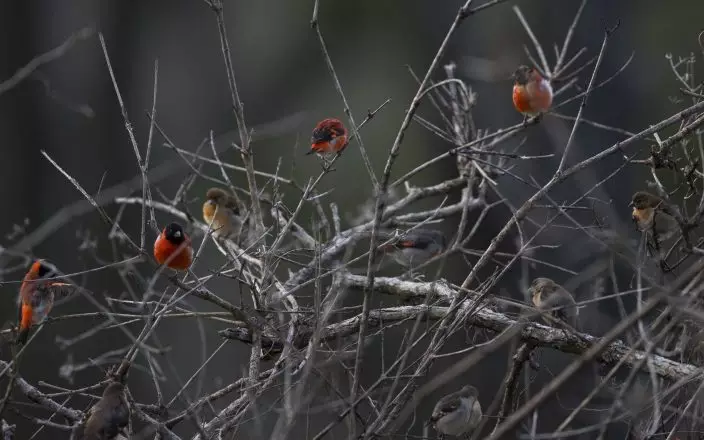
In this Oct. 23, 2018 photo, Venezuelan red siskin perch on branches in Vargas, Venezuela. Some 40 farmers in the rugged, coastal mountains of Carayaca, northwest of the capital Caracas, have stopped cutting down trees _ an important first step to creating a robust habitat for the threatened bird to thrive and repopulate.(AP PhotoFernando Llano)
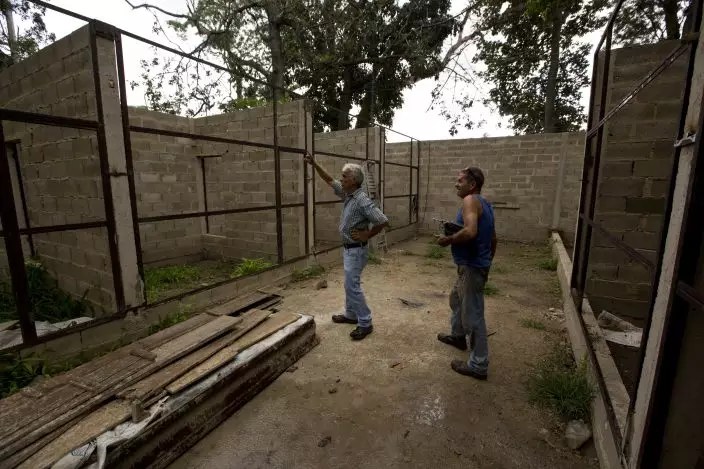
In this Oct. 18, 2018 photo, Federico Pantin, left, gives instructions to a worker at a new investigation center to breed Venezuela's endangered red siskin bird, at his private zoo in Turmero, Venezuela. Here, 200 birds are expected to be hatched next year, adding to the 25 caged at the Smithsonian Institution, forming a type of Noah's Ark to ensure that the iconic species does not disappear. (AP PhotoFernando Llano)
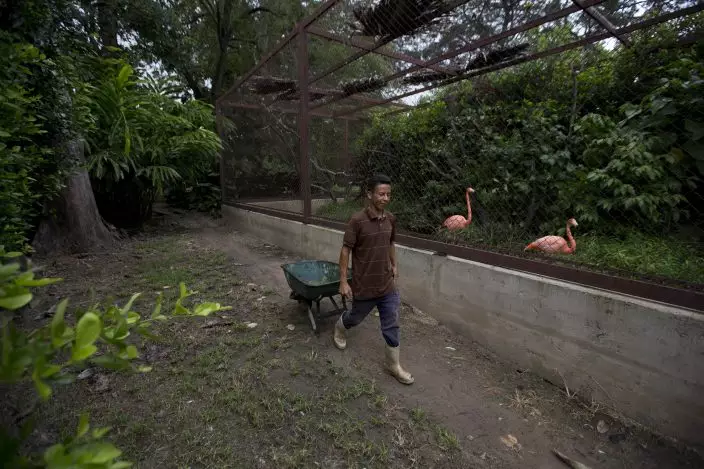
In this Oct. 18, 2018, a private zoo worker pulls a wheelbarrow past a caged area of American flamingos, near the site where an investigation center to breed Venezuela's red siskin bird will be built in Turmero, Venezuela. Protection under Venezuelan law dating back to the 1940s hasn't stopped poachers from catching red siskin birds to sell on the international black market. (AP PhotoFernando Llano)
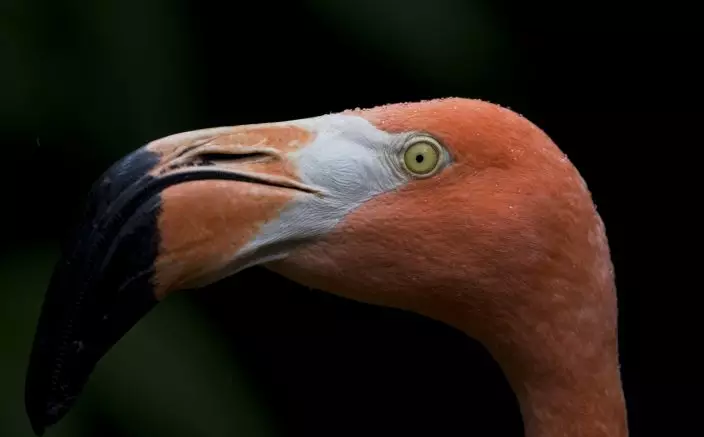
In this Oct. 18, 2018 photo, an American flamingo rescued from a hunter stands in a private zoo, where an investigation center to breed Venezuela's red siskin will be built in Turmero, Venezuela. Ranked sixth in the world for the number of bird species, many of them found nowhere else, Venezuela for decades was a coveted destination for naturalists and amateur birders looking to add to their life-lists. (AP PhotoFernando Llano)
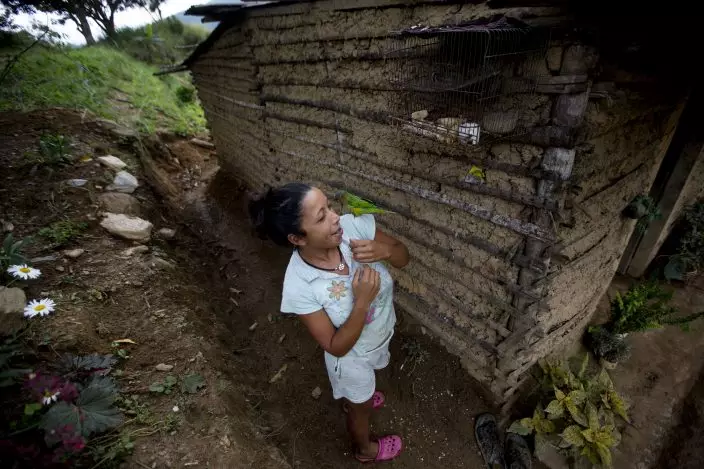
In this Oct. 10, 2018 photo, Carmen Martinez plays with her pet bird, a brown-throated Parakeet that was captured near her home in the coastal area of Carayaca on the outskirts of Caracas, Venezuela. The oil-rich nation was a pioneer in tropical ornithological research since the 18th century explorations of German scientist Alexander von Humboldt. (AP PhotoFernando Llano)
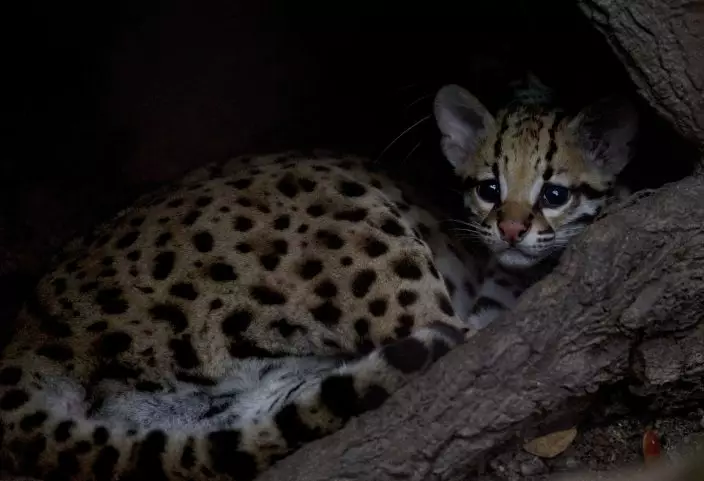
In this Oct. 18, 2018 photo, an ocelote cub hides inside a cave at a private zoo where an investigation center to breed Venezuela's red siskin bird is being built in Turmero, Venezuela. The Red Siskin Initiative launched about three years ago on a shoestring budget of less than $100,000 from the U.S. Fish and Wildlife Service and private groups in the U.S. and Venezuela. (AP PhotoFernando Llano)
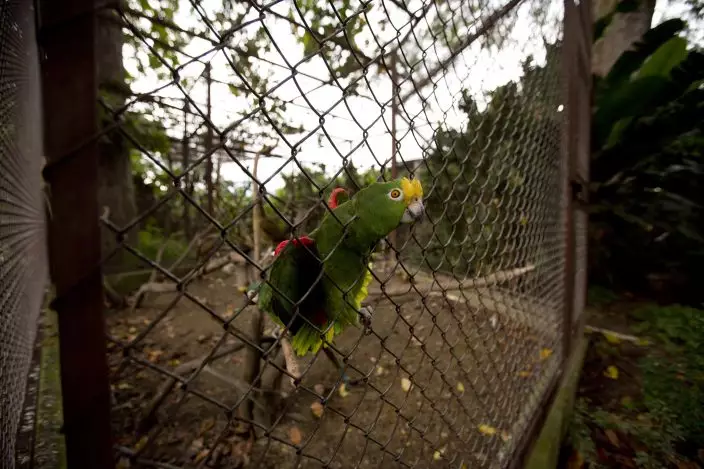
In this Oct. 18, 2018 photo, a yellow crowned macaw peers through its cage at a private zoo where an investigation center to breed Venezuela's red siskin bird is being built in Turmero, Venezuela. Poor Venezuelan families often capture and sell threatened birds to illegal traffickers, some in the military, adding to the challenges of rescuing endangered birds from extinction. (AP PhotoFernando Llano)
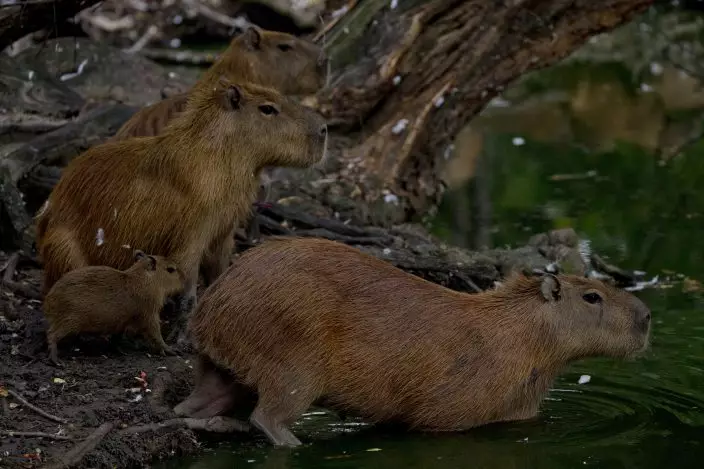
In this Oct. 18, 2018 photo, a group of Capybaras enter a lake at a private zoo where an investigation center to breed Venezuela's endangered red siskin bird is being built in Turmero, Venezuela. Online they go for more than $300, and demand remains high in Eastern Europe and Asia, scientists say. (AP PhotoFernando Llano)
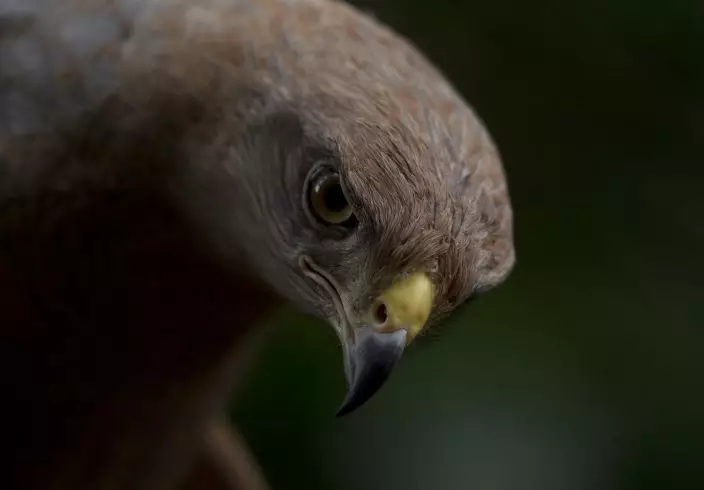
In this Oct. 18, 2018, a Savanna Hawk peers from inside its cage at a private zoo that is building an investigation center to breed Venezuela's endangered red siskin bird in Turmero, Venezuela. The threat of the red siskin disappearing has brought together an international team including scientists from the Smithsonian Institution in Washington and poor coffee farmers in Venezuela's remote mountains, all set on rescuing it from extinction. (AP PhotoFernando Llano)
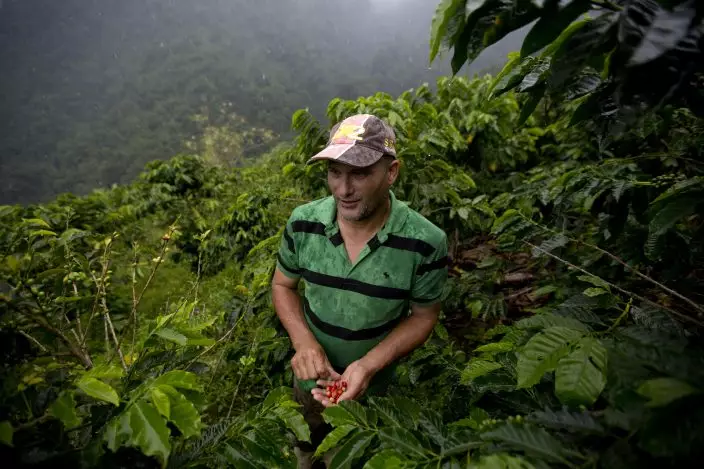
In this Oct. 10, 2018 photo, farmer Simon Then shows red coffee beans he picked on his organic coffee farm in the coastal area of Carayaca on the outskirts of Caracas, Venezuela. No red siskins birds make this mountainside home yet, but Then envisions the terrain covered in dense forest as he and his neighbors join in the effort to restore the endangered bird. (AP PhotoFernando Llano)
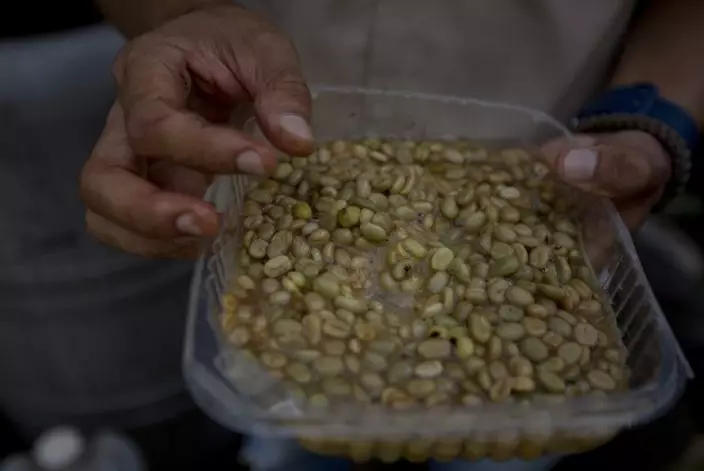
In this Oct. 10, 2018 photo, agronomist Luis Arrieta inspects coffee beans that are in the germination process, to be planted in fields where peaches are grown in the coastal area of Carayaca on the outskirts of Caracas, Venezuela. The threat of the finch-like red siskin vanishing from the wild has brought together an international team including scientists from the United States and Venezuelan coffee farmers set on rescuing it from extinction. (AP PhotoFernando Llano)
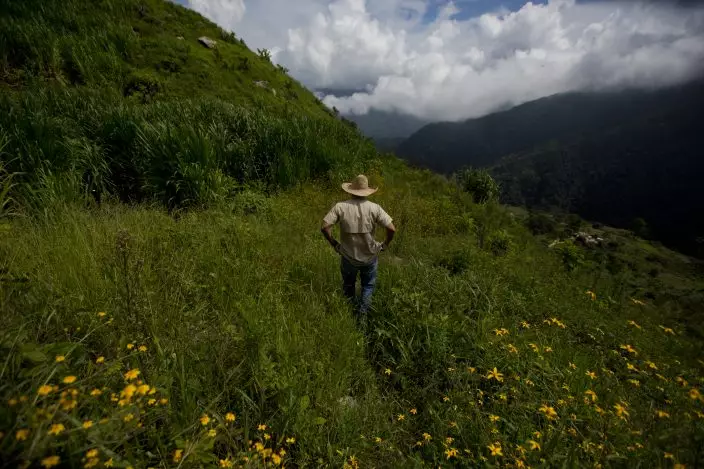
In this Oct. 10, 2018 photo, agronomist Luis Arrieta inspects a freshly planted coffee field that used to be a peach orchard in the coastal area of Carayaca on the outskirts of Caracas, Venezuela. Arrieta is part of The Red Siskin Initiative, which is trying to entice farmers into growing organic coffee groves with layers of thick branches to invite the endangered, perching finch-like red siskin birds. (AP PhotoFernando Llano)
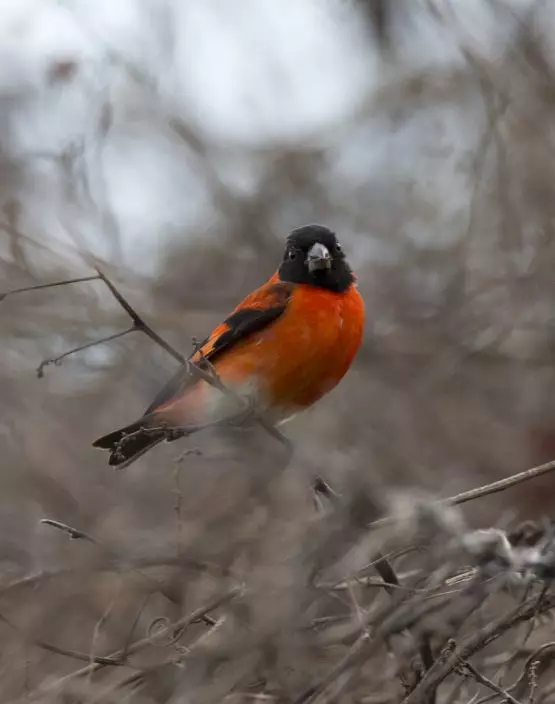
In this Oct. 24, 2018 photo, a Venezuelan male red siskin bird perches on a branch in Vargas, Venezuela. Once flourishing in the millions, as few as 300 remain in the wild in Venezuela, although scientists say it's difficult to estimate their numbers in the politically turbulent and dangerous country. (AP PhotoFernando Llano)
That threat has brought together an international team including scientists from the Smithsonian Institution in Washington and poor coffee farmers in Venezuela's remote mountains, all set on rescuing it from extinction. The plan is to entice farmers to plant organic coffee groves with layers of thick branches that are inviting to the endangered, perching songbird, which has lost a lot of its habitat.
In this Oct. 10, 2018, farmers cut trees to grow fruit and vegetables in the coastal area of Carayaca on the outskirts of Caracas, Venezuela, where the finch-like red siskin bird is vanishing from the wild. There is a trend among farmers boosting coffee bean production by thinning coffee groves for more sunlight, or ripping them out altogether to plant vegetables that turn a quicker profit. (AP PhotoFernando Llano)
"They don't have many years left, unless we do something right now," said Miguel Arvelo, a veterinarian for the Caracas-based nonprofit Provita, one of the groups spearheading the effort.
The "Cardenalito," or "Little Cardinal" as it is affectionately called, holds a special place in Venezuelan culture, the poster child of some 1,400 bird species — from the Amazon to the Andes — that live in one of the world's most biodiverse landscapes.
Once flourishing in the millions, as few as 300 remain in the wild in Venezuela, although scientists say it's difficult to estimate their numbers in the politically turbulent and dangerous country.
This Oct. 20, 2018 photo shows Bolivar bank notes decorated with images of Venezuela's red siskin bird, as part of rescue program in Caracas, Venezuela. Images of a tiny red bird that barely fills the palm of one's hand appear everywhere in Venezuela _ printed on money, labels of craft beer bottles and the cover of children's school books. (AP PhotoFernando Llano)
The Red Siskin Initiative launched about three years ago on a shoestring budget of less than $100,000 from the U.S. Fish and Wildlife Service and private groups in the U.S. and Venezuela.
Planting organic groves with thick branches reverses a trend among farmers who boost bean production by thinning coffee groves for more sunlight, or cut them down altogether to plant vegetables that turn a quicker profit.
Farmers who meet the project's strict standards will win the right to market their beans with "Bird Friendly" labels and take advantage of a loophole in Venezuelan law to set prices for premium products, sometimes five times higher than price caps set by the socialist government. Eventually they hope to export the coffee.
In this Oct. 23, 2018 photo, Venezuelan female red siskin birds perch on a branch in Vargas, Venezuela. The "Cardenalito," or "Little Cardinal" as it is affectionately called, holds a special place in Venezuelan culture, the poster child of some 1,400 bird species _ from the Amazon to the Andes _ that live in one of the world's most biodiverse landscapes. (AP PhotoFernando Llano)
In parallel, a red siskin breeding center is being built at a private zoo in Venezuela where 200 birds are expected to be hatched next year, adding to the 25 caged at the Smithsonian Institution, forming a type of Noah's Ark to ensure that the iconic species does not disappear. Red siskins from the center will be introduced into the coffee groves.
While still in its early stages, backers say coffee initiative is already showing positive results. Some 40 farmers in the rugged, coastal mountains of Carayaca, northwest of the capital Caracas, have already stopped cutting down trees — an important first step to creating a robust habitat.
The tiny bird is prized for its fiery red plumage and jet-black hood on males, coveted by breeders who cross them with less colorful canaries to produce offspring of orange or red spots.
In this Oct. 20, 2018 photo, the wrapping of chocolate bars, brand "El Cardenalito and Cacao," is decorated with images of Venezuela's red siskin bird, and the message "Forest-Preserving Coffee," as part of a campaign to rescue the bird from extinction in Caracas, Venezuela. Farmers who meet The Red Siskin Initiative project's strict standards will win the right to market their coffee beans with "Bird Friendly" labels and take advantage of a loophole in Venezuelan law to set prices for premium products, sometimes five-times higher than price caps set by the socialist government. Eventually they hope to export the coffee. (AP PhotoFernando Llano)
Protection under Venezuelan law dating back to the 1940s hasn't stopped poachers from catching it to sell on the international black market. Online they go for more than $300, and demand remains high in Eastern Europe and Asia, scientists say.
Adding to challenges, poor Venezuelan families often capture and sell the threatened bird to illegal traffickers. The profit can feed their children for months, said biologist Jhonathan Miranda, a Provita researcher.
Michael Braun, co-founder of the Red Siskin Initiative and a research scientist at Smithsonian's National Museum of Natural History, said Venezuela's deepening crisis has also taken a toll.
In this Oct. 23, 2018 photo, Venezuelan red siskin perch on branches in Vargas, Venezuela. Some 40 farmers in the rugged, coastal mountains of Carayaca, northwest of the capital Caracas, have stopped cutting down trees _ an important first step to creating a robust habitat for the threatened bird to thrive and repopulate.(AP PhotoFernando Llano)
The oil-rich nation was for decades a coveted destination for naturalists and amateur birders. But recently a field researcher in a remote mountain range was robbed of his binoculars and then shot at by two young men on a motorcycle, Braun said. At least one key member of their research team joined a growing exodus of Venezuelans fleeing the country.
"Every time I tell somebody we have an endangered bird project in Venezuela, they say, 'Oh, Venezuela? Good luck,'" Braun said. "It's a challenge."
The red siskin's primary range is the Caribbean coastal region of Venezuela, and some have been found in neighboring areas of Colombia and Guyana.
In this Oct. 18, 2018 photo, Federico Pantin, left, gives instructions to a worker at a new investigation center to breed Venezuela's endangered red siskin bird, at his private zoo in Turmero, Venezuela. Here, 200 birds are expected to be hatched next year, adding to the 25 caged at the Smithsonian Institution, forming a type of Noah's Ark to ensure that the iconic species does not disappear. (AP PhotoFernando Llano)
Scientists carefully conceal the bird's location to protect them from poachers, but they allowed The Associated Press to photograph a small flock at a secret location in their natural habitat.
Catching sight of them required arriving before dawn, hiding motionless and silently in tall grass thick with mosquitoes under pouring rain. Then, the sun broke through and they swooped in — a dozen or more — landing one by one on tangled tree branches overhead, preening and loudly singing.
In Carayaca, Simon Then, a 53-year-old blue-eyed, blond farmer — descended from early German settlers — walks through his family's coffee grove surrounded by dozens of leafy, 5-foot-high shrubs nestled on a steep slope. His eyes fill with emotion showing off the red cherries starting to appear without the use of chemicals.
In this Oct. 18, 2018, a private zoo worker pulls a wheelbarrow past a caged area of American flamingos, near the site where an investigation center to breed Venezuela's red siskin bird will be built in Turmero, Venezuela. Protection under Venezuelan law dating back to the 1940s hasn't stopped poachers from catching red siskin birds to sell on the international black market. (AP PhotoFernando Llano)
No red siskins make this mountainside home yet, but Then envisions the terrain covered in dense forest one day as he and his neighbors join in the effort to restore the endangered bird.
"It's more work," he said about the challenges of organic farming, "but it gives us more money."
AP photographer Fernando Llano and AP writer Scott Smith contributed to this report.
In this Oct. 18, 2018 photo, an American flamingo rescued from a hunter stands in a private zoo, where an investigation center to breed Venezuela's red siskin will be built in Turmero, Venezuela. Ranked sixth in the world for the number of bird species, many of them found nowhere else, Venezuela for decades was a coveted destination for naturalists and amateur birders looking to add to their life-lists. (AP PhotoFernando Llano)
In this Oct. 10, 2018 photo, Carmen Martinez plays with her pet bird, a brown-throated Parakeet that was captured near her home in the coastal area of Carayaca on the outskirts of Caracas, Venezuela. The oil-rich nation was a pioneer in tropical ornithological research since the 18th century explorations of German scientist Alexander von Humboldt. (AP PhotoFernando Llano)
In this Oct. 18, 2018 photo, an ocelote cub hides inside a cave at a private zoo where an investigation center to breed Venezuela's red siskin bird is being built in Turmero, Venezuela. The Red Siskin Initiative launched about three years ago on a shoestring budget of less than $100,000 from the U.S. Fish and Wildlife Service and private groups in the U.S. and Venezuela. (AP PhotoFernando Llano)
In this Oct. 18, 2018 photo, a yellow crowned macaw peers through its cage at a private zoo where an investigation center to breed Venezuela's red siskin bird is being built in Turmero, Venezuela. Poor Venezuelan families often capture and sell threatened birds to illegal traffickers, some in the military, adding to the challenges of rescuing endangered birds from extinction. (AP PhotoFernando Llano)
In this Oct. 18, 2018 photo, a group of Capybaras enter a lake at a private zoo where an investigation center to breed Venezuela's endangered red siskin bird is being built in Turmero, Venezuela. Online they go for more than $300, and demand remains high in Eastern Europe and Asia, scientists say. (AP PhotoFernando Llano)
In this Oct. 18, 2018, a Savanna Hawk peers from inside its cage at a private zoo that is building an investigation center to breed Venezuela's endangered red siskin bird in Turmero, Venezuela. The threat of the red siskin disappearing has brought together an international team including scientists from the Smithsonian Institution in Washington and poor coffee farmers in Venezuela's remote mountains, all set on rescuing it from extinction. (AP PhotoFernando Llano)
In this Oct. 10, 2018 photo, farmer Simon Then shows red coffee beans he picked on his organic coffee farm in the coastal area of Carayaca on the outskirts of Caracas, Venezuela. No red siskins birds make this mountainside home yet, but Then envisions the terrain covered in dense forest as he and his neighbors join in the effort to restore the endangered bird. (AP PhotoFernando Llano)
In this Oct. 10, 2018 photo, agronomist Luis Arrieta inspects coffee beans that are in the germination process, to be planted in fields where peaches are grown in the coastal area of Carayaca on the outskirts of Caracas, Venezuela. The threat of the finch-like red siskin vanishing from the wild has brought together an international team including scientists from the United States and Venezuelan coffee farmers set on rescuing it from extinction. (AP PhotoFernando Llano)
In this Oct. 10, 2018 photo, agronomist Luis Arrieta inspects a freshly planted coffee field that used to be a peach orchard in the coastal area of Carayaca on the outskirts of Caracas, Venezuela. Arrieta is part of The Red Siskin Initiative, which is trying to entice farmers into growing organic coffee groves with layers of thick branches to invite the endangered, perching finch-like red siskin birds. (AP PhotoFernando Llano)
In this Oct. 24, 2018 photo, a Venezuelan male red siskin bird perches on a branch in Vargas, Venezuela. Once flourishing in the millions, as few as 300 remain in the wild in Venezuela, although scientists say it's difficult to estimate their numbers in the politically turbulent and dangerous country. (AP PhotoFernando Llano)