Skip to Content Facebook Feature Image

Government asks high court to hear transgender military case

News

Government asks high court to hear transgender military case
News

News

Government asks high court to hear transgender military case

2018-11-24 06:19 Last Updated At:11-25 00:30

The Trump administration asked the Supreme Court on Friday to issue an unusually quick ruling on the Pentagon's policy of restricting military service by transgender people. It's the fourth time in recent months the administration has sought to bypass lower courts that have blocked some of its more controversial proposals and push the high court, with a conservative majority, to weigh in quickly on a divisive issue.

Earlier this month, the administration asked the high court to fast-track cases on the president's decision to end the Deferred Action for Childhood Arrivals program, which shields young immigrants from deportation. Administration officials also recently asked the high court to intervene to stop a trial in a climate change lawsuit and in a lawsuit over the administration's decision to add a question on citizenship to the 2020 census.

The 9th U.S. Circuit Court of Appeals, a frequent target of criticism by President Donald Trump, is involved in three of the cases. Trump's recent salvo against the "Obama judge" who ruled against his asylum policy — not one of the issues currently before the Supreme Court — prompted Chief Justice John Roberts to fire back at the president for the first time for feeding perceptions of a biased judiciary.
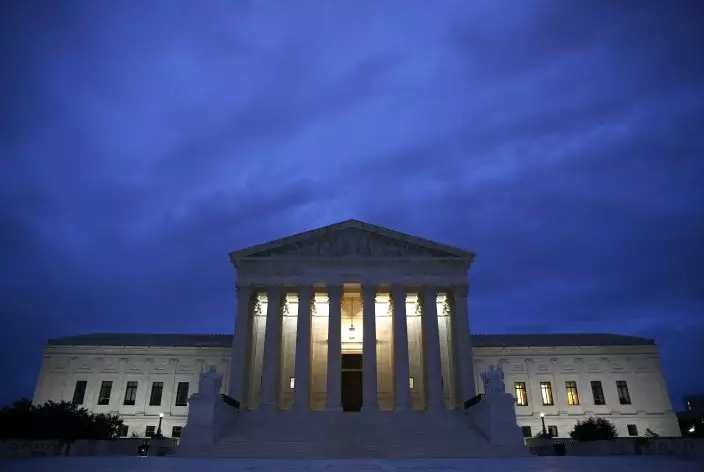
FILE - In this Sept. 27, 2018, file photo, The Supreme Court building is seen at dawn on Capitol Hill in Washington. The Trump administration is asking the Supreme Court to fast-track cases on the president's decision to prevent certain transgender people from serving in the military. The administration asked the court on Nov. 23, to take up three cases on the issue. (AP PhotoPatrick Semansky, File)

FILE - In this Sept. 27, 2018, file photo, The Supreme Court building is seen at dawn on Capitol Hill in Washington. The Trump administration is asking the Supreme Court to fast-track cases on the president's decision to prevent certain transgender people from serving in the military. The administration asked the court on Nov. 23, to take up three cases on the issue. (AP PhotoPatrick Semansky, File)

Joshua Matz, publisher of the liberal Take Care blog, said the timing of the administration's effort to get the Supreme Court involved in the issues at an early stage could hardly be worse for Roberts and other justices who have sought to dispel perceptions that the court is merely a political institution, especially since the confirmation of Justice Brett Kavanaugh. At an especially sensitive moment for the Supreme Court, the Trump administration is "forcing it into a minefield that many justices would almost surely prefer to avoid," Matz said.

The Supreme Court almost always waits to get involved in a case until both a trial and appeals court have ruled in it. Often, the justices wait until courts in different areas of the country have weighed in and come to different conclusions about the same legal question.

So it's rare for the justices to intervene early as the Trump administration has been pressing them to do. One famous past example is when the Nixon administration went to court to try to prohibit the publication of the Pentagon Papers, the secret history of U.S. involvement in the Vietnam War.

In the immigration case, the administration told the high court it should step in and decide the fate of DACA ahead of an appeals court's ruling because the policy otherwise could be in place until the middle of 2020 before the justices might otherwise rule. The appeals court has since ruled, but the administration's request that the court hear the case stands.

In the military case, the administration argued that the Supreme Court should step in before an appeals court rules because the case "involves an issue of imperative public importance: the authority of the U.S. military to determine who may serve in the Nation's armed forces."

In a statement, Peter Renn, an attorney for Lambda Legal, which brought one of the challenges to the transgender military policy, called the Trump administration's action Friday a "highly unusual step" that is "wildly premature and inappropriate."

The Pentagon initially lifted its ban on transgender troops serving openly in the military in 2016, under President Barack Obama's administration. But the Trump administration revisited that policy, with Trump ultimately issuing an order banning most transgender troops from serving in the military except under limited circumstances. Several lawsuits were filed over the administration's policy change, with lower courts all ruling against the Trump administration.

Still ongoing in lower courts are the census and climate change cases. The Supreme Court for now has refused to block the climate change trial. In the census question case, the court has agreed to decide what kind of evidence a trial judge can consider and indefinitely put off questioning of Commerce Secretary Wilbur Ross. But it rejected an administration request to delay the trial and allowed other depositions to take place.

The court will hear arguments in the census question case in February. It's unclear when it will act on the administration's other requests.
HONOLULU (AP) — Crews on Tuesday began evaluating damage from a surprise downpour that sent floodwaters raging through a neighborhood near downtown Honolulu — the latest bout in a series of storms and flooding that have pummeled the state over the past two weeks.

Residents along Oahu's North Shore, famous for its big wave surfing, were cleaning up from the worst flooding to hit Hawaii in two decades when a storm Monday unleashed several inches of rain on the southern part of the island. Reddish-brown torrents gushed along roads in the Manoa Valley, a few miles east of downtown Honolulu, sweeping away parked cars and swamping much of the neighborhood.

“I was shocked to see how much flash flooding there was in my area,” said resident Andrew Phomsouvanh, who recorded video of streets transformed into a confluence of rapids. “The water just keeps coming.”

Natalie Aczon had gone to the drugstore to pick up some medication for her mother on Monday. By the time she left the store some 15 minutes later, water was roaring down the street next to the shopping center.

“People came running out from Longs and one of the guys actually said, ‘That’s my white car.’ And it had elevated,” she said.

The ferocity of Monday's downpour even took National Weather Service meteorologists aback. They knew that lingering instability from a powerful winter storm system called a “Kona low” could yield more rain, but their models aren't good at predicting how much moisture can remain in such systems, said forecaster Cole Evans.

“When you think it's over it's not quite over,” he said Tuesday.

The downpour, which dumped 2 to 4 inches (5 to 10 centimeters) of rain per hour, was highly localized: One rain gauge in the upper part of the valley recorded 6 inches (15 centimeters), while the airport a few miles away got just one-hundredth of an inch (less than a millimeter).

Honolulu Mayor Rick Blangiardi called it a “classic rain bomb,” and he said that earlier in the day, the skies were sunny.

“We had no warning,” he said Tuesday as he toured the damage.

The Kona low was moving off to the east, Evans said, and it should not pose further risk of bursts like Monday's burst. Flood watches were in effect for parts of Maui and the Big Island.

There were no immediate reports of deaths or serious injuries, but authorities said hundreds of homes on Oahu's North Shore had been damaged by last week's flooding, which came as heavy rains fell on soil already saturated by downpours from a winter storm a week earlier.

More than 230 people had to be rescued. The water pushed houses off their foundations, floated cars out of parking spots and left walls, floor and counters covered with thick, reddish volcanic mud.

Evacuation orders covered 5,500 people north of Honolulu, and some residents fled on surfboards as water reached waist or chest high.

Farms around the state reported more than $9.4 million worth of damage as of Monday, according to a survey conducted by Agriculture Stewardship Hawaii, the Hawaii Farm Bureau and other organizations.

Even before Monday, Gov. Josh Green said the cost of the storm could top $1 billion, including damage to airports, schools, roads, homes and a Maui hospital in Kula. He called it the state’s most serious since flooding since 2004, when floods in Manoa inundated homes and a University of Hawaii library.

Green's office said Tuesday he had submitted a major disaster declaration request to the Trump administration.

Molly Pierce, a spokesperson for the Oahu Emergency Management Agency, said that in addition to volunteers and public workers who have been cleaning up, a contract company had arrived to begin collecting, sorting and removing large piles of debris.

She called the storm system “extremely unusual” but that officials were cautiously optimistic Tuesday that the rains are finally ending.

“Most of us have not seen something that just keeps going like this,” Pierce said. “We feel like we keep getting punched down. But we'll keep getting back up.”

The intensity and frequency of heavy rains in Hawaii have increased amid human-caused global warming, experts say.

Johnson reported from Seattle. Associated Press writer Mark Thiessen in Anchorage, Alaska, and Gabriela Aoun Angueira in San Diego contributed to this report.

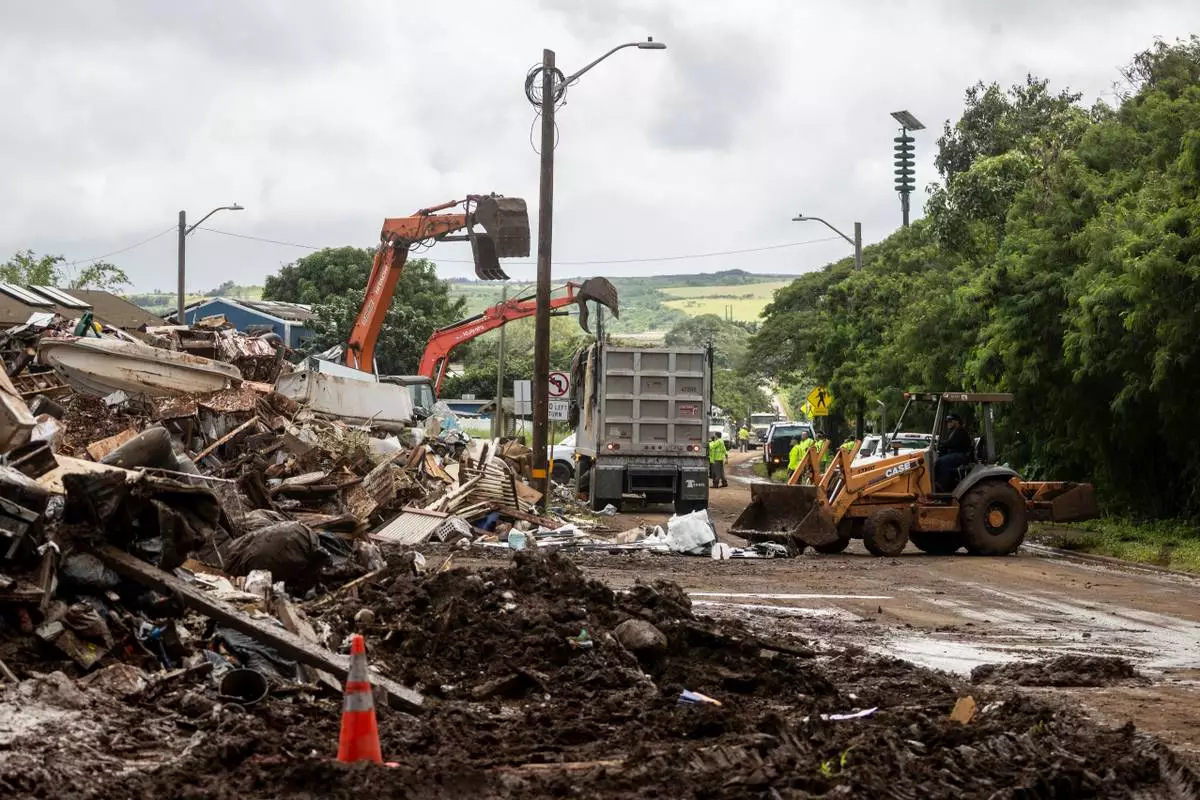
Excavators place debris onto trucks at a roundabout turned debris triage point by residents after the flood in Waialua, Hawaii Monday, March 23, 2026. (Stephen Lam/San Francisco Chronicle via AP)

Excavators place debris onto trucks at a roundabout turned debris triage point by residents after the flood in Waialua, Hawaii Monday, March 23, 2026. (Stephen Lam/San Francisco Chronicle via AP)

Recommended Articles