Lyudmila Alexeyeva, a human rights pioneer and dissident who challenged the Soviet and Russian regimes for decades, demanding that they free political prisoners and establish democratic rights, died Saturday in a Moscow hospital, a Russian official said. She was 91.
"She remained a human rights activist to the very end," said Mikhail Fedotov, head of Russia's Human Rights Council. "This is a loss for the entire human rights movement in Russia."
The gentle but courageous activist was born under dictator Josef Stalin's regime. She risked her own freedom to protest the plight of political prisoners in the Soviet Union in the 1960s and 1970s and co-founded the Moscow Helsinki Group, Russia's oldest human rights organization, in 1976.
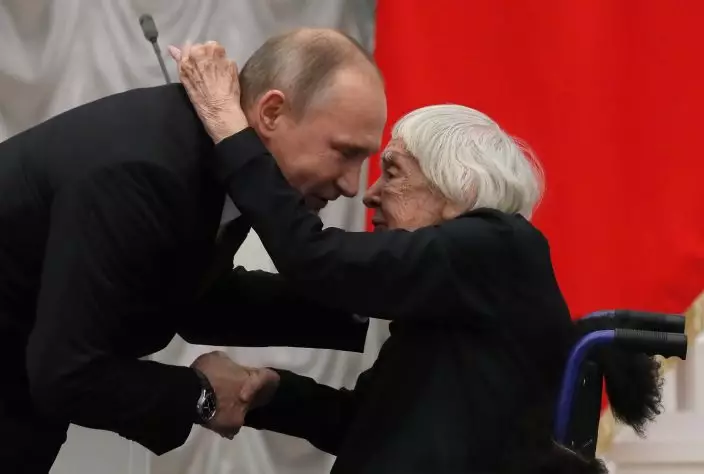
FILE - In this file photo taken on Monday, Dec. 18, 2017, Russian President Vladimir Putin, left, congratulates the Moscow Helsinki Group Chair and human rights activist Lyudmila Alexeyeva, during a ceremony to present the 2017 State Awards for Outstanding Achievements in Human Rights and and Charity Work at the Kremlin in Moscow, Russia. Alexeyeva, who was forced into exile by Soviet authorities after founding Russia's oldest human rights organization in 1976, passed away in a Moscow hospital Friday, Dec. 7, 2018 at age 91. (Yuri KochetkovPool Photo via AP, File)
Alexeyeva faced death threats throughout her career and was forced into exile by Soviet authorities in 1977.
She returned to Russia in 1993 after the 1991 collapse of the Soviet Union and continued her work energetically, but suspicion of non-governmental organizations under President Vladimir Putin's rule increasingly impeded her activities.
In 2014, she announced that the Moscow Helsinki Group had laid off most of its staff and cut pay for the remainder. The move followed declining foreign donations in the wake of legislation requiring groups receiving such funding to register as "foreign agents."
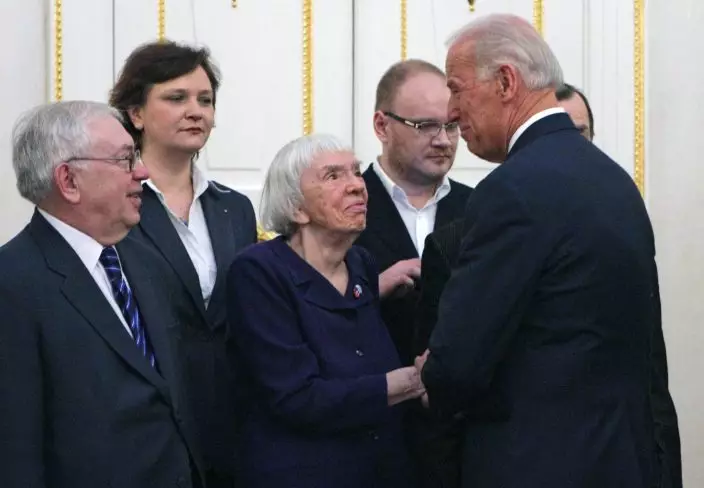
FILE In this file photo taken on Thursday, March 10, 2011, Vice President of the United States Joe Biden, right, speaks to Russian human right's activist Lyudmila Alexeyeva, second right, as he meets with Russian Civil Society leaders in Moscow, Russia. Alexeyeva, who was forced into exile by Soviet authorities after founding Russia's oldest human rights organization in 1976, passed away in a Moscow hospital Friday, Dec. 7, 2018 at age 91. (AP PhotoAlexander Zemlianichenko)
Alexeyeva relentlessly pressed Soviet authorities to improve human rights, through times of crushing repression and those of relative tolerance, a job that required enormous patience.
"In Soviet times, we couldn't do anything to defend human rights," she told The Associated Press in a 2009 interview. "We couldn't even defend ourselves. Our activity was confined to proclaiming that the state should respect human rights and defend them."
After the Soviet collapse, she turned into a respectful but insistent voice urging that Russia's newly elected leadership live up to its rhetoric about democracy and the rule of law.
Despite Putin's early patronage, including his naming her to an advisory council, Alexeyeva was a leading critic of Russia's second war in Chechnya, launched in 1999 during Putin's first term as prime minister, and of Putin's weakening of Russia's democratic institutions.
Government officials later accused nongovernment organizations like the Moscow Helsinki Group of spying on Russia for the West, and Alexeyeva became the target of death threats by nationalist groups. Still, she remained determined and optimistic, maintaining her ties to the Kremlin.
"I don't accuse, I explain," she said. "I say, 'You don't agree? We will speak some more.'"
While she was certain that Russia would one day embrace Western-style democracy, she did not expect that it would happen soon.
"I won't live to see Russia become a democratic state with the rule of law," she told the AP.
Still, Putin made a house call to Alexeyeva on her 90th birthday last year, complete with a champagne toast.
In the early 2000s, Alexeyeva privately urged Putin to halt plans to expel thousands of Chechen refugees from camps in the neighboring region of Ingushetia and force them to return to their war-ravaged homeland.
"He agreed, the camps existed for two years after that and the people lived in camps rather than under bombs," she said.
In December 2008, Putin proposed legislation that would have significantly broadened the definition of treason. Rights activists said the law would make anyone critical of the government liable to prosecution as an enemy of the state. After an outcry by Alexeyeva and others, the proposal was withdrawn.
But Alexeyeva and her allies lost at least as many battles as they won.
After the December 2003 parliamentary election — a watershed vote that saw most of Russia's liberal opposition leadership driven from parliament — Alexeyeva recalled bluntly telling Putin: "We don't have elections anymore, because the results are decided by the bosses and not the people."
Born in Crimea on July 20, 1927, Alexeyeva studied archaeology at Moscow State University. She was drawn into the dissident movement during the Khrushchev thaw, the period of relaxed censorship under Soviet leader Nikita Khrushchev in the 1950s and early 1960s.
She was part of the small but determined circle of Moscow dissidents that included Sergei Kovalyov, a biologist who survived a gulag labor camp, and physicist Andrei Sakharov, who won the 1985 Nobel Peace Prize. The dissidents often met but seldom talked about their illegal political activities, working in secret cells to deter arrests.
In the early 1970s, Alexeyeva worked on the Chronicle of Current Events, the most important of the dissident underground journals typed up on onionskin sheets backed by carbon copy paper and circulated hand-to-hand.
One night Alexeyeva grew worried as she waited in a friend's apartment for a courier to deliver the latest edition of the Chronicle for retyping. When a knock came at the door, she hid, certain it was the KGB, before hearing the voice of fellow dissident Kovalyov. Until that moment, she said, she didn't know he was one of the journal's editors.
Kovalyov later spent seven years in a Soviet labor camp for his role in the publication.
Like other dissidents, including author Alexander Solzhenitsyn, Alexeyeva was threatened with arrest unless she left the Soviet Union. The mother of two fled with her younger son, Mikhail, in 1977, eventually settling in the United States. There, she co-wrote about her life in "The Thaw Generation: Coming of Age in the Post-Stalin Era" and also wrote a book called "Soviet Dissent."
In the 2009 interview, Alexeyeva recalled how Russia had changed since her dissident days. One major watershed, she said, was the 1976 Helsinki agreement, which introduced the concept of human rights to the world.
"Now every policeman knows what human rights means," Alexeyeva said. "He doesn't enforce them, but he knows. That is why I think that today is much easier for us than in the Soviet times."
Many liberal Russian have blamed the country's leaders for steering Russia toward authoritarianism. But Alexeyeva said Russia's problem wasn't its leaders, it was its weak society, which she said was incapable of holding leaders to account.
"I don't think the leaders of Western democracies are really such strong democrats," she said, but added that Western leaders have to support human rights and the rule of law or risk being voted out.
Alexeyeva said she often received death threats — and sometimes wondered if she dismissed them too lightly.
She recalled having tea in her kitchen in 2008 with Stanislav Markelov, a lawyer who represented Chechen families with grievances against the government. Markelov said someone was threatening his life, but Alexeyeva tried to be reassuring.
"I told him we all get them," she said, her eyes misting.
Markelov, however, was shot and killed on a snowy Moscow street in January 2009 along with Anastasia Baburova, a young journalist.
Still, Alexeyeva said neither she nor her colleagues would give up their human rights cause.
"I don't know of a single person who works with me who would stop doing what they are doing because of threats," she said. "If I stopped what I am doing now, life wouldn't be interesting to me."
She is survived by her two sons, five grandchildren and three great-grandchildren.