Chechnya's leader and his security forces have been widely accused by human rights groups of extrajudicial arrests, torture and killings at home. Now they are threatening Chechens who fled abroad, warning they will pay dearly for their criticisms if they ever return home.
In a chilling video that has been watched by 2 million people, Magomed Daudov, the right-hand man of Chechnya's strongman, apparently contacted blogger Tumso Abdurakhmanov through WhatsApp, pressuring and threatening him.
Click to Gallery
In this photo taken on Wednesday, Nov. 14, 2018, Tumso Abdurakhmanov, the 32-year-old Chechen video blogger, is photographed during an interview with The Associated Press somewhere in Poland. Abdurakhmanov, a critic of the Chechen ruler, faces deportation from Poland as European nations become increasingly wary of sheltering refugees from Chechnya. (AP PhotoFrancesca Ebel)
FILE - In this Thursday, Dec. 1, 2016 file photo, Chechen regional leader Ramzan Kadyrov smiles prior to President Vladimir Putin's annual state of the nation address in the Kremlin in Moscow, Russia. Kadyrov and his security forces have been widely accused by international human rights groups of extrajudicial arrests, torture and killings. (AP PhotoPavel Golovkin, file)
In this photo taken on Wednesday, Nov. 14, 2018, Tumso Abdurakhmanov, the 32-year-old Chechen video blogger, is photographed during an interview with The Associated Press somewhere in Poland. Abdurakhmanov, a critic of the Chechen ruler, faces deportation from Poland as European nations become increasingly wary of sheltering refugees from Chechnya. (AP PhotoFrancesca Ebel)
FILE - In this Saturday, May 16, 2015 file photo, head of the Chechen leader's administration Magomed Daudov attends a wedding registry office in Chechnya's provincial capital Grozny, Russia. Magomed Daudov, the right-hand man of the provincial leader Ramzan Kadyrov, is one the most feared men in the Russian province of Chechnya. (AP PhotoFile)
Abdurakhmanov's case highlights the growing dangers for those from mostly Muslim Chechnya who try to seek asylum in Europe, where authorities have become increasingly reluctant to allow them in amid terrorism fears and a growing political backlash against all migrants.
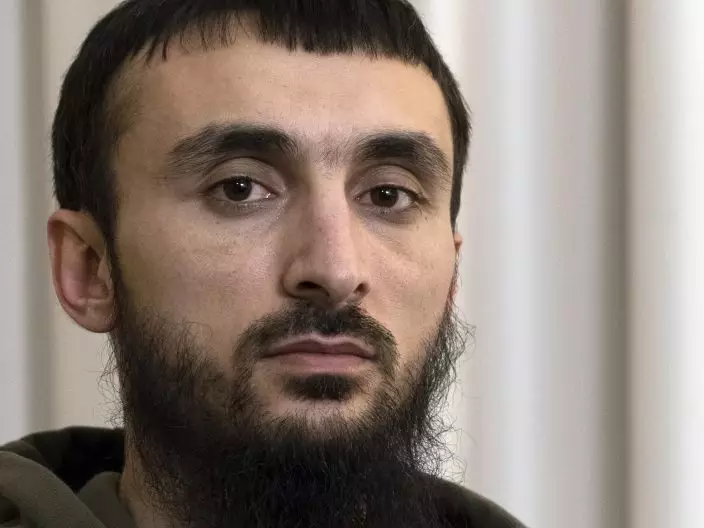
In this photo taken on Wednesday, Nov. 14, 2018, Tumso Abdurakhmanov, the 32-year-old Chechen video blogger, is photographed during an interview with The Associated Press somewhere in Poland. Abdurakhmanov, a critic of the Chechen ruler, faces deportation from Poland as European nations become increasingly wary of sheltering refugees from Chechnya. (AP PhotoFrancesca Ebel)
Abdurakhmanov, who's in danger of being deported from Poland, says he will be killed if he is sent back to Chechnya.
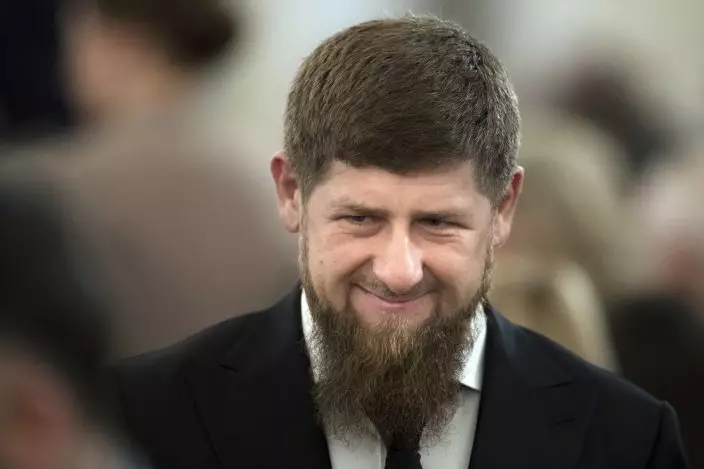
FILE - In this Thursday, Dec. 1, 2016 file photo, Chechen regional leader Ramzan Kadyrov smiles prior to President Vladimir Putin's annual state of the nation address in the Kremlin in Moscow, Russia. Kadyrov and his security forces have been widely accused by international human rights groups of extrajudicial arrests, torture and killings. (AP PhotoPavel Golovkin, file)
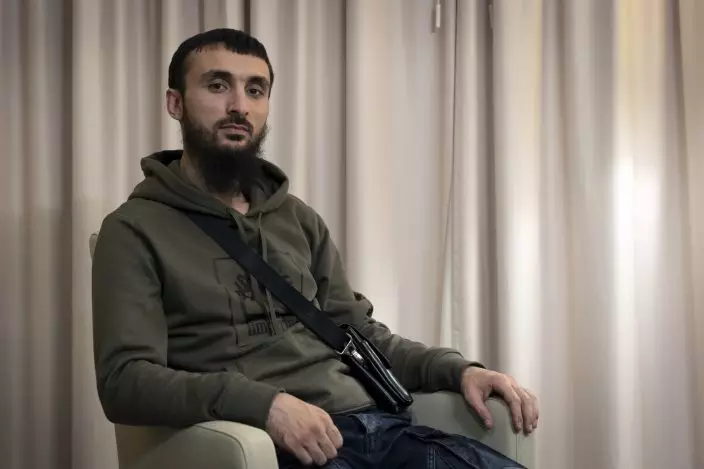
In this photo taken on Wednesday, Nov. 14, 2018, Tumso Abdurakhmanov, the 32-year-old Chechen video blogger, is photographed during an interview with The Associated Press somewhere in Poland. Abdurakhmanov, a critic of the Chechen ruler, faces deportation from Poland as European nations become increasingly wary of sheltering refugees from Chechnya. (AP PhotoFrancesca Ebel)
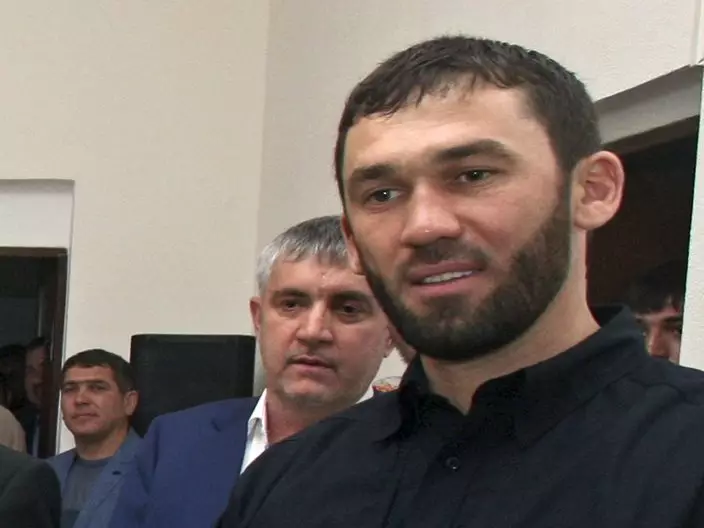
FILE - In this Saturday, May 16, 2015 file photo, head of the Chechen leader's administration Magomed Daudov attends a wedding registry office in Chechnya's provincial capital Grozny, Russia. Magomed Daudov, the right-hand man of the provincial leader Ramzan Kadyrov, is one the most feared men in the Russian province of Chechnya. (AP PhotoFile)
NICOSIA, Cyprus (AP) — Former Cypriot President George Vassiliou, a successful businessman who helped to energize his divided island's economy and set it on the road to European Union membership, has died. He was 94.
Vassiliou died Wednesday after being hospitalized on Jan. 6 for a respiratory infection. Cyprus President Nikos Christodoulides praised Vassiliou as a leader who became synonymous with the country's economic prosperity, social progress and push toward modernization.
“Cyprus has lost a universal citizen who broadened our homeland's international imprint,” Christodoulides said in a written statement.
His wife Androulla, a lawyer who twice served as a European commissioner, posted on X in the early hours Wednesday that her companion of 59 years “slipped away quietly in our arms” in hospital.
“It's difficult to say farewell to a man who was a superb husband and father, a man full of kindness and love for the country and its people,” she wrote.
When he became president in 1988, Vassiliou lifted hopes that a peace deal with the island's breakaway Turkish Cypriots was possible after more than a decade of off-again, on-again talks. He swiftly relaunched stalled reunification negotiations with Turkish Cypriot leader Rauf Denktash, but they ended at an impasse that continues today.
Cyprus was split into an internationally recognized Greek-speaking south and a Turkish-speaking north in 1974, when Turkey invaded the island after a coup aimed at uniting it with Greece. A Turkish Cypriot declaration of independence nine years later was recognized only by Turkey.
During an interview in 1989, one year into his five-year term as president, Vassiliou said: "The only dangerous thing for the Cyprus issue is to remain ... in a vacuum, forgotten and with no one taking any interest."
But Vassiliou succeeded on many other fronts, using his skills as a successful entrepreneur to modernize and expand his county’s economy, even though he had been raised by parents who were pro-communist.
Vassiliou was born in Cyprus in 1931 to two doctors who were activists and volunteered their services to the communist forces during the civil war that engulfed Greece in the immediate aftermath of World War II.
With the defeat of the communists in Greece in 1949, the Vassiliou family moved to Hungary and later Uzbekistan.
George Vassiliou initially studied medicine in Geneva and Vienna, but he later switched to economics, earning a doctorate from the University of Economics in Budapest.
After a brief stint doing marketing in London, Vassiliou returned to Cyprus in 1962, and he began a successful business career that made him a millionaire. He founded the Middle East Market Research Bureau, a consultancy business that grew to have offices in 30 countries in the Middle East, South Africa, eastern and central Europe.
In 1987, Vassilou was elected president of Cyprus as an independent entrepreneur who also was supported by the island's powerful communist party AKEL, which his father had one been a prominent member of.
Vassiliou bucked the staid political culture of the time by making the presidency more accessible to the public and visiting government offices and schools. That prompted some criticism that he was turning the presidency into a marketing pulpit.
"I consider it the president’s obligation to come in contact with the civil service," Vassiliou told Greek state TV. "I call this communication with youth. Some call it marketing. ... I call it the proper execution of the president's mission."
He also pushed through key reforms, including imposing a sales tax while slashing income taxes, streamlining a cumbersome civil service, establishing the first Cyprus university, and abolishing a state monopoly in electronic media. To make sure the world better understood the Cyprus peace process, he widely expanded a network of press offices at Cypriot diplomatic missions.
Through his tenure, the island's per capita gross domestic product almost doubled, culminating in possibly his most notable achievement as president — applying for full membership to the European Union, a goal achieved 13 years later.
Vassiliou lost the presidency in 1993 to Glafcos Clerides, who appointed his rival as Cyprus' chief negotiator with the EU in 1998. A decade later, Vassiliou headed a Greek Cypriot team negotiating EU matters during reunification talks. He remained politically active, founding a party of his own and being elected to the Cypriot legislature in 1996.
He authored several books on EU issues and Cypriot politics; was a member of several international bodies, including the Shimon Peres Institute of Peace; and received honors and decorations from countries such as France, Italy, Austria, Portugal and Egypt.
Apart from his wife, Vassiliou is also survived by two daughters and a son.
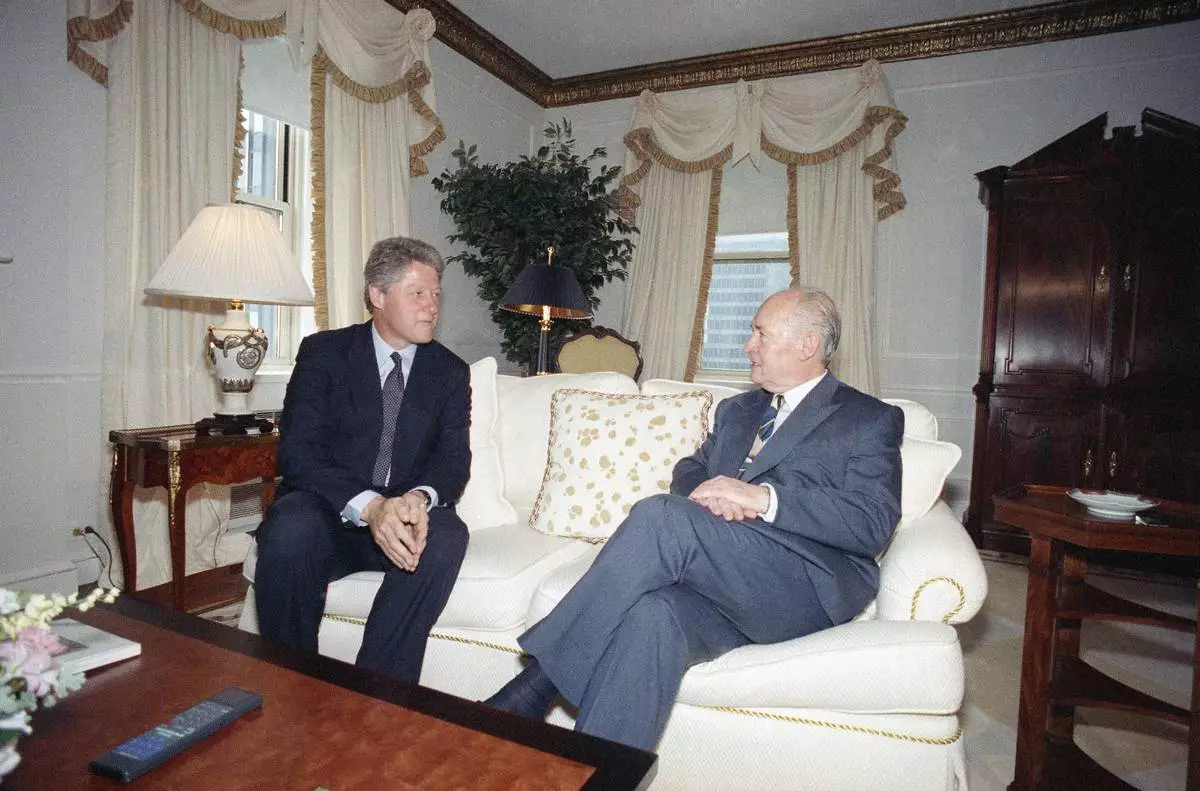
FILE -Democratic Presidential Candidate Bill Clinton, left, meets with President George Vassiliou of Cyprus at New York's Waldorf-Astoria hotel, Aug. 9, 1992. (AP Photo/Mario Cabrera, File)
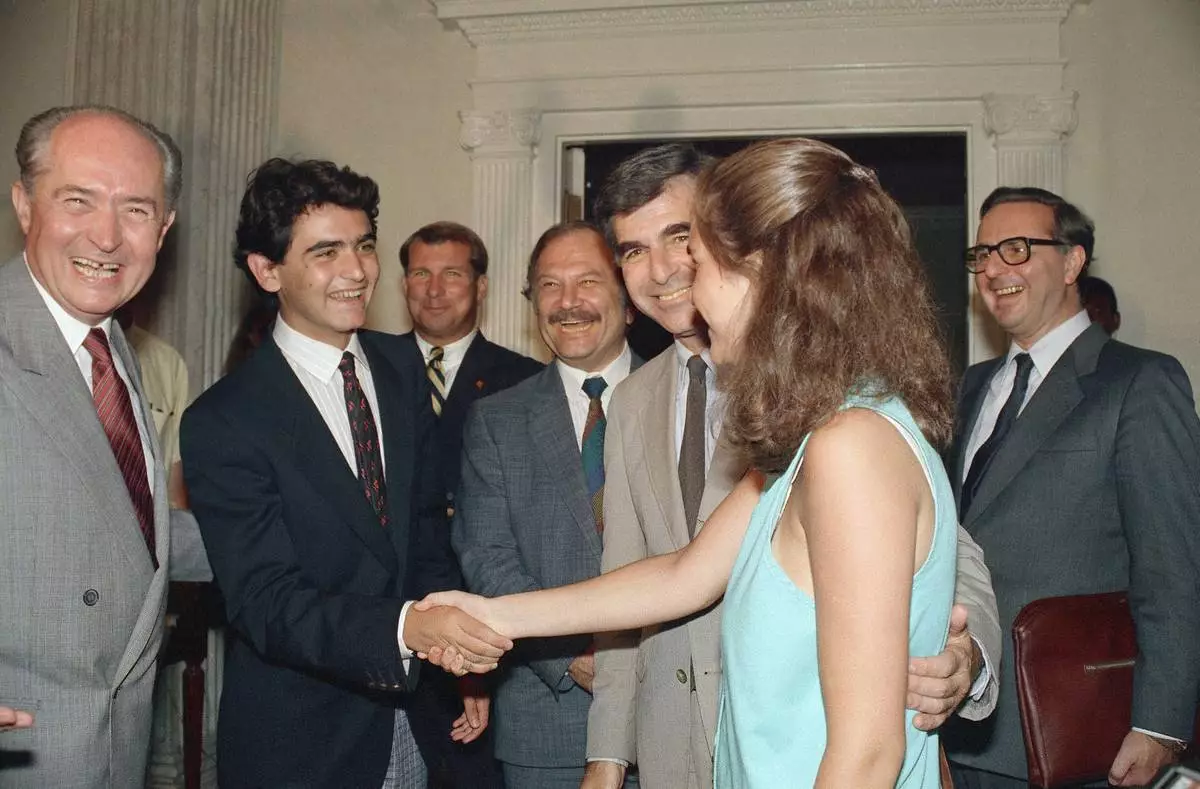
FILE -Cyprus President George Vassiliou, left, smiles as his son Evelthon, 17, is introduced to the daughter of Massachusetts Governor and Democratic presidential nominee Michael S. Dukakis, Kara, 19, at the Statehouse in Boston on Aug. 3, 1988 as Dukakis, second from right looks on, during a visit by the Cyprus President to Boston. (AP Photo/Carol Francavilla, File)