Ben Cuevas created a knitted heart, brain and intestines as part of his art, which was inspired by his HIV diagnosis.
An artist who knits sculptures of human body parts – ranging from an entire skeleton to a heart and intestines – has revealed how his HIV diagnosis has led him to raise awareness of the condition through his work.
Suffering with depression and anxiety, Ben Cuevas, 31, first began knitting in 2007 to ease his symptoms, as he tried to make it in America’s fiercely competitive Hollywood film industry.
Ben, of Los Angeles, California, USA, said: “I started knitting when I was 20 and living in Hollywood, aspiring to work in film as a director or producer.”
[video width="1920" height="1080" mp4="https://media-proc-wowm.bastillepost.com/wp-content/uploads/global/2018/12/20181228—GL—bones.mp4"][/video]
He continued: “My neighbour knitted and I was fascinated when I watched her, so I asked her to teach me a bit, and I soon discovered it was a wonderful tool.
“I found it so interesting and slowly started making it a hobby by just knitting rubbish scarfs and hats in my spare time.
“I’d had anxiety and depression for as long as I could remember and knitting was a form of meditation which took me to a calmer place.”
Soon realising film was not for him, in 2007 Ben enrolled on a two and a half year art course at the renowned Hampshire College in Amherst, Massachussetts – bringing his knitting skills into his work, when tasked to create a sculpture for his final assignment.
Fascinated by anatomy and the inner workings of the human body, he explained: “I knew from the word go that I had to utilise my knitting skills for this project.
“I made a knitted heart, which took me two weeks straight to complete and a week to plan.”
He continued: “I used about five balls of yarn, with each ball costing around £12. I didn’t make a pattern for it, or for any of the sculptural work, as it slows things down. And since I don’t intend on my work being replicated by others, there isn’t much point in making a pattern.
“All my knitted sculptures are made intuitively. I research 3D models online of what I would like to knit. I study their shapes and break the object down into component parts. With the heart, for instance, I broke down into four parts – the main chambers, the aorta and the two arteries.
“My professors were impressed, as we would rarely be asked to use those kind of materials for these projects. No-one was graded a mark, but I got a glowing evaluation from my professor who said it was extraordinary.”
Finding a niche, Ben decided to take his unique anatomical textiles a step further and, a year later, knitted an incredible 5ft 8in tall human skeleton, sitting in a lotus position.
To create the different parts of the skeleton, Ben used a variety of wool, including a type of yarn for the bones, a 100% Peruvian highland wool and a special wool/silk blend, for the cartilage.
Using a classroom skeleton, like those used in biology lessons, Ben studied the forms, in order create his knitted version accurately.
First, he built a frame, using a slightly bent steel rod and sturdy aluminium wire, then knitting around it and taking a gruelling three months to stitch everything together, like sewing up a jumper, covering each individual bone.
Luckily, Ben’s hard-work paid off, and the skeleton was on show at the Wassaic Project’s Summer Festival in New York’s Hudson Valley a month after he left college.
Since then, he has gone on to knit a human brain, veins, and eyeballs outside the sockets, complete with an optic nerve.
He said: “I like to play with opposites, like making bones look soft or bloody organs look cosy.
“It came naturally to me, especially as I’ve always been obsessed with biology.
“I remember being a little kid and looking through my mum’s books. She had a Grey’s Anatomy colouring book that I got hold off and I went through it over and over again. I loved learning about the body – it’s fascinating.”
Ben is able to earn his living through artwork by selling to collectors, working on commissions and being featured in exhibitions.
One of his favourite – and most bizarre – commissions was from a client who lost a toe due to diabetes.
He explained: “The client wanted a new toe to display on their wall, it ended up being very cathartic for them and I felt honoured to work on such a personal and outside of the box piece.”
Diagnosed HIV positive in 2011, again Ben found salvation in his work – this time mounting a tactile, interactive exhibition of his soft sculptures, with a twist, at the Viral Illumination exhibition in LA.
On the surface, it just looked like a room full of 12 inviting, knitted pillows.
But, on closer scrutiny, they were what Ben calls PILLows – with each one resembling one of the pills used to treat HIV.
Ben continued: “I created the PILLows for HIV awareness. All the pills are part of the treatment for the condition, such as Genvoya, a four in one pill I take once a day.
“I wanted people to feel comfortable talking about HIV and the treatment around it. So, what better way to make people feel comfortable than to get them in a room full of squishy pillows?.
“The pill pillows are autobiographical to an extent and show my body’s functionality – where it has failed and what I’ve had to do to make myself better.”
Facing the fragility of his own body, after being diagnosed with HIV, deepened Ben’s interest in the human form.
He said: “It changed the way I thought about my work, such as when I created the knitted veins installation – I was thinking more about blood than ever before and it become a powerful symbol to me.
“When people see my work, I think they see something odd, but I also believe it makes them feel calm because of the softness and detail. I want people to think more about the internal workings of our body and about the wonder, beauty and machinery of the human spectacle.”
OAKMONT, Pa. (AP) — Jim “Bones” Mackay often has said he would always be a caddie, even now that he has left his longtime role to be a course reporter for NBC Sports. That much was evident in the final, chaotic hour of the U.S. Open.
Mackay was with the final group of Sam Burns and Adam Scott. By the time they reached the final hole Sunday, the championship had been decided. J.J. Spaun made a 65-foot birdie putt to finish at 279. The last two players on the course were five shots or more behind.
That's when Mackay identified a potential problem and solved it. When it was over, he removed the flag on the 18th hole, which traditionally is the “trophy” for the winner's caddie. That was Mark Carens, who had to leave the 18th with another group coming through.
“We were 200 yards away when J.J. made his putt,” Mackay said Tuesday. “That scene ... I realized J.J. won the tournament and I was super happy for both of those guys. But it just occurred to me, Mark might not have access to the flag.”
Carens joined Spaun in the scoring area. Sam Burns and Adam Scott closed out their rough back nine with bogeys. Mackay waited for them to finish and grabbed the pin.
“There were so many people inside the ropes, I just wanted to make sure Mark got it, or to have the option,” Mackay said. “As I got to scoring, he was coming out with J.J. I handed it to him, said, ‘Congrats,’ and left him alone.”
Only a caddie would think to do that. Mackay is a caddie.
The Royal & Ancient Golf Club talks about a feasibility study for the British Open to return to Turnberry. Far more serious is whether to take golf’s oldest championship outside the United Kingdom for the first time.
The topic was Portmarnock in Ireland. The response from Mark Darbon, the R&A’s new CEO, was that “we’re serious.”
“We’re having a proper look at it,” Darbon said in a recent interview “It’s clearly a great course.”
Darbon said he went to Portmarnock, located on a peninsula about 10 miles (16 kilometers) northwest of Dublin, for the first time last month.
“Wonderful links golf course,” he said. “And clearly a links course that provides a challenge to the best golfers in the world is right in the heart of our thinking about where we take our prized Open Championship.”
Darbon pointed out the history with Portmarnock and the R&A, specifically the Walker Cup in 1991 and the British Amateur in 1949 and 2019, along with the Women’s British Amateur last year and in 1931.
“We think if we’re happy taking our Amateur Championships there, why not consider it for the Open, too?” he said.
Work remains, particularly the logistics of a massive crowd — The Open is all about “big” these days — on and off the peninsula.
The PGA Championship a decade ago flirted with the idea of going around the world. For the British Open to leave the U.K. for the first time would not open more borders.
“I think the simple answer is ‘no,’ it wouldn’t open up our thinking more broadly,” Darbon said. “If you go back in history, the home territory of the Royal & Ancient Golf Club of St. Andrews is the British Isles, basically. We think if we’ve got this great history with the Republic of Ireland and its great golf course, then why not look at it?”
The KPMG Women’s PGA is now on equal terms with the U.S. Women’s Open when it comes to prize money. KPMG announced Tuesday its total purse is now $12 million, up from $10.4 million a year ago.
KPMG took over as title sponsor in 2015 when the PGA of America became partners with the LPGA in the major championship that dates to 1955.
More than money, the company has provided players with data to improve their games called “KPMG Performance Insights,” which operates on a smaller scale of the ShotLink data on the PGA Tour.
For the Women’s PGA, which starts Thursday at the Fields Ranch East at PGA of America headquarters near Dallas, KPMG is adding AI-enhanced features like hole-by-hole analysis delivered to players after each round.
Another feature is AI-generated scoring targets, particularly the cut, giving players an idea if they’re safe or need to make a move.
“The high purse, top courses, comprehensive broadcast coverage, and technology are all ways we are setting the standard,” said Paul Knopp, the U.S. chairman and CEO of KPMG.
Another measure of how well Scottie Scheffler and Rory McIlroy have played this year — McIlroy until the Masters, Scheffler ever since then — is that both already have locked up a spot on their Ryder Cup teams with at least two months left in the qualifying period.
Scheffler locked up his spot among the leading six players two weeks ago. Team Europe disclosed Tuesday that McIlroy already has clinched a spot. The Ryder Cup is at Bethpage Black in Farmingdale, New York, at the end of September.
More interesting is who gets the other spots, or even is in position for a captain's pick. U.S. Open champion J.J. Spaun moved all the way up to No. 3, followed by Bryson DeChambeau, Justin Thomas and Collin Morikawa. All have Ryder Cup experience.
Of the next six in the U.S. standings, only Harris English and Brian Harman have played in a Ryder Cup.
McIlroy is followed by Tyrrell Hatton, Shane Lowry, Robert MacIntyre, Sepp Straka and Rasmus Hojgaard. MacIntyre moved up seven spots to No. 4 with as the U.S. Open runner-up.
Keegan Bradley, the U.S. captain who has said he would play if he qualifies, is at No. 17 with three $20 million tournaments to play and the British Open.
The PGA Tour says 143 players have competed in a signature event since 2024. The Travelers Championship is the final one of 2025. ... The Korn Ferry Tour is adding a tournament in Amarillo, Texas, to its 2026 schedule. The OccuNet Classic will be played played June 11-14 at Tascosa Golf Club. ... The two players picking up medals on the 18th green at Oakmont for the U.S. Open were from San Diego State — J.J. Spaun, the U.S. Open champion, and Justin Hastings of the Cayman Islands, the low amateur. ... Corey Conners, who had to withdraw from the final round of the U.S. Open with a wrist injury, withdrew from the $20 million Travelers Championship. He was replaced in the field by Jhonattan Vegas. ... The field for the KPMG Women's PGA features all 100 players from the Race to CME Globe on the LPGA Tour.
Philip Barbaree Jr. finished in last place at the U.S. Open and earned the largest paycheck of his career at $41,785.
“I feel like I’ve earned the right to do whatever I want to do.” — Rory McIlroy.
AP golf: https://apnews.com/hub/golf
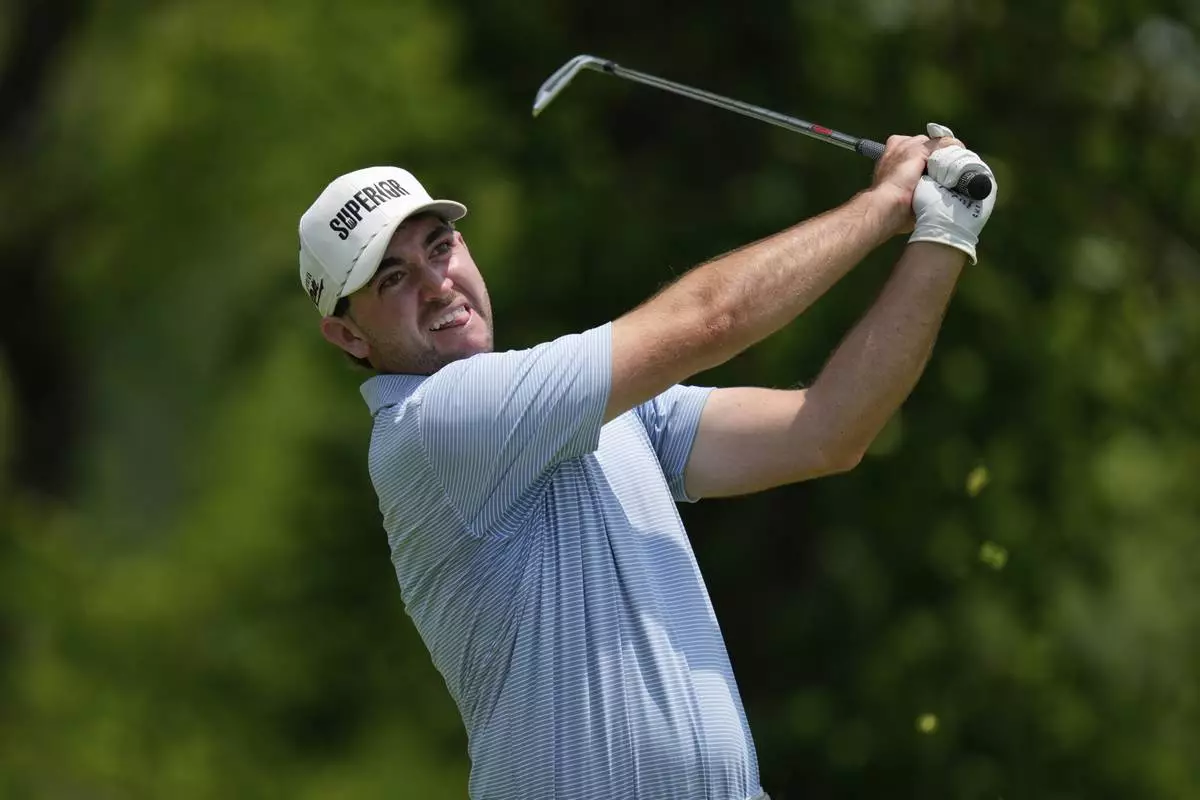
Philip Barbaree tees off on the 13th hole during the first round of the U.S. Open golf tournament at Oakmont Country Club Thursday, June 12, 2025, in Oakmont, Pa. (AP Photo/Seth Wenig)
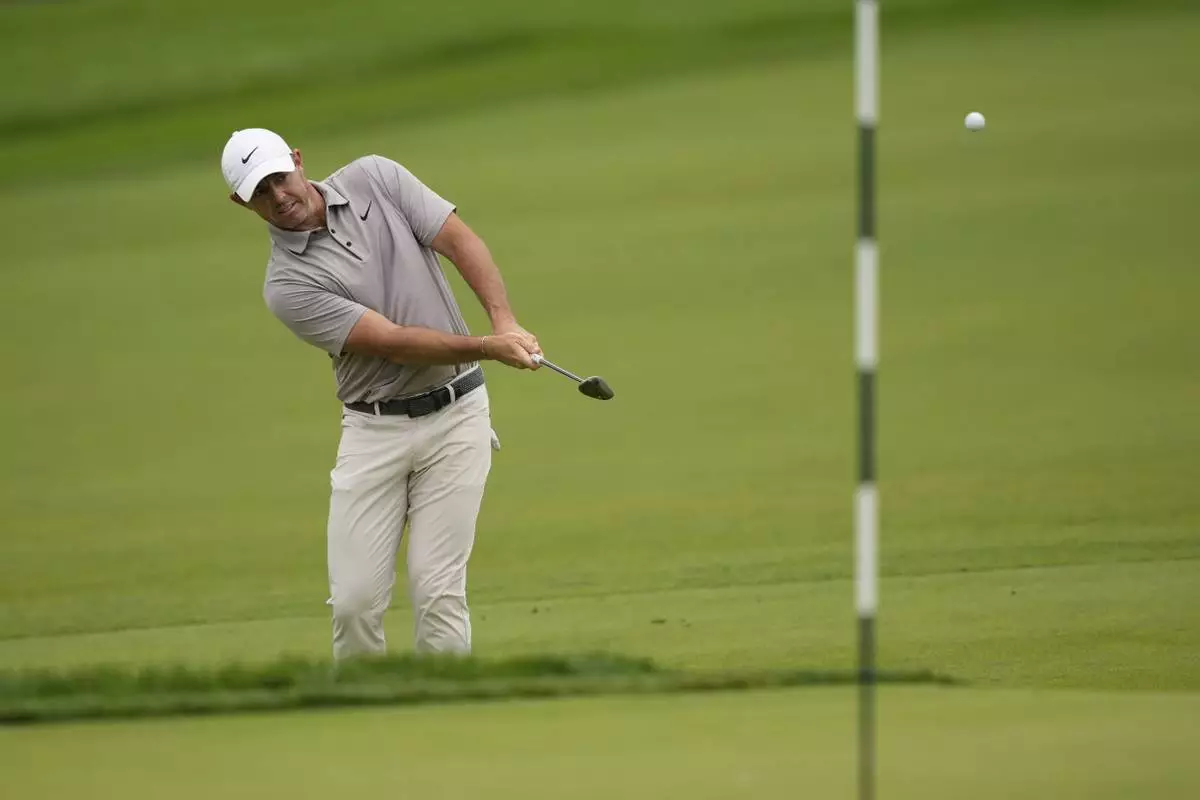
Rory McIlroy, of Northern Ireland, chips onto the seventh green during the third round of the U.S. Open golf tournament at Oakmont Country Club Saturday, June 14, 2025, in Oakmont, Pa. (AP Photo/Carolyn Kaster)
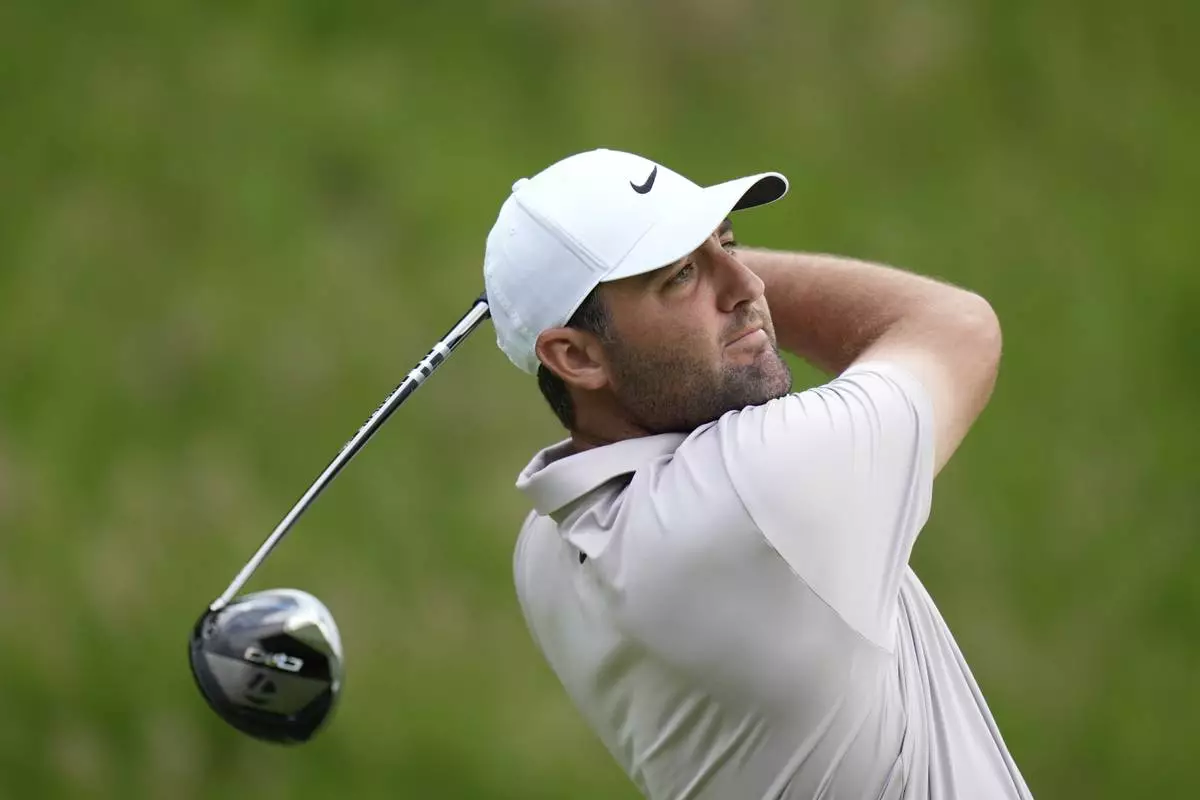
Scottie Scheffler tees off on the seventh hole during a practice round ahead of the U.S. Open golf tournament at Oakmont Country Club Tuesday, June 10, 2025, in Oakmont, Pa. (AP Photo/Seth Wenig)
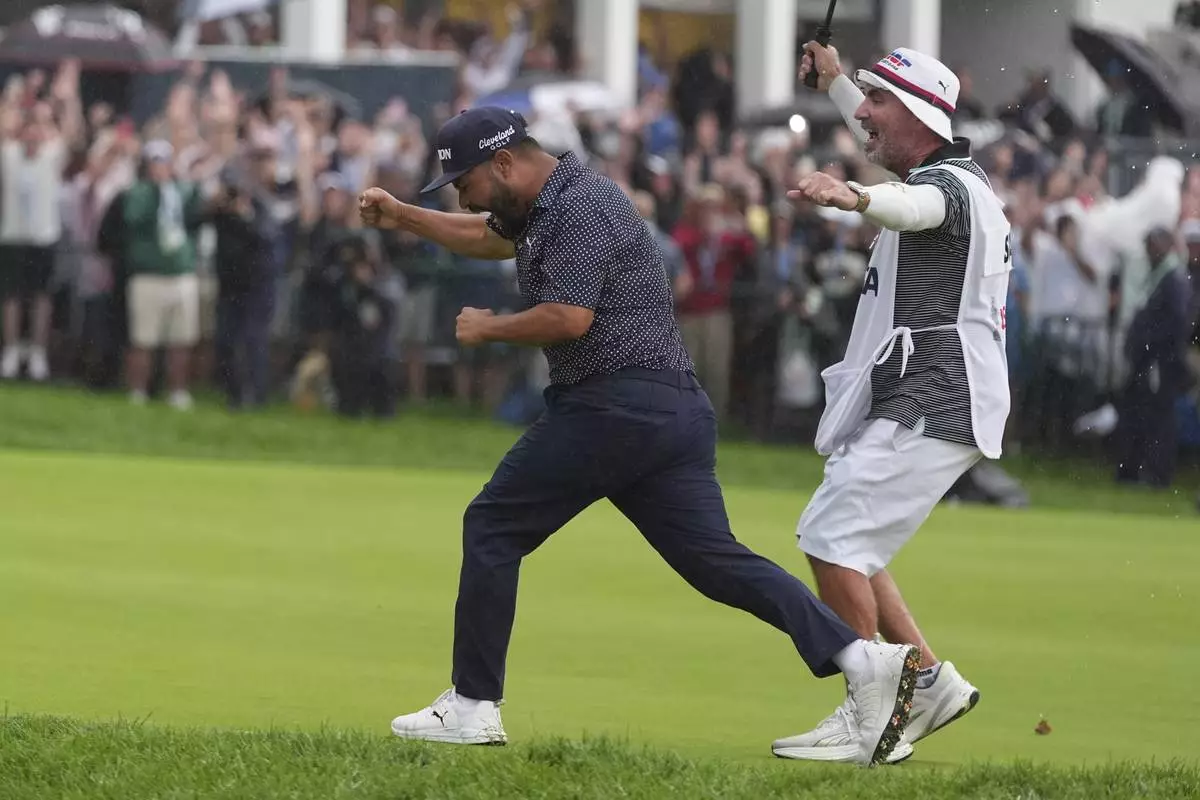
J.J. Spaun celebrates with his caddie, Mark Carens, after making a birdie putt on the 18th hole during the final round of the U.S. Open golf tournament at Oakmont Country Club Sunday, June 15, 2025, in Oakmont, Pa. (AP Photo/Seth Wenig)