

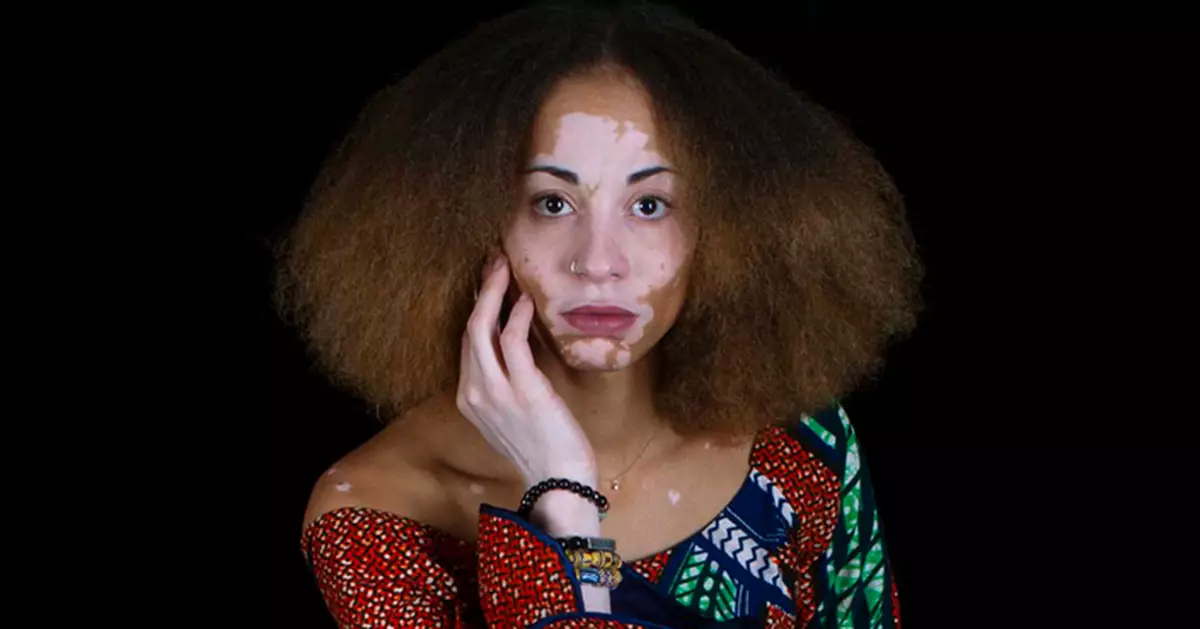
African-American Jasmine Colgan says that the condition that has uncontrollably turned her skin a patchy white is the “best thing that ever happened”.
A woman has used tattoos to embrace the condition that saw her dark skin turn white uncontrollably and says it is “the best thing that ever happened” – despite the difficulties it has caused in her love life.
Click to Gallery


Jasmine Colgan, 29, who is of Ghanaian and Irish heritage, told of how a smattering of white dots appeared out of the blue on her arms and legs back in 2011.
At first, she wasn’t especially worried – but within months, the marks had spread to her face and elsewhere, transforming vast patches of her skin from its natural brown colour to a Caucasian white, causing her self-esteem to plummet.
Diagnosed with vitiligo – where a lack of melanin causes pale white patches to appear on the skin – in 2011, she eventually embraced the condition by tattooing rings around the marks it left.
But sadly, though she has finally rebuilt her confidence, she has found her love life affected.
Jasmine, an artist of Denver, Colorado, USA, said: “I have had dating issues in the past as I think for men particularly, it can be difficult for them to see beyond the surface.”
She continued: “People don’t cherish difference as much as they should do, and I’m really proud of my skin because it makes me who I am.”
She added: “But I am not worried because I know that I am still the same strong person I have always been, and one day I will meet someone who sees that.”
Jasmine told of how she was studying photography, aged 21, at the University of Colorado Denver in June 2011, when she first noticed the white speckling on her legs and arms.
Thinking that perhaps it was just freckling, she decided, at first, not to visit her doctor.
Within two months, though, the patches spread to her face, back and fingers.
Recalling the onset of the drastic and sudden alteration in her appearance, Jasmine said: “It was absolutely terrifying.”
She continued: “It was very difficult trying to come to terms with it for a long time, because the way you look is changing very obviously and you have no control over it real life healthwhatsoever.”
Taking to the internet, Jasmine soon found a page about vitiligo, and became convinced that was what she had.
Still, she hoped that, if she sought medical help, she would be able to secure some form of treatment that would revert her skin back to its normal colour.
However, that did not happen.
In August 2011, a doctor officially confirmed her condition as vitiligo, and prescribed steroid cream to attempt to stimulate the production of melanin – but it made little difference.
From there, she underwent eight months of phototherapy treatment at Anschutz Medical Campus in Colorado – where fluorescent lightbulbs were used to treat her skin condition, something Jasmine was willing to go through for a time, even though it carries a risk of skin cancer according to the NHS.
But when that also failed to make a difference to her appearance, and the patches continued to expand, Jasmine, who, at one time had been an aspiring model, fell into a deep pit of depression.
“It was really tough knowing that you haven’t changed at all in yourself, but when you look in the mirror you see a totally different person,” she admitted candidly.
“People started to stare a lot at me in the street, and that became hugely uncomfortable, walking into a room and knowing that there are all of these eyes on you.”
She added: “And people can be cruel too. Someone once told me I look like a cow, which was pretty hurtful.”
The hardest part, however, was the feeling that she was losing her connection to her African ancestry as her skin tone became more and more akin to a Caucasian person’s.
She added: “I am very proud of where I come from and my family’s Ghanaian roots, so it was upsetting to see that very visibly disappearing in me.”
Over time, though, Jasmine began to embrace her unique complexion by incorporating it into her artwork by tattooing around the spots every six months, documenting their growth “like rings of a tree”.
“I know that by the time I’m 50 I will probably be completely white, so having these tattoos on my arms is a visual document of how my condition develops,” she said.
“It has made me realise that I’m so lucky to have this unique thing happen to me. It’s like an organic artwork all over my body – and that’s really special.”
Now, Jasmine has also produced a series of striking self-portraits, featuring herself with a backdrop of traditional Ghanaian artefacts, as a way to “reconnect” with her heritage.
As her patches continue to grow at a rate of around 1mm every six months, she said the condition has made her a “better and wiser person” and insists she would not change it if she had the chance.
She explained: “It took me about four years to really accept the new image of myself and understand that this is who I am now.”
Jasmine continued: “But now I feel so lucky to have been affected by the condition as it has made me want to help others, who may be struggling with the way they look, to feel empowered in themselves.
“Honestly, if I could wave a magic wand and make the vitiligo go away today, I wouldn’t because I know I am a much wiser and better person as a consequence of it.”