Skip to Content Facebook Feature Image

'Babadook' director grapples with divisive follow-up

ENT

'Babadook' director grapples with divisive follow-up
ENT

ENT

'Babadook' director grapples with divisive follow-up

2019-01-28 07:50 Last Updated At:08:00

There's an early scene in director Jennifer Kent's film "The Nightingale" that is so relentlessly brutal, it's become almost infamous and has evoked the most extreme reactions, both positive and negative.

And it's not at all what Kent expected to happen. She thought she'd made a film about love. So why, she wondered, are some saying it is, "needlessly punishing" and that they'll never watch it again.

The film screened for U.S. audiences for the first time at the 2019 Sundance Film Festival. It's set in 1825 in Tasmania and follows an Irish convict, Clare, played by Aisling Franciosi, who hunts a British officer (Sam Claflin) through the wilderness seeking revenge for what he's done to her and her family. It's an epic, beautiful and demanding journey as Clare enlists an Aboriginal tracker (Baykali Ganambarr) to help her navigate the treacherous terrain. IFC plans to release it in theaters this summer.

Aisling Franciosi, left and director Jennifer Kent pose for a portrait to promote the film "The Nightingale" at the Salesforce Music Lodge during the Sundance Film Festival on Friday, Jan. 25, 2019, in Park City, Utah. (Photo by Taylor JewellInvisionAP)

Aisling Franciosi, left and director Jennifer Kent pose for a portrait to promote the film "The Nightingale" at the Salesforce Music Lodge during the Sundance Film Festival on Friday, Jan. 25, 2019, in Park City, Utah. (Photo by Taylor JewellInvisionAP)

It's Kent's first feature since her debut, "The Babadook," which played at Sundance five years ago and went on to become a critical darling and modest box office hit. Its reception changed her life and made her realize that she had a career and could keep going as a filmmaker. Since then she's been in demand, and has turned down "some good films" that she declined to name simply because if she's going to spend years of her life on a film, she has to be passionate about it. So far, that's only happened when she's written it.

It's why she nearly killed herself to make "The Nightingale."

"I was seeing violence all around me and I'm a sensitive person and I was looking at a lot of violence and thinking, 'What are we doing to each other? What are we doing to ourselves? Are there other ways through this?'" Kent said. "I wanted to tell a story about the necessity of love, compassion, kindness and empathy in a very dark time."

Aisling Franciosi, left and director Jennifer Kent pose for a portrait to promote the film "The Nightingale" at the Salesforce Music Lodge during the Sundance Film Festival on Friday, Jan. 25, 2019, in Park City, Utah. (Photo by Taylor JewellInvisionAP)

Aisling Franciosi, left and director Jennifer Kent pose for a portrait to promote the film "The Nightingale" at the Salesforce Music Lodge during the Sundance Film Festival on Friday, Jan. 25, 2019, in Park City, Utah. (Photo by Taylor JewellInvisionAP)

She turned to her own country's deplorable history of penal colonies and the Tasmanian genocide for inspiration.

"It was a very violent time," Kent said. "Much more violent than was depicted in the film, believe it or not."

The shoot was incredibly difficult on location with rough terrain and dangerous waters to contend with. At one point her star even fainted after being in the freezing cold river.
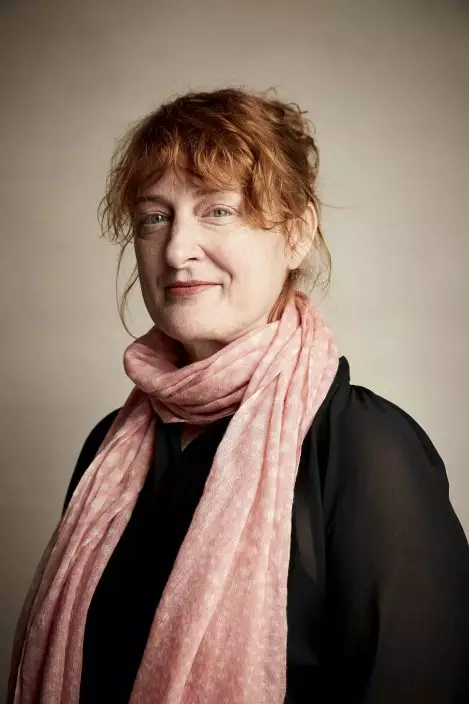
Director Jennifer Kent poses for a portrait to promote the film "The Nightingale" at the Salesforce Music Lodge during the Sundance Film Festival on Friday, Jan. 25, 2019, in Park City, Utah. (Photo by Taylor JewellInvisionAP)

Director Jennifer Kent poses for a portrait to promote the film "The Nightingale" at the Salesforce Music Lodge during the Sundance Film Festival on Friday, Jan. 25, 2019, in Park City, Utah. (Photo by Taylor JewellInvisionAP)

"It was just a nightmare," she said. "And people were saying, 'You'll never do this, you won't finish this film.' And I thought 'Yes, I (expletive) will, but it may kill me.'"

Kent is genuinely surprised at how polarizing it's been, since, for her it's ultimately a, "very positive film about love."

"Some people have been so up in arms and say, 'It's so shocking!' And I say, 'Yes of course! Do you not think I'm shocked by this material myself?'" Kent said. "It is shocking and it's my job to shine a light on that, not from some historical curiosity, but because I feel we're in trouble in the world. And I wanted to speak about it."

"My job is to communicate something in the purest form I can. To make it easier on the audience? I couldn't do it! Sorry," she said with a weary laugh.

She's trying not to think too hard about the reception. She knows why she made the film and she's proud of it. If she thinks too hard about the stress that some people feel at the end, it causes her, "a lot of pain, actually."

"It's quite stressful, but I put my hand up for it," she said. "I think as a filmmaker we just have to accept that we can't control what a story will do to someone."

"The only thing you have as a filmmaker is your own point of view," Kent added. "I feel proud that I had the guts to give over my own."

Follow AP Film Writer Lindsey Bahr on Twitter: www.twitter.com/ldbahr
PORT-OF-SPAIN, Trinidad (AP) — The government of Trinidad and Tobago said Monday that it would allow the U.S. military to access its airports in coming weeks as tensions build between the United States and Venezuela.

The announcement comes after the U.S. military recently installed a radar system at the airport in Tobago. The Caribbean country's government has said the radar is being used to fight local crime, and that the small nation wouldn't be used as a launchpad to attack any other country.

The U.S. would use the airports for activity that would be "logistical in nature, facilitating supply replenishment and routine personnel rotations,” Trinidad and Tobago’s Ministry of Foreign Affairs said in a statement. It did not provide further details.

Trinidad’s prime minister previously has praised ongoing U.S. strikes on alleged drug boats in the Caribbean.

Only seven miles (11 kilometers) separate Venezuela from the twin-island Caribbean nation at their closest point. It has two main airports: Piarco International Airport in Trinidad and ANR Robinson International Airport in Tobago.

Hours after the announcement, Venezuelan Vice President Delcy Rodríguez said her country was immediately canceling any contract, deal or negotiation to supply natural gas to Trinidad and Tobago.

She claimed that the government of Trinidad and Tobago participated in the recent U.S. seizure of an oil tanker off the country’s coast, calling it an “act of piracy.”

She also accused Trinidad and Tobago’s prime minister, Kamla Persad-Bissessar, of having a “hostile agenda” against Venezuela, noting that the U.S. military installed an airport radar in Tobago.

“This official has turned the territory of Trinidad and Tobago into a US aircraft carrier to attack Venezuela, in an unequivocal act of vassalage,” Rodríguez said.

The office of Trinidad's prime minister did not immediately return a message seeking comment.

Trinidad and Venezuela had previously reached a deal over the development of a gas field in Venezuelan waters, near the maritime border separating the two countries.

In December 2023, Venezuela granted a license for oil giant Shell and Trinidad and Tobago to produce gas from the field. In October, the U.S. government granted Trinidad and Tobago permission to negotiate the gas deal without facing U.S sanctions placed on Venezuela.

Amery Browne, an opposition senator and Trinidad and Tobago's former foreign minister, accused the Trinidadian government on Monday of being deceptive in its announcement.

Browne said that Trinidad and Tobago has become “complicit facilitators of extrajudicial killings, cross-border tension and belligerence.”

“There is nothing routine about this. It has nothing to do with the usual cooperation and friendly collaborations that we have enjoyed with the USA and all of our neighbors for decades," he said.

He said the "blanket permission” with the U.S. takes the country “a further step down the path of a satellite state” and that it embraces a “'might is right' philosophy.”

American strikes began in September and have killed more than 80 people as Washington builds up a fleet of warships near Venezuela, including the largest U.S. aircraft carrier.

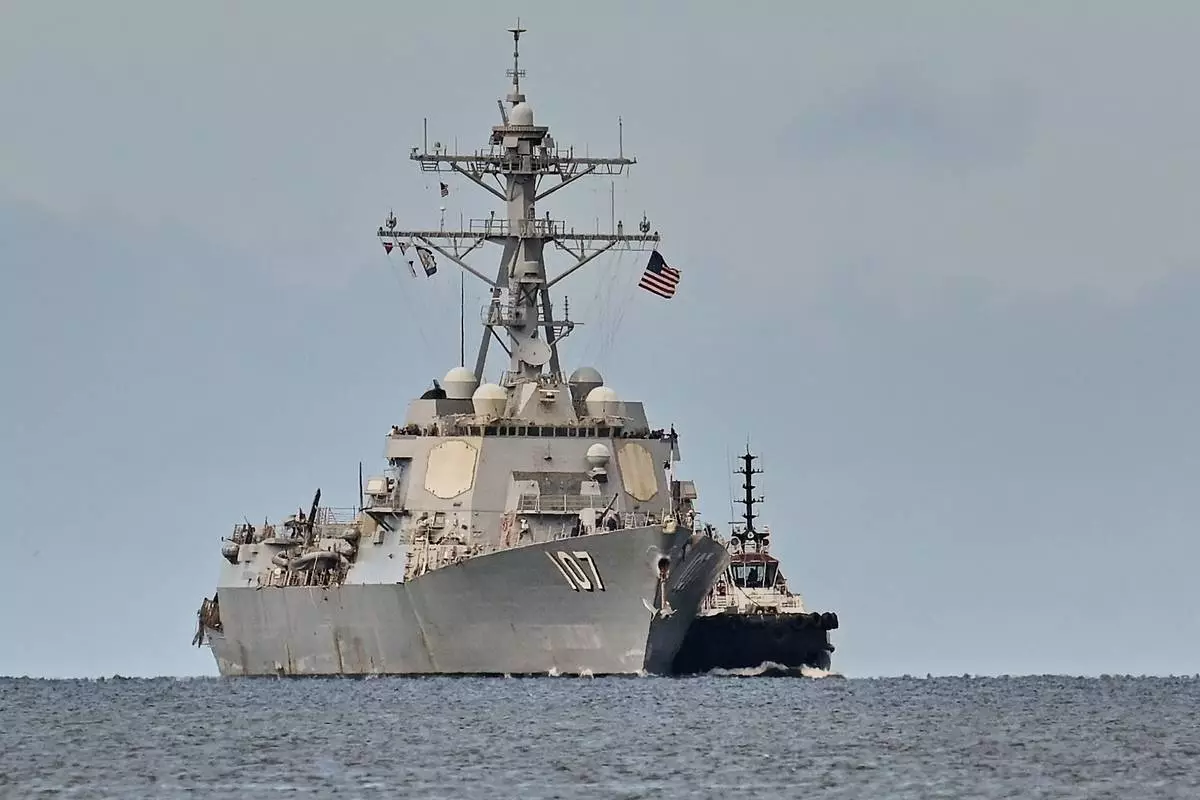
In October, an American warship docked in Trinidad's capital, Port-of-Spain, as the administration of U.S. President Donald Trump boosts military pressure on Venezuela and President Nicolás Maduro.

U.S. lawmakers have questioned the legality of the strikes against vessels in the Caribbean and the eastern Pacific Ocean, and recently announced that there would be a congressional review of them.

Follow AP’s coverage of Latin America and the Caribbean at https://apnews.com/hub/latin-america

FILE - The USS Gravely destroyer arrives to dock for military exercises in Port-of-Spain, Trinidad and Tobago, Sunday, Oct. 26, 2025. (AP Photo/Robert Taylor, File)

FILE - The USS Gravely destroyer arrives to dock for military exercises in Port-of-Spain, Trinidad and Tobago, Sunday, Oct. 26, 2025. (AP Photo/Robert Taylor, File)

Recommended Articles