There's an early scene in director Jennifer Kent's film "The Nightingale" that is so relentlessly brutal, it's become almost infamous and has evoked the most extreme reactions, both positive and negative.
And it's not at all what Kent expected to happen. She thought she'd made a film about love. So why, she wondered, are some saying it is, "needlessly punishing" and that they'll never watch it again.
The film screened for U.S. audiences for the first time at the 2019 Sundance Film Festival. It's set in 1825 in Tasmania and follows an Irish convict, Clare, played by Aisling Franciosi, who hunts a British officer (Sam Claflin) through the wilderness seeking revenge for what he's done to her and her family. It's an epic, beautiful and demanding journey as Clare enlists an Aboriginal tracker (Baykali Ganambarr) to help her navigate the treacherous terrain. IFC plans to release it in theaters this summer.

Aisling Franciosi, left and director Jennifer Kent pose for a portrait to promote the film "The Nightingale" at the Salesforce Music Lodge during the Sundance Film Festival on Friday, Jan. 25, 2019, in Park City, Utah. (Photo by Taylor JewellInvisionAP)
It's Kent's first feature since her debut, "The Babadook," which played at Sundance five years ago and went on to become a critical darling and modest box office hit. Its reception changed her life and made her realize that she had a career and could keep going as a filmmaker. Since then she's been in demand, and has turned down "some good films" that she declined to name simply because if she's going to spend years of her life on a film, she has to be passionate about it. So far, that's only happened when she's written it.
It's why she nearly killed herself to make "The Nightingale."
"I was seeing violence all around me and I'm a sensitive person and I was looking at a lot of violence and thinking, 'What are we doing to each other? What are we doing to ourselves? Are there other ways through this?'" Kent said. "I wanted to tell a story about the necessity of love, compassion, kindness and empathy in a very dark time."

Aisling Franciosi, left and director Jennifer Kent pose for a portrait to promote the film "The Nightingale" at the Salesforce Music Lodge during the Sundance Film Festival on Friday, Jan. 25, 2019, in Park City, Utah. (Photo by Taylor JewellInvisionAP)
She turned to her own country's deplorable history of penal colonies and the Tasmanian genocide for inspiration.
"It was a very violent time," Kent said. "Much more violent than was depicted in the film, believe it or not."
The shoot was incredibly difficult on location with rough terrain and dangerous waters to contend with. At one point her star even fainted after being in the freezing cold river.
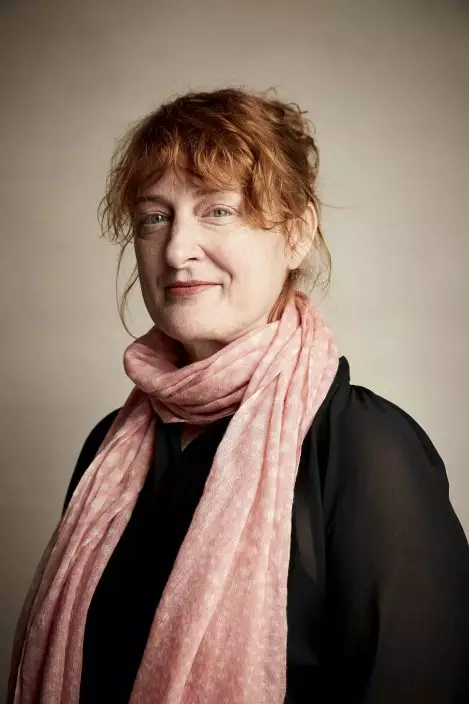
Director Jennifer Kent poses for a portrait to promote the film "The Nightingale" at the Salesforce Music Lodge during the Sundance Film Festival on Friday, Jan. 25, 2019, in Park City, Utah. (Photo by Taylor JewellInvisionAP)
"It was just a nightmare," she said. "And people were saying, 'You'll never do this, you won't finish this film.' And I thought 'Yes, I (expletive) will, but it may kill me.'"
Kent is genuinely surprised at how polarizing it's been, since, for her it's ultimately a, "very positive film about love."
"Some people have been so up in arms and say, 'It's so shocking!' And I say, 'Yes of course! Do you not think I'm shocked by this material myself?'" Kent said. "It is shocking and it's my job to shine a light on that, not from some historical curiosity, but because I feel we're in trouble in the world. And I wanted to speak about it."
"My job is to communicate something in the purest form I can. To make it easier on the audience? I couldn't do it! Sorry," she said with a weary laugh.
She's trying not to think too hard about the reception. She knows why she made the film and she's proud of it. If she thinks too hard about the stress that some people feel at the end, it causes her, "a lot of pain, actually."
"It's quite stressful, but I put my hand up for it," she said. "I think as a filmmaker we just have to accept that we can't control what a story will do to someone."
"The only thing you have as a filmmaker is your own point of view," Kent added. "I feel proud that I had the guts to give over my own."
Follow AP Film Writer Lindsey Bahr on Twitter: www.twitter.com/ldbahr
WASHINGTON (AP) — The U.S. military has amassed an unusually large force in the Caribbean Sea and the waters off the coast of Venezuela since this summer, when the Trump administration first began to shift assets to the region as part of its anti-drug trafficking operations.
In all, U.S. Southern Command says there are around 15,000 personnel operating in the area, in the largest military buildup in the region in generations.
It is part of the Trump administration's escalating pressure campaign on Venezuelan President Nicolás Maduro, who has been charged with narco-terrorism in the U.S., and includes a series of strikes on alleged drug-running boats that have killed more than 100 people since early September.
Here is a look at the ships, planes and troops in the region:
The Navy has 11 warships in the region — the nation's largest aircraft carrier, the USS Gerald R. Ford, as well as five destroyers, three amphibious assault ships, and two cruisers.
The three amphibious assault ships make up an amphibious readiness group and carry an expeditionary unit of Marines. As a result, those ships also have on board a variety of Marine helicopters, Osprey tilt rotor aircraft and Harrier jets that have the capability of either transporting large numbers of Marines or striking targets on land and sea.
The USS Ford has multiple squadrons of fighter jets as well as other aircraft and helicopters.
While officials have not offered specific numbers, destroyers and cruisers typically deploy with a missile loadout that contains Tomahawk cruise missiles, which can strike hundreds of miles from their launch point.
A U.S. Navy submarine also is operating in the broader area of South America and is capable of carrying and launching cruise missiles.
A squadron of advanced U.S. Marine Corps F-35B Lightning II jets has been sent to an airstrip in Puerto Rico. The planes were first spotted landing on the island territory in mid-September.
More recently, U.S. Navy EA-18G “Growler” electronic warfare jets were photographed flying out of Puerto Rico.
MQ-9 Reaper Air Force drones, capable of flying long distances and carrying up to eight laser-guided missiles, also have been spotted operating out of Puerto Rico by commercial satellites and military watchers, as well as photojournalists, around the same time in September.
It has been widely reported that the Navy also is operating P-8 Poseidon maritime patrol aircraft out of the region.
In October, the military released a photo of a U.S. Air Force AC-130J Ghostrider, a heavily armed plane capable of firing its large guns with precision onto ground targets, sitting on the tarmac in Puerto Rico.
There has been a multitude of other military aircraft that have temporarily flown through the region as part of military operations there.
The U.S. Air Force has repeatedly flown B-52 Stratofortress and B-1 Lancer bombers to the region in what the Pentagon has said were training flights. However, at least one such flight was dubbed a “bomber attack demo” in photos online.
Recently, the U.S. military also flew a pair of F/A-18 fighter jets over the Gulf of Venezuela in what appears to be the closest American warplanes have come to the South American country’s airspace since the start of the campaign.
The gulf is bounded by Venezuela and only about 150 miles (240 kilometers) at its widest point. The planes spent more than 30 minutes flying in the area.
All told, about 15,000 personnel are in the region, with nearly 10,000 being the sailors and Marines aboard the warships. U.S. Southern Command refused to offer any formal breakdown of the total figure, citing operational security.
Lt. Col. Emanuel Ortiz, a spokesperson for Southern Command, said in an email that the total figure “includes all military services and government civilians in support of this mission.”
The Pentagon has not offered specific numbers on how many drones, aircraft or ground crew are in the region, so their impact on that broader figure is unknown.
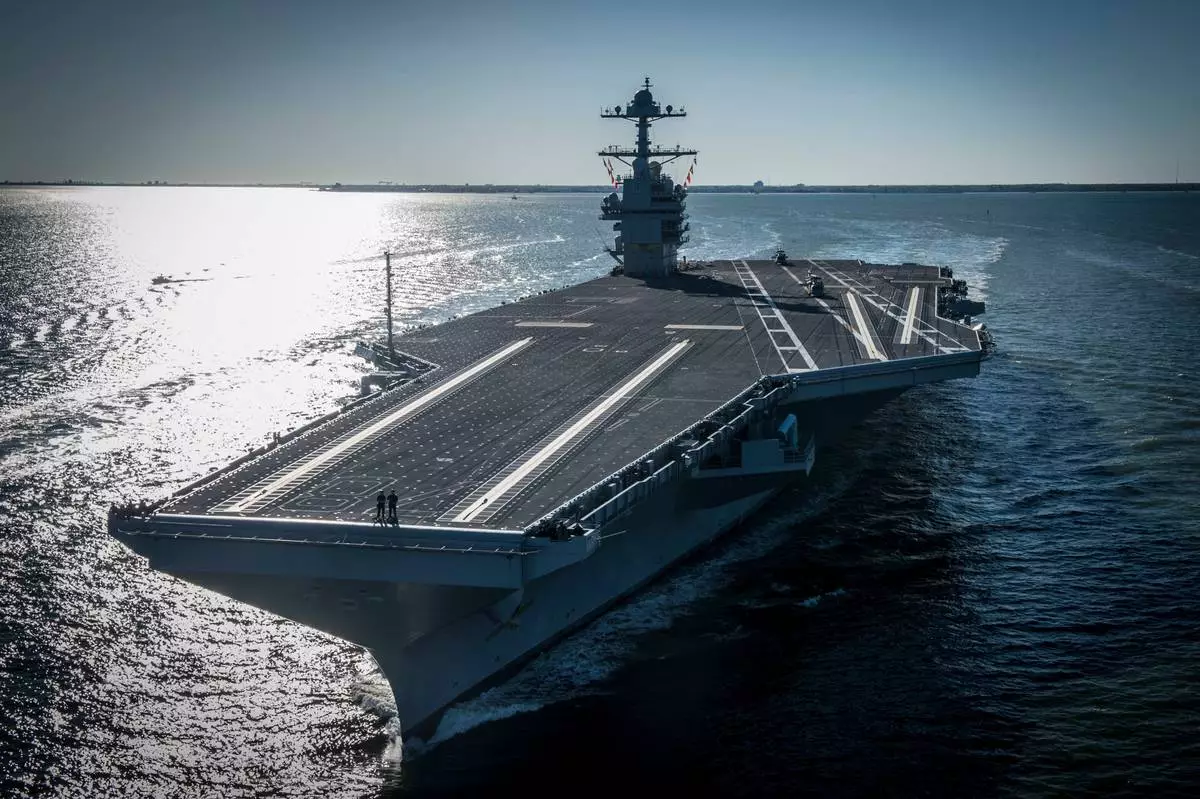
FILE - In this photo provided by the U.S. Navy, the USS Gerald R. Ford embarked on the first of its sea trials to test various state-of-the-art systems on its own power for the first time, April 8, 2017, from Newport News, Va. (Mass Communication Specialist 2nd Class Ridge Leoni/U.S. Navy via AP, File)
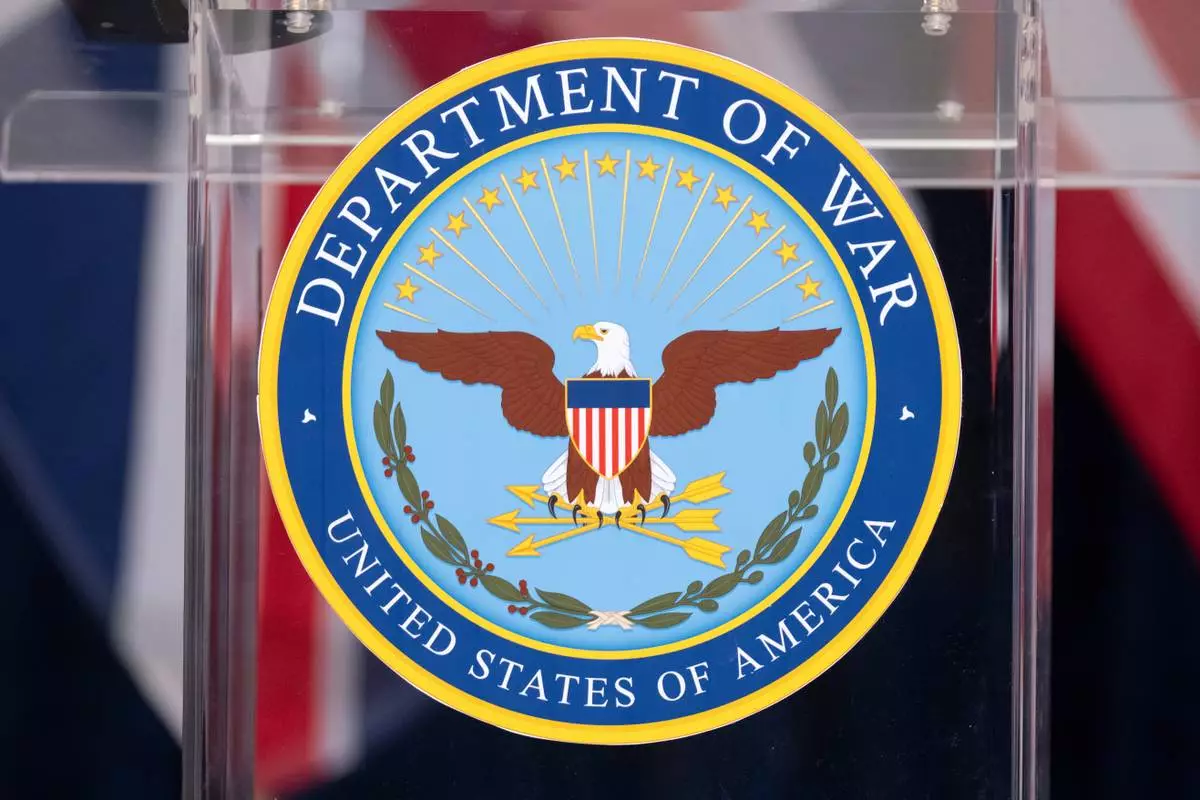
The seal is seen on a podium at the Pentagon, Wednesday, Dec. 10, 2025, in Washington, before Defense Secretary Pete Hegseth speaks. (AP Photo/Mark Schiefelbein)