Skip to Content Facebook Feature Image

Joby: U.S. Government’s Advanced Air Mobility Plan is Pivotal Step Toward Commercial Launch

News

Joby: U.S. Government’s Advanced Air Mobility Plan is Pivotal Step Toward Commercial Launch
News

News

Joby: U.S. Government’s Advanced Air Mobility Plan is Pivotal Step Toward Commercial Launch

2025-12-18 05:05 Last Updated At:05:21

SANTA CRUZ, Calif.--(BUSINESS WIRE)--Dec 17, 2025--

Joby Aviation, Inc. (NYSE:JOBY), a company developing electric air taxis for commercial passenger service, today announced its support for the U.S. Department of Transportation’s (DOT) Advanced Air Mobility (AAM) National Strategy, as well as its intent to immediately engage on key recommendations. The Strategy provides a clear policy roadmap for AAM deployment and integration across workforce, infrastructure, safety and data sharing.

This press release features multimedia. View the full release here: https://www.businesswire.com/news/home/20251217622364/en/

“This strategy is tangible proof that the U.S. government recognizes the value of the AAM industry, and it comes as we’re preparing for early air taxi operations in U.S. cities through the eIPP program, created by an Executive Order this summer. It’s a powerful signal that our federal government, in coordination with state, local and tribal communities, is prepared to usher in the next generation of U.S. leadership in aviation,” said JoeBen Bevirt, founder and CEO of Joby.

Congress passed the “Advanced Air Mobility and Coordination Act” in 2022 to ensure federal agencies work in coordination on investments necessary for the maturation of the AAM ecosystem in the United States. The DOT, under Secretary Duffy’s leadership, subsequently brought together at least 19 federal agencies and departments to develop and publish this Strategy. The Strategy fosters innovation, ensures safety, and promotes cohesion across the federal government to shape the future of air transportation in the United States.

It also comes as the Federal Aviation Administration (FAA) and DOT look to execute the Electric Vertical Take Off and Landing (eVTOL) Integration Pilot Program (eIPP) starting in 2026. eIPP supports eVTOL use cases across the country ahead of FAA Type Certification, such as proving routes for operations. The eIPP’s near-term operations and the Strategy’s policy recommendations empower regulators, communities and industry alike to move forward in lockstep.

Joby’s advanced progress towards certification and operational maturity uniquely positions the company to immediately engage on the Strategy’s core recommendations:

The Administration’s roadmap comes at a moment of unprecedented validation for Joby. In 2025, Joby’s flight test program spanned three countries, including operations at the World Expo in Osaka, Japan, extreme-environment testing in the United Arab Emirates, and public airport-to-airport missions in California. With its aircraft now advancing into the final stage of FAA certification, and pre-certification demonstration programs launching next year, 2026 is set to be an inflection point.

About Joby

Joby Aviation, Inc. (NYSE:JOBY) is a California-based transportation company developing an all-electric, vertical take-off and landing air taxi. Joby intends to both operate its fast, quiet, and convenient air taxi service in cities around the world and sell its aircraft to other operators and partners. To learn more, visit www.jobyaviation.com.

Forward-Looking Statements ​​

This release contains “forward-looking statements” within the meaning of the “safe harbor” provisions of the Private Securities Litigation Reform Act of 1995, including but not limited to, statements regarding the development and performance of our aircraft; the growth of our manufacturing capabilities; our regulatory outlook, progress and timing, including potential operations in 2026 ahead of FAA certification; our business plan, objectives, goals and market opportunity; plans for, and potential benefits of, our strategic partnerships; and our current expectations relating to our business, financial condition, results of operations, prospects, capital needs and growth of our operations. You can identify forward-looking statements by the fact that they do not relate strictly to historical or current facts. These statements may include words such as “anticipate”, “estimate”, “expect”, “project”, “plan”, “intend”, “believe”, “may”, “will”, “should”, “can have”, “likely” and other words and terms of similar meaning in connection with any discussion of the timing or nature of future operating or financial performance or other events. All forward looking statements are subject to risks and uncertainties that may cause actual results to differ materially, including: our ability to launch our air taxi service and the growth of the urban air mobility market generally; our ability to produce aircraft that meet our performance expectations in the volumes and on the timelines that we project; the competitive environment in which we operate; our future capital needs; our ability to adequately protect and enforce our intellectual property rights; our ability to effectively respond to evolving regulations and standards relating to our aircraft; our reliance on third-party suppliers and service partners; uncertainties related to our estimates of the size of the market for our service and future revenue opportunities; and other important factors discussed in the section titled “Risk Factors” in our Annual Report on Form 10-K, filed with the Securities and Exchange Commission (the “SEC”) on February 27, 2025, our Quarterly Reports on Form 10-Q filed with the SEC on May 8, 2025 and August 7, 2025, and in future filings and other reports we file with or furnish to the SEC. Any such forward-looking statements represent management’s estimates and beliefs as of the date of this release. While we may elect to update such forward-looking statements at some point in the future, we disclaim any obligation to do so, even if subsequent events cause our views to change.

Joby’s electric air taxi at Edwards Air Force Base Credit: Joby Aviation
Joby’s electric air taxi at Edwards Air Force Base Credit: Joby Aviation

NEW YORK (AP) — More drops for AI stocks dragged the U.S. market lower Wednesday, and Wall Street sank to its fourth straight loss.

The S&P 500 fell 1.2% for its worst day in nearly a month, though it’s still not far from its all-time high set last week. The Dow Jones Industrial Average dipped 228 points, or 0.5%, and the Nasdaq composite dropped 1.8%.

Slightly more stocks rose within the S&P 500 than fell, but they got drowned out by the drops for companies in the artificial-intelligence industry.

Questions continue to dog the former superstars about whether their yearslong dominance of Wall Street meant their prices shot too high, as well as whether all the investment in AI will produce enough profit and productivity to prove worth the cost. Worries are also rising about the debt that some companies are taking on to pay for it all.

Broadcom dropped 4.5%, Oracle fell 5.4% and CoreWeave sank 7.1%. Nvidia, the chip company that’s become Wall Street’s most influential stock because of its tremendous size, fell 3.8% and was the day's heaviest weight on the S&P 500.

Power companies that jumped earlier in the year on expectations for stronger demand from electricity-sucking data centers also lost some of their shine. Constellation Energy fell 6.7%.

Only 17% of respondents in a survey of relatively big businesses by UBS said they’re in production at scale with their AI projects. That could be “a reminder for tech investors to remain sober about the likely 2026 revenue growth uplift from AI products,” according to UBS analysts, though the rate continues to rise.

Also on the losing end of Wall Street was Lennar, which sank 4.5% following a mixed profit report. The homebuilder delivered a weaker profit for the latest quarter than analysts expected, though its revenue topped expectations.

Executive Chairman Stuart Miller said that conditions remain challenging, with customers feeling less confident while looking for discounts and more affordable options. As a result, the company gave limited forecasts for its upcoming financial performance.

Progressive, meanwhile, fell 2% after the insurer based in Mayfield Village, Ohio, said that its net income for November fell 5% from its year-ago level.

On the winning side of Wall Street were oil companies, after President Donald Trump ordered a blockade of all “sanctioned oil tankers” into Venezuela. It’s Trump’s latest escalation against Venezuela, which may be sitting on more oil than any other country.

That sent the price of a barrel of benchmark U.S. crude higher by 1.2% to $55.94. just a day after it sank to its lowest level since 2021. Brent crude, the international standard, climbed 1.3% to $59.68 per barrel.

That in turn helped ConocoPhillips rise 4.6% and cut into its loss for the year so far, which came into the day at 8.5%. Devon Energy rallied 5.3%, and Exxon Mobil climbed 2.4%.

Oil prices had dropped through most of this year on expectations that companies are pumping more than enough crude to meet the world’s demand.

Netflix added 0.2% after Warner Bros. Discovery’s board said it still recommends shareholders approve a buyout offer from the streaming giant for its Warner Bros. business, rather than a competing hostile bid from Paramount Skydance for the entire company.

Warner Bros. Discovery fell 2.4%, while Paramount Skydance dropped 5.4%.

All told, the S&P 500 fell 78.83 points to 6,721.43. The Dow Jones Industrial Average dipped 228.29 to 47,885.97, and the Nasdaq composite dropped 418.14 to 22,693.32.

In the bond market, Treasury yields held relatively steady ahead of a report coming on Thursday that will show how bad inflation has been for U.S. consumers.

The yield on the 10-year Treasury held at 4.15%, where it was late Tuesday.

In stock markets abroad, indexes were mixed in Europe following a stronger finish in Asia.

South Korea’s Kospi leaped 1.4% for one of the world’s bigger gains and shaved its loss for the week so far down to 2.7%.

AP Business Writer Elaine Kurtenbach contributed.

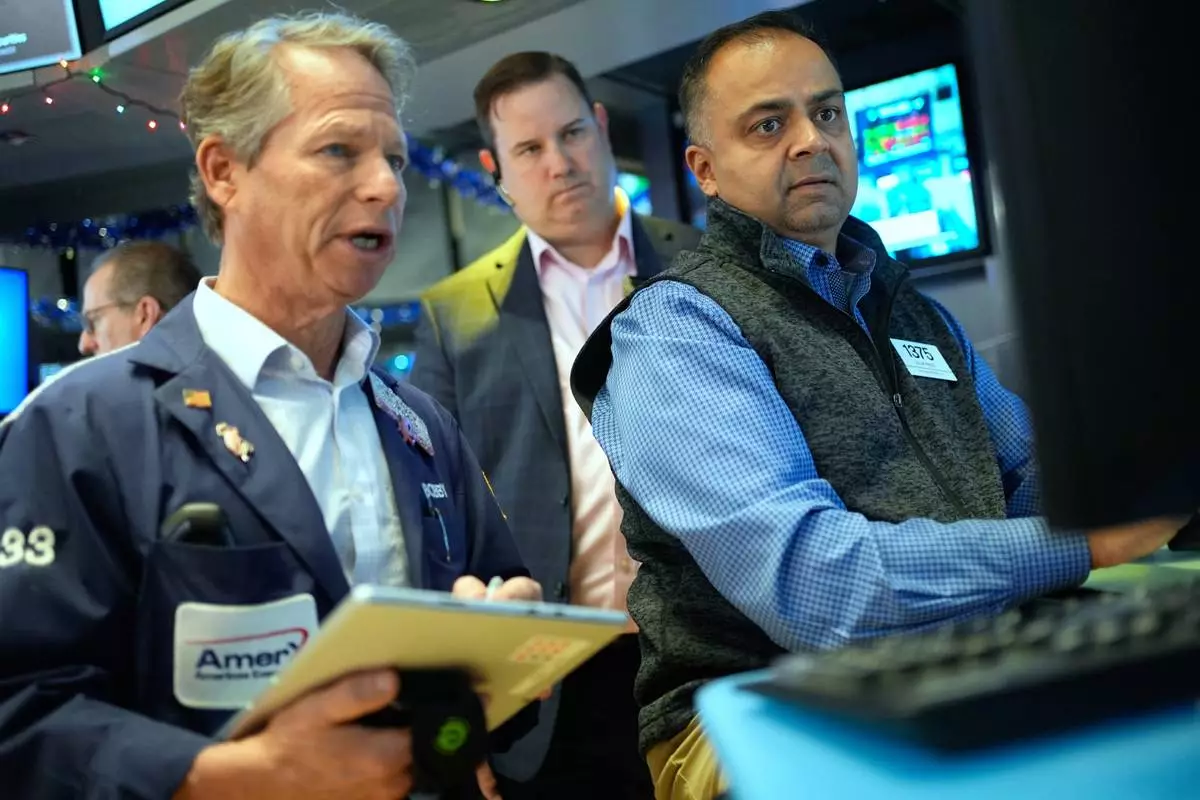
Dilip Patel, right, and Bobby Charmak, left, work on the floor at the New York Stock Exchange in New York, Wednesday, Dec. 10, 2025. (AP Photo/Seth Wenig)

Dilip Patel, right, and Bobby Charmak, left, work on the floor at the New York Stock Exchange in New York, Wednesday, Dec. 10, 2025. (AP Photo/Seth Wenig)

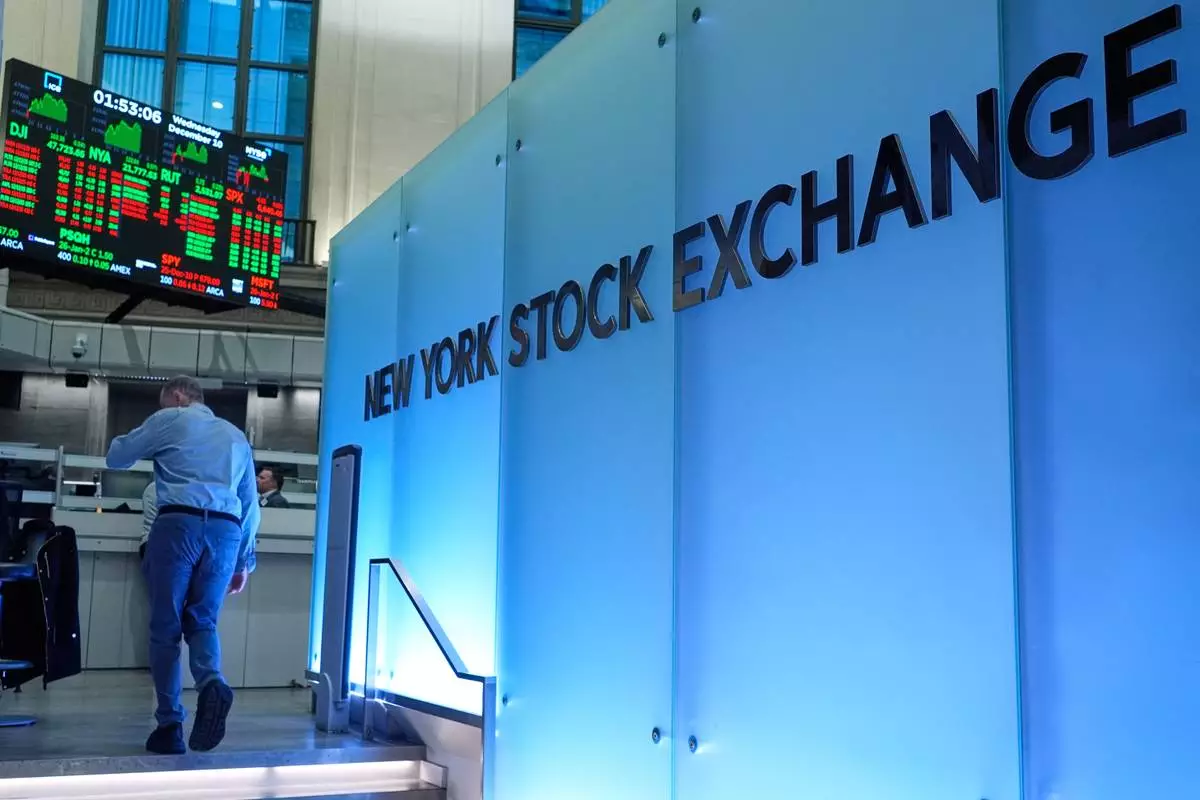
Traders work on the floor at the New York Stock Exchange in New York, Wednesday, Dec. 10, 2025. (AP Photo/Seth Wenig)

Traders work on the floor at the New York Stock Exchange in New York, Wednesday, Dec. 10, 2025. (AP Photo/Seth Wenig)

Currency traders work near a screen showing the Korea Composite Stock Price Index (KOSPI), left, at the foreign exchange dealing room of the Hana Bank headquarters, in Seoul, South Korea, Wednesday, Dec. 17, 2025. (AP Photo/Ahn Young-joon)

Currency traders work near a screen showing the Korea Composite Stock Price Index (KOSPI), left, at the foreign exchange dealing room of the Hana Bank headquarters, in Seoul, South Korea, Wednesday, Dec. 17, 2025. (AP Photo/Ahn Young-joon)

A currency trader watches monitors near a screen showing the Korea Composite Stock Price Index (KOSPI) at the foreign exchange dealing room of the Hana Bank headquarters, in Seoul, South Korea, Wednesday, Dec. 17, 2025. (AP Photo/Ahn Young-joon)

A currency trader watches monitors near a screen showing the Korea Composite Stock Price Index (KOSPI) at the foreign exchange dealing room of the Hana Bank headquarters, in Seoul, South Korea, Wednesday, Dec. 17, 2025. (AP Photo/Ahn Young-joon)

A currency trader stands near a screen showing the Korea Composite Stock Price Index (KOSPI), top left, and the foreign exchange rate between U.S. dollar and South Korean won at the foreign exchange dealing room of the Hana Bank headquarters, in Seoul, South Korea, Wednesday, Dec. 17, 2025. (AP Photo/Ahn Young-joon)

A currency trader stands near a screen showing the Korea Composite Stock Price Index (KOSPI), top left, and the foreign exchange rate between U.S. dollar and South Korean won at the foreign exchange dealing room of the Hana Bank headquarters, in Seoul, South Korea, Wednesday, Dec. 17, 2025. (AP Photo/Ahn Young-joon)

Recommended Articles