Skip to Content Facebook Feature Image

Witnesses tell AP about Christianity in North Korea

News

Witnesses tell AP about Christianity in North Korea
News

News

Witnesses tell AP about Christianity in North Korea

2019-02-01 18:02 Last Updated At:18:40

Christianity is virtually outlawed in North Korea, where dictator Kim Jong Un is the subject of a personality cult that treats him like a god. The possession of Bibles, open religious services and any attempt to build underground church networks could mean torture, lengthy prison terms or execution.

The following is what North Korean defectors, a Christian activist and a South Korean Catholic bishop with previous links to the North told The Associated Press about the ways North Koreans maintain their beliefs:

LEE HANBYEOL
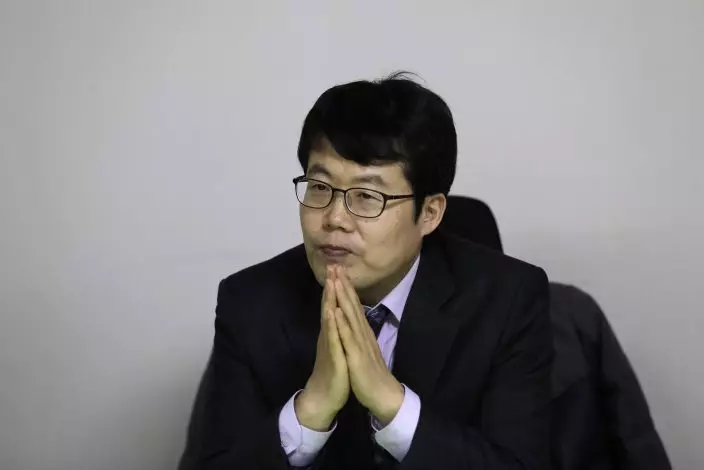
In this Dec. 21, 2018, photo, South Korean pastor Peter Jung speaks during an interview in Uijeongbu, South Korea. Experts and defectors say most of North Korea’s underground Christians do not engage in the extremely dangerous work of proselytizing. Instead, they largely keep their beliefs to themselves or within their immediate families. (AP PhotoLee Jin-man)

In this Dec. 21, 2018, photo, South Korean pastor Peter Jung speaks during an interview in Uijeongbu, South Korea. Experts and defectors say most of North Korea’s underground Christians do not engage in the extremely dangerous work of proselytizing. Instead, they largely keep their beliefs to themselves or within their immediate families. (AP PhotoLee Jin-man)

Lee, 35, is a North Korean refugee in Seoul whose Christian father prayed whenever his wife slipped into China to borrow money from relatives in the mid-1990s.

"I saw him praying many times. ... My mom risked her life to go to China illegally to feed our family. So when my mom left, he kept praying, sitting cross-legged and trembling in the corner of our room," Lee said.

Lee said she didn't know about Christianity at the time. Her father kept his faith to himself until his death in 1997 in an apparent effort to protect his family. Lee believes her father was part of a Christian population that flourished in North Korea before the 1950-53 Korean War.
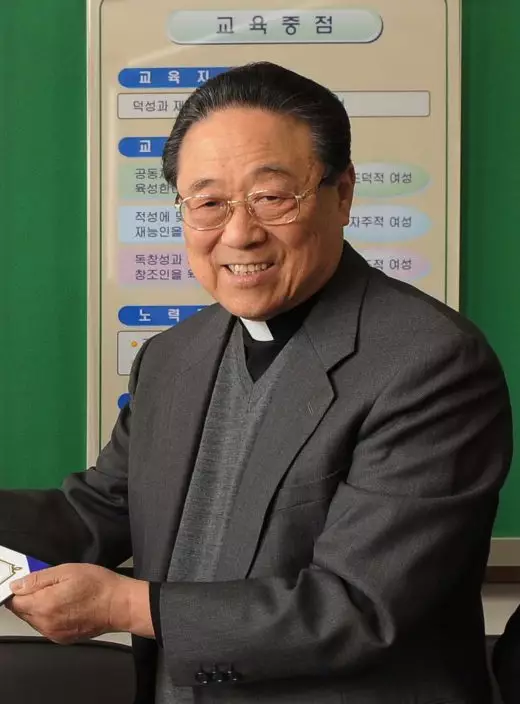
In this Feb. 10, 2009, photo, John Chang, a Roman Catholic bishop who visited North Korea in 1987, attends a charity event for disadvantaged students in Chuncheon, South Korea. Experts and defectors say most of North Korea’s underground Christians do not engage in the extremely dangerous work of proselytizing. Instead, they largely keep their beliefs to themselves or within their immediate families. (Yonhap via AP)

In this Feb. 10, 2009, photo, John Chang, a Roman Catholic bishop who visited North Korea in 1987, attends a charity event for disadvantaged students in Chuncheon, South Korea. Experts and defectors say most of North Korea’s underground Christians do not engage in the extremely dangerous work of proselytizing. Instead, they largely keep their beliefs to themselves or within their immediate families. (Yonhap via AP)

"I often think about how great it would have been if my father and I could have prayed together while holding each other's hands," said Lee, now a devout Christian.

J.M.

A former resident of North Korea's North Hamgyong province, J.M. encountered Christianity after he fled to China in 1998. He was arrested by Chinese police and sent back home in 2001. After serving several months in prison, he said he tried to spread his faith to his parents.

"My father found it difficult to embrace (Christianity) but my mother quickly accepted it," said J.M. Although he agreed to speak with the AP to highlight the plight of Christians in North Korea, he asked to be identified only by his initials because of worries about the safety of his relatives in the North. "My mother told me she would pray for me."

In 2002, J.M. escaped to South Korea so he could worship freely. He later found that both his parents had died.

Now a Seoul-based pastor, J.M. is trying to promote Christianity in North Korea. He has visited China and baptized about six North Koreans who made temporary visits to Chinese border towns.

PETER JUNG

Jung is Lee's South Korean husband and a pastor who specializes in spreading Christianity in North Korea. He said his group provides shelters, food and money to North Koreans visiting Chinese border towns before teaching them Christianity.

When they return home, Jung said his group asks some of the reliable North Korean visitors to memorize Bible verses or carry Bibles with them. Some regularly come back and receive fresh financial support and Christian learning. Their mission in North Korea includes creating a "religious atmosphere" by getting people there to exchange text messages containing Christian-themed words like "peace," Jung said.

JOHN CHANG

Chang is a Roman Catholic bishop who visited North Korea in 1987 and met five North Koreans introduced to him by the government as Catholics. After talking with the North Koreans, all of whom had baptized Catholic names, Chang said he was convinced they were genuine Catholics.

"I asked them where they were baptized and by whom. They were all familiar with Catholic terms that they couldn't have used all of sudden just by quickly learning them," he said. "Their stories weren't cooked up."

The next year, two North Korean Catholics went to Vatican City and met then Pope John Paul II.

Conservative Christian activists in Seoul said those North Koreans were likely fake believers or those who renounced their faith a long time ago to survive harsh religious crackdowns. In the late 1980s, North Korea was seeking to improve ties with the Vatican as a way to ease its international isolation, experts say.

Follow Hyung-jin Kim at www.twitter.com/hyungjin1972

TRENTON, N.J. (AP) — Richard “Dick” Codey, a former acting governor of New Jersey and the longest serving legislator in the state's history, died Sunday. He was 79.

Codey’s wife, Mary Jo Codey, confirmed her husband’s death to The Associated Press.

“Gov. Richard J. Codey passed away peacefully this morning at home, surrounded by family, after a brief illness,” Codey's family wrote in a Facebook post on Codey's official page.

"Our family has lost a beloved husband, father and grandfather -- and New Jersey lost a remarkable public servant who touched the lives of all who knew him," the family said.

Known for his feisty, regular-guy persona, Codey was a staunch advocate of mental health awareness and care issues. The Democrat also championed legislation to ban smoking from indoor areas and sought more money for stem cell research.

Codey, the son of a northern New Jersey funeral home owner, entered the state Assembly in 1974 and served there until he was elected to the state Senate in 1982. He served as Senate president from 2002 to 2010.

Codey first served as acting governor for a brief time in 2002, after Christine Todd Whitman’s resignation to join President George W. Bush’s administration. He held the post again for 14 months after Gov. Jim McGreevey resigned in 2004.

At that time, New Jersey law mandated that the Senate president assume the governor’s role if a vacancy occurred, and that person would serve until the next election.

Codey routinely drew strong praise from residents in polls, and he gave serious consideration to seeking the Democratic nomination for governor in 2005. But he ultimately chose not to run when party leaders opted to back wealthy Wall Street executive Jon Corzine, who went on to win the office.

Codey would again become acting governor after Corzine was incapacitated in April 2007 due to serious injuries he suffered in a car accident. He held the post for nearly a month before Corzine resumed his duties.

After leaving the governor’s office, Codey returned to the Senate and also published a memoir that detailed his decades of public service, along with stories about his personal and family life.

“He lived his life with humility, compassion and a deep sense of responsibility to others,” his family wrote. “He made friends as easily with Presidents as he did with strangers in all-night diners.”

Codey and his wife often spoke candidly about her past struggles with postpartum depression, and that led to controversy in early 2005, when a talk radio host jokingly criticized Mary Jo and her mental health on the air.

Codey, who was at the radio station for something else, confronted the host and said he told him that he wished he could “take him outside.” But the host claimed Codey actually threatened to “take him out,” which Codey denied.

His wife told The Associated Press that Codey was willing to support her speaking out about postpartum depression, even if it cost him elected office.

“He was a really, really good guy,” Mary Jo Codey said. “He said, ‘If you want to do it, I don’t care if I get elected again.’”

Jack Brook contributed reporting from New Orleans.

FILE - New Jersey State Sen. and former Democratic Gov. Richard Codey is seen before New Jersey Gov. Phil Murphy delivers his State of the State address to a joint session of the Legislature at the statehouse, in Trenton, N.J., Tuesday, Jan. 10, 2023. (AP Photo/Matt Rourke, File)

FILE - New Jersey State Sen. and former Democratic Gov. Richard Codey is seen before New Jersey Gov. Phil Murphy delivers his State of the State address to a joint session of the Legislature at the statehouse, in Trenton, N.J., Tuesday, Jan. 10, 2023. (AP Photo/Matt Rourke, File)

Recommended Articles