Skip to Content Facebook Feature Image

Sunwolves prepare for Super Rugby season with higher purpose

Sport

Sunwolves prepare for Super Rugby season with higher purpose
Sport

Sport

Sunwolves prepare for Super Rugby season with higher purpose

2019-02-14 08:53 Last Updated At:09:00

With the Rugby World Cup looming, there's a renewed sense of urgency for the Sunwolves as the Japan-based club prepares for its fourth season in Super Rugby.

The Sunwolves struggled for wins in their first two seasons in the competition but showed signs of a breakthrough last year when they won three matches. The team's more pressing task this season is helping Japan's players prepare to compete in a World Cup that Japan will host, the first time the rugby's global showpiece will be held outside of the traditional rugby strongholds.

The Sunwolves kick off their 2019 Super Rugby campaign on Saturday in Singapore against the Durban, South Africa-based Sharks.

New head coach Tony Brown and Jamie Joseph, head coach of the national team, will synchronize their efforts to ensure the best Japanese players are in peak condition by September when the World Cup kicks off in Japan.

"It is 100 percent crucial the Sunwolves are aligned with Japan in the way we play the game and the players we use, as everything is geared toward the World Cup," Brown told Japan's domestic media when he announced his initial 29-man squad.

Joseph coached the Sunwolves last season and says the Super Rugby franchise will play a vital role in helping Japan prepare for the World Cup.

"In a World Cup year my core responsibility is to prepare the national team, especially as Japan is hosting the tournament," Joseph said. "Tony being at the helm as head coach will allow us to continue the hard work we invested last season, as well as prepare any players also in the national team for the World Cup."

Among the established Japanese players returning for the Sunwolves side are captain Michael Leitch, Keita Inagaki, Shota Horie, Fumiaki Tanaka and Kazuki Himeno, all of whom are expected to represent Japan in the World Cup.

Foreign-born returnees include Pieter Labuschagne and Grant Hattingh, the uncapped South African-born backrowers who have been included in Joseph's preliminary World Cup squad, and Australian lock James Moore.

Finding the right balance for players on Japan's national team will be crucial, with more players than usual eventually available to the Sunwolves.

Brown is also an assistant coach for the national teams and says the players in the selection frame for the World Cup will need to prove themselves in the Super Rugby competition.

Brown, a flyhalf who played 18 tests for the New Zealand All Blacks from 1999-2001, is the Sunwolves' fourth head coach in as many years. He was the team's attack coach in 2018 and will be assisted this season by Scott Hansen, who continues in his role as an assistant coach.

The Sunwolves will play six home games in Tokyo and two in Singapore. Their schedule will also see them play four games in Australia, two in New Zealand and one each in South Africa and Argentina.

Japan stunned two-time champion South Africa at the 2015 World Cup in England in what was one of the biggest upsets in the history of the tournament.

That match ended with Japan, coached by Australian Eddie Jones — who now coaches England — edging the Springboks 34-32. It ensured none of the highly-ranked teams will take Japan lightly in any circumstances.

Fullback Ayumu Goromaru scored 24 points for Japan. But Goromaru, who has since had unsuccessful stints with Queensland Reds in Super Rugby and French side Toulon, is not likely to play for Japan in this World Cup.

The pressure this time will be on the hosts to advance from a tough Pool A that includes Ireland, Scotland, Russia and Samoa.

The Sept. 20 to Nov. 2 Rugby World Cup will include 48 matches across 12 cities stretching from Hokkaido in the north to Kyushu in the southwest.

More AP sports: https://apnews.com/apf-sports and https://twitter.com/AP_Sports
MELBOURNE, Australia (AP) — Get ready for the 2026 Australian Open with a guide that tells you everything you need to know about how to watch the first Grand Slam tennis tournament of the season on TV, who the defending champions are, what the schedule is and more:

Singles play begins next Sunday at 11 a.m. local time (7 p.m. Saturday EST) around the grounds, with the first match in Rod Laver Arena scheduled to begin at 11:30 a.m. (7:30 p.m. Saturday EST).

— In the U.S.: ESPN and Tennis Channel

— Other countries are listed here

Madison Keys of the United States and Jannick Sinner of Italy won the 2025 singles trophies. Keys beat the No. 1-ranked Aryna Sabalenka 6-3, 2-6, 7-5 for her first Grand Slam trophy. Sinner beat Alexander Zverev 6-3, 7-6 (4), 6-3 to successfully defend his title at Melbourne Park.

Sabalenka will be the top-seeded woman and Carlos Alcaraz the top-seeded man. They currently are ranked No. 1, and the tournament seedings usually follow the WTA and ATP rankings.

The Australian Open is played outdoors on hard courts at Melbourne Park, located along the Yarra River near downtown Melbourne. There are retractable roofs at Rod Laver Arena, Margaret Court Arena and John Cain Arena. Women play best-of-three-set matches with a first-to-10 tiebreaker at 6-all in the third; men play best-of-five with a tiebreaker at 6-all in the fifth. Like at the U.S. Open and French Open, there are night sessions. The tournament is staged each year around the last two weeks of January, during the school summer holidays Down Under.

The Australian Open is introducing “opening week” where the Melbourne Park precinct will be open to the public from the start of the qualifying tournament, and live music will be staged every night at Grand Slam Oval. Fans can watch open practice sesions in Rod Laver Arena to see some of the sport's biggest names preparing for the first major of the year. Organizers are also expanding the so-called 1 Point Slam in opening week, where 22 professional players and 10 amateurs get the chance to play for 1 million Australian dollars in prize money.

First round of qualifying for the men's and women's singles.

— Jan. 18-19-20: First Round (Women and Men)

— Jan. 21-22: Second Round (Women and Men)

— Jan. 23-24: Third Round (Women and Men)

— Jan. 25-26: Fourth Round (Women and Men)

— Jan. 27-28: Quarterfinals (Women and Men)

— Jan. 29: Women’s Semifinals

— Jan. 30: Men’s Semifinals

— Jan. 31: Women’s Final

— Feb. 1: Men’s Final

— Top-ranked Aryna Sabalenka describes the season schedule as “insane.”

— Coco Gauff adds some context on the “worst” fans

— Novak Djokovic is cutting ties with the Professional Tennis Players Association

— Venus Williams gets a wildcard entry for the Australian Open, at age 45

— Carlos Alcaraz ends his 7-year partnership with coach Juan Carlos Ferrero

— The ATP is adding a heat rule like the one the women have had for 30 years

— Nick Kyrgios will do doubles time, but won't play singles at the Australian Open

Australian Open prize money has increased by 16% on last year to a record total in local currency of 111.5 million Australian dollars (US$75 million). That was up from 96.5 million Australian dollars in 2025. The women’s and men’s singles champions will win 4.15 million Australian dollars ($2.8 million), a 19% increase on last year.

AP tennis: https://apnews.com/hub/tennis

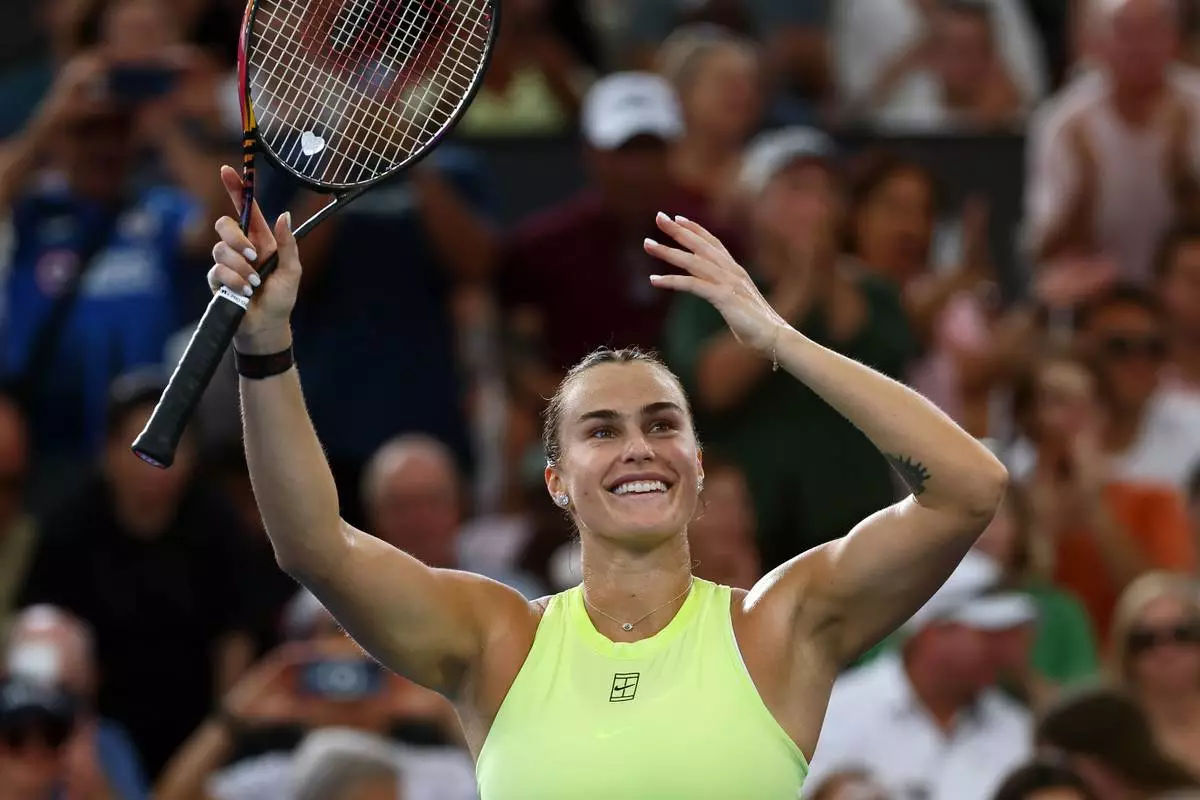
Aryna Sabalenka of Belarus waves to the crowd after winning the women's final match against Marta Kostyuk of Ukraine 6-4, 6-3, at the Brisbane International tennis tournament in Brisbane, Australia, Sunday, Jan. 11, 2026. (AP Photo/Tertius Pickard)

Aryna Sabalenka of Belarus waves to the crowd after winning the women's final match against Marta Kostyuk of Ukraine 6-4, 6-3, at the Brisbane International tennis tournament in Brisbane, Australia, Sunday, Jan. 11, 2026. (AP Photo/Tertius Pickard)

Recommended Articles