MELBOURNE, Australia (AP) — Get ready for the 2026 Australian Open with a guide that tells you everything you need to know about how to watch the first Grand Slam tennis tournament of the season on TV, who the defending champions are, what the schedule is and more:
Singles play begins next Sunday at 11 a.m. local time (7 p.m. Saturday EST) around the grounds, with the first match in Rod Laver Arena scheduled to begin at 11:30 a.m. (7:30 p.m. Saturday EST).
— In the U.S.: ESPN and Tennis Channel
— Other countries are listed here
Madison Keys of the United States and Jannik Sinner of Italy won the 2025 singles trophies. Keys beat No. 1-ranked Aryna Sabalenka 6-3, 2-6, 7-5 for her first Grand Slam trophy. Sinner beat Alexander Zverev 6-3, 7-6 (4), 6-3 to successfully defend his title at Melbourne Park.
Sabalenka will be the top-seeded woman and Carlos Alcaraz the top-seeded man. They currently are ranked No. 1, and the tournament seedings usually follow the WTA and ATP rankings.
Sabalenka is the money-line favorite to win the women’s singles trophy, according to BetMGM Sportsbook. The two-time champion is listed at +175, with Iga Swiatek next at +450. Coco Gauff is the third choice at +600. Sinner is the favorite to grab a third consecutive men’s championship at -125, ahead of Alcaraz (+160), with a big drop-off to third choice Novak Djokovic (+900).
The Australian Open is played outdoors on hard courts at Melbourne Park, located along the Yarra River near downtown Melbourne. There are retractable roofs at Rod Laver Arena, Margaret Court Arena and John Cain Arena. Women play best-of-three-set matches with a first-to-10, win-by-two tiebreaker at 6-all in the third; men play best-of-five with a tiebreaker at 6-all in the fifth. Like at the U.S. Open and French Open, there are night sessions. The tournament is staged each year around the last two weeks of January, during the school summer break Down Under.
The Australian Open is introducing “opening week” where the Melbourne Park precinct is open to the public from the start of the qualifying tournament, and live music will be staged every night at Grand Slam Oval. Fans can watch open practice sessions in Rod Laver Arena to see some of the sport's biggest names preparing for the first major of the year. Organizers are also expanding the so-called 1 Point Slam in the opening week, where 22 professional players and 10 amateurs get the chance to play for 1 million Australian dollars in prize money.
First round of qualifying for the men's and women's singles.
— Jan. 18-19-20: First Round (Women and Men)
— Jan. 21-22: Second Round (Women and Men)
— Jan. 23-24: Third Round (Women and Men)
— Jan. 25-26: Fourth Round (Women and Men)
— Jan. 27-28: Quarterfinals (Women and Men)
— Jan. 29: Women’s Semifinals
— Jan. 30: Men’s Semifinals
— Jan. 31: Women’s Final
— Feb. 1: Men’s Final
— Top-ranked Aryna Sabalenka describes the season schedule as ‘insane’
— Coco Gauff adds some context on the 'worst' fans
— Novak Djokovic is cutting ties with the Professional Tennis Players Association
— Venus Williams gets a wild-card entry for the Australian Open, at age 45
— Carlos Alcaraz ends his 7-year partnership with coach Juan Carlos Ferrero
— The ATP is adding a heat rule like the one the women have had for 30 years
— Nick Kyrgios will play doubles but not singles at the Australian Open
Australian Open prize money has increased by 16% from last year to a record total in local currency of 111.5 million Australian dollars ($75 million). That was up from 96.5 million Australian dollars in 2025. The women’s and men’s singles champions will win 4.15 million Australian dollars ($2.8 million), a 19% increase from last year.
AP tennis: https://apnews.com/hub/tennis

Aryna Sabalenka of Belarus waves to the crowd after winning the women's final match against Marta Kostyuk of Ukraine 6-4, 6-3, at the Brisbane International tennis tournament in Brisbane, Australia, Sunday, Jan. 11, 2026. (AP Photo/Tertius Pickard)
The economy, inflation and how those forces could impact the lives of Americans were front and center over the past week. Trips to the grocery store or gas station are more painful than they were last year, and that is impacting the decisions of both households and businesses.
Here’s a snapshot of prominent economic data and news that occurred over the past week and what it potentially means for you.
The average long-term U.S. mortgage rate climbed this week to its highest level in nearly nine months, driving up borrowing costs for homebuyers during what’s traditionally the housing market’s busiest time of the year.
The benchmark 30-year fixed rate mortgage rate rose to 6.51% from 6.36% last week, mortgage buyer Freddie Mac said Thursday. Despite the sharp increase, the average rate remains below 6.86%, where it was a year ago.
Rates have been mostly trending higher since the war with Iran began. The closure of the Strait of Hormuz has roiled energy markets, sending crude oil prices sharply higher — a key driver of inflation.
Expectations of higher oil prices and worries about big and growing debts for the U.S. government and others have pushed up long-term bond yields, causing mortgage rates to head higher.
U.S. retailers have spent months navigating an uncertain economic environment, from President Donald Trump’s tariffs to the impact of soaring gasoline prices due to the Iran war. The average price for a gallon of regular gasoline rose again this week, ending at about $4.55 per gallon on Friday, according to AAA. Gasoline prices are about 45% above where they were at this time last year.
Based on quarterly financial reports from Walmart, Target, Home Depot, Lowe’s and TJX, shoppers are cautious but still spending, helped by more generous tax refunds. Yet there is a widespread belief among economists that once those refunds dry up, shoppers will pull back on spending. Consumer spending is the dominant economic engine for the U.S., and retreat would have broad implications for the U.S.
Walmart issued a forecast for the current quarter on Thursday that was weaker than what Wall Street had been expecting. Target raised its annual revenue outlook on Wednesday, saying it expected momentum to continue the rest of the year. Yet the upgraded sales expectations were still below the pace of the first quarter.
Fewer Americans filed for jobless aid last week as layoffs remain low despite a number of uncertainties that continue to cloud the economy.
U.S. applications for unemployment benefits for the week ending May 16 fell by 3,000 to 209,000, the Labor Department reported Thursday. That’s fewer than the 213,000 new applications analysts surveyed by the data firm FactSet had forecast.
Weekly filings for unemployment benefits are considered a proxy for U.S. layoffs and are close to a real-time indicator of the health of the job market.
Despite historically low layoffs, the labor market appears to be stuck in what economists call a “low-hire, low-fire” state. That’s kept the unemployment rate low at 4.3%, but left many of those out of work struggling to find new employment.
The split between Wall Street and most U.S. households grew even wider Friday, as U.S. stocks rose toward the finish of an eighth straight winning week, their longest such streak since 2023. That’s even though a survey showed on the same day that U.S. consumers are feeling worse about the economy.
Shares of Workday and Zoom Communications rose after both delivered better profit reports for the latest quarter than analysts expected.
They’re the latest companies to top analysts’ expectations for profits for the start of 2026. And the cavalcade of such reports has helped U.S. stocks remain near their records. Stock prices tend to follow the path of corporate profits over the long term.
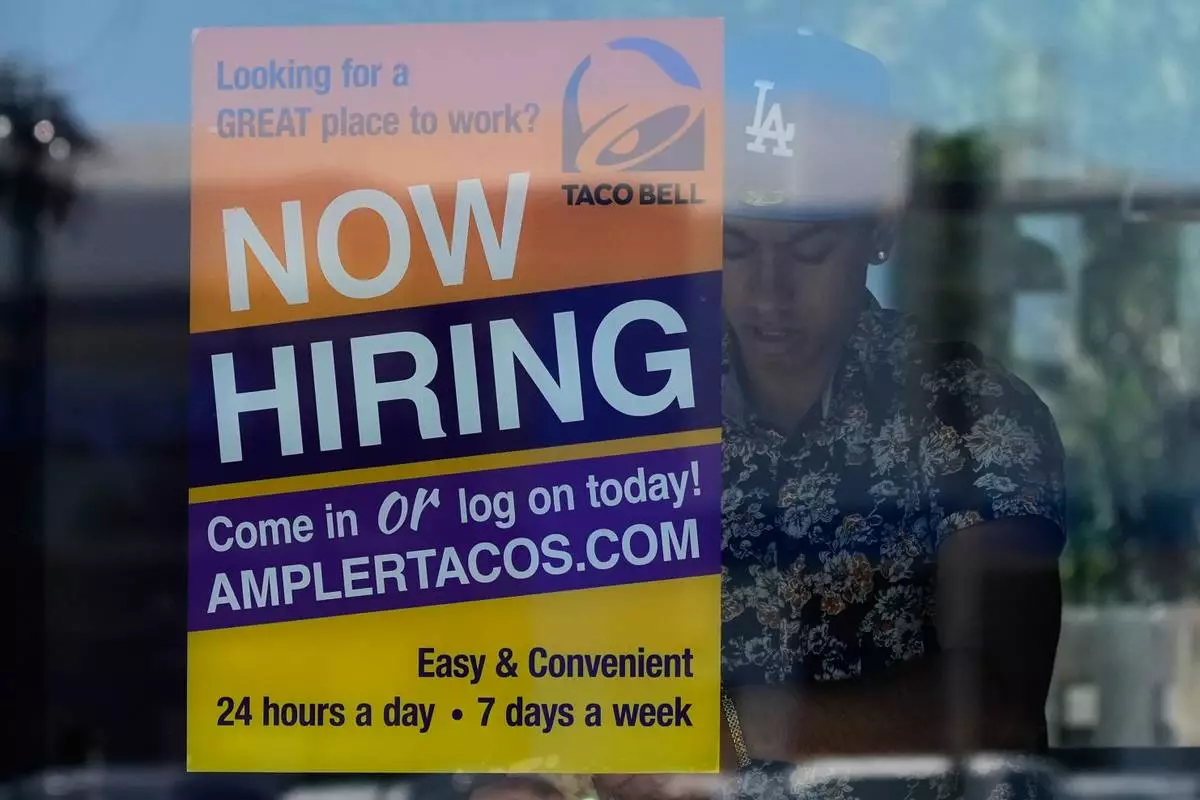
A hiring sign is displayed at a restaurant in Niles, Ill., Thursday, May 14, 2026. (AP Photo/Nam Y. Huh)

Drones operated by Zipline leave base to make deliveries from a Walmart store in Pea Ridge, Ark., Friday, Sept. 26, 2025. (AP Photo/Charlie Riedel)

Options trader Anthony Spina works on the floor of the New York Stock Exchange, Friday, May 22, 2026. (AP Photo/Richard Drew)

Trader Robert Arciero works on the floor of the New York Stock Exchange, Friday, May 22, 2026. (AP Photo/Richard Drew)