Skip to Content Facebook Feature Image

Killings of teens spark UK debate over rising knife crime

News

Killings of teens spark UK debate over rising knife crime
News

News

Killings of teens spark UK debate over rising knife crime

2019-03-05 22:11 Last Updated At:22:20

Jodie Chesney was a keen Explorer Scout. Yousef Makki wanted to be a surgeon.

The two 17-year-olds were stabbed to death on the same weekend in different parts of England, plunging friends and families into grief and igniting an intense political debate about why so many young people in Britain are being killed — and who is to blame.

"How many more?" asked the Daily Mail on Tuesday alongside photos of 27 teenagers who have been stabbed to death in the past year. The Daily Mirror pointed the finger at Prime Minister Theresa May: "How many more, Mrs. May?"
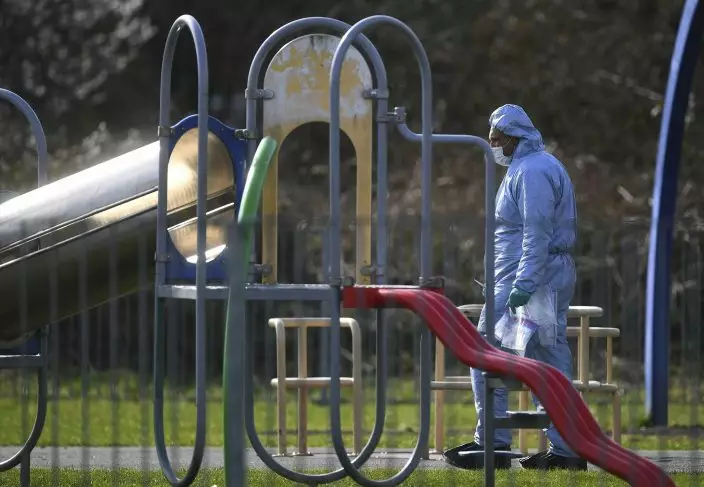
Police forensic officers at the scene in east London, Saturday March 2, 2019, following the fatal stabbing of a 17-year-old girl on Friday night.  Two 17-year-olds were stabbed to death last weekend in different parts of England, plunging families into grief and igniting an intense debate, published in Britain's news media Tuesday March 5, 2019, about why so many young people are dying, and who is to blame.(Victoria JonesPA via AP)

Police forensic officers at the scene in east London, Saturday March 2, 2019, following the fatal stabbing of a 17-year-old girl on Friday night. Two 17-year-olds were stabbed to death last weekend in different parts of England, plunging families into grief and igniting an intense debate, published in Britain's news media Tuesday March 5, 2019, about why so many young people are dying, and who is to blame.(Victoria JonesPA via AP)

After falling for a decade, knife crime is on the rise in Britain. There were 285 knife murders in England and Wales in the year to March 2018, the highest number since comparable records began in 1946. The number of people admitted to hospitals with blade injuries rose 8 percent from the year before.

Knives are the most common murder weapon in the U.K., where guns are tightly restricted. About 40 percent of murder victims were stabbed to death last year, while only 4 percent were shot.

Both the causes of the crime wave and its solutions are hotly disputed. Police leaders and opposition politicians blame years of public spending cuts by the Conservative-led government, which has slashed funding to police by almost 20 percent since 2010, leading to 20,000 fewer officers on the streets.
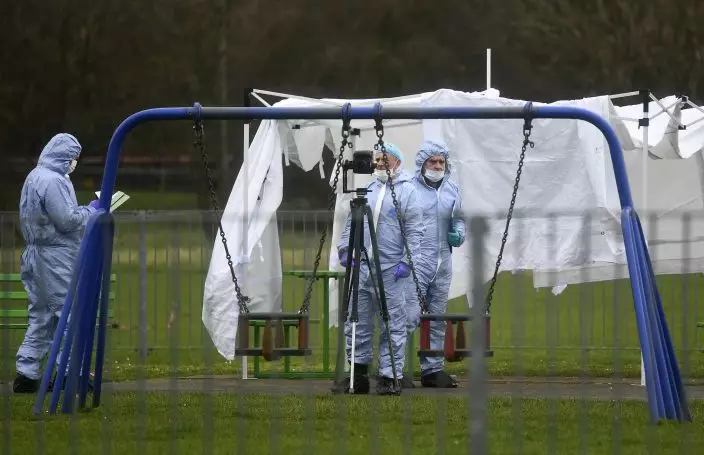
Police forensic officers at the scene in east London Saturday March 2, 2019, following the fatal stabbing of a 17-year-old girl on Friday night.  Two 17-year-olds were stabbed to death last weekend in different parts of England, plunging families into grief and igniting an intense debate published in Britain's news media Tuesday March 5, 2019, about why so many young people are dying, and who is to blame.(Victoria JonesPA via AP)

Police forensic officers at the scene in east London Saturday March 2, 2019, following the fatal stabbing of a 17-year-old girl on Friday night. Two 17-year-olds were stabbed to death last weekend in different parts of England, plunging families into grief and igniting an intense debate published in Britain's news media Tuesday March 5, 2019, about why so many young people are dying, and who is to blame.(Victoria JonesPA via AP)

Government cuts to local budgets also mean there are fewer youth programs and after-school activities and worse mental health services for young people in many areas.

"Of course there's a link between youth centers having massive cuts, mental health services having massive cuts, schools having massive cuts, children's services having massive cuts and young people having less constructive things to do," said London Mayor Sadiq Khan, a member of the opposition Labour Party.

"The government needs to wake up, reverse these cuts to our police — but also our preventative services too," he told Sky News.

The government denies austerity is to blame. May insisted Monday there was "no direct correlation between certain crimes and police numbers."

She was contradicted by Britain's most senior police officer, who said "of course there is" a link between crime levels and police numbers.

"In the last few years police officer numbers have gone down a lot, there's been a lot of other cuts in public services, there has been more demand for policing and therefore there must be something," Metropolitan Police chief Cressida Dick told radio station LBC.

Experts say rising crime can't be blamed solely on government cuts. Police and community workers say the surge in violence is partly driven by battles over control of the illegal drug trade. Social media plays a role in escalating disputes from online threats into real-life violence.

In London, authorities recently set up a Violence Reduction Unit, which treats violence as a public health issue, rather than simply as a law-and-order problem. It brings together police, health workers, probation staff and community groups, seeking to identify potential perpetrators and victims and tried to steer them away from crime.

London's approach is modeled on a program introduced in the early 2000s in Glasgow, Scotland, which managed to reduce murders in the city by almost half.

It's a long-term approach whose results may not be clear for years. Meanwhile, the families of the latest victims await justice.

Two teens have been arrested over the death of Makki, who was stabbed in the street Saturday in a wealthy commuter village on the edge of Manchester. They have not been charged.

Police have not made any arrests in connection with the killing of Chesney, who was stabbed in the back Friday evening as she sat on a park bench with friends in an eastern suburb of London.

Some in Britain are calling for longer sentences for knife crimes, which have already been toughened in recent years. Merely carrying a bladed weapon can bring a four-year prison sentence.

"My argument is build more prisons — we need to have a consequence," said John Apter, national chairman of police officers' union the Police Federation of England and Wales.

But Tim Bateman, an expert in youth justice at the University of Bedfordshire, said a "getting tough" approach would likely be counterproductive.

"Young people in particular tend not to think through the consequences of their actions, so responses that that rely on deterrence simply don't work," he said.

Follow Jill Lawless on Twitter at http://Twitter.com/JillLawless
WASHINGTON (AP) — U.S. forces boarded another oil tanker in the Caribbean Sea on Friday, the U.S. military said, as the Trump administration targets sanctioned tankers traveling to and from Venezuela as part of a broader effort to take control of the South American country's oil.

The predawn raid was carried out by Marines and Navy sailors launched from the aircraft carrier USS Gerald R. Ford, part of the extensive force the U.S. has built up in the Caribbean in recent months, according to U.S. Southern Command, which declared “there is no safe haven for criminals” as it announced the seizure of the tanker called the Olina. The Coast Guard then took control of the vessel, officials said.

Southern Command and Homeland Security Secretary Kristi Noem both posted unclassified footage on social media Friday morning of a U.S. helicopter landing on the vessel and U.S. personnel conducting a search of the deck and tossing what appeared to be an explosive device in front of a door leading to inside the ship.

In her post, Noem said the ship was “another ‘ghost fleet’ tanker ship suspected of carrying embargoed oil” and it had departed Venezuela “attempting to evade U.S. forces."

The Olina is the fifth tanker that has been seized by U.S. forces as part of the effort by President Donald Trump’s administration to control the production, refining and global distribution of Venezuela’s oil products, and the third since the U.S. ouster of Venezuela President Nicolás Maduro in a surprise nighttime raid.

In a post on his social media network later in the day, Trump said the seizure was conducted “in coordination with the Interim Authorities of Venezuela” but offered no elaboration.

The White House did not immediately respond to requests for more details.

Venezuela’s government acknowledged in a statement that it was working with U.S. authorities to return the tanker, “which set sail without payment or authorization from the Venezuelan authorities,” to the South American nation.

“Thanks to this first successful joint operation, the ship is sailing back to Venezuelan waters for its protection and relevant actions,” according to the statement.

Samir Madani, co-founder of TankerTrackers.com, said his organization used satellite imagery and surface-level photos to document that at least 16 tankers left the Venezuelan coast in contravention of the quarantine U.S. forces have set up to block sanctioned ships from conducting trade. The Olina was among that flotilla.

U.S. government records show that the Olina was sanctioned for moving Russian oil under its prior name, Minerva M, and flagged in Panama.

While records show the Olina is now flying the flag of Timor-Leste, it is listed in the international shipping registry as having a false flag, meaning the registration it is claiming is not valid. In July, the owner and manager of the ship on its registration was changed to a company in Hong Kong.

According to ship tracking databases, the Olina last transmitted its location in November in the Caribbean, north of the Venezuelan coast. Since then, however, the ship has been running dark with its location beacon turned off.

While Noem and the military framed the seizure as part of an effort to enforce the law, other officials in the Trump administration have made clear they see it as a way to generate cash as they seek to rebuild Venezuela's battered oil industry and restore its economy.

In an early morning social media post, Trump said the U.S. and Venezuela “are working well together, especially as it pertains to rebuilding, in a much bigger, better, and more modern form, their oil and gas infrastructure.”

The administration said it expects to sell 30 million to 50 million barrels of sanctioned Venezuelan oil, with the proceeds to go to both the U.S. and Venezuelan people. But the president expects the arrangement to continue indefinitely. He met Friday with executives from oil companies to discuss his goal of investing $100 billion in Venezuela to repair and upgrade its oil production and distribution.

Vice President JD Vance told Fox News this week that the U.S. can “control” Venezuela’s “purse strings” by dictating where its oil can be sold.

Madani estimated that the Olina is loaded with 707,000 barrels of oil, which at the current market price of about $60 a barrel would be worth more than $42 million.

Associated Press writers Dánica Coto in San Juan, Puerto Rico, Josh Boak in Washington, and Regina Garcia Cano in Caracas, Venezuela, contributed to this report.

This story has been corrected to reflect that the United States has seized three tankers, not five, since Nicolás Maduro was ousted as Venezuela’s president.

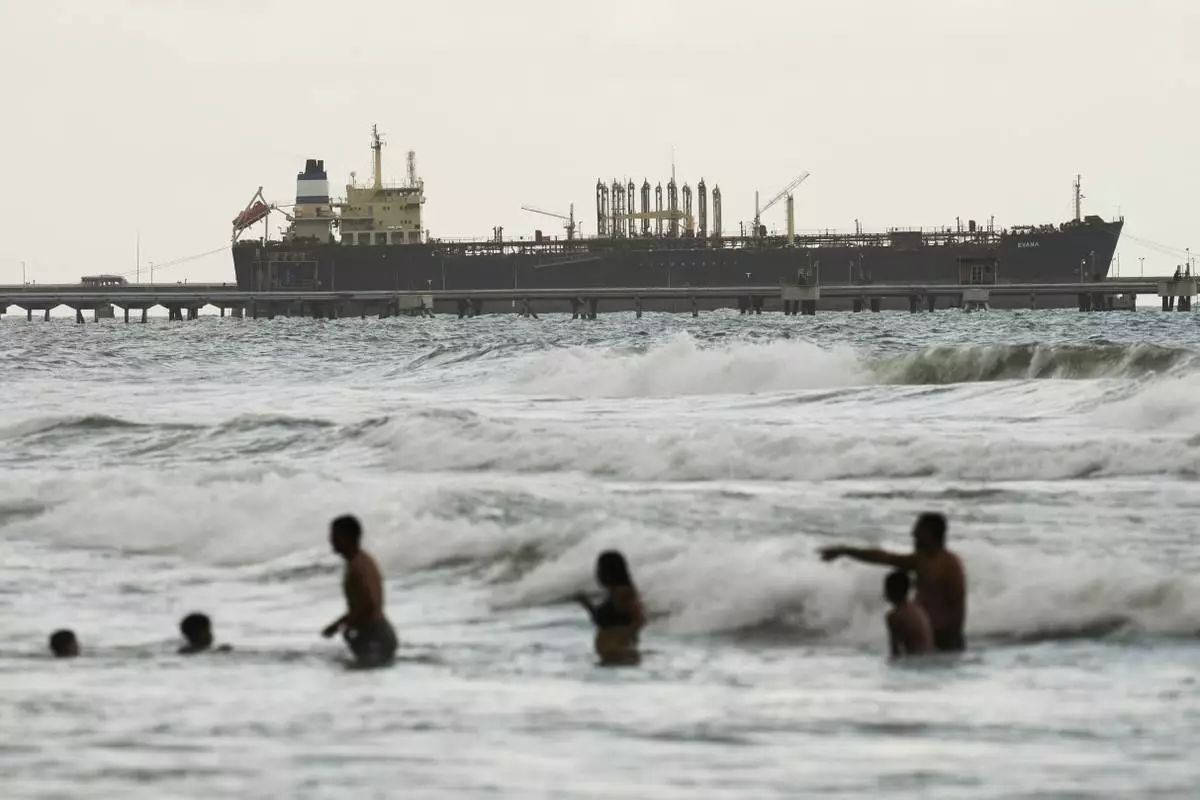
FILE - Evana, an oil tanker, is docked at El Palito Port in Puerto Cabello, Venezuela, Dec. 21, 2025. The U.S. military says U.S. forces have boarded another oil tanker in the Caribbean Sea. The Olina is the fifth tanker seized by U.S. forces. (AP Photo/Matias Delacroix, File)

FILE - Evana, an oil tanker, is docked at El Palito Port in Puerto Cabello, Venezuela, Dec. 21, 2025. The U.S. military says U.S. forces have boarded another oil tanker in the Caribbean Sea. The Olina is the fifth tanker seized by U.S. forces. (AP Photo/Matias Delacroix, File)

Recommended Articles