
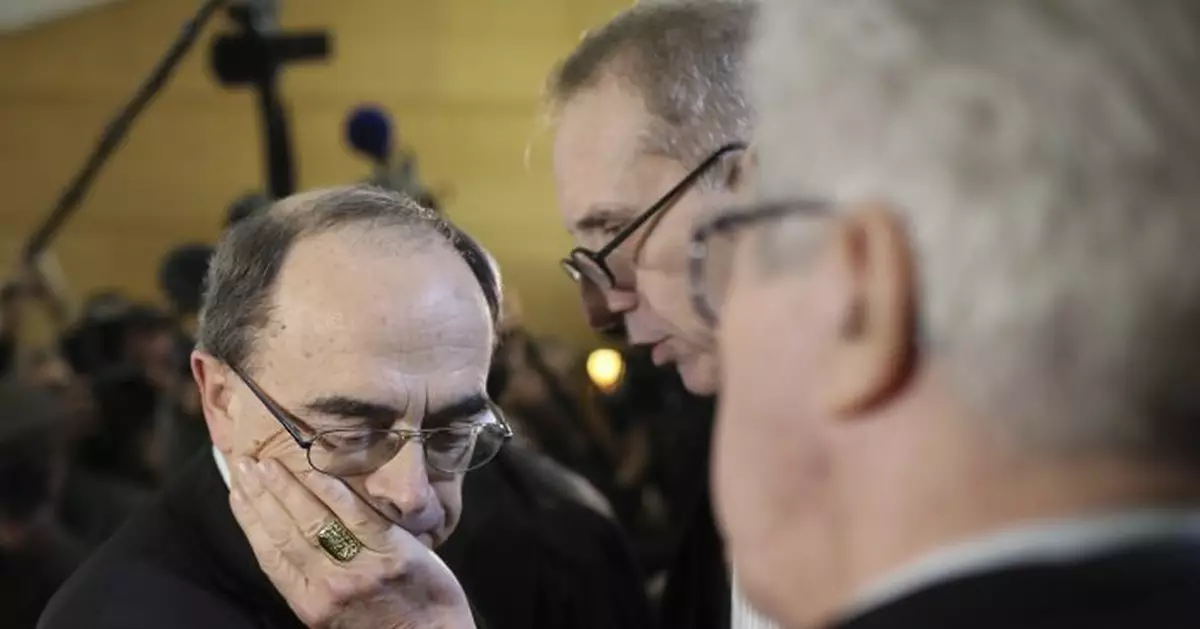
The Latest on a church sex abuse trial in France (all times local):
10:15 a.m.
A French court has found top Catholic official Cardinal Philippe Barbarin guilty for failing to report to justice accusations against a pedophile priest.
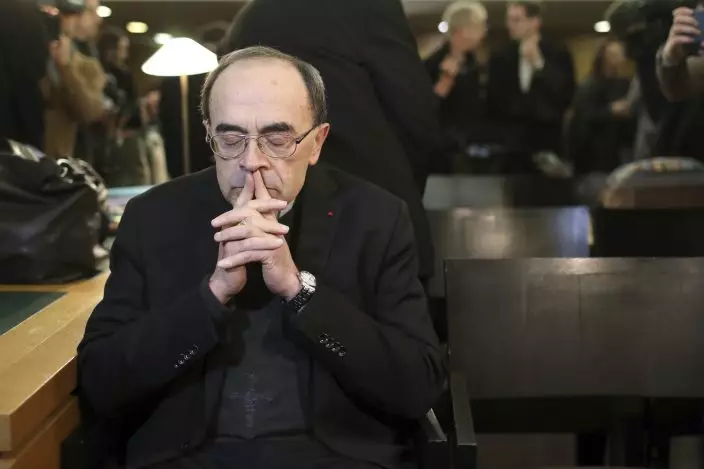
FILE - In this Jan. 7, 2019 file photo, French Cardinal Philippe Barbarin waits for the start of his trial at the Lyon courthouse, central France. Pope. A French court on Thursday March 7, 2019 is expected to acquit a cardinal and five other defendants accused of protecting a pedophile priest, but alleged victims say France's most important church sex abuse trial has at least allowed them to bring the affair into the open. (AP PhotoLaurent Cipriani, File)
In a surprise decision Thursday in France's most important church sex abuse trial, the Lyon court handed Barbarin a six-month suspended prison sentence for not reporting the facts in the period between July 2014 and June 2015.
The Rev. Bernard Preynat's alleged victims said Barbarin and other church officials covered up for him for years, but the statute of limitations had expired on some charges and even the victims had expected that the cardinal would be acquitted.
The prosecutor had also argued against convicting, saying there were no grounds to prove legal wrongdoing.
The priest has confessed to abusing Boy Scouts in the 1970s and 80s and will be tried separately.
8:45 a.m.
A French court is expected to acquit a cardinal and five other defendants accused of protecting a pedophile priest at the end of France's most important church sex abuse trial.
The Lyon court will deliver its verdict on Thursday morning.
The Rev. Bernard Preynat's alleged victims said church hierarchy covered up for him for years. But by the time the four-day trial reached court in Lyon last January, the statute of limitations had expired on some charges.
Even the prosecutor argued against convicting Cardinal Philippe Barbarin and other church officials, saying there were no grounds to prove legal wrongdoing.
Barbarin faces up to three years in prison and fines if convicted.
The priest has confessed to abusing Boy Scouts in the 1970s and 80s and will be tried separately.
BRUSSELS (AP) — European Commission President Ursula von der Leyen said on Friday that she will start to “provisionally implement” a massive trade deal with the Mercosur bloc of nations in South America despite not having approval from European Parliament.
The trans-Atlantic trade deal is expected to create one of the world’s largest free trade zones covering more than 700 million people. Trade between the two tops 110 billion euro ($129 billion) and accounts for a quarter of global gross domestic product.
However, the deal has faced heavy criticism from Europe’s agriculture sector and environmentalists — and will likely tough resistance by elected representatives in the European Parliament.
For now, von der Leyen's move means she is basically sidestepping those lawmakers.
“When they are ready, we are ready,” von der Leyen said, referring to the EU lawmakers without whose approval the agreement cannot be concluded. With backing from Europe leaders, she said the Commission will “provisionally implement the agreement” after Uruguay and Argentina ratified the EU-Mercosur trade deal on Thursday.
French President Emmanuel Macron slammed the move in remarks to reporters in Paris.
″For France, it’s a surprise. A bad surprise," he said. "And for the European Parliament, it’s bad manners.″
Macron said he would work to make sure hard-won protections for farmers and health would be respected in the roll-out.
″We will be uncompromising on the respect for these rules," he said, including heightened surveillance of sensitive sectors, safeguard clauses, mirror clauses notably for pesticides, and tightened sanitary rules in third countries.
″I will never defend a deal that is lax on what we import and tough on what we produce at home, because that is inconsistent toward European consumers, and it is criminal for European sovereignty," Macron said.
The deal comes in the wake of global trade shocks from the tariffs imposed by the United States and the throttling of critical mineral supplies from China that pushed the 27-nation EU to forge a raft of free trade deals across the world.
Both Spain and Germany, backers of the trade deal, praised Leyen's move.
German's foreign minister Johann Wadephul said in a social media post that with Mercosur deal's implementation, “companies & people from both continents can finally benefit from more prosperity & growth. Germany will work tirelessly to help tap the full potential of this historic agreement.”
Carlos Cuerpo, Spain’s economy minister, said that “in an increasingly uncertain world, Europe cannot afford to fall behind. The Mercosur agreement is a major step in European Union’s roadmap to become more independent and resilient.”
Along with Macron's remarks, other critics were also swift to condemn von der Leyen's move.
“Applying the trade deal now, without the Court’s opinion and without MEPs’ consent, would trample over the democratic processes," said an open letter signed by 171 environmental, labor and agricultural groups in Europe and South America which called von der Leyen's provisional implementation a “democratic scandal.”
“At a time when many in our society feel sidelined and are losing faith in political processes, opting for provisional application would be profoundly anti-democratic and would risk inflaming tensions within EU countries as well as between them.”
Von der Leyen is likely to shrug off such criticism as she has in the past to advance a deal she describes as vital for the EU's survival in a newly disordered world.
“This is about resilience, this is about growth, and Europe shaping its own future," von der Leyen said at a news conference. No questions were allowed.
“Our businesses, our workers, and our citizens will reap the benefits, and they should reap them as soon as possible," she added. “Mercosur embodies the spirit in which Europe is acting on the global scene."
She also acknowledged that the “agreement can only be fully concluded once the European Parliament has given its consent” and said the commission would “continue closely with all EU institutions, member states, and stakeholders to ensure a smooth and transparent process.”
European lawmakers voted in January to challenge the deal at the European Court of Justice, which could delay it for years or even derail it.
Even without any obstacles from that court or the parliament, the deal could still take months for the deal to go into effect.
Associated Press writers Angela Charlton in Paris, Geir Moulson in Berlin, and Suman Naishadham in Madrid contributed to this report.
European Commission President Ursula von der Leyen prepares to address the audience during a high level event on the Eastern Border Regions Strategy at EU headquarters in Brussels, Thursday, Feb. 26, 2026. (AP Photo/Virginia Mayo)