
Skip to Content Facebook Feature Image

New US military budget focused on China despite border talk

News

New US military budget focused on China despite border talk
News

News

New US military budget focused on China despite border talk

2019-03-16 12:52 Last Updated At:13:00

Chinese bombers. Chinese hypersonic missiles. Chinese cyberattacks. Chinese anti-satellite weapons.

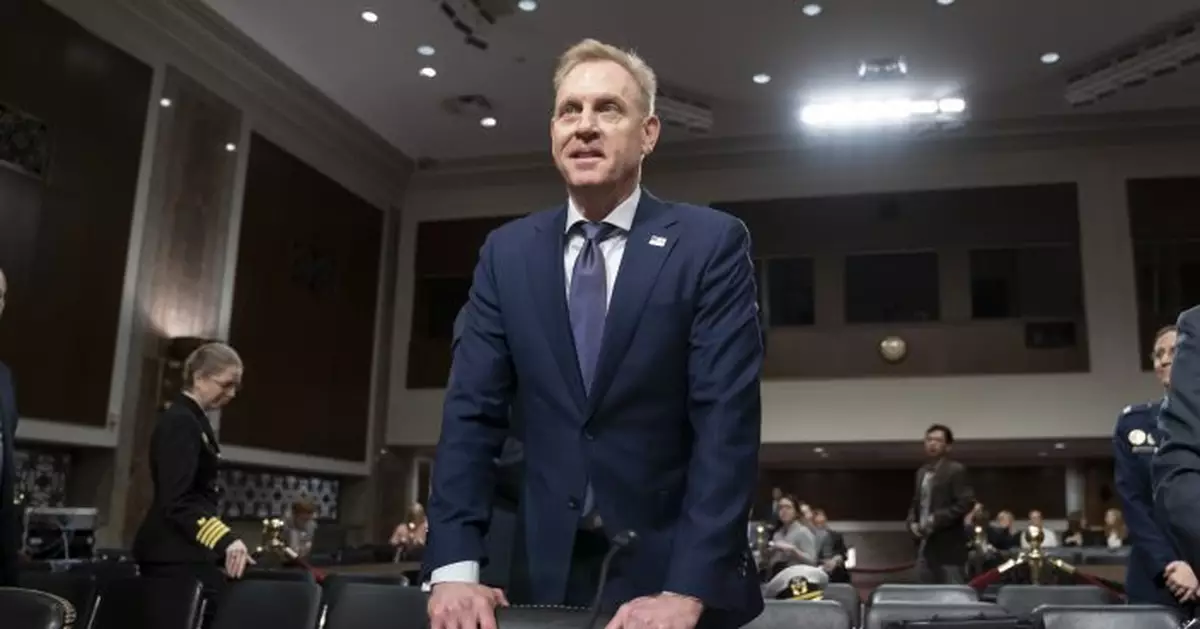
To a remarkable degree, the 2020 Pentagon budget proposal is shaped by national security threats that Acting Defense Secretary Patrick Shanahan has summarized in three words: "China, China, China."

The U.S. is still fighting small wars against Islamic extremists, and Russia remains a serious concern, but Shanahan seeks to shift the military's main focus to what he considers the more pressing security problem of a rapidly growing Chinese military.

This theme, which Shanahan outlined Thursday in presenting the administration's proposed 2020 defense budget to the Senate Armed Services Committee, is competing for attention with narrower, more immediate problems like President Donald Trump's effort to use the military to build a border wall.

The hearing, for example, spent more time on the wall and prospects for using military funds to build parts of it than on any aspect of foreign policy, including the conflict in Syria or military competition with China, Russia or North Korea.

Shanahan is hardly the first defense chief to worry about China. Several predecessors pursued what the Obama administration called a "pivot" to the Pacific, with China in mind. But Shanahan sees it as an increasingly urgent problem that exceeds traditional measures of military strength and transcends partisan priorities.

"We've been ignoring the problem for too long," Shanahan told a senator.

"China is aggressively modernizing its military, systematically stealing science and technology, and seeking military advantage through a strategy of military-civil fusion," he wrote in prepared testimony to the committee, which is considering a $718 billion Pentagon budget designed in part to counter China's momentum.

The $25 billion the Pentagon is proposing to spend on nuclear weapons in 2020, for example, is meant in part to stay ahead of China's nuclear arsenal, which is much smaller than America's but growing. Shanahan said China is developing a nuclear-capable long-range bomber that, if successful, would enable China to join the United States and Russia as the only nations with air-, sea- and land-based nuclear weapons.

Shanahan ticked off a list of other Chinese advancements — hypersonic missiles against which the U.S. has limited defenses; space launches and other space efforts that could enable it to fight wars in space; "systematically stealing" of U.S. and allied technology, and militarizing land features in the South China Sea.

Bonnie S. Glaser, director of the China Power Project at the Center for Strategic and International Studies, says the U.S. has been lacking effective strategies for competing with China on a broad scale.

"It is overdue," she said of the Shanahan focus. "We have been somewhat slow in catching up" in such areas as denying China its regional ambitions, including efforts to fully control the South China Sea, which is contested by several other countries.

Some defense analysts think Shanahan and the Pentagon have inflated the China threat.

"I do think it's worth asking what exactly is threatening about China's behavior," said Christopher Preble, vice president for defense and foreign policy studies at the Cato Institute. He doesn't discount China as a security issue, including in the South China Sea, but doubts the U.S. military is the institution best suited to deal with such non-military problems as cyber intrusions into American commercial networks.

In Preble's view, competition with the Chinese is not mainly military. "I still don't believe the nature of the threat is quite as grave as we're led to believe" by the Pentagon, he said. "They tend to exaggerate the nature of the threat today."

In his previous role as deputy defense secretary, Shanahan and President Donald Trump's first defense secretary, Jim Mattis, crafted a national defense strategy that put China at the top of the list of problems.

"As China continues its economic and military ascendance, asserting power through an all-of-nation long-term strategy, it will continue to pursue a military modernization program that seeks Indo-Pacific regional hegemony in the near-term and displacement of the United States to achieve global pre-eminence in the future," that strategy document says.

That explains in part why the U.S. is spending billions more on space, including means of defending satellites against potential Chinese attack, and on building hypersonic missiles to stay ahead of Chinese and Russian hypersonic weapons development.

It also explains some of the thinking behind preparing for an early retirement of the USS Harry Truman aircraft carrier, a strategy that views carriers as a less relevant asset in a future armed conflict involving China.

This concern about countering China has permeated the entire U.S. military. Gen. Thomas Waldhauser, head of U.S. Africa Command, said last month that dozens of African heads of state were invited to Beijing last fall to consider billions in Chinese loans and grants, and that China is building thousands of miles of railroads in Africa, mostly linked to Chinese mineral extraction operations.

"They're heavily invested and heavily involved" in Africa, he said.

The top U.S. commander in Europe told Congress this week that China also is making inroads in Europe.

"China is looking to secure access to strategic geographic locations and economic sectors through financial stakes in ports, airlines, hotels, and utility providers, while providing a source of capital for struggling European economies," Gen. Curtis Scaparrotti said.

It has never been unusual for the leader of the host country to show up for one of the biggest moments of soccer's World Cup — the gala where the team pairings are revealed.

What made President Donald Trump’s appearance this month different was the “FIFA Peace Prize.” The newly created honor by the sport's international federation was, to no one's surprise, presented to Trump, who'd been angling for a far more prestigious award — the Nobel Peace Prize.

Trump hovering over soccer’s international spectacle was a fitting moment in a cycle that shifted into overdrive in 2025: The U.S. president, with the help of some U.S. politicians and many sports leaders, took unprecedented steps to bend sports to his own worldview.

“I think sports is one fundamental example of Trump’s belief that he’s in charge of everything,” said David Niven, who teaches a “Sports and Politics” course at the University of Cincinnati.

Though the Trump administration’s policies on immigration, transgender issues and more have repercussions in many areas, all veered into the games people play, and watch, in 2025.

Next year's World Cup and the 2028 Los Angeles Olympics — sports events that tout their ability to bring the world together — will be scrutinized for whether they accomplish that goal in a country that has become less welcoming.

In one example, an executive order Trump signed soon after taking office seeks to reduce opportunities for transgender athletes.

In another, U.S. Immigration and Customs Enforcement has ramped up activity, leading to more than 605,000 deportations since Trump's first day in office, according to the administration.

“Fans, whenever you have a major soccer event, they’ll show up and support their team,” said Louis Moore, a Michigan State professor who teaches about sports in society. He said he suspects ICE will be at some of the venues “and I just hope that FIFA has the backbone to have something worked out where you could protect players and fans.”

Whether ICE shows up at World Cup games is an open question. But the White House has been sending mixed messages that could have an impact on athletes and fans coming to America for these international sports events.

On one hand, the administration has touted the creation of a “FIFA Pass,” designed to allow ticketholders to get expedited appointments for their visas. On the other, it recently announced expansion of travel bans and immigration restrictions — some targeting countries taking part in the World Cup — in reaction to the shooting of two National Guard members in Washington last month.

The debate over transgender athletes was a touchstone cultural issue that helped Trump win last year’s election.

Early in his term, Trump signed an executive order, “Keeping Men Out of Women’s Sports,” empowering federal agencies to ensure schools receiving federal funding comply with the administration’s reading of Title IX, which interprets “sex” as the gender a person was assigned at birth.

The day after Trump signed his order, the NCAA amended its own rules to adhere to the administration’s guidance.

“President Trump’s order provides a clear, national standard,” said NCAA President Charlie Baker, a former Massachusetts governor.

Several months later, and with no fanfare, the U.S. Olympic and Paralympic Committee (USOPC) changed its policy to conform with Trump’s. It was a move Olympic legal expert Jill Pilgrim said was backed by a “well-reasoned set of arguments."

"But I’d be pretty shocked if this doesn’t get challenged” in court, Pilgrim said.

All the while, key leaders took pains to stay on Trump's good side.

Though some believe it violated FIFA's own requirements to be politically neutral, the FIFA Peace Prize afforded an excuse for its president, Gianni Infantino, to lavish praise on Trump, who has the ability to make life easy or incredibly awkward for the sport when it comes to the United States next year.

While soccer gave a trophy to Trump, U.S. Olympic leaders used a White House ceremony this summer to present him with a set of medals from the 1984 Olympics — the last time they were held in Los Angeles.

It was part of an event attended by LA28 and USOPC leaders Casey Wasserman and Gene Sykes during which Trump signed an executive order creating an Olympic “task force."

Though the task force is charged with overseeing functions the government would normally provide for the Olympics anyway — like security and visa processing — this gave Trump a chance to take credit for it while bringing Wasserman and Sykes to the White House to thank him.

It made for some awkwardness when Trump asked a silent room for applause after thanking Sykes for the USOPC’s move on the transgender policy.

“Some of this is almost to the point of parody,” said Niven, the Cincinnati professor. “They’re just shiny things that are in front of him at a given moment.”

Also over the summer, Trump was a specially invited guest of the PGA of America at one of its biggest events, the Ryder Cup — a Europe vs. USA golf tournament held outside New York.

The invitation came some three years after the PGA removed the 2022 PGA Championship from one of Trump's golf courses, saying hosting there would be “detrimental to the brand" in the wake of the Jan. 6, 2021, attacks on Congress.

In addition to his rift with the PGA, Trump supported LIV Golf — the Saudi-backed league that caused a rupture in the sport after dangling nine-figure salaries to lure many of its top players. Early in 2025, Trump held a White House meeting to try to make peace.

Though nothing came of that meeting, both that and his appearance at the Ryder Cup marked his symbolic return into the fold of the sport he cares about most.

If there was lingering resentment among the players during the Ryder Cup's emotionally charged week, it was not perceptible — they took pains to call it an honor to have Trump there, while treading nowhere near politics.

College sports is one area testing the limits of Trump’s influence, though that hasn't kept him from trying.

The “Saving College Sports” executive order Trump signed in July was a sweeping document that, among other things, ordered labor officials to clarify whether college athletes can be considered employees of their schools.

For the NCAA, the answer is a hard no. It also seeks antitrust protections to prevent it from being sued.

Ultimately, Congress has the authority to decide both issues. But Republicans and Democrats envision far different remedies for an industry in flux. Neither side passed significant legislation on the issue.

“It’s one of the thorniest issues out there, and it just defies simple solution,” Niven said of the college conundrum. “That’s not exactly the description of Congress’ sweet spot for contributing.”

All of which could leave an opening for Trump — who hasn't weighed in much since the executive order — to try again in 2026.

“Something ought to be done, and I’m willing to put the federal government behind it,” he said last week. “But if it’s not done, you’re going to wipe out colleges. They’re going to get wiped out, including ones who do well in football.”

https://apnews.com/sports

FILE - President Donald Trump presents the Presidential Medal of Freedom to Tiger Woods during a ceremony in the Rose Garden of the White House in Washington, Monday, May 6, 2019. (AP Photo/Manuel Balce Ceneta, File)

FILE - President Donald Trump presents the Presidential Medal of Freedom to Tiger Woods during a ceremony in the Rose Garden of the White House in Washington, Monday, May 6, 2019. (AP Photo/Manuel Balce Ceneta, File)

FILE - President Donald Trump listens as Casey Wasserman, chairman of LA28, presents him a full set of medals from the 1984 Olympics in Los Angeles, during an event regarding the 2028 Los Angeles Olympic Games, in the South Court Auditorium of the Eisenhower Executive Office Building on the White House campus, Tuesday, Aug. 5, 2025, in Washington. (AP Photo/Julia Demaree Nikhinson, File)

FILE - President Donald Trump listens as Casey Wasserman, chairman of LA28, presents him a full set of medals from the 1984 Olympics in Los Angeles, during an event regarding the 2028 Los Angeles Olympic Games, in the South Court Auditorium of the Eisenhower Executive Office Building on the White House campus, Tuesday, Aug. 5, 2025, in Washington. (AP Photo/Julia Demaree Nikhinson, File)

FILE - President Donald Trump signs an executive order at the White House in Washington, Feb. 5, 2025, barring transgender female athletes from competing in women's or girls' sporting events. (AP Photo/Alex Brandon, File)

FILE - President Donald Trump signs an executive order at the White House in Washington, Feb. 5, 2025, barring transgender female athletes from competing in women's or girls' sporting events. (AP Photo/Alex Brandon, File)

FILE - President Donald Trump, left, and his granddaughter Kai Trump attend the Ryder Cup golf tournament at Bethpage Black Golf Course in Farmingdale, N.Y., Friday, Sept. 26, 2025. (Mandel Ngan/Pool Photo via AP, File)

FILE - President Donald Trump, left, and his granddaughter Kai Trump attend the Ryder Cup golf tournament at Bethpage Black Golf Course in Farmingdale, N.Y., Friday, Sept. 26, 2025. (Mandel Ngan/Pool Photo via AP, File)

FILE - FIFA President Gianni Infantino, right, awards President Donald Trump with the FIFA Peace Prize during the draw for the 2026 soccer World Cup at the Kennedy Center in Washington, Friday, Dec. 5, 2025. (AP Photo/Chris Carlson, File)

FILE - FIFA President Gianni Infantino, right, awards President Donald Trump with the FIFA Peace Prize during the draw for the 2026 soccer World Cup at the Kennedy Center in Washington, Friday, Dec. 5, 2025. (AP Photo/Chris Carlson, File)

Recommended Articles