Skip to Content Facebook Feature Image

Justices reject B&B owner who denied room to gay couple

News

Justices reject B&B owner who denied room to gay couple
News

News

Justices reject B&B owner who denied room to gay couple

2019-03-19 04:28 Last Updated At:04:40

The U.S. Supreme Court on Monday left in place Hawaii court rulings that found a bed and breakfast owner violated the state's anti-discrimination law by refusing to rent a room to a lesbian couple.

The justices rejected an appeal from Aloha Bed & Breakfast owner Phyllis Young, who argued that she should be allowed to turn away gay couples because of her religious beliefs.

"Mrs. Young will rent a bedroom in her home to anyone, including those who are LGBT, but will not rent to any romantic partners other than a husband and wife," her attorney, James Hochberg, said in a statement. "This kind of governmental coercion should disturb every freedom-loving American no matter where you stand on marriage."
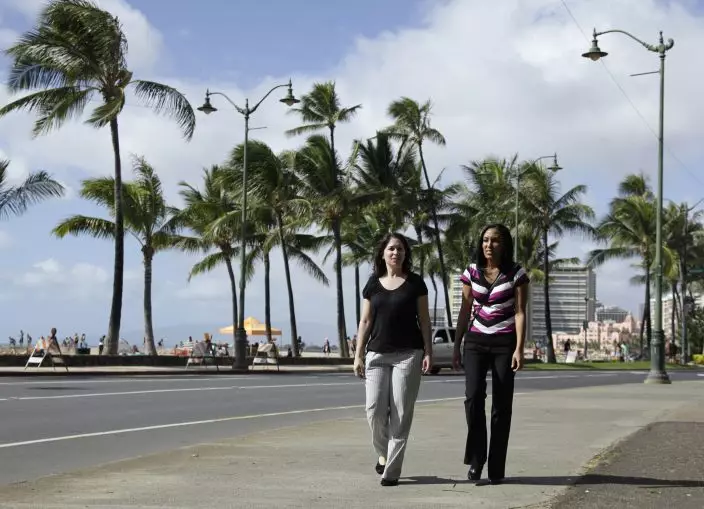
FILE - In this Dec. 19, 2011 file photo, Diane Cervelli, left, and Taeko Bufford, right, walk past Waikiki beach in Honolulu. The U.S. Supreme Court is rejecting an appeal from a Hawaii bed and breakfast that wouldn't rent a room to the lesbian couple. The justices on Monday, March 18, 2019 left in place Hawaii state court rulings that found the Aloha Bed & Breakfast in Honolulu violated Hawaii's anti-discrimination law by turning the couple away. Owner Phyllis Young had argued she should be allowed to turn away gay couples because of her religious beliefs. (AP PhotoEric Risberg, File)

FILE - In this Dec. 19, 2011 file photo, Diane Cervelli, left, and Taeko Bufford, right, walk past Waikiki beach in Honolulu. The U.S. Supreme Court is rejecting an appeal from a Hawaii bed and breakfast that wouldn't rent a room to the lesbian couple. The justices on Monday, March 18, 2019 left in place Hawaii state court rulings that found the Aloha Bed & Breakfast in Honolulu violated Hawaii's anti-discrimination law by turning the couple away. Owner Phyllis Young had argued she should be allowed to turn away gay couples because of her religious beliefs. (AP PhotoEric Risberg, File)

The case involved an effort by Diane Cervelli and Taeko Bufford of Long Beach, California, to book a room at Aloha Bed & Breakfast in 2007 while they were visiting a friend nearby.

When they specified they would need just one bed, Young told them she was uncomfortable reserving a room for lesbians and canceled the reservation.

Cervelli and Bufford filed complaints with the Hawaii Civil Rights Commission.

Young told the commission she is Catholic and believes that homosexuality is wrong, according to the appeals court ruling.

The commission found the business illegally discriminated against the couple and issued Cervelli and Bufford "right to sue" notices.

They filed their lawsuit in 2011.

"The freedom of religion does not give businesses a right to violate nondiscrimination laws that protect all individuals from harm, whether on the basis of race, gender, or sexual orientation," Peter Renn, an attorney who represents the couple, said in a statement.

Last year, the Hawaii Supreme Court rejected Young's appeal of a lower court ruling that ordered her to stop discriminating against same-sex couples.

Associated Press reporter Mark Sherman in Washington, D.C., contributed to this report.
ABOARD AIR FORCE ONE (AP) — President Donald Trump said Sunday that he is “inclined” to keep ExxonMobil out of Venezuela after its top executive was skeptical about oil investment efforts in the country after the toppling of former President Nicolás Maduro.

“I didn’t like Exxon’s response,” Trump said to reporters on Air Force One as he departed West Palm Beach, Florida. “They’re playing too cute.”

During a meeting Friday with oil executives, Trump tried to assuage the concerns of the companies and said they would be dealing directly with the U.S., rather than the Venezuelan government.

Some, however, weren’t convinced.

“If we look at the commercial constructs and frameworks in place today in Venezuela, today it’s uninvestable,” said Darren Woods, CEO of ExxonMobil, the largest U.S. oil company.

An ExxonMobil spokesperson did not immediately respond Sunday to a request for comment.

Also on Friday, Trump signed an executive order that seeks to ensure that Venezuelan oil revenue remains protected from being used in judicial proceedings.

The executive order, made public on Saturday, says that if the funds were to be seized for such use, it could “undermine critical U.S. efforts to ensure economic and political stability in Venezuela.” Venezuela has a history of state asset seizures, ongoing U.S. sanctions and decades of political uncertainty.

Getting U.S. oil companies to invest in Venezuela and help rebuild the country’s infrastructure is a top priority of the Trump administration after Maduro's capture.

The White House is framing the effort to “run” Venezuela in economic terms, and Trump has seized tankers carrying Venezuelan oil, has said the U.S. is taking over the sales of 30 million to 50 million barrels of previously sanctioned Venezuelan crude, and plans to control sales worldwide indefinitely.

Kim reported from West Palm Beach, Florida.

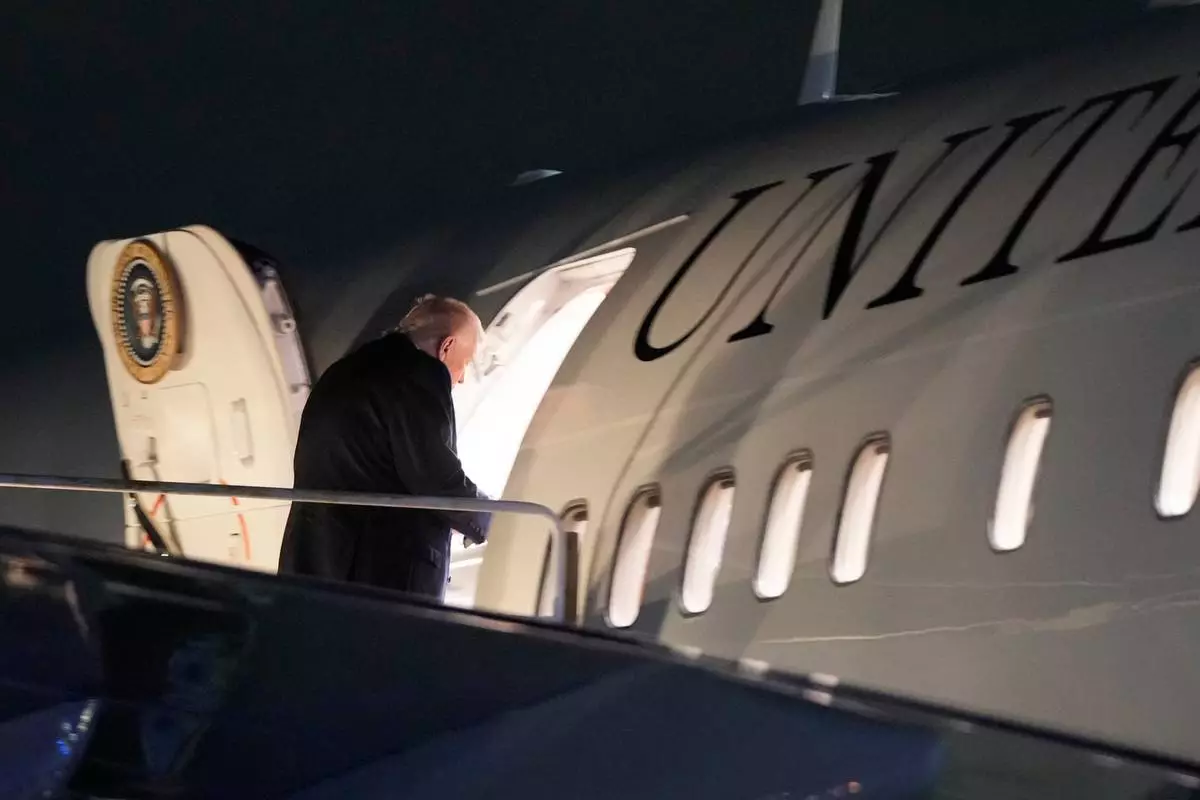
President Donald Trump boards Air Force One at Palm Beach International Airport, Sunday, Jan. 11, 2026, in West Palm Beach, Fla. (AP Photo/Julia Demaree Nikhinson)

President Donald Trump boards Air Force One at Palm Beach International Airport, Sunday, Jan. 11, 2026, in West Palm Beach, Fla. (AP Photo/Julia Demaree Nikhinson)

Recommended Articles