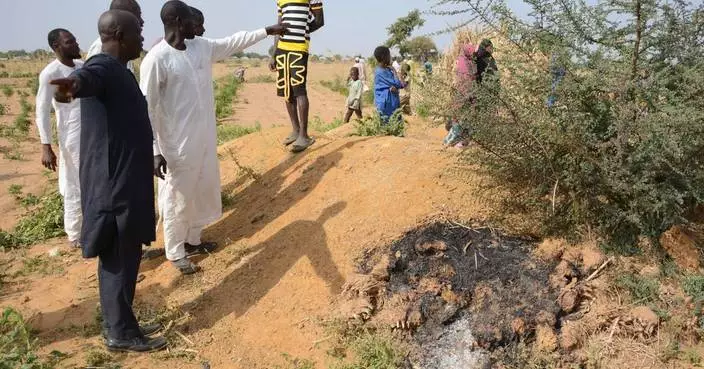
Sin City? More like Sting City.
Grammy-winning superstar Sting is heading to Las Vegas to launch a residency next year.
Sixteen performances of "Sting: My Songs" will take place at The Colosseum at Caesars Palace, beginning May 22, 2020. Shows are also planned for June, August and September.
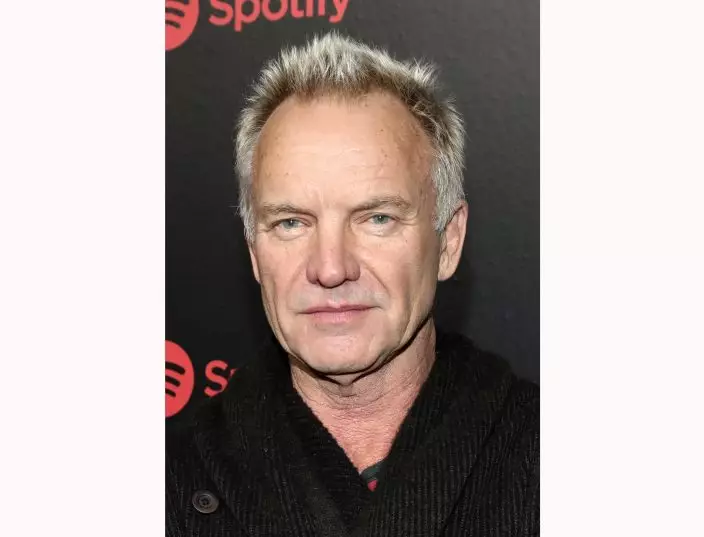
FILE - In a Jan. 25, 2018 file photo, Sting attends Spotify's Best New Artists 2018 Party at Skylight Clarkson Square, in New York. Sting is heading to Las Vegas to launch a residency next year. Sixteen performances of “Sting: My Songs” will take place at The Colosseum at Caesars Palace, beginning May 22, 2020. Shows are also planned for June, August and September. (Photo by Amy SussmanInvisionAP, File)
"Visually, sound-wise, dancing — it's going to be a Vegas show. I'm really committed to that," Sting said in an interview with The Associated Press. "I am a little frightened and a little excited at the same time."
Tickets for the general public, starting at $59, go on sale May 3.
Sting said he's been offered a residency in Vegas in the past, but he felt it wasn't the right time: "I always thought, 'I'm not quite ready for that. I'm still a touring animal.' (Now) I'm ready."
Residencies in Vegas once were meant for acts heading into retirement or in the final stretch of their careers, but that's changed with contemporary artists going to the city to perform, from Jennifer Lopez to Lady Gaga.
Sting said he likes the idea of performing at a single venue every night, compared to traveling city-to-city on a normal tour.
"Being in one place is actually a different, spiritual vibe," he said. "Welcoming people into your house — that's basically what it's going to be. I'll be telling the story of my life through songs. I've had a long, interesting life and I can't wait."
Before he heads to Vegas, Sting has a string of projects in the works: He will tour the United Kingdom with Shaggy (they won the best reggae album Grammy this year for their collaborative album "44/876"); he has a number of solo shows in the United States and around the world; and he will release a new album, "My Songs," on May 24.
The album finds Sting re-shaping and re-imagining some of his biggest hits, from "Every Breath You Take" to "If You Love Somebody Set Them Free."
"We weren't treating the original recordings as holy relics or museum pieces ... we were just having fun with the songs," said the 67-year-old, adding that his voice is now "different to what it was 30, 40 years ago. It has more texture, a richness to it."
His song, "Shape of My Heart," will also appear on the new album. The tune has been sampled by a number of artists throughout the years, from rapper Nas to Grammy-winning R&B singer Monica to English singer Craig David, who collaborated with Sting when he re-worked the song in 2002.
The most famous version is Juice WRLD's "Lucid Dreams," one of the biggest hits of the last year.
"I'm always intrigued by that. I'm always pleased by what I hear because they hear something in that lovely, descending bass line that makes for reflection. That pleases me. And there have been some fabulous versions," Sting said of artists sampling "Shape of My Heart."
"I was very impressed by what he put on top of (my version)," he said of "Lucid Dreams" specifically. "It's a really good song."
DUBAI, United Arab Emirates (AP) — Widening demonstrations sparked by Iran's ailing economy spread Thursday into the Islamic Republic's rural provinces, with at least seven people being killed in the first fatalities reported among security forces and protesters, authorities said.
The deaths may mark the start of a heavier-handed response by Iran’s theocracy over the demonstrations, which have slowed in the capital, Tehran, but expanded elsewhere. The fatalities, two on Wednesday and five on Thursday, occurred in four cities, largely home to Iran’s Lur ethnic group.
The protests have become the biggest in Iran since 2022, when the death of 22-year-old Mahsa Amini in police custody triggered nationwide demonstrations. However, the demonstrations have yet to be countrywide and have not been as intense as those surrounding the death of Amini, who was detained over not wearing her hijab, or headscarf, to the liking of authorities.
The most-intense violence appeared to strike Azna, a city in Iran's Lorestan province, some 300 kilometers (185 miles) southwest of Tehran. There, online videos purported to show objects in the street ablaze and gunfire echoing as people shouted: “Shameless! Shameless!”
The semiofficial Fars news agency reported three people had been killed. Other media, including pro-reform outlets, cited Fars for the report while state-run media did not fully acknowledge the violence there or elsewhere. It wasn't clear why there wasn't more reporting over the unrest, but journalists had faced arrest over their reporting in 2022.
In Lordegan, a city in Iran's Chaharmahal and Bakhtiari province, online videos showed demonstrators gathered on a street, with the sound of gunfire in the background. The footage matched known features of Lordegan, some 470 kilometers (290 miles) south of Tehran.
Fars, citing an anonymous official, said two people had been killed during the protests Thursday.
The Washington-based Abdorrahman Boroumand Center for Human Rights in Iran said two people had been killed there, identifying the dead as demonstrators. It also shared a still image of what appeared to be an Iranian police officer, wearing body armor and wielding a shotgun.
In 2019, the area around Lordegan saw widespread protests and demonstrators reportedly damaged government buildings after a report said people there had been infected with HIV by contaminated needles used at a local health care clinic.
In Fuladshahr in Iran's Isfahan province, state media reported on the death of a man there Thursday that activist groups attributed to the police opening fire on demonstrators.
A separate demonstration Wednesday night reportedly led to the 21-year-old volunteer in the paramilitary Revolutionary Guard's Basij force.
The state-run IRNA news agency reported on the Guard member’s death but did not elaborate. An Iranian news agency called the Student News Network, which is believed to be close to the Basij, directly blamed demonstrators for the Guard member's death, citing comments from Saeed Pourali, a deputy governor in Lorestan province.
The Guard member “was martyred ... at the hands of rioters during protests in this city in defense of public order,” he reportedly said. Another 13 Basij members and police officers suffered injuries, he added.
“The protests that have occurred are due to economic pressures, inflation and currency fluctuations, and are an expression of livelihood concerns," Pourali said. "The voices of citizens must be heard carefully and tactfully, but people must not allow their demands to be strained by profit-seeking individuals.”
The protests took place in the city of Kouhdasht, over 400 kilometers (250 miles) southwest of Tehran. Local prosecutor Kazem Nazari said 20 people had been arrested after the protests and that calm had returned to the city, the judiciary's Mizan news agency reported.
Iran's civilian government under reformist President Masoud Pezeshkian has been trying to signal it wants to negotiate with protesters. However, Pezeshkian has acknowledged there is not much he can do as Iran's rial currency has rapidly depreciated, with $1 now costing some 1.4 million rials.
Meanwhile, state television separately reported on the arrests of seven people, including five it described as monarchists and two others it said had linked to European-based groups. State TV also said another operation saw security forces confiscate 100 smuggled pistols, without elaborating.
Iran's theocracy had declared Wednesday a public holiday across much of the country, citing cold weather, likely as a bid to get people out of the capital for a long weekend. The Iranian weekend is Thursday and Friday, while Saturday marks Imam Ali's birthday, another holiday for many.
The protests, taking root in economic issues, have heard demonstrators chant against Iran's theocracy as well. The country's leaders are still reeling after Israel launched a 12-day war against the country in June. The U.S. also bombed Iranian nuclear sites during the war.
Iran has said it is no longer enriching uranium at any site in the country, trying to signal to the West that it remains open to potential negotiations over its atomic program to ease sanctions. However, those talks have yet to happen as U.S. President Donald Trump and Israeli Prime Minister Benjamin Netanyahu have warned Tehran against reconstituting its atomic program.
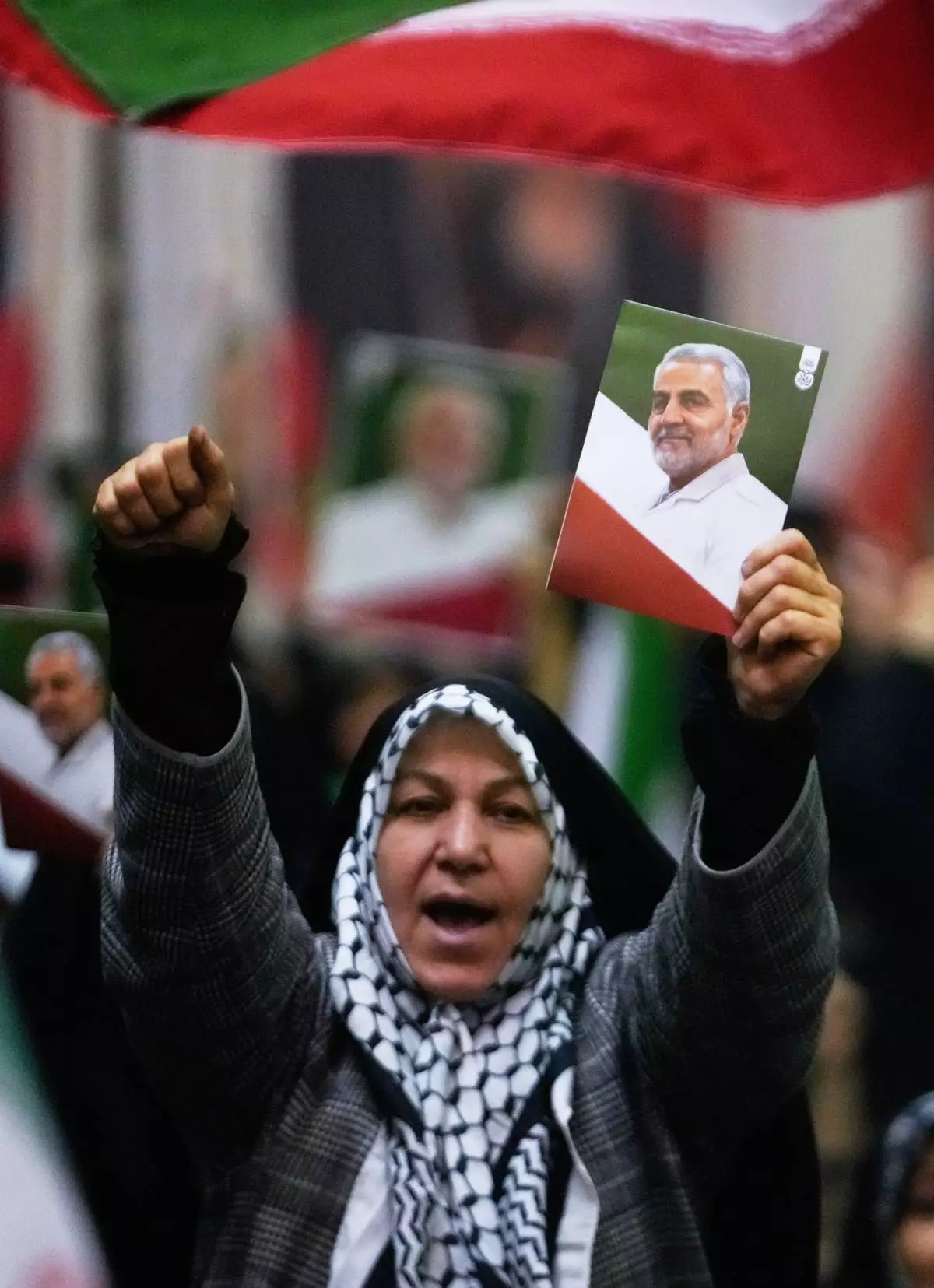
A woman chants slogans as she holds up a poster of the late commander of Iran's Revolutionary Guard expeditionary Quds Force, Gen. Qassem Soleimani, who was killed in a U.S. drone attack in 2020 in Iraq, during a ceremony commemorating his death anniversary at the Imam Khomeini grand mosque in Tehran, Iran, Thursday, Jan. 1, 2026. (AP Photo/Vahid Salemi)
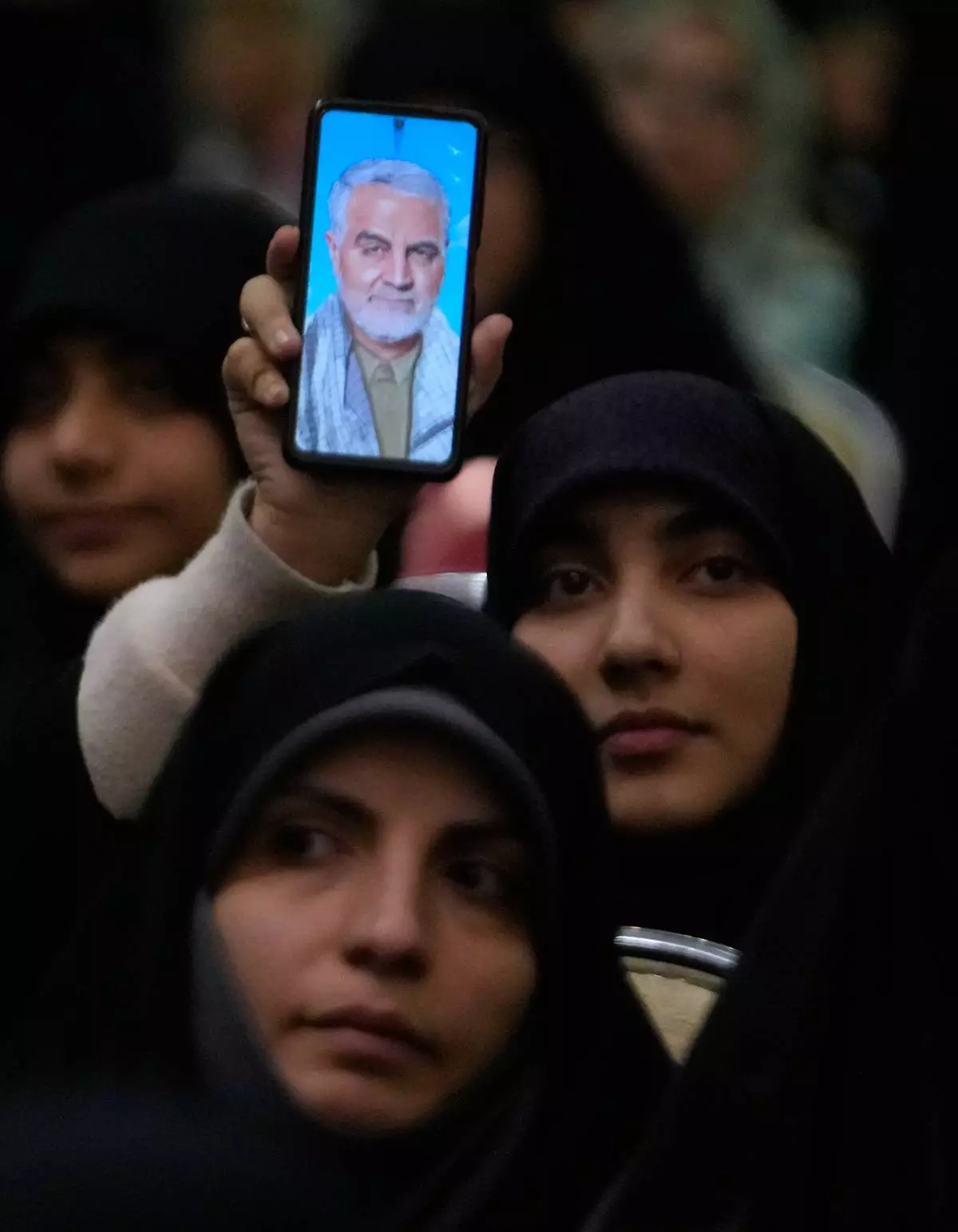
A woman shows a portrait of the late commander of Iran's Revolutionary Guard expeditionary Quds Force, Gen. Qassem Soleimani, who was killed in a U.S. drone attack in 2020 in Iraq, on her smartphone during a ceremony commemorating his death anniversary at the Imam Khomeini grand mosque in Tehran, Iran, Thursday, Jan. 1, 2026. (AP Photo/Vahid Salemi)
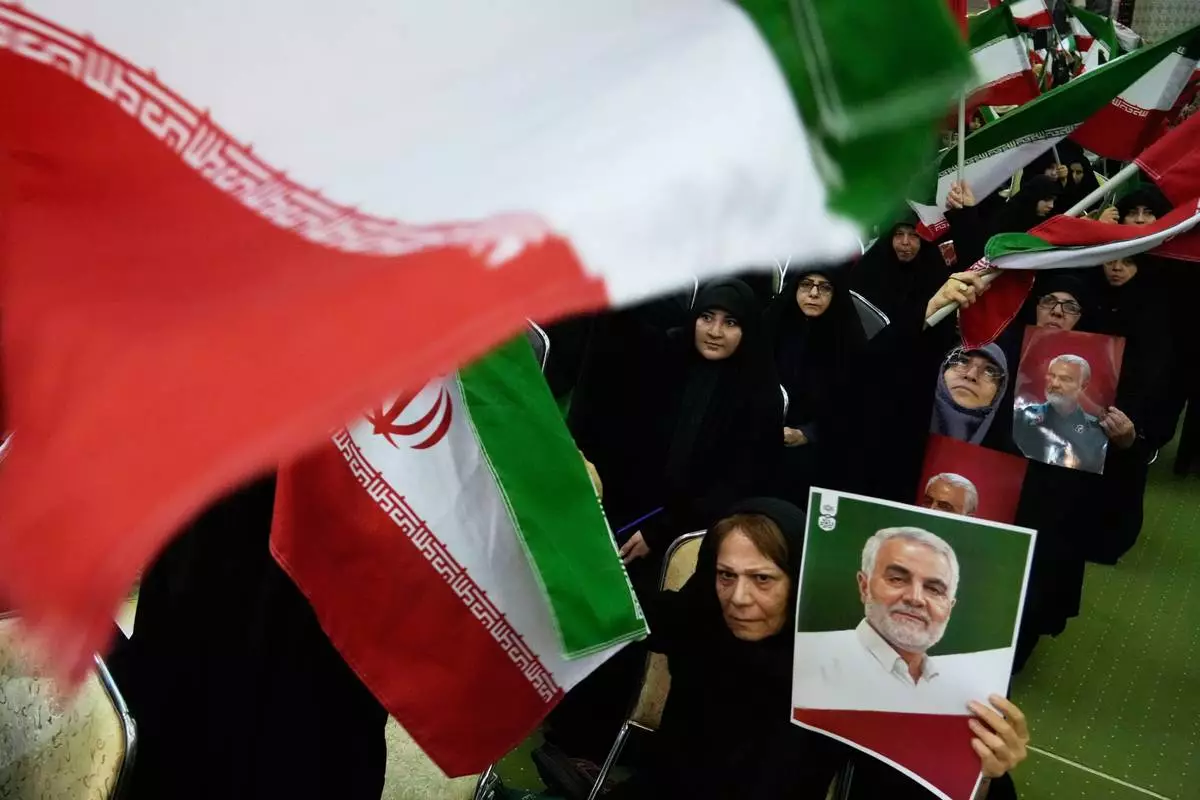
Women wave national flags as they hold up posters of the late commander of the Iran's Revolutionary Guard expeditionary Quds Force, Gen. Qassem Soleimani, who was killed in a U.S. drone attack in 2020 in Iraq, during a ceremony commemorating his death anniversary at the Imam Khomeini grand mosque in Tehran, Iran, Thursday, Jan. 1, 2026. (AP Photo/Vahid Salemi)
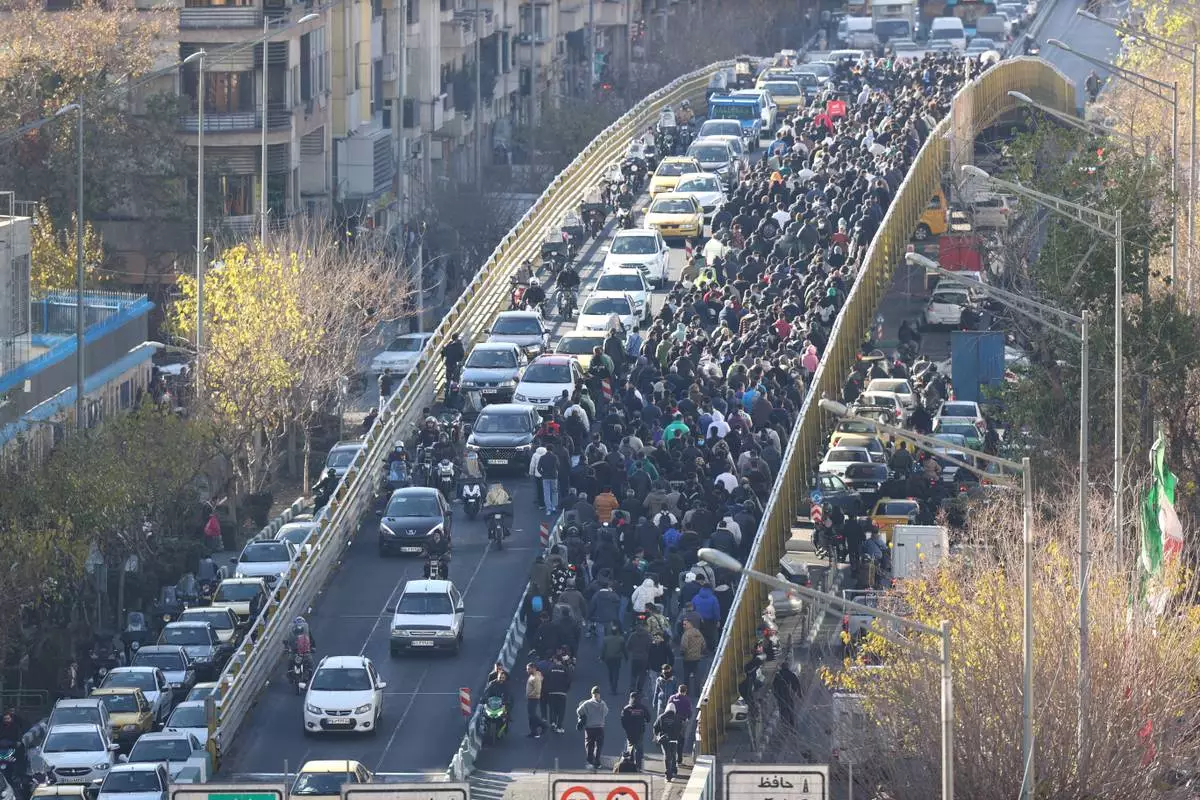
Protesters march in downtown Tehran, Iran, Monday, Dec. 29, 2025. (Fars News Agency via AP)
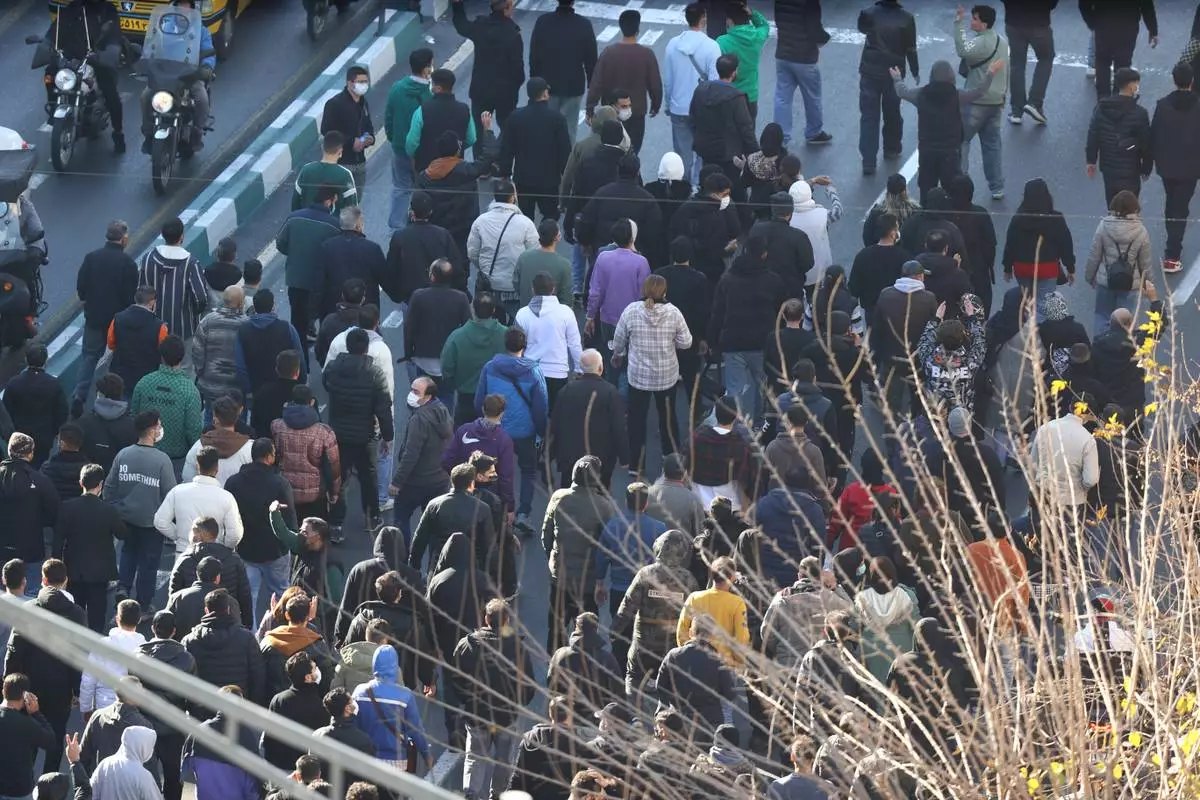
Protesters march in downtown Tehran, Iran, Monday, Dec. 29, 2025. (Fars News Agency via AP)