The Ugandan pop star and opposition politician known as Bobi Wine was remanded to a maximum-security prison on Monday after being charged over his role in a street protest last year against a tax on social media.
Wine, whose real name is Kyagulanyi Ssentamu, and others led an anti-government protest in the capital, Kampala, in July 2018 without the police's prior authorization, Ugandan police spokesman Fred Enanga told The Associated Press.
Wine, 37, appeared in a magistrate's court wearing his trademark red beret, the symbol of his movement against the long rule of President Yoweri Museveni, who has been in power since 1986. Wine will return to court on May 2, the earliest he can be freed on bail.
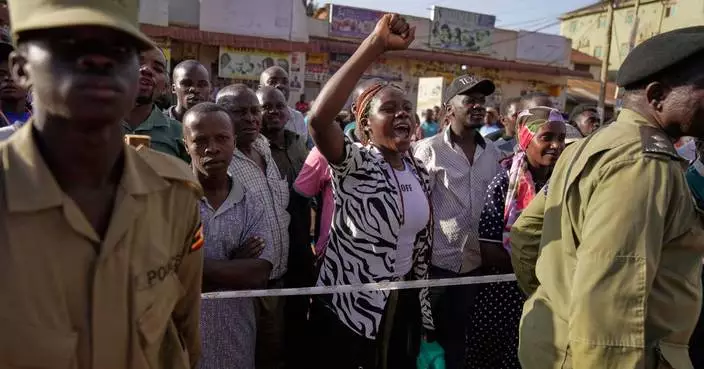
As Wine boarded a prison service van, his supporters chanted the slogan he has popularized: "People power!"
The popular singer has emerged as a powerful opponent to Museveni. Wine is urging Uganda's youth to take over leadership of this East African country and has hinted he may run for the presidency in 2021.
He has had several rough encounters with the security forces, including being detained briefly inside his own home on the outskirts of Kampala last week by police who said they wanted to protect public order.
Wine faces separate treason charges stemming from an incident in which Museveni's presidential convoy was attacked by stone throwers during a campaign event in a northern town last August. Wine's arrest over that event sparked street protests in Kampala by supporters demanding his release, with scores of people detained, and a social media campaign to #FreeBobiWine was launched. Dozens of top international musicians, including Angelique Kidjo and Chris Martin, signed a letter demanding his release.
While the more serious treason charges have been widely dismissed as fake and politically motivated, the new charges — disobedience of statutory authority — could encumber Wine's political activism if he fails to win bail.
Enanga, the police spokesman, said the director of public prosecutions, had finally sanctioned the criminal charges following months of investigations.
Wine was a successful singer in Uganda before he won a seat in the national assembly in 2017. His popularity grew when he opposed efforts to prolong Museveni's rule.
Museveni, who is 74, is now able to seek re-election in 2021 after parliament passed legislation removing a clause in the constitution that had prevented anyone over 75 from holding the presidency. In one chaotic session as the bill was being debated, security personnel entered the parliamentary chamber and roughed up opposition lawmakers, including Wine, who had been trying to delay a procedural vote.
In recent years Ugandan forces have been accused by opposition politicians of harassing and torturing perceived opponents, and Museveni himself is accused of wanting to rule for life.
Museveni accuses Wine and other opposition figures of encouraging young people into rioting.
Uganda has not witnessed a peaceful transfer of power since independence from Britain in 1962.
BEIJING (AP) — Breaking with the United States, Canada has agreed to cut its 100% tariff on Chinese electric cars in return for lower tariffs on Canadian farm products, Prime Minister Mark Carney said Friday.
Carney made the announcement after two days of meetings with Chinese leaders. He said there would be an initial cap of 49,000 vehicles on Chinese EV exports to Canada, growing to 70,000 over five years. China will reduce its tariff on canola seeds, a major Canadian export, from about 84% to about 15%, he told reporters.
“It has been a historic and productive two days,” Carney said, speaking outside against the backdrop of a traditional pavilion and a frozen pond at a Beijing park. “We have to understand the differences between Canada and other countries, and focus our efforts to work together where we’re aligned.”
Earlier Friday, he and Chinese leader Xi Jinping pledged to improve relations between their two nations after years of acrimony.
Xi told Carney in a meeting at the Great Hall of the People that he is willing to continue working to improve ties, noting that talks have been underway on restoring and restarting cooperation since the two held an initial meeting in October on the sidelines of a regional economic conference in South Korea.
“It can be said that our meeting last year opened a new chapter in turning China–Canada relations toward improvement,” China's top leader said.
Carney, the first Canadian prime minister to visit China in eight years, said better relations would help improve a global governance system that he described as “under great strain.”
He called for a new relationship “adapted to new global realities” and cooperation in agriculture, energy and finance.
Those new realities reflect in large part the so-called America-first approach of U.S. President Donald Trump. The tariffs he has imposed have hit both the Canadian and Chinese economies. Carney, who has met with several leading Chinese companies in Beijing, said ahead of his trip that his government is focused on building an economy less reliant on the U.S. at what he called “a time of global trade disruption.”
A Canadian business owner in China called Carney's visit game-changing, saying it re-establishes dialogue, respect and a framework between the two nations.
“These three things we didn’t have,” said Jacob Cooke, the CEO of WPIC Marketing + Technologies, which helps exporters navigate the Chinese market. “The parties were not talking for years.”
Canada had followed the U.S. in putting tariffs of 100% on EVs from China and 25% on steel and aluminum under former Prime Minister Justin Trudeau, Carney’s predecessor.
China responded by imposing duties of 100% on Canadian canola oil and meal and 25% on pork and seafood. It added a 75.8% tariff on canola seeds last August. Collectively, the import taxes effectively closed the Chinese market to Canadian canola, an industry group has said. Overall, China's imports from Canada fell 10.4% last year to $41.7 billion, according to Chinese trade data.
China is hoping Trump’s pressure tactics on allies such as Canada will drive them to pursue a foreign policy that is less aligned with the United States. The U.S. president has suggested Canada could become America's 51st state.
Carney departs China on Saturday and visits Qatar on Sunday before attending the annual gathering of the World Economic Forum in Switzerland next week. He will meet business leaders and investors in Qatar to promote trade and investment, his office said.
Associated Press business writer Chan Ho-him in Hong Kong contributed to this report.

Canada's Prime Minister Mark Carney, center, arrives to meet with Chinese President Xi Jinping, at the Great Hall of the People in Beijing, China, Friday, Jan. 16, 2026. (AP Photo/Vincent Thian, Pool)
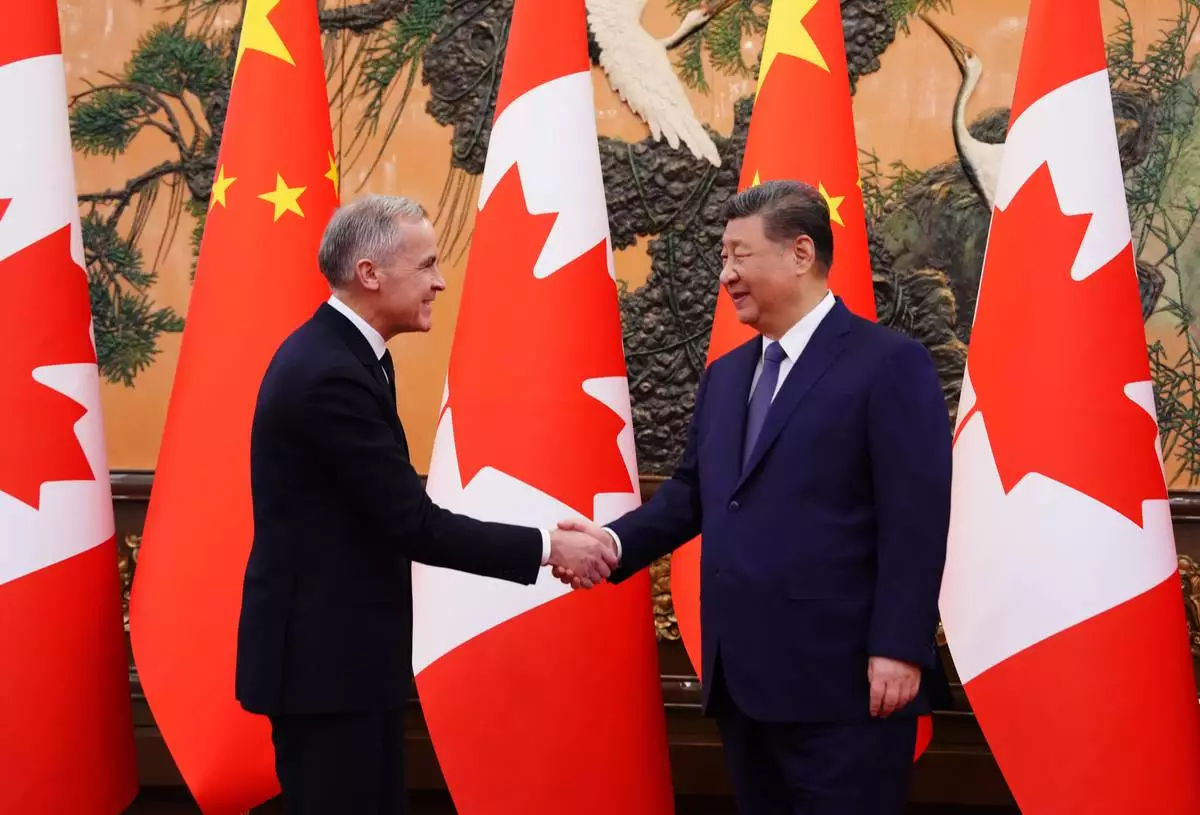
Canada's Prime Minister Mark Carney, left, meets with Chinese President Xi Jinping at the Great Hall of the People in Beijing Friday, Jan. 16, 2026. (Sean Kilpatrick/The Canadian Press via AP)
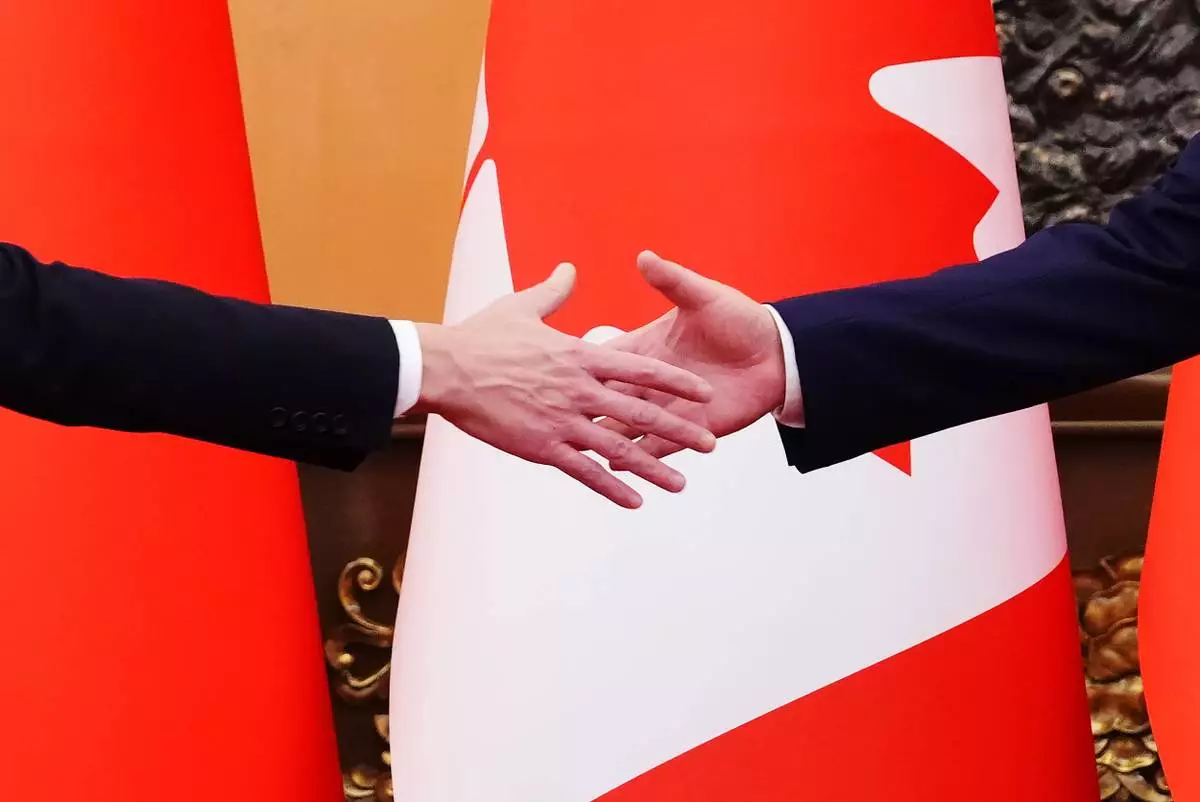
Canada's Prime Minister Mark Carney, left, shakes hands with China's President Xi Jinping at the Great Hall of the People in Beijing Friday, Jan. 16, 2026. (Sean Kilpatrick/The Canadian Press via AP)