Her character suffers through one of the most harrowing deathbed scenes in all of opera. But that doesn't faze Karita Mattila, who's looking forward to performing it as "quite an adventure."
The Finnish soprano, noted for her dramatic intensity as well as her luminous voice, is returning to the Metropolitan Opera as Mme. de Croissy, the First Prioress, in Francis Poulenc's 20th-century masterpiece, "Dialogues of the Carmelites." The opera is adapted from a play that is loosely based on the true story of a group of Carmelite nuns who were guillotined during the French Revolution.
The revival of the classic John Dexter production opens Friday for three performances, the last of which, on Saturday afternoon, May 11, will be broadcast live in HD to movie theaters worldwide.
Mattila's character appears in just two scenes early in the opera, but the grim realism of her death from cancer can leave an impression that lingers until the tragic conclusion. One of the challenges, she said, is to convince the audience that she's writhing in agony as she sings.
"It's tough because you have to stay in bed and make it work," Mattila said in an interview after a rehearsal last month. "But it helps to be fit, so you can find uncomfortable-looking positions for an ill person and still sing it."
Fitness has never been an issue for Mattila, who at 58 retains the willowy figure that helped make her portrayal of Strauss' "Salome" — which included a flash of full frontal nudity — a sensation at the Met in 2004.
That was perhaps the high point of a long Met career that began in 1990 and has taken her through more than a dozen leading roles totaling nearly 150 performances in operas by Mozart, Wagner and Janacek, among others.
Now, at an age when many sopranos think about retiring, Mattila is thinking instead about all the new roles she's eager to take on. Peter Gelb, the Met's general manager, said the company was looking to find new assignments for her, "since Karita has been such a major part of recent Met vocal history and still has so much to offer."
She said she had never seen "Dialogues" before, "and I just thought it would be quite an adventure." As she studied the part, she became fascinated by the character of Mme. De Croissy, who in her delirious final moments lashes out at God.
"She's so human facing death, she becomes so bare with all her weaknesses," Mattila said. "She has spent 30 years in that convent, and then to have such a moment at the end — it fascinates me. You can be a president, a king, whatever and you still struggle with the same issues as everybody else."
Vocally, she said, the role is tricky because although it has its share of high notes, much of it lies "lower than the usual dramatic soprano stuff," especially her first scene with Blanche, the conflicted young newcomer who is the opera's heroine. First Prioresses at the Met over the years have included the great French soprano Regine Crespin, who originated the role when the production premiered in 1977.
Yannick Nezet-Seguin, the Met's music director who is conducting this revival, said Mattila's portrayal "lives up to the legendary singers" who have performed it previously at the Met. "In addition to the conviction of her acting," he said, "being a soprano makes the high notes of the role even more effective."
The score calls for the First Prioress to emit moans or "death rattles" as she nears her end. These sound as if they might be punishing to the voice, but Mattila said, "We singers know how to make it work. We do all kinds of screams and things. You just have to do it with a supportive voice."
Besides the First Prioress, Mattila is debuting three other new roles this year. She recently sang the Foreign Princess in Dvorak's "Rusalka" in Paris, and this fall will appear in Berlin as Kabanicha in Janacek's "Katya Kabanova" and in Munich as Ortrud in Wagner's "Lohengrin."
Then in 2021 she'll undertake a role (she won't say where because it hasn't been announced) that's one of the toughest in the soprano repertory — the heroine of Wagner's "Tristan und Isolde."
"I'll be 61," she said, "but as long as one is healthy, it's never too late, eh?"
JOHANNESBURG (AP) — South African immigration authorities raided a United States refugee processing center in Johannesburg and seven Kenyans working there illegally were arrested and given deportation orders, South Africa's Home Affairs Ministry said Wednesday, as the U.S. called the action “unacceptable.”
Tuesday's raid occurred at a center that processes applications by white South Africans who have been given priority for refugee status in the U.S. by the Trump administration. It was bound to increase tensions between the countries, whose relations have cooled dramatically since President Donald Trump returned to office.
The Trump administration's claim that members of South Africa's Afrikaner white minority group are being persecuted by the Black-led government has been widely rejected, but it has been central to the deterioration of ties between the U.S. and Africa's most advanced economy.
The Home Affairs Ministry said the Kenyans were in the country on tourist visas which did not allow them to work, adding that U.S. officials' work with them at the refugee processing center “raises serious questions about intent and diplomatic protocol.”
It was not immediately clear whether the U.S. had known about the Kenyans’ status.
The ministry said no U.S. officials were arrested in the raid and that the site was not a diplomatic one. It said South Africa's Foreign Ministry has started “formal diplomatic engagements with both the United States and Kenya to resolve this matter.”
U.S. State Department spokesperson Tommy Pigott said “interfering in our refugee operations is unacceptable,” adding that they were seeking “immediate clarification from the South African government and expect full cooperation and accountability.”
The U.S. Embassy in a statement last month said the U.S. government had contracted a Kenya-based company, RSC Africa, to process refugee applications by white South Africans. RSC Africa is operated by Church World Service, a U.S.-based nongovernmental organization that offers refugee assistance and works with the U.S. Refugee Admissions Program.
The Home Affairs Ministry said the Kenyans were working at the U.S. refugee processing site “despite the fact that earlier visa applications for Kenyan nationals to perform this work had been lawfully declined.” The seven Kenyans were given deportation orders and banned from entering South Africa for a five-year period.
Trump has singled out South Africa for criticism on a range of issues, claiming without evidence that Afrikaners are being killed and having their land seized and that South Africa is pursuing an anti-U.S. foreign policy through its diplomatic relations with Palestinian authorities and Iran.
The U.S. boycotted last month's Group of 20 world leaders summit in South Africa, and Trump said it will exclude South Africa from the group when it hosts the annual summit next year. Trump also issued an executive order in February that said the U.S. would stop aid and assistance to South Africa over what it called its “egregious actions.”
South Africa's government has said the U.S. claims over the persecution of Afrikaners are based on misinformation and that white South Africans don't meet the criteria for refugee status because there is no persecution, although it said it wouldn't stop anyone applying. Afrikaners are white South Africans descended from mainly Dutch and French colonial settlers who first came to the country in the 17th century.
The Trump administration announced in October it was dramatically cutting the annual quota for refugees allowed in the U.S. to 7,500 from a previous limit of 125,000 and white South Africans would be given most of the places. A first group of white South African refugees had already arrived in the U.S. under the new program for them in May. It's not clear how many have been relocated since then.
Imray reported from Cape Town, South Africa. Associated Press writer Matthew Lee in Washington contributed to this report.
AP Africa news: https://apnews.com/hub/africa
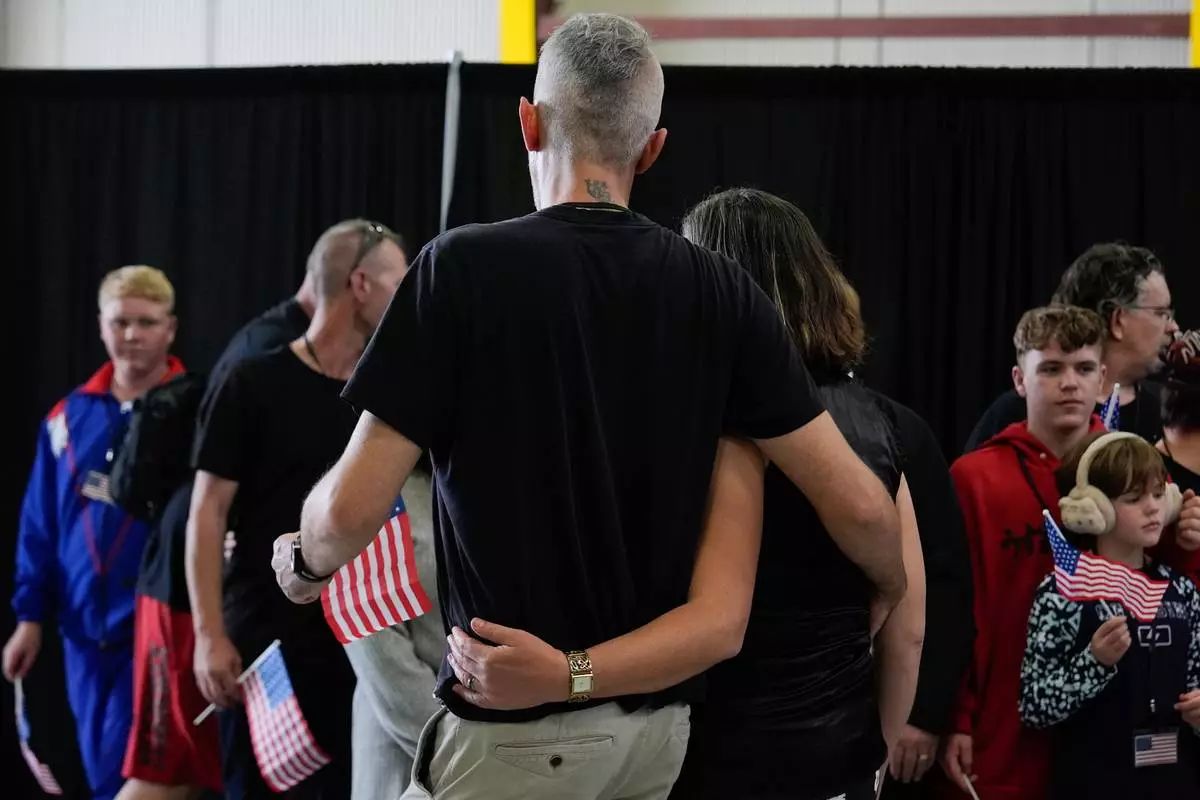
FILE - Refugees from South Africa arrive, Monday, May 12, 2025, at Dulles International Airport in Dulles, Va. (AP Photo/Julia Demaree Nikhinson, File)
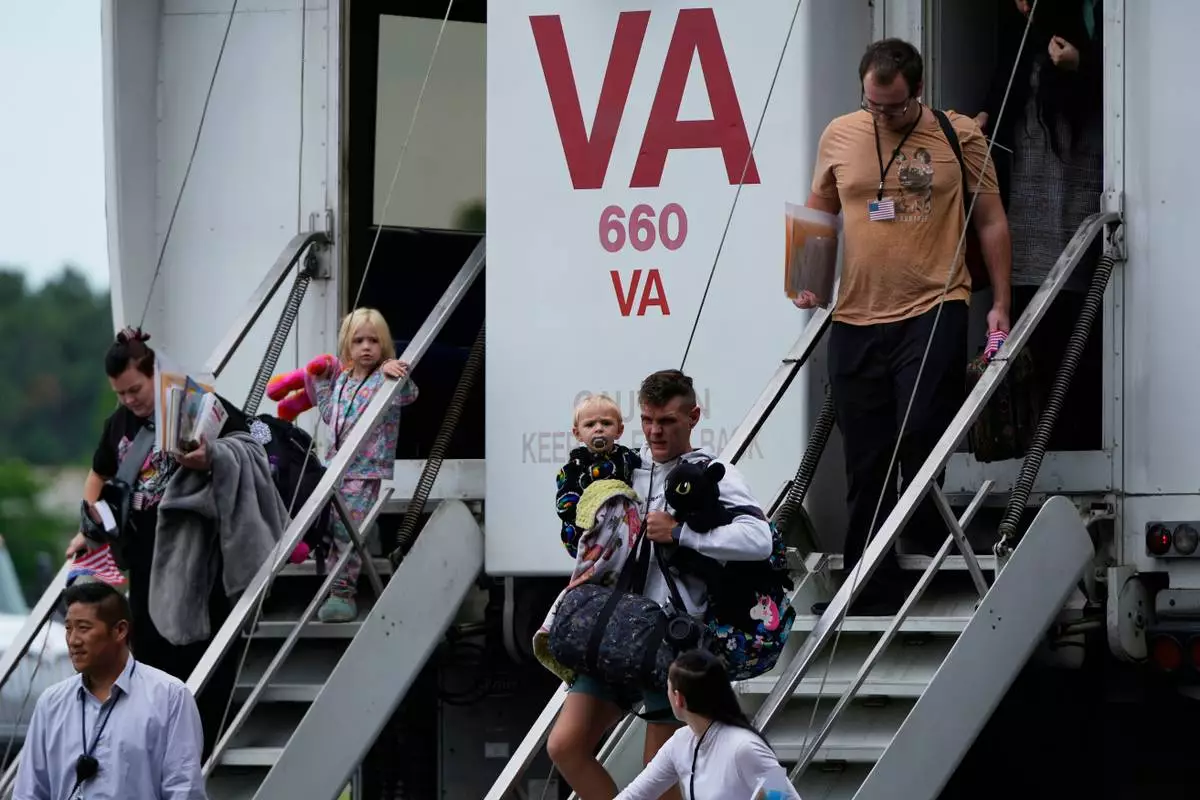
FILE - Refugees from South Africa, arrive Monday, May 12, 2025, at Dulles International Airport in Dulles, Va. (AP Photo/Julia Demaree Nikhinson, File)