While Germany systematically wiped out traces of Adolf Hitler's Nazi regime after World War II, the legacy of his Axis ally, Benito Mussolini, remains present in Italy even today.
Many monuments and symbols glorifying Mussolini's two-decade rule were removed following the war, but a surprising number remain in plain view in Rome, reflecting Italy's complicated relationship with its 20th century history .
Click to Gallery
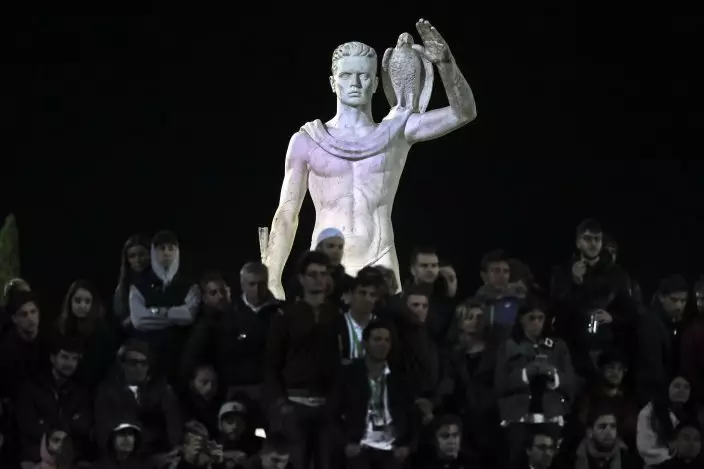
One of the statues by sculptor Eugenio Baroni adorns the Pietrangeli tennis stadium behind spectators watching a match at the Italian Open tennis tournament, in Rome, Thursday, May 16, 2019. The tennis stadium is part of the Foro Italico sports complex, which was initially called Foro Mussolini (Mussolini's Forum). It was built under Benito Mussolini's regime to bolster Rome's bid for the 1944 Olympics, which never took place. (AP PhotoAndrew Medichini)
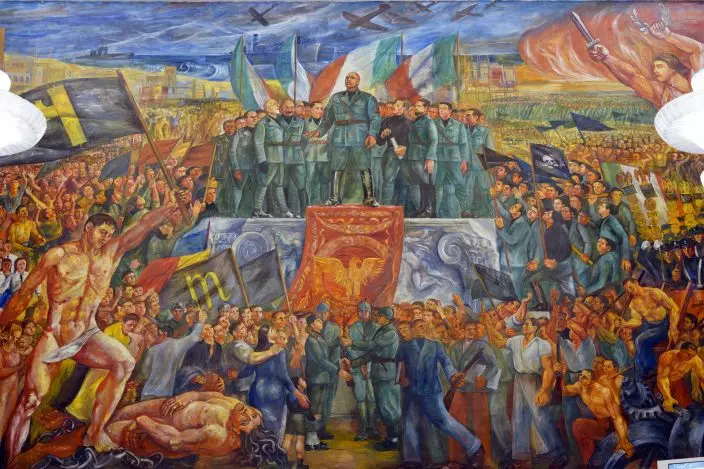
A detail of the mural titled "Apotheosis of Fascism", by Luigi Montanarini, believed to have been painted between the late1930's and early 1940's, in the Salone d'Onore of the CONI headquarters, in Rome, Tuesday, May 14, 2019. While Germany systematically wiped out traces of Adolf Hitler’s Nazi regime after World War II, the legacy of his Axis ally, Benito Mussolini, remains present in Italy even today. (AP PhotoAndrew Medichini)
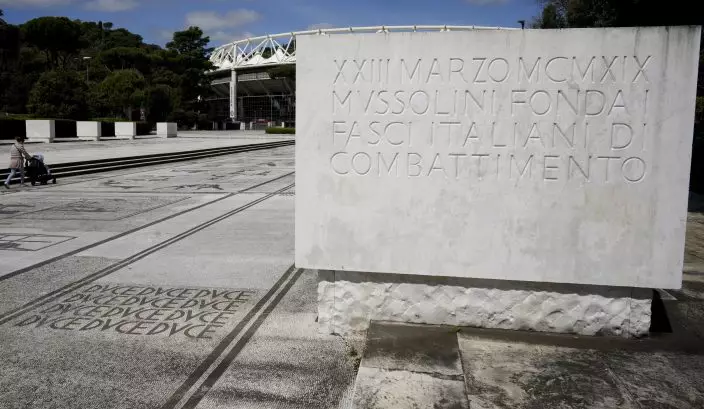
The word DVCE, which was Benito Mussolini's title, is written on the mosaic pavement of the The Piazzale at the Foro Italico sporting complex in Rome, Monday, May 6, 2019, next to a plaque commemorating the founding of Mussolini's Fasci Italiani di Combattimento (Italian Fighting Fasces) on March 23, 1919. The Foro Italico, formerly called Foro Mussolini (Mussolini's Forum) was built under Mussolini's regime to bolster Rome's bid for the Olympics in the 1940's. (AP PhotoAndrew Medichini)
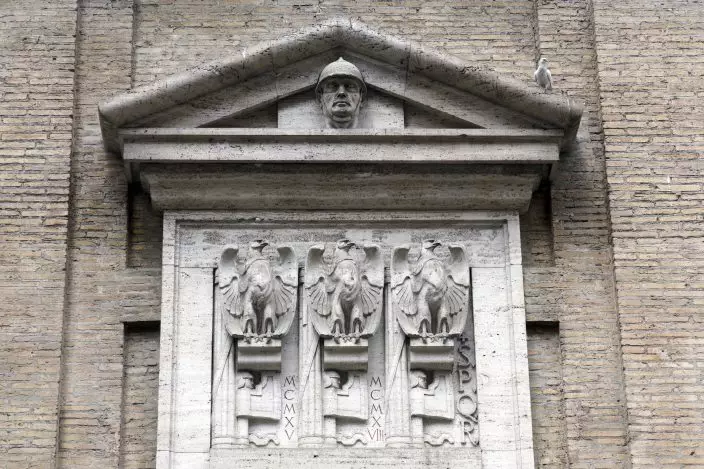
Fasces, the original symbol of Fascism adapted from ancient Rome, showing a bundle of rods tied together around an axe, are seen carved with eagles on the facade of the Madonna dei Monti church, above a plaque commemorating the fallen soldiers of WWI, in downtown Rome, Friday, May 3, 2019. While Germany systematically wiped out traces of Adolf Hitler’s Nazi regime after World War II, the legacy of his Axis ally, Benito Mussolini, remains present in Italy even today. (AP PhotoAndrew Medichini)
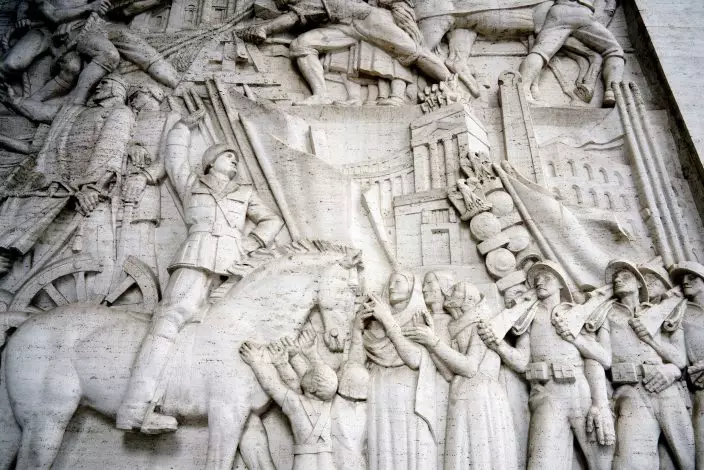
A detail of a giant marble bas-relief titled "The Story of Rome through its Constructions", made in 1940 by sculptor Publio Morbiducci, shows Italian dictator Benito Mussolini on horseback, at the entrance of a building in the EUR neighborhood of Rome, Monday, May 6, 2019. Mussolini transformed Rome’s urban landscape with grand construction projects like EUR, a new city district that was originally designed as celebration of fascism for a world fair in 1942. The fair was canceled due to WWII and construction was halted but resumed after the war. (AP PhotoAndrew Medichini)
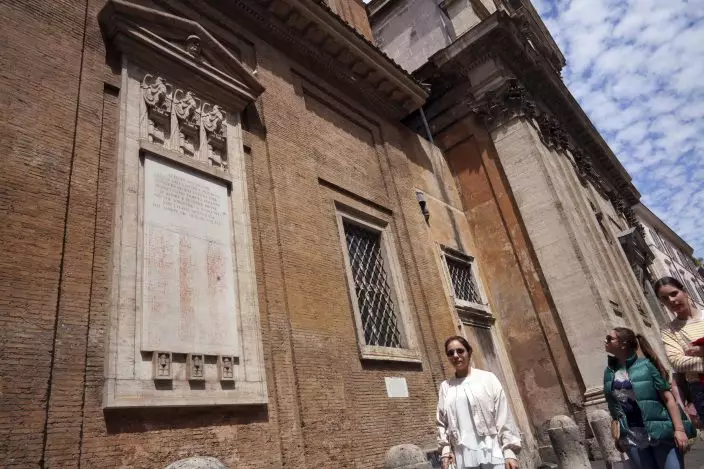
People walk past a plaque commemorating the fallen soldiers of WWI adorned with the original symbol of fascism, a bundle of sticks featuring an axe, carved along with eagles on the facade of the Madonna dei Monti church, in downtown Rome, Friday, May 3, 2019. While Germany systematically wiped out traces of Adolf Hitler’s Nazi regime after World War II, the legacy of his Axis ally, Benito Mussolini, remains present in Italy even today. (AP PhotoAndrew Medichini)
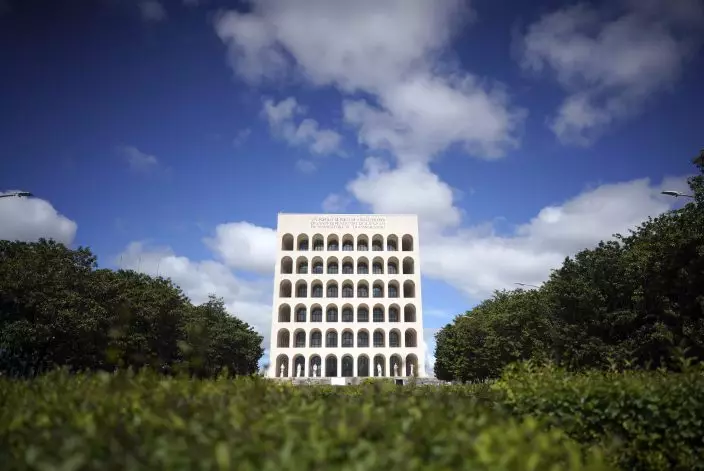
A view of the Palazzo della Civilta' Italiana, also known as the Square Colosseum, in the EUR district of Rome, Monday, May 6, 2019. On its façade is engraved a phrase from Mussolini's 1935 speech announcing Italy's invasion of Ethiopia. Mussolini transformed Rome’s urban landscape with grand construction projects like EUR, a new city district that was originally designed as celebration of fascism for a world fair in 1942. The fair was canceled due to WWII and construction was halted but resumed after the war. (AP PhotoAndrew Medichini)
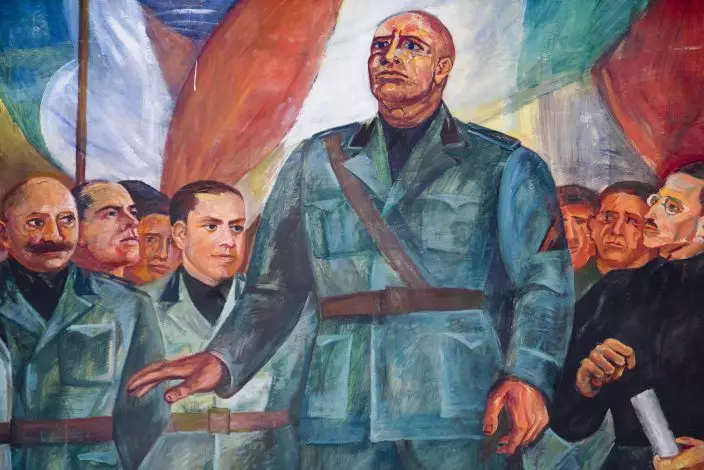
A detail of the mural titled "Apotheosis of Fascism", by Luigi Montanarini, believed to have been painted between the late1930's and early 1940's, in the Salone d'Onore of the CONI headquarters, in Rome, Tuesday, May 14, 2019. While Germany systematically wiped out traces of Adolf Hitler’s Nazi regime after World War II, the legacy of his Axis ally, Benito Mussolini, remains present in Italy even today. (AP PhotoAndrew Medichini)
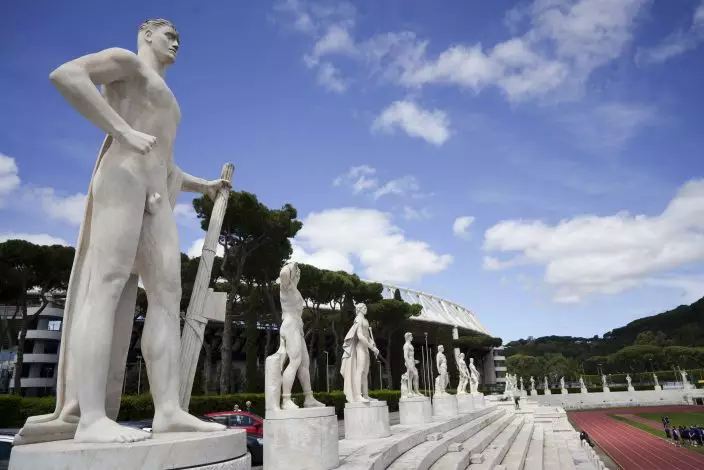
A marble statue holding a fasces, a bundle of rods tied together around an axe, adopted by Italian dictator Benito Mussolini as a symbol of power, adorns the track and field Stadio Dei Marmi stadium of the Foro Italico, in Rome, Monday, May 6, 2019. The Stadio Dei Marmi was designed by architect Enrico Del Debbio and completed in 1928. (AP PhotoAndrew Medichini)
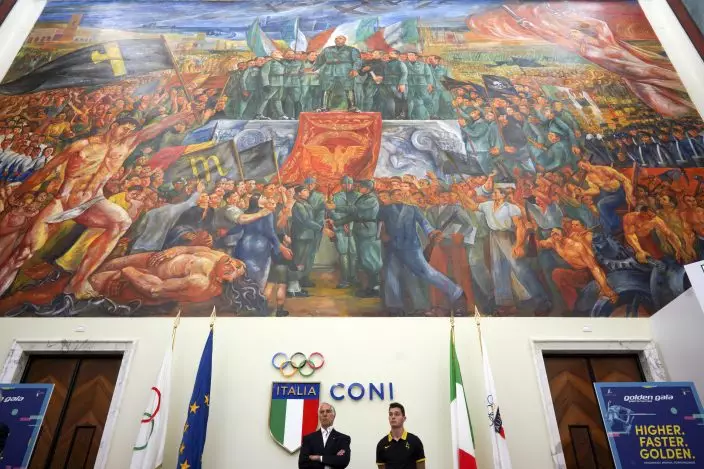
CONI (Italian Olympic Committee) president Giovanni Malago', bottom left, and Italian athlete Filippo Tortu attend a press conference to present the Golden Gala athletic meeting, as they stand beneath a mural titled "Apotheosis of Fascism", in the Salone d'Onore of the CONI headquarters, in Rome, Tuesday, May 14, 2019. The mural, by Luigi Montanarini, is believed to have been painted between the late 1930's and early 1940's. While Germany systematically wiped out traces of Adolf Hitler’s Nazi regime after World War II, the legacy of his Axis ally, Benito Mussolini, remains present in Italy even today. (AP PhotoAndrew Medichini)
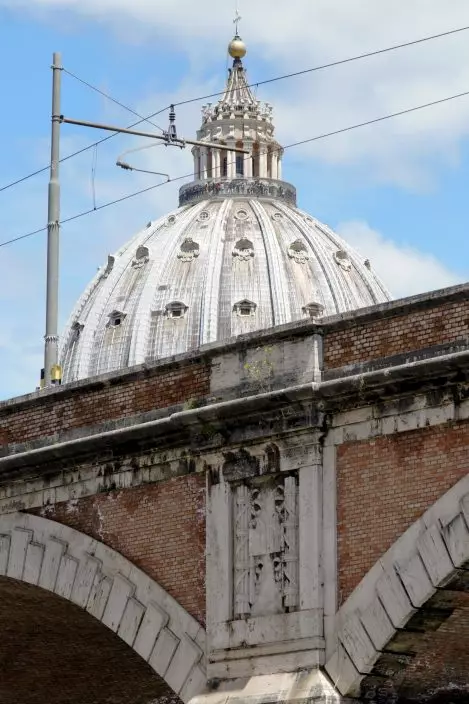
Fasces, a bundle of rods tied around an axe, the symbol which Italian dictator Benito Mussolini adopted from ancient Rome, are seen carved in a bridge by St. Peter's Basilica, in Rome, Monday, May 6, 2019. While Germany systematically wiped out traces of Adolf Hitler’s Nazi regime after World War II, the legacy of his Axis ally, Benito Mussolini, remains present in Italy even today. (AP PhotoAndrew Medichini)
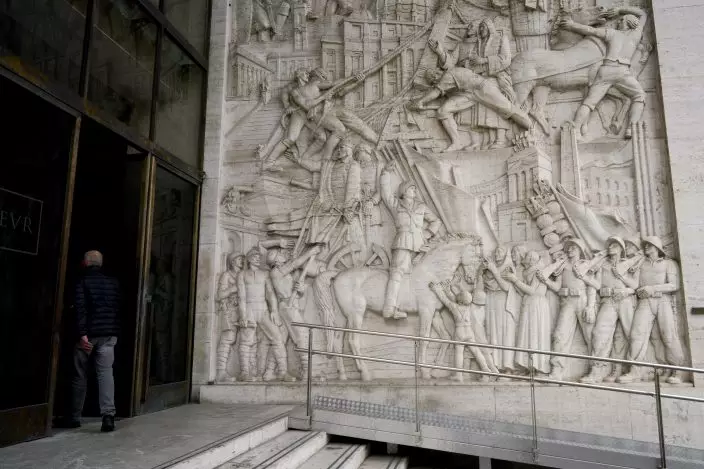
A man enters a building where a marble bas-relief titled "The Story of Rome through its Constructions", made in 1940 by sculptor Publio Morbiducci, shows from top to bottom the history of Rome from its foundation to the fascist period with its dictator Benito Mussolini on a horse, in the EUR neighborhood of Rome, Monday, May 6, 2019. Mussolini transformed Rome’s urban landscape with grand construction projects like EUR, a new city district that was originally designed as celebration of fascism for a world fair in 1942. The fair was canceled due to WWII and construction was halted but resumed after the war. (AP PhotoAndrew Medichini)
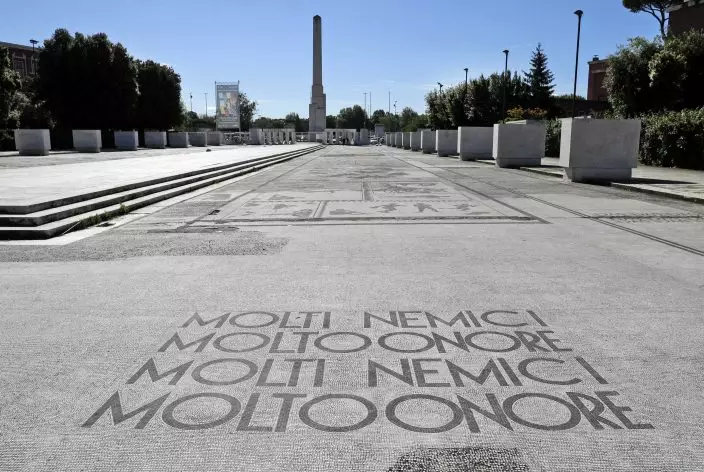
A Fascist motto reading in Italian "Many enemies, much honor", decorates the mosaic pavement on the avenue from the Olympic stadium to a fascist-era obelisk, in Rome's Foro Italico sporting ground, Thursday, May, 16, 2019. The Foro Italico, formerly called Foro Mussolini (Mussolini's Forum), was built under Mussolini's regime to bolster Rome's bid for the Olympics in the 1940's. The obelisk was built in 1932. (AP PhotoGregorio Borgia)
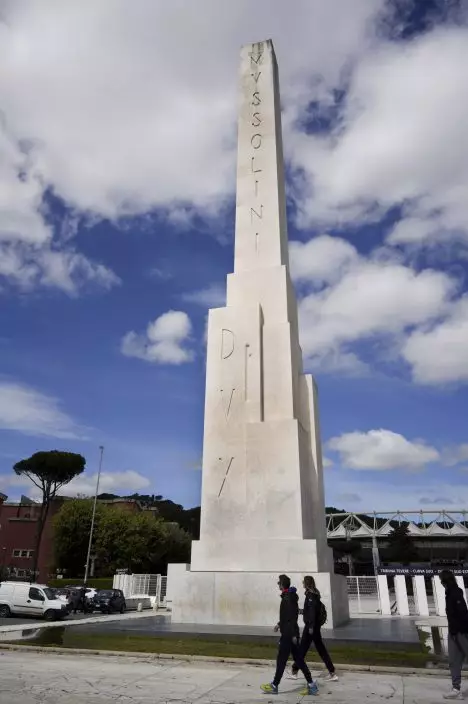
A marble obelisk by architect Costantino Costantini with writing reading in Latin MVSSOLINI DVX (Mussolini Leader) stands at the Foro Italico sporting complex, formerly called Foro Mussolini (Mussolini's Forum), in front of the Olympic Stadium, in Rome, Monday, May 6, 2019. It is one of the few public references to Mussolini which remained after WWII. The Foro was built under Mussolini's regime to bolster Rome's bid for the Olympics in the 1940's, the obelisk was built in 1932. (AP PhotoAndrew Medichini)
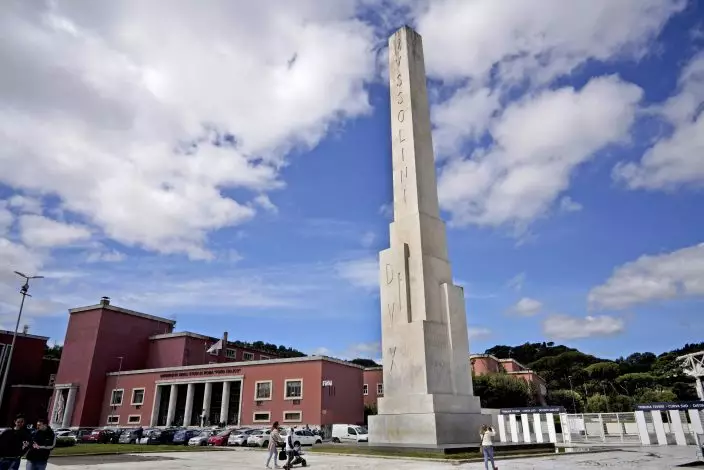
A marble obelisk by architect Costantino Costantini with writing reading in Latin MVSSOLINI DVX (Mussolini Leader) stands at the Foro Italico sporting complex, formerly called Foro Mussolini (Mussolini's Forum), in front of the Olympic Stadium, in Rome, Monday, May 6, 2019. It is one of the few public references to Mussolini which remained after WWII. The Foro was built under Mussolini's regime to bolster Rome's bid for the Olympics in the 1940's, the obelisk was built in 1932. (AP PhotoAndrew Medichini)
The Foro Italico sports complex on the western bank of the river Tiber is one of the most striking examples of fascist architecture, with statues carrying fasces — an ancient Roman symbol adopted by Mussolini — pavement mosaics paying homage to the fascist dictator and a marble obelisk that bears his name. In the nearby headquarters of the Italian Olympic Committee, news conferences are still held in front of a mural showing Mussolini on a pedestal addressing a crowd.
One of the statues by sculptor Eugenio Baroni adorns the Pietrangeli tennis stadium behind spectators watching a match at the Italian Open tennis tournament, in Rome, Thursday, May 16, 2019. The tennis stadium is part of the Foro Italico sports complex, which was initially called Foro Mussolini (Mussolini's Forum). It was built under Benito Mussolini's regime to bolster Rome's bid for the 1944 Olympics, which never took place. (AP PhotoAndrew Medichini)
Mussolini transformed Rome's urban landscape with grand construction projects like EUR, a new city district that was originally designed as celebration of fascism for a world fair in 1942. The fair was canceled due to WWII and construction was halted but resumed after the war.
The most prominent building in the district is known as the "Square Colosseum," a marble-clad palazzo engraved with a quote from Mussolini's 1935 speech announcing the invasion of Ethiopia. Another building features a marble bas-relief from 1940 showing Mussolini on a horse, giving the fascist salute.
A detail of the mural titled "Apotheosis of Fascism", by Luigi Montanarini, believed to have been painted between the late1930's and early 1940's, in the Salone d'Onore of the CONI headquarters, in Rome, Tuesday, May 14, 2019. While Germany systematically wiped out traces of Adolf Hitler’s Nazi regime after World War II, the legacy of his Axis ally, Benito Mussolini, remains present in Italy even today. (AP PhotoAndrew Medichini)
The word DVCE, which was Benito Mussolini's title, is written on the mosaic pavement of the The Piazzale at the Foro Italico sporting complex in Rome, Monday, May 6, 2019, next to a plaque commemorating the founding of Mussolini's Fasci Italiani di Combattimento (Italian Fighting Fasces) on March 23, 1919. The Foro Italico, formerly called Foro Mussolini (Mussolini's Forum) was built under Mussolini's regime to bolster Rome's bid for the Olympics in the 1940's. (AP PhotoAndrew Medichini)
Fasces, the original symbol of Fascism adapted from ancient Rome, showing a bundle of rods tied together around an axe, are seen carved with eagles on the facade of the Madonna dei Monti church, above a plaque commemorating the fallen soldiers of WWI, in downtown Rome, Friday, May 3, 2019. While Germany systematically wiped out traces of Adolf Hitler’s Nazi regime after World War II, the legacy of his Axis ally, Benito Mussolini, remains present in Italy even today. (AP PhotoAndrew Medichini)
A detail of a giant marble bas-relief titled "The Story of Rome through its Constructions", made in 1940 by sculptor Publio Morbiducci, shows Italian dictator Benito Mussolini on horseback, at the entrance of a building in the EUR neighborhood of Rome, Monday, May 6, 2019. Mussolini transformed Rome’s urban landscape with grand construction projects like EUR, a new city district that was originally designed as celebration of fascism for a world fair in 1942. The fair was canceled due to WWII and construction was halted but resumed after the war. (AP PhotoAndrew Medichini)
People walk past a plaque commemorating the fallen soldiers of WWI adorned with the original symbol of fascism, a bundle of sticks featuring an axe, carved along with eagles on the facade of the Madonna dei Monti church, in downtown Rome, Friday, May 3, 2019. While Germany systematically wiped out traces of Adolf Hitler’s Nazi regime after World War II, the legacy of his Axis ally, Benito Mussolini, remains present in Italy even today. (AP PhotoAndrew Medichini)
A view of the Palazzo della Civilta' Italiana, also known as the Square Colosseum, in the EUR district of Rome, Monday, May 6, 2019. On its façade is engraved a phrase from Mussolini's 1935 speech announcing Italy's invasion of Ethiopia. Mussolini transformed Rome’s urban landscape with grand construction projects like EUR, a new city district that was originally designed as celebration of fascism for a world fair in 1942. The fair was canceled due to WWII and construction was halted but resumed after the war. (AP PhotoAndrew Medichini)
A detail of the mural titled "Apotheosis of Fascism", by Luigi Montanarini, believed to have been painted between the late1930's and early 1940's, in the Salone d'Onore of the CONI headquarters, in Rome, Tuesday, May 14, 2019. While Germany systematically wiped out traces of Adolf Hitler’s Nazi regime after World War II, the legacy of his Axis ally, Benito Mussolini, remains present in Italy even today. (AP PhotoAndrew Medichini)
A marble statue holding a fasces, a bundle of rods tied together around an axe, adopted by Italian dictator Benito Mussolini as a symbol of power, adorns the track and field Stadio Dei Marmi stadium of the Foro Italico, in Rome, Monday, May 6, 2019. The Stadio Dei Marmi was designed by architect Enrico Del Debbio and completed in 1928. (AP PhotoAndrew Medichini)
CONI (Italian Olympic Committee) president Giovanni Malago', bottom left, and Italian athlete Filippo Tortu attend a press conference to present the Golden Gala athletic meeting, as they stand beneath a mural titled "Apotheosis of Fascism", in the Salone d'Onore of the CONI headquarters, in Rome, Tuesday, May 14, 2019. The mural, by Luigi Montanarini, is believed to have been painted between the late 1930's and early 1940's. While Germany systematically wiped out traces of Adolf Hitler’s Nazi regime after World War II, the legacy of his Axis ally, Benito Mussolini, remains present in Italy even today. (AP PhotoAndrew Medichini)
Fasces, a bundle of rods tied around an axe, the symbol which Italian dictator Benito Mussolini adopted from ancient Rome, are seen carved in a bridge by St. Peter's Basilica, in Rome, Monday, May 6, 2019. While Germany systematically wiped out traces of Adolf Hitler’s Nazi regime after World War II, the legacy of his Axis ally, Benito Mussolini, remains present in Italy even today. (AP PhotoAndrew Medichini)
A man enters a building where a marble bas-relief titled "The Story of Rome through its Constructions", made in 1940 by sculptor Publio Morbiducci, shows from top to bottom the history of Rome from its foundation to the fascist period with its dictator Benito Mussolini on a horse, in the EUR neighborhood of Rome, Monday, May 6, 2019. Mussolini transformed Rome’s urban landscape with grand construction projects like EUR, a new city district that was originally designed as celebration of fascism for a world fair in 1942. The fair was canceled due to WWII and construction was halted but resumed after the war. (AP PhotoAndrew Medichini)
A Fascist motto reading in Italian "Many enemies, much honor", decorates the mosaic pavement on the avenue from the Olympic stadium to a fascist-era obelisk, in Rome's Foro Italico sporting ground, Thursday, May, 16, 2019. The Foro Italico, formerly called Foro Mussolini (Mussolini's Forum), was built under Mussolini's regime to bolster Rome's bid for the Olympics in the 1940's. The obelisk was built in 1932. (AP PhotoGregorio Borgia)
A marble obelisk by architect Costantino Costantini with writing reading in Latin MVSSOLINI DVX (Mussolini Leader) stands at the Foro Italico sporting complex, formerly called Foro Mussolini (Mussolini's Forum), in front of the Olympic Stadium, in Rome, Monday, May 6, 2019. It is one of the few public references to Mussolini which remained after WWII. The Foro was built under Mussolini's regime to bolster Rome's bid for the Olympics in the 1940's, the obelisk was built in 1932. (AP PhotoAndrew Medichini)
A marble obelisk by architect Costantino Costantini with writing reading in Latin MVSSOLINI DVX (Mussolini Leader) stands at the Foro Italico sporting complex, formerly called Foro Mussolini (Mussolini's Forum), in front of the Olympic Stadium, in Rome, Monday, May 6, 2019. It is one of the few public references to Mussolini which remained after WWII. The Foro was built under Mussolini's regime to bolster Rome's bid for the Olympics in the 1940's, the obelisk was built in 1932. (AP PhotoAndrew Medichini)