Kurt Busch has been called many things during his tumultuous 20 seasons at NASCAR's top level. He is ornery, easily unhinged and has lost control of his temper enough times that it nearly derailed his career.
But the most important descriptor for Busch is one often overlooked. He is a wheelman, one of the very best in NASCAR, and in the twilight of his career Busch has a chance to make that his lasting mark.
Busch beat his brother head-to-head for the first time at the Cup level in a dramatic, two-lap overtime shootout at Kentucky Speedway for Busch's first victory with new team Chip Ganassi Racing. It was the third time Kurt and Kyle Busch have finished 1-2 in a Cup race, but the first time Kurt got the best of his little brother.
The win came a week after a horrible pit call in Daytona cost Busch and the No. 1 team a victory. Busch had slid through a massive accident unscathed to take the lead, and as NASCAR said the race was one lap away from resuming, crew chief Matt McCall called Busch in for a quick pit stop.
A lightning strike seconds later halted all action and the race was eventually called, costing Busch, McCall and Ganassi the victory.
So how sweet it was Saturday night when McCall used a late call to change four tires, putting Busch in position to challenge for the Kentucky victory when the race took a sudden turn and headed to overtime. Busch charged hard toward the front, eventually got alongside Kyle and neither refused to budge. Their cars touched, wiggled, Kurt appeared to bang the wall, both seemed to hanging onto the steering wheel as if they were racing for the NASCAR championship.
After Kurt got to the checkered flag first, he dove into the arms of his waiting crew, celebrated on the frontstretch, then did an old-school trip to victory lane with his crew riding along on his Chevrolet. One team member proudly waved the checkered flag for the journey.
The victory was the 31st career Cup win for Busch, the 2004 NASCAR champion, and extended his streak of winning at least one race a year to six consecutive seasons. Busch has just three winless years in 19 full Cup seasons — his rookie year, and then in 2012 and 2013 when he was trying to salvage his career after he was fired by Roger Penske for too many public blowups.
But he landed at Furniture Row Racing in 2013 and was the conduit in building a backmarker team into a championship contender. Busch's time with the Colorado-based team was just one season, but his knowledge of race cars and how to get the most out of his equipment set the framework for Martin Truex Jr.'s 2017 championship.
Busch spent five years at Stewart-Haas Racing, overshadowed by Kevin Harvick the entire time, and when a new contract didn't materialize he moved to Ganassi and a struggling Chevrolet group. But if the car isn't competitive, no one bothered to tell Busch, who has been among the top Chevy drivers all year.
He has 11 top-10 finishes through 19 races, and his Kentucky victory was the third consecutive for a resurgent Chevrolet effort. Busch has won with nine different crew chiefs in his Cup career, proving that in his case he can get it done if the car has speed.
Busch still has his cranky side, and he was difficult through the first third of the season with media because he didn't like NASCAR's policy that forced him to meet with reporters after qualifying. At Bristol early in the season, he essentially repeated the same answer verbatim to every question asked: "The car was loose and we didn't get a good time. I did one lap and I'm in here talking for 30th. Car was loose, we didn't get a good time, I don't know what I can help you guys with."
After this weekend's win, Busch insisted he has made gains in all those personal areas that have left black marks on his resume. He credited his wife, Ashley, a professional polo player, for helping him see the bigger picture and settle down just a bit.
"The power of positivity is something she's taught me over these few years," he said. "You come in and you talk a game and you deliver it, and you do it with execution through team meetings, showing up early, staying late, and motivating guys to do a better job. And the way that I've won races in the past, I try to go after the weakness of a team and try to fix that first and then start to make things better as we go."
More AP auto racing: https://apnews.com/apf-AutoRacing and https://twitter.com/AP_Sports
CAPE TOWN, South Africa (AP) — Englishman Ollie Jenks remembers when his friend first pitched the idea to him.
“It was so ridiculous I couldn't say no,” Jenks said.
The proposal by his Canadian buddy Seth Scott, a fellow lover of cars and crazy adventures, was for them to drive a decades-old British-made Reliant Robin car from London to the southern tip of Africa — a 14,000-mile (22,500-kilometer) journey through 22 countries — to set a record for the longest trip in a three-wheeled vehicle.
Reliant Robins have cultlike status in the U.K. as humble three-wheelers that, in Jenks' words, were designed to go to the shops and back in 1970s Britain. They went out of production in the early 2000s but remain loved in British culture, especially after a Reliant appeared as the Trotter brothers' trusty but battered yellow van in the hugely popular sitcom “Only Fools and Horses.”
Yet you couldn't find a less suitable vehicle to take thousands of miles through tropical jungles, mountain ranges and deserts down the west side of Africa. And that's precisely why Jenks went for the absurd plan.
Sheila, the silver three-wheeler — one of the last Reliant Robins to be built — was acquired specifically for the adventure. Jenks and Scott set off in October with a can of fuel and a few essential supplies strapped to Sheila's small roof, and a large amount of blind hope that they would somehow make it to Cape Town, South Africa, near the bottom of the world.
“No power steering, no air con, and it doesn’t do well up hills or down them. It is the most unsuitable car for probably any journey,” Jenks said in an unkind assessment of Sheila's abilities. “We made friends with the designer of this car, and he’s scared to take it any more than 20 miles.”
Jenks and Scott ignored all the advice and took Sheila on the epic journey over four-and-a-half months that cost in the region of $40,000 to $50,000, Jenks said. They had help from sponsors and crowd funding, and documented the journey on an Instagram page that pulled in nearly 100,000 followers under the title: “14,000 miles, 3 wheels, 0 common sense.”
They arrived in Benin during an attempted coup. They skirted through northern Nigeria as the U.S. launched airstrikes on Islamic State targets. They were given a military escort for about 300 miles (480 kilometers) through a region of separatist violence in Cameroon.
“Imagine this car in a military convoy,” Jenks said.
And there were many brushes with traffic-related danger, including when an overtaking bus almost flattened Sheila against a cliff face in Congo.
True to form that Reliants are sometimes not so reliable, there were also countless breakdowns on the punishing roads.
Sheila needed her wheel springs replaced in the first two weeks. The gearbox broke in Ghana, leaving them with only fourth gear. In Cameroon, there were clutch and distributor problems and then the big one: the engine blew up.
Through all the technical problems, the kindness of strangers and the intrepidness of Jenks and Scott kept them going. One man got a new gearbox shipped to Ghana. Reliant enthusiasts in the U.K. helped find a new engine to send to Cameroon.
After one breakdown, people helped load Sheila onto a cattle truck so she could be taken to a garage. Mechanics across the continent screwed, hammered and welded Sheila to keep her together, sometimes shaking their heads at the madness of it all.
But there were also majestic moments, the kind that Jenks and Scott had envisioned to make it all worth it.
Sheila cruised through stunning mountain ranges and vast deserts — where surely no Reliant Robin has gone before. She went on safari, driving alongside galloping giraffes, spotting endangered rhinos, and posing for a picture next to a giant elephant.
More than 120 days after setting off, she rattled into Cape Town last month on an engine that began badly overheating in the Namibian desert and had been touch and go for about 1,000 miles (1,600 kilometers).
“This is a great underdog story,” said Graeme Hurst, a South African car lover who followed them on Instagram and came to see Sheila. “I see the farcical kind of comical nature of it ... but also the sheer admiration. I mean, they have utter tenacity.”
In South Africa, Sheila was put on temporary display in a showroom for high-end cars and was the center of attention ahead of the glittering Porsches and Mercedes, showing off her broken side window, her gas-stained windshield, her bent tire rims, and her countless dents and scratches.
She will rest now and be given the thorough service she deserves, Jenks said. Eventually, she'll be driven to Kenya, put on a ship to Turkey, then make one last trip back to the U.K. to find a home at the London Transport Museum.
Jenks said he felt triumphant after reaching Cape Town, but relieved to have survived and finally be out of the tiny two-seater.
“It was like driving a motorized coffin,” he said.
AP Africa news: https://apnews.com/hub/africa
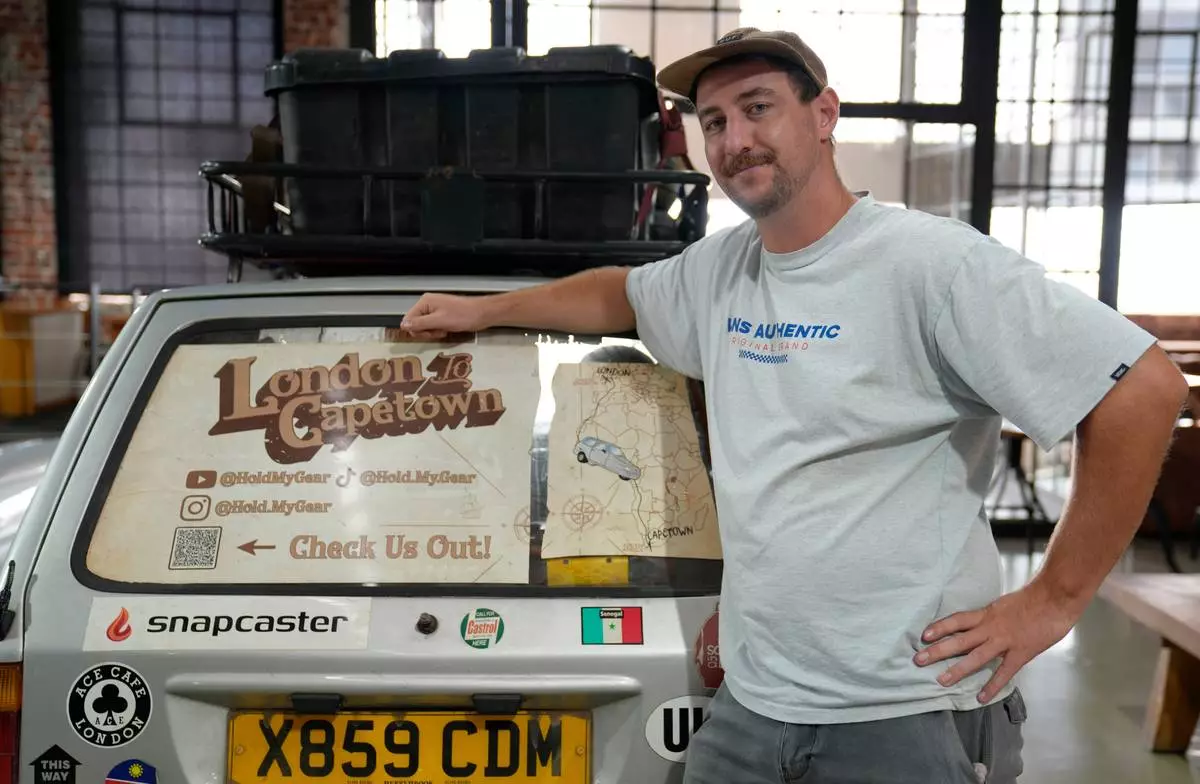
Oliver Jenks poses with the Reliant Robin called "Sheila the three-wheeler" he and Seth Scott drove from London to Cape Town in a bid to break a Guinness World Record for being the first to do the journey in a three-wheeled car in Cape Town, South Africa, Friday, March 20, 2026. (AP Photo/Nardus Engelbrecht)
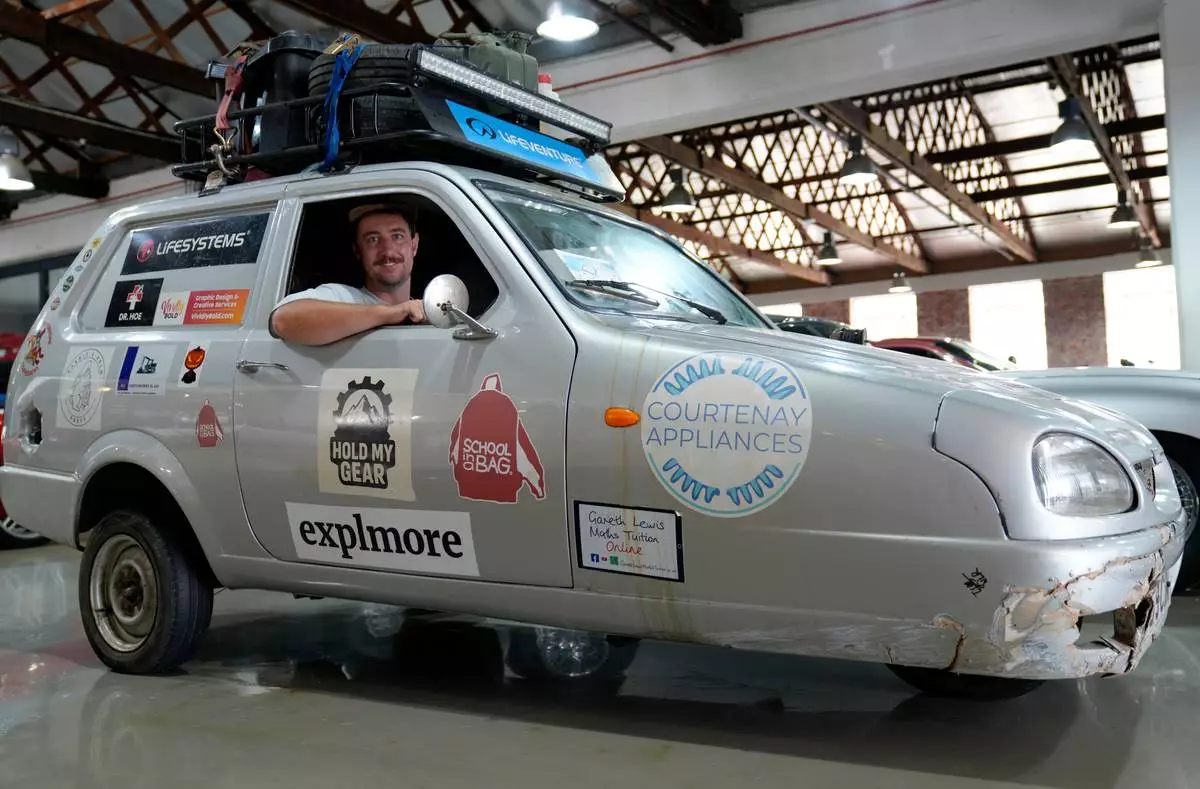
Oliver Jenks poses with the Reliant Robin called "Sheila the three-wheeler" he and Seth Scott drove from London to Cape Town in a bid to break a Guinness World Record for being the first to do the journey in a three-wheeled car in Cape Town, South Africa, Friday, March 20, 2026. (AP Photo/Nardus Engelbrecht)