The Mexican tax authority is auctioning 2,000 pieces of jewelry seized from criminals and tax cheats to raise money for building rural roads in western Mexico.
Ricardo Rodriguez Vargas is head of Mexico's Institute to Return the Stolen to the People. He said the goal of Sunday's sale is to raise 21 million pesos ($1.1 million) from the 148 lots of jewelry.
The auction took place outside Los Pinos, a mansion in the capital's Chapultepec Park that served as the official presidential residence until Dec. 1, when President Andrés Manuel López Obrador took office and turned the property into a cultural center open to the public.
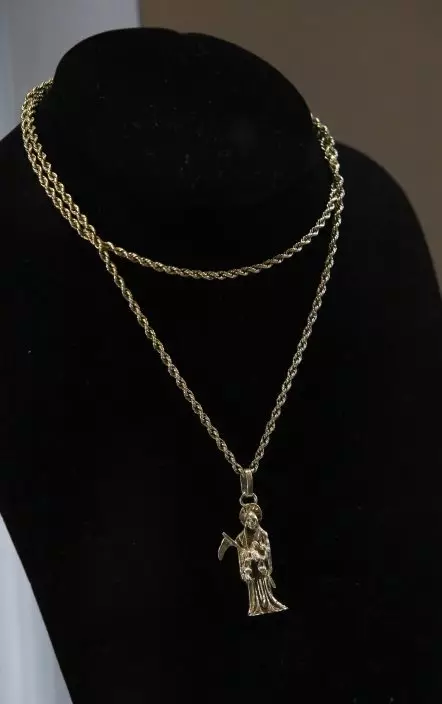
A necklace made of white gold with a pendant in the image of "Holy Death" is on display only during an auction of government seized jewelry at Los Pinos Cultural Center, formerly the presidential residence, in Mexico City, Sunday, July 28, 2019. This necklace was removed from the auction due to the image it represents and was only displayed. (AP PhotoGinnette Riquelme)
It's the third such auction of luxury goods organized by López Obrador, who has sought to set a tone of austerity in his administration.
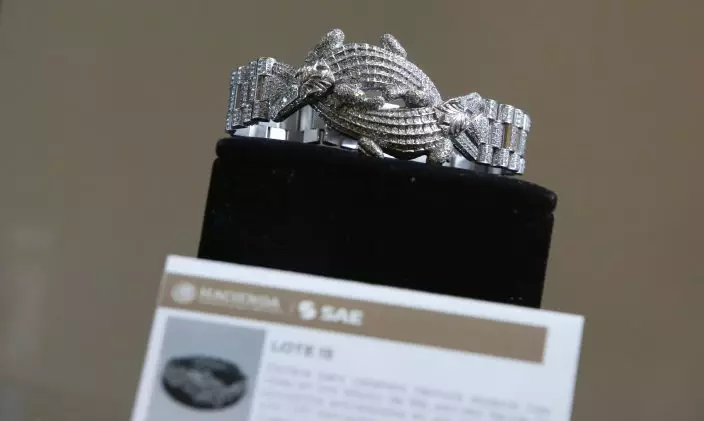
A men's bracelet made of 18K white gold and featuring two crocodiles entwined and covered with 1,331 diamonds is displayed to the public during an auction of government seized jewelry at Los Pinos Cultural Center, formerly the presidential residence, in Mexico City, Sunday, July 28, 2019. (AP PhotoGinnette Riquelme)
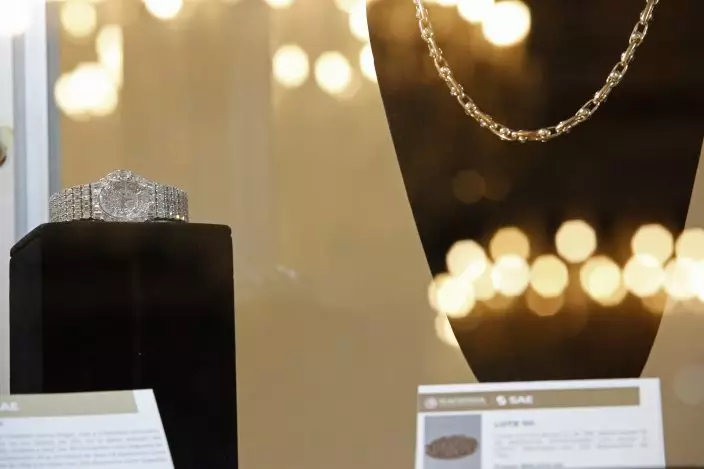
A men's watch is displayed during a public auction of government seized jewelry at Los Pinos Cultural Center, formerly the presidential residence, in Mexico City, Sunday, July 28, 2019. The watch is made of 18k white gold with 49 diamonds and had a starting price of 2,953,700.00 Mexican pesos (about $155,000 dollars). (AP PhotoGinnette Riquelme)
HAVANA (AP) — Cuban President Miguel Díaz-Canel said Monday that his administration is not in talks with the U.S. government, a day after President Donald Trump threatened the Caribbean island in the wake of the U.S. attack on Venezuela.
Díaz-Canel posted a flurry of brief statements on X after Trump suggested that Cuba “make a deal, BEFORE IT IS TOO LATE.” He did not say what kind of deal.
Díaz-Canel wrote that for “relations between the U.S. and Cuba to progress, they must be based on international law rather than hostility, threats, and economic coercion.”
He added: “We have always been willing to hold a serious and responsible dialogue with the various US governments, including the current one, on the basis of sovereign equality, mutual respect, principles of International Law, and mutual benefit without interference in internal affairs and with full respect for our independence."
His statements were reposted by Cuban Foreign Minister Bruno Rodríguez on X.
On Sunday, Trump wrote that Cuba would no longer live off oil and money from Venezuela, which the U.S. attacked on Jan. 3 in a stunning operation that killed 32 Cuban officers and led to the arrest of President Nicolás Maduro.
Cuba was receiving an estimated 35,000 barrels a day from Venezuela before the U.S. attacked, along with some 5,500 barrels daily from Mexico and roughly 7,500 from Russia, according to Jorge Piñón of the Energy Institute at the University of Texas at Austin, who tracks the shipments.
Even with oil shipments from Venezuela, widespread blackouts have persisted across Cuba given fuel shortages and a crumbling electric grid. Experts worry a lack of petroleum would only deepen the island's multiple crises.
The situation between the U.S. and Cuba is “very sad and concerning,” said Andy S. Gómez, retired dean of the School of International Studies and senior fellow in Cuban Studies at the University of Miami.
He said he sees Díaz-Canel’s latest comments “as a way to try and buy a little bit of time for the inner circle to decide what steps it’s going to take.”
Gómez said he doesn’t visualize Cuba reaching out to U.S. officials right now.
“They had every opportunity when President (Barack) Obama opened up U.S. diplomatic relations, and yet they didn’t even bring Cuban coffee to the table,” Gómez said. “Of course, these are desperate times for Cuba.”
Michael Galant, senior research and outreach associate at the Center for Economic and Policy Research in Washington, D.C., said he believes Cuba might be willing to negotiate.
“Cuba has been interested in finding ways to ease sanctions,” he said. “It's not that Cuba is uncooperative.”
Galant said topics for discussion could include migration and security, adding that he believes Trump is not in a hurry.
“Trump is hoping to deepen the economic crisis on the island, and there are few costs to Trump to try and wait that out,” he said. “I don’t think it’s likely that there will be any dramatic action in the coming days because there is no rush to come to the table.”
Cuba's president stressed on X that “there are no talks with the U.S. government, except for technical contacts in the area of migration.”
The island’s communist government has said U.S. sanctions cost the country more than $7.5 billion between March 2024 and February 2025.
Coto reported from San Juan, Puerto Rico.
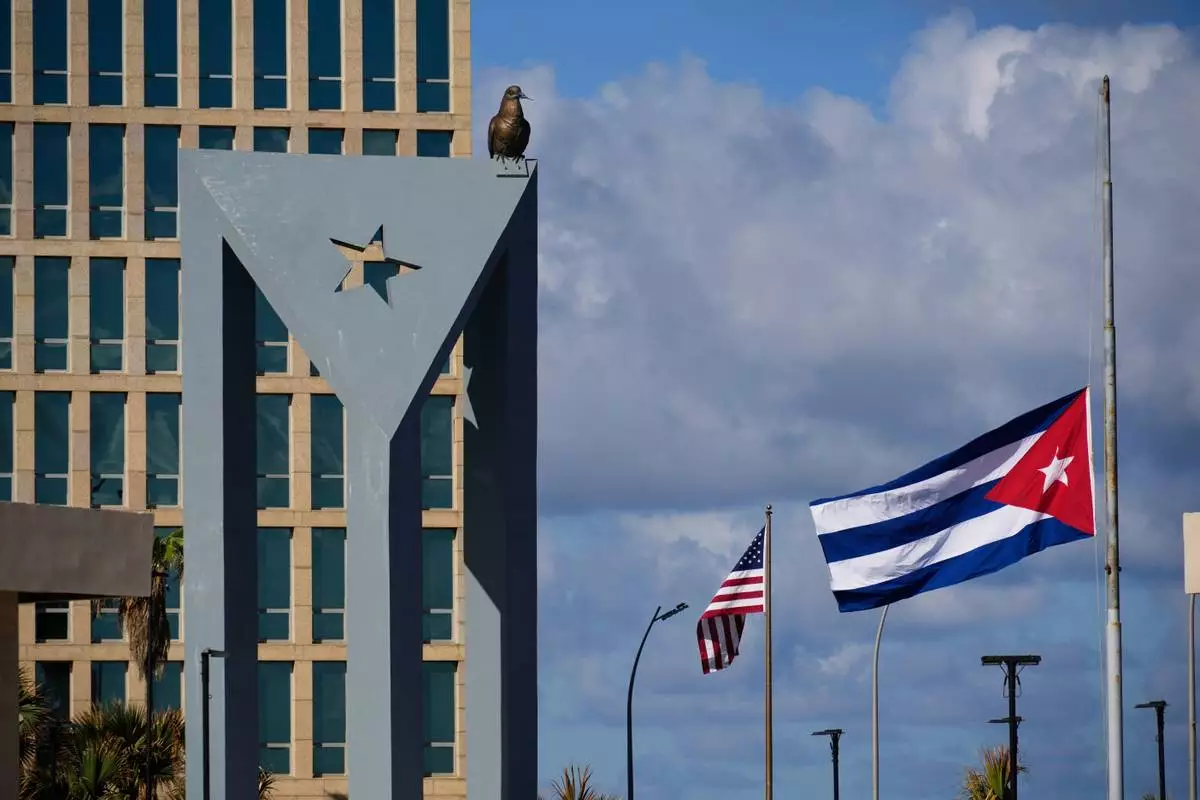
The Cuban flag flies at half-mast at the Anti-Imperialist Tribune near the U.S. embassy in Havana, Cuba, Monday, Jan. 5, 2026, in memory of Cubans who died two days before in Caracas, Venezuela during the capture of Venezuelan President Nicolas Maduro by U.S. forces. (AP Photo/Ramon Espinosa)