
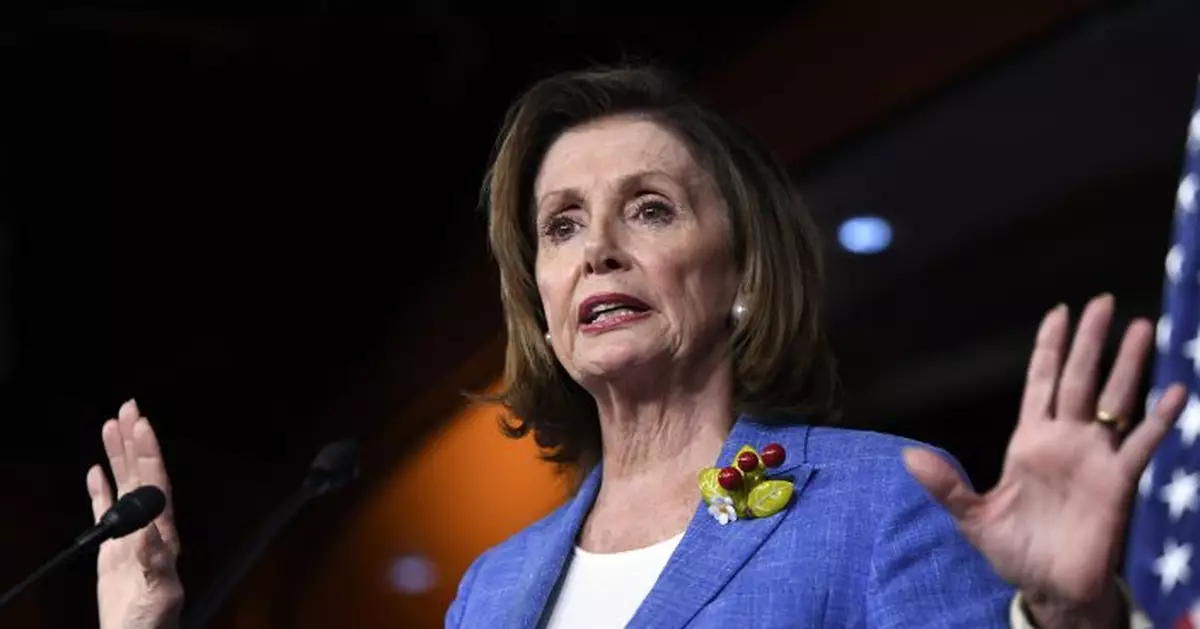
A hard-won, warts-and-all budget pact between House Speaker Nancy Pelosi and President Donald Trump is facing a key vote in the GOP-held Senate, with many conservatives torn between supporting the president and risking their political brand with an unpopular vote to add $2 trillion or more to the government's credit card.
The Trump-supported legislation backed by the Democratic speaker would also stave off a government shutdown and protect budget gains for both the Pentagon and popular domestic programs. It's attached to a must-do measure to lift the so-called debt limit to permit the government to borrow freely to pay its bills.
For many Republicans it's a tough vote, expected Wednesday afternoon. The tea party-driven House GOP conference broke against it by a 2-1 margin, but most pragmatists see the measure as preferable to an alternative fall landscape of high-wire deadlines and potential chaos. The government otherwise would face a potential debt default, an Oct. 1 shutdown deadline, and the return in January of across-the-board spending cuts known as sequestration.
Senate Majority Leader Mitch McConnell, R-Ky., is confident it will pass despite the misgivings of many Republicans.
But for new arrivals to the Senate, particularly those who ran against a broken Washington culture, the sweeping measure represents a lot of what they ran against: unrestrained borrowing and trillion-dollar deficits, fueled by a bipartisan thirst for new spending.
"This budget process, if we can even call it a process, put taxpayers at the mercy of a House Speaker who has no interest in prudent budgeting," said freshman Sen. Josh Hawley, R-Mo. "Our system is not supposed to work this way. When the entire federal budget depends on four or five people striking a deal among themselves, something is not right."
The budget and debt bill, however, is a top priority for McConnell, who set up the initial talks — taken over by Pelosi and Treasury Secretary Steven Mnuchin earlier this month — and pushed to isolate conservative forces in the White House who were disruptive. Top Senate Democrat Chuck Schumer of New York and House GOP leader Kevin McCarthy of California are also supporting the deal.
For House Republicans, as the minority party, it was easy to take a pass on voting for the legislation. Pelosi also made a point of showing she had enough Democratic votes to push it through without their help. But it's a different dynamic in the Senate, where Republicans hold the majority and are expected to deliver a strong vote for a Trump-backed agreement.
"Given the realities of divided government, it is a strong deal that achieves my Republican colleagues' and my No. 1 priority," McConnell said, citing gains for the military. "The Trump administration has negotiated their way to a major win on defense. The House has passed the compromise legislation. The president is ready and waiting to sign it."
Minority Whip Dick Durbin, D-Ill., said he expected a strong showing by the Senate's Democrats in favor of the bill. And GOP leadership stalwarts like Sens. Roy Blunt, R-Mo., Roger Wicker, R-Miss., and John Cornyn, R-Texas, swiftly swung behind the measure, calling it about the best result possible in a legislating matrix that demands Pelosi's blessing for bills to become law.
"So what price did we have to pay to get this? We had to give Nancy Pelosi a 4% increase this year in domestic spending and zero increase next year for an average annual increase that's less than the growth in (gross domestic product)," Wicker said, adding that many House Republicans took the "vote no, hope yes" approach to the legislation.
"I want to know what better deal anybody could have crafted that got Nancy Pelosi's sign-off in the House and Mitch McConnell's sign-off in the Senate, along with McCarthy and Schumer," Wicker said.
The agreement between the administration and Pelosi lifts the limit on the government's $22 trillion debt for two years and averts the risk of the Pentagon and domestic agencies from being hit with $125 billion in automatic spending cuts that are the last gasp of the 2011 budget deal.
CARACAS, Venezuela (AP) — Venezuela’s parliament on Tuesday approved a measure that criminalizes a broad range of activities that can hinder navigation and commerce in the South American country, such as the seizure of oil tankers.
The bill — introduced, debated and approved within two days in the National Assembly — follows this month's seizures by U.S. forces of two tankers carrying Venezuelan oil in international waters. The seizures are the latest strategy in U.S. President Donald Trump's four-month pressure campaign on Venezuela's leader Nicolás Maduro.
The tankers are part of what the Trump administration has said is a fleet Venezuela uses to evade U.S. economic sanctions.
The unicameral assembly, which is controlled by Venezuela's ruling party, did not publish drafts on Tuesday nor the final version of the measure. But as read on the floor, the bill calls for fines and prison sentences of up to 20 years for anyone who promotes, requests, supports, finances or participates in “acts of piracy, blockades or other international illegal acts” against commercial entities operating with the South American country.
Venezuela's political opposition, including Nobel Peace laureate María Corina Machado, has expressed support for Trump's Venezuela policy, including the seizure of tankers. Machado and Trump have both repeatedly said that Maduro's days in power are numbered.
The bill, which now awaits Maduro’s signature, also instructs the executive branch to come up with “incentives and mechanisms for economic, commercial and other protections” for national or foreign entities doing business with Venezuela in the event of piracy activities, a maritime blockade or other unlawful acts.
The U.S. Coast Guard on Saturday seized a Panama-flagged vessel called Centuries that officials said was part of the fleet moving sanctioned cargo. With assistance from the U.S. Navy, it seized a rogue tanker called Skipper on Dec. 10. That ship was registered in Panama.
Trump, after that first seizure, said the U.S. would carry out a “blockade” of Venezuela. He later demanded that Venezuela return assets that it seized from U.S. oil companies years ago, justifying anew his announcement of the blockade against sanctioned oil tankers traveling to or from the South American country.
At an emergency meeting of the U.N. Security Council called by Venezuela, U.S. Ambassador Mike Waltz on Tuesday stressed that sanctioned oil tankers “operate as the primary economic lifeline for Maduro and his illegitimate regime.”
“Maduro’s ability to sell Venezuela’s oil enables his fraudulent claim to power and his narco-terrorist activities,” Waltz said. “The United States will impose and enforce sanctions to the maximum extent to deprive Maduro of the resources he uses to fund Cartel de los Soles.”
Maduro was indicted in 2020 on narcoterrorism charges in the U.S. and accused of leading the Cartel de los Soles, which the Trump administration designated as a foreign terrorist organization last month. But the entity is not a cartel per se.
Venezuelans began using the term Cartel de los Soles in the 1990s to refer to high-ranking military officers who had grown rich from drug-running. As corruption expanded nationwide, its use loosely expanded to police and government officials as well as activities like illegal mining and fuel trafficking.
At Tuesday's meeting, Venezuela’s U.N. Ambassador Samuel Moncada accused the U.S. of acting “outside international law” and its own domestic laws, by demanding that Venezuelans vacate the country and hand it over to the Trump administration, including all its oil fields.
“What right does the United States government have to appropriate, to date, almost 4 million barrels of Venezuelan oil?” Moncada asked, referring to the cargo of the two seized tankers. “This alleged naval blockade is essentially a military act aimed at laying siege to the Venezuelan nation, degrading its economic and military apparatus, weakening its social and political cohesion, and causing internal chaos to facilitate aggression by external forces.”
Many countries expressed concern about violations of international maritime law and adhering to the United Nations Charter, which requires all 193 member nations to respect the sovereignty and territorial integrity of every other country. The United States’ actions were supported by a few countries, including Panama and Argentina.
Associated Press writer Edith Lederer in New York contributed to this report.
Lawmaker Giuseppe Alessandrello gives a speech during an extraordinary session at the National Assembly in Caracas, Venezuela, Monday, Dec. 22, 2025. (AP Photo/Matias Delacroix)
Evana, an oil tanker, is docked at El Palito port in Puerto Cabello, Venezuela, Sunday, Dec. 21, 2025. (AP Photo/Matias Delacroix)