GENEVA (AP) — A U.S. official focusing on arms control on Monday provided what he called new, declassified details of a Chinese underground nuclear test nearly six years ago and urged countries to press China and Russia to do more on nuclear disarmament.
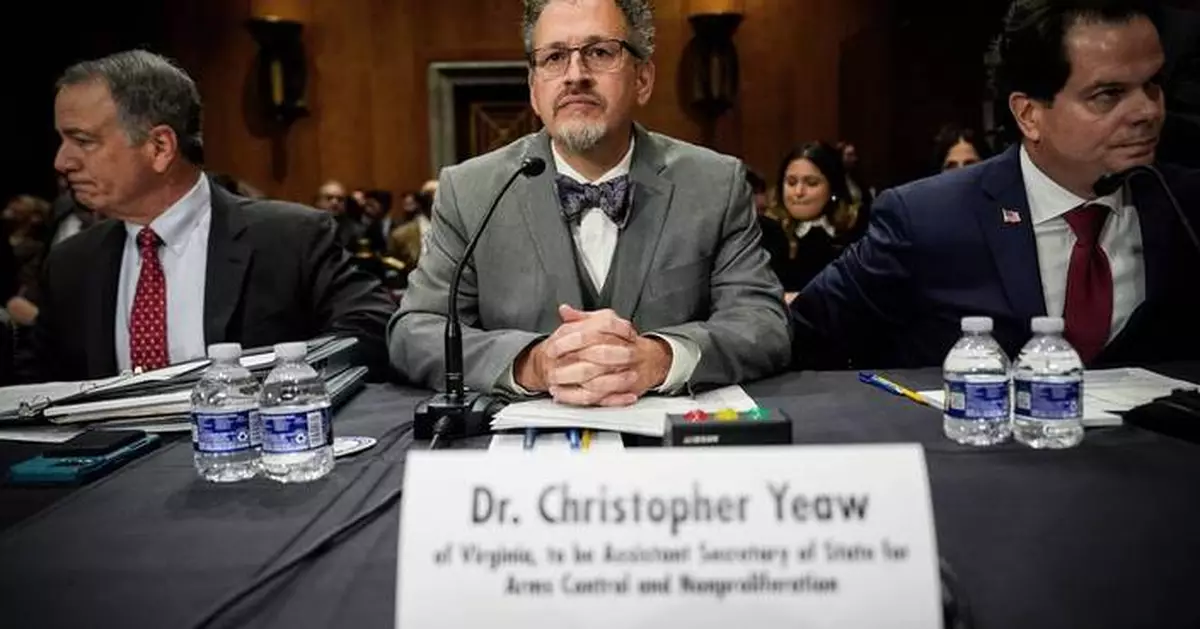
Christopher Yeaw, assistant secretary of state for the bureau of arms control and nonproliferation, spoke to a U.N.-backed body after the last nuclear arms pact between the United States and Russia expired this month. That has ended limits on the arsenals of the world’s biggest nuclear powers and raised concerns about a possible new arms race.
Yeaw called for greater transparency from China and pointed to some shortcomings of the New START treaty, such as that it didn't address Russia's large arsenal of nonstrategic nuclear weapons — which counts up to 2,000 warheads.
“But perhaps its greatest flaw was that New START did not account for the unprecedented, deliberate, rapid and opaque nuclear weapons buildup by China,” he told the U.N.-backed Conference on Disarmament.
Yeaw said Beijing “has deliberately, and without constraint, massively expanded its nuclear arsenal” despite its assurances to the contrary. He lamented a lack of transparency about China's “endpoint” or goals.
“We believe China may achieve parity within the next four or five years,” he said.
Beijing has balked at any restrictions on its smaller but growing nuclear arsenal and denies carrying out such a nuclear test.
Yeaw met Monday with a Russian delegation and was to meet with Chinese and other delegations Tuesday in Geneva. U.S. officials have already held repeated meetings with partners, including nuclear-armed France and Britain.
In his speech, Yeaw cited an explosion detected at the Lop Nur underground site in western China as a magnitude 2.75 seismic event on June 22, 2020, based on information collected from an international monitoring system station in neighboring Kazakhstan.
“It was a probable explosion based upon comparisons between historic explosions and earthquakes,” he said. “The seismic signals were indicative of a single fire explosion, not typical of mining explosions.”
Yeaw said China has made it “difficult” for the international community to monitor its testing activities and that during talks, it rejected allowing seismic testing stations to be put at a comparable distance to Lop Nur that the U.S. allows near its test site in Nevada.
China's ambassador to the conference said Monday that Beijing “resolutely rejects the unfounded accusations” by the U.S. and lashed out at “continued distortion and smearing of China’s nuclear policy by certain countries.”
“The U.S. accusation that China conducted a nuclear explosion test is completely unfounded and is merely a pretext for resuming its own nuclear testing,” Ambassador Jian Shen said. “The U.S.’s practice of smearing other countries to evade international arms control obligations seriously damages its own international standing.”
If China conducted yield-producing nuclear explosive tests, it would severely tarnish its reputation as a responsible nuclear power, said Tong Zhao, a senior fellow focused on nuclear policy and China at the Carnegie Endowment for International Peace in Washington.
Some in the U.S. could cite that as justification for testing weapons again.
“There are American nuclear weapon scientists who genuinely think, no matter what other countries do, that the U.S. needs to resume nuclear testing simply to ensure its own arsenal would be reliable in the long run,” Zhao said.
President Donald Trump in October pointed to U.S. intentions to resume nuclear tests for the first time since 1992, but Energy Secretary Chris Wright later said such tests would not include nuclear explosions.
Yeaw, speaking last week at the Hudson Institute, a think tank in Washington, pointed to Trump’s previous comments by saying the U.S. will return to testing on an “equal basis.” He said that doesn’t mean “Ivy Mike-style atmospheric testing” but “presumes a response to a prior standard. Look no further than China or Russia for that standard.”
In his first term, Trump tried and failed to push for a three-way nuclear pact involving China.
Just after the New START pact expired, Secretary of State Marco Rubio said the U.S. was “pursuing all avenues” to fulfill Trump’s “desire for a world with fewer of these awful weapons” but insisted Washington would not stand by while Russia and China expand their nuclear forces.
“Since 2020, China has increased its nuclear weapons stockpile from the low 200s to more than 600 and is on pace to have more than 1,000 warheads by 2030,” Rubio wrote on Substack this month.
The U.S. has expressed a willingness to pursue multiple diplomatic avenues over the issue — whether bilateral, in a small group of countries or in broader multilateral talks.
“We are looking to all of you to help encourage nuclear-weapon states like China and Russia to engage meaningfully in a multilateral process,” Yeaw told the conference, which brings together some 65 countries on issues like nuclear, biological and chemical weapons.
Shen said China has consistently supported the goals of the Comprehensive Nuclear Test Ban Treaty, “always adhered” to the commitments of the five nuclear weapons states to suspend nuclear testing and “never” engaged in activities that violate the treaty.
He also suggested Beijing, which has been on a vigorous military buildup in recent years, still has fewer nuclear weapons than the U.S. or Russia and said it was “unfair, unreasonable and unfeasible” to demand China engage in three-way nuclear arms control talks.
“China’s nuclear arsenal is not on the same scale as the country with the largest nuclear arsenal, and the strategic security environment faced by China’s nuclear policy is completely different from that of the U.S.,” Shen said.
Associated Press writers Didi Tang and Ben Finley in Washington contributed to this report.
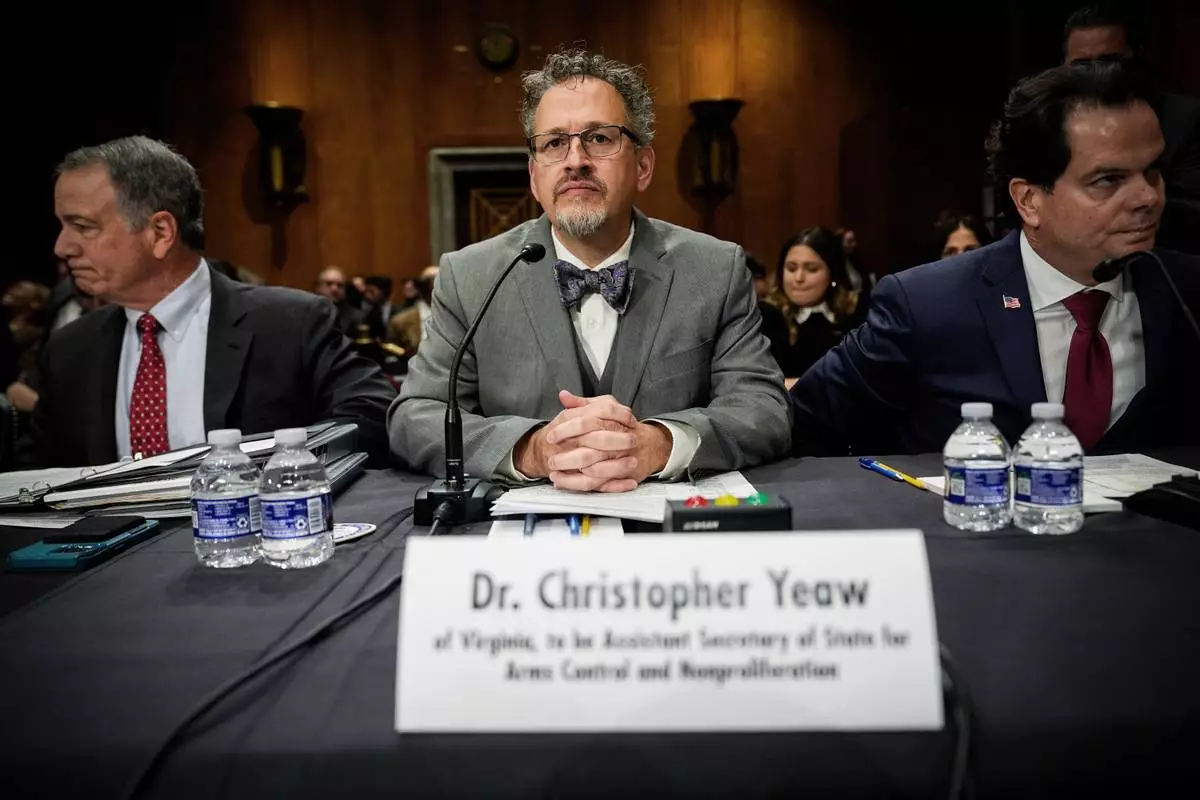
FILE - Christopher Yeaw, center, arrives to a Senate Foreign Relations Committee confirmation hearing on his nomination to be an assistant Secretary of State, Nov. 19, 2025, on Capitol Hill in Washington. (AP Photo/Julia Demaree Nikhinson, File)
TAPALPA, Mexico (AP) — A day after the Mexican army killed the country's most powerful drug lord, the picturesque town where it happened was a study in contrasts.
Tourist shops in Tapalpa were open Monday, and workers were on the job. But gunshots also rang out, and in the street was a dead man lying beside a bullet-pocked vehicle.
Meanwhile, heavily armed Mexican security forces kept up their battle with cartel gunmen following the killing that sparked a surge in violence and put the country on edge. Cartel fighters continued to block roads as smoke rose on the outskirts of the town in the state of Jalisco.
More than 70 people died in the attempt to capture Nemesio Oseguera Cervantes and the aftermath, authorities said Monday. Known as as “El Mencho,” he was the notorious leader of the Jalisco New Generation Cartel, one of the most powerful criminal organizations in Mexico.
The body count taken by security officials included security forces, suspected cartel members and others. Officials did not offer details, and the circumstances of most of the deaths were unclear.
Oseguera Cervantes was the boss of one of the fastest-growing criminal networks in Mexico, known for trafficking fentanyl, methamphetamine and cocaine to the United States and staging brazen attacks against Mexican government officials. The organization responded to his death with widespread violence, including erecting more than 250 roadblocks across 20 states and setting fire to vehicles.
Oseguera Cervantes died after a shootout with the Mexican military. Mexican Defense Secretary Ricardo Trevilla said Monday that authorities had followed one of his romantic partners to his hideout in Tapalpa.
The cartel leader and two bodyguards fled into a wooded area where they were seriously wounded in a firefight. They were taken into custody and died on the way to Mexico City, Trevilla said.
In a different location in Jalisco, soldiers killed another high-ranking cartel member who Trevilla said was coordinating violence and offering more than $1,000 for every soldier killed.
The dead included 25 members of the Mexican National Guard who were killed in six separate attacks, Security Secretary Omar García Harfuch said.
Harfuch said some 30 criminal suspects were killed in Jalisco, and four others were killed in the neighboring state of Michoacan. Also killed were a prison guard and an agent from the state prosecutor’s office.
As the threat of more violence loomed, several Mexican states canceled school Monday, while local and foreign governments warned their citizens to stay inside.
The White House confirmed that the U.S. provided intelligence support to the operation to capture the cartel leader and applauded Mexico's army for taking down a man who was one of the most wanted criminals in both countries.
Mexico hoped the death of the world's biggest fentanyl traffickers would ease Trump administration pressure to do more against the cartels, but many people were anxious as they waited to see the powerful cartel's reaction.
The U.S. Embassy said via X that its personnel in eight cities and in the state of Michoacan would shelter in place and work remotely Monday. It warned U.S. citizens in many parts of Mexico to do the same.
Cars began circulating in Guadalajara before sunrise Monday with the start of the workweek, a notable change from Sunday, when Jalisco's state capital and Mexico's second-largest city was almost completely shut down as fearful residents stayed home.
More than 1,000 people were stuck overnight in Guadalajara’s zoo, where they slept in buses.
Luis Soto Rendón, the zoo’s director, said many had been trapped there since Sunday morning, when violence broke out in Jalisco and the surrounding states. Families concluded they could not return home in nearby states like Zacatecas and Michoacan.
“We decided to let people stay inside the zoo for their safety,” Soto said. “There are small children and senior citizens.”
José Luis Ramírez, a 54-year-old therapist, was in a long line of people waiting outside a pharmacy, one of the few businesses that were open Monday in Guadalajara. Families were buying food, medicine, water, diapers and baby formula, from pharmacists through a chained door.
It was Ramírez’s first time leaving the house since the violence erupted, but he struck a hopeful tone, saying that despite the bloodshed, civilians needed to move forward.
“We have to not think scared, but be cool-headed, like they say, and take things as they come,” he said.
Those who had to work carefully made their way across the city.
Irma Hernández, a 43-year-old hotel security guard in Guadalajara, normally takes public transportation to her job, but buses were not running, and she had no way to cross the city. Her bosses organized a private car to pick her up. Her family, she said, was staying at home, too scared to leave.
“I am worried because I don't know how to get home if something happens,” she said.
U.S. President Donald Trump has demanded Mexico do more to fight the smuggling of fentanyl, threatening to impose more tariffs or take unilateral military action if the country does not show results.
The operation may also pave the way for more violence as rival criminal groups take advantage of the blow dealt to El Mencho's organization, said David Mora, Mexico analyst for the International Crisis Group.
“This might be a moment in which those other groups see that the cartel is weakened and want to seize the opportunity for them to expand control and to gain control over Cartel Jalisco in those states,” he said.
Ever since President Claudia Sheinbaum took office, "the army has been way more confrontational, combative against criminal groups in Mexico,” Mora said. “This is signaling to the U.S. that if we keep cooperating, sharing intelligence, Mexico can do it. We don’t need U.S. troops on Mexican soil."
The U.S. State Department had offered a reward of up to $15 million for information leading to the arrest of El Mencho. The Jalisco New Generation Cartel began operating around 2009.
In February 2025, the Trump administration designated the cartel as a foreign terrorist organization. It has been one of the most aggressive cartels in its attacks on the military — including on helicopters — and is a pioneer in launching explosives from drones and installing mines.
At a blockade Monday on the outskirts of Tapalpa, 25-year-old Joel Ramírez and two friends were waiting for soldiers to clear a blockade of tree limbs. He hauls things in his pickup for a living and had not been able to get home since Sunday's violence.
“Everything seems calmer, but we were almost there and got stuck,” he said. “We're scared.”
Verza reported from Mexico City. Associated Press writer Fabiola Sánchez in Mexico City also contributed to this report.
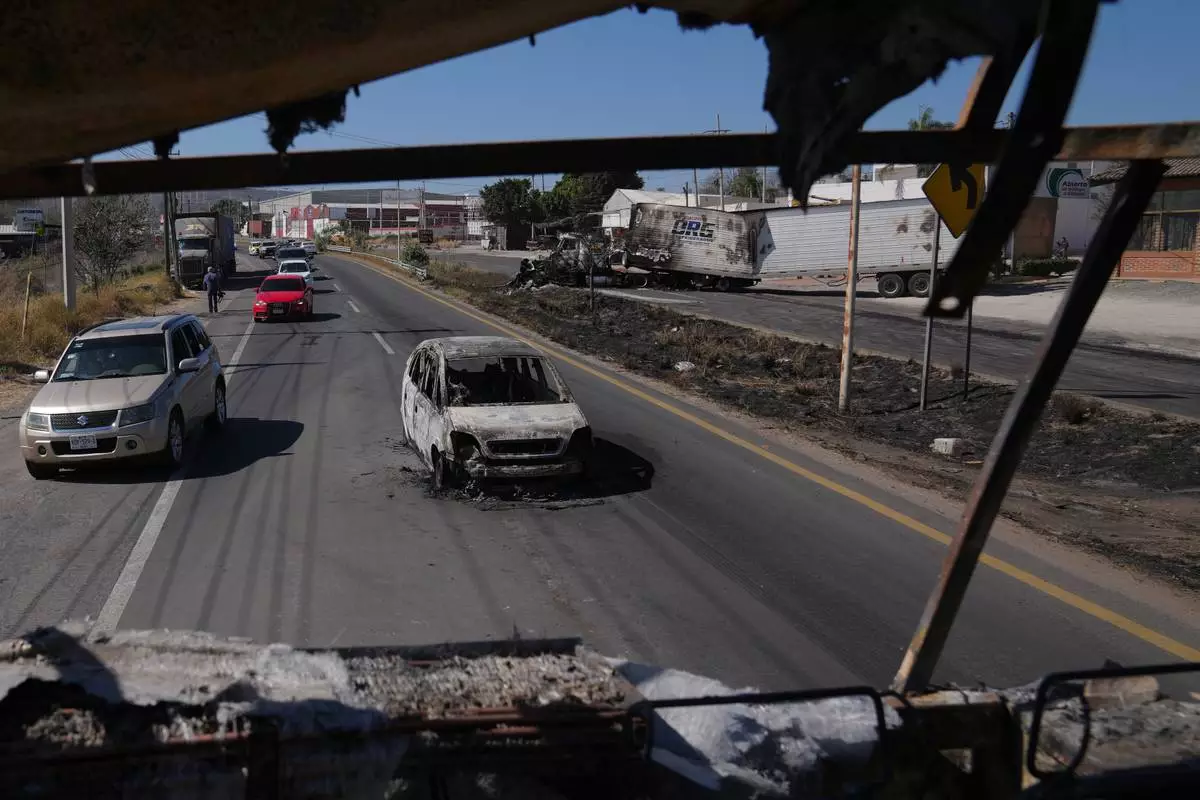
Vehicles pass a burned car a day after the Mexican army killed the leader of the Jalisco New Generation Cartel, Nemesio Oseguera Cervantes, known as "El Mencho," in Guadalajara, Mexico, Monday, Feb. 23, 2026. (AP Photo/Marco Ugarte)
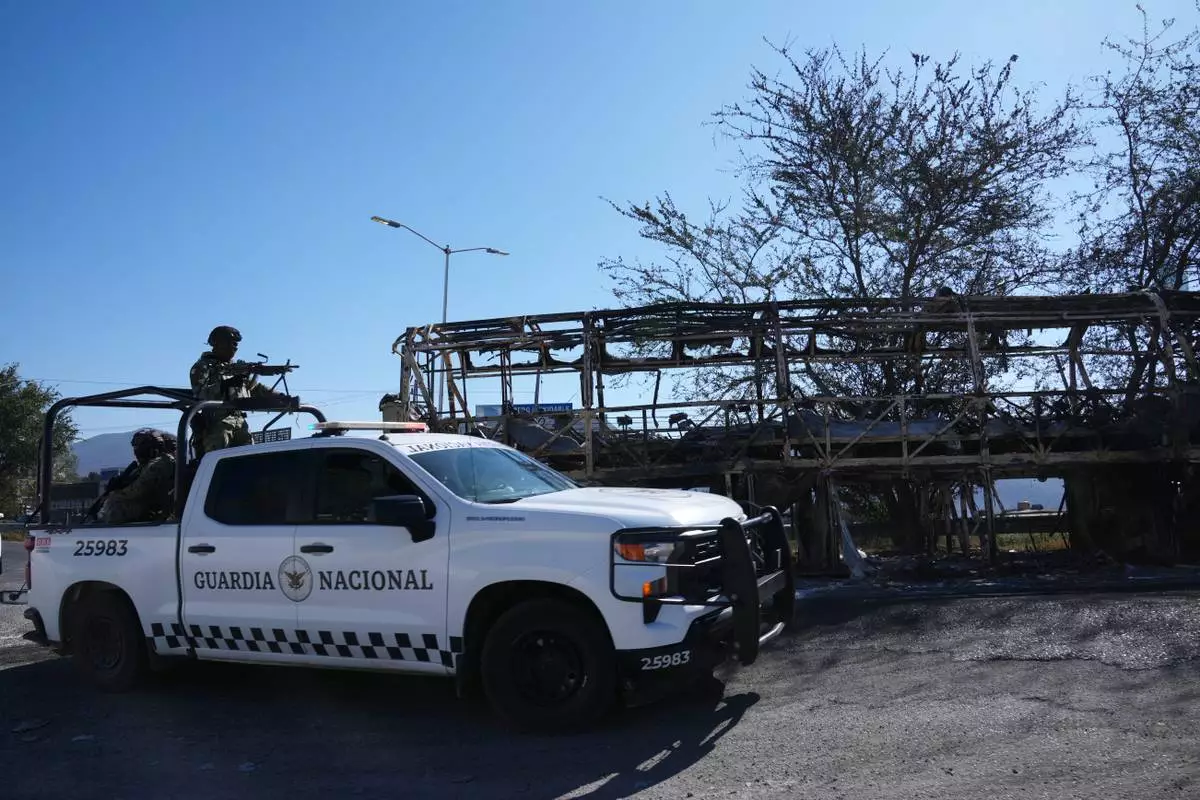
National Guard patrol past a charred vehicle the day after the Mexican army killed Jalisco New Generation Cartel leader Nemesio Oseguera Cervantes, known as "El Mencho," in Guadalajara, Mexico, Monday, Feb. 23, 2026. (AP Photo/Marco Ugarte)
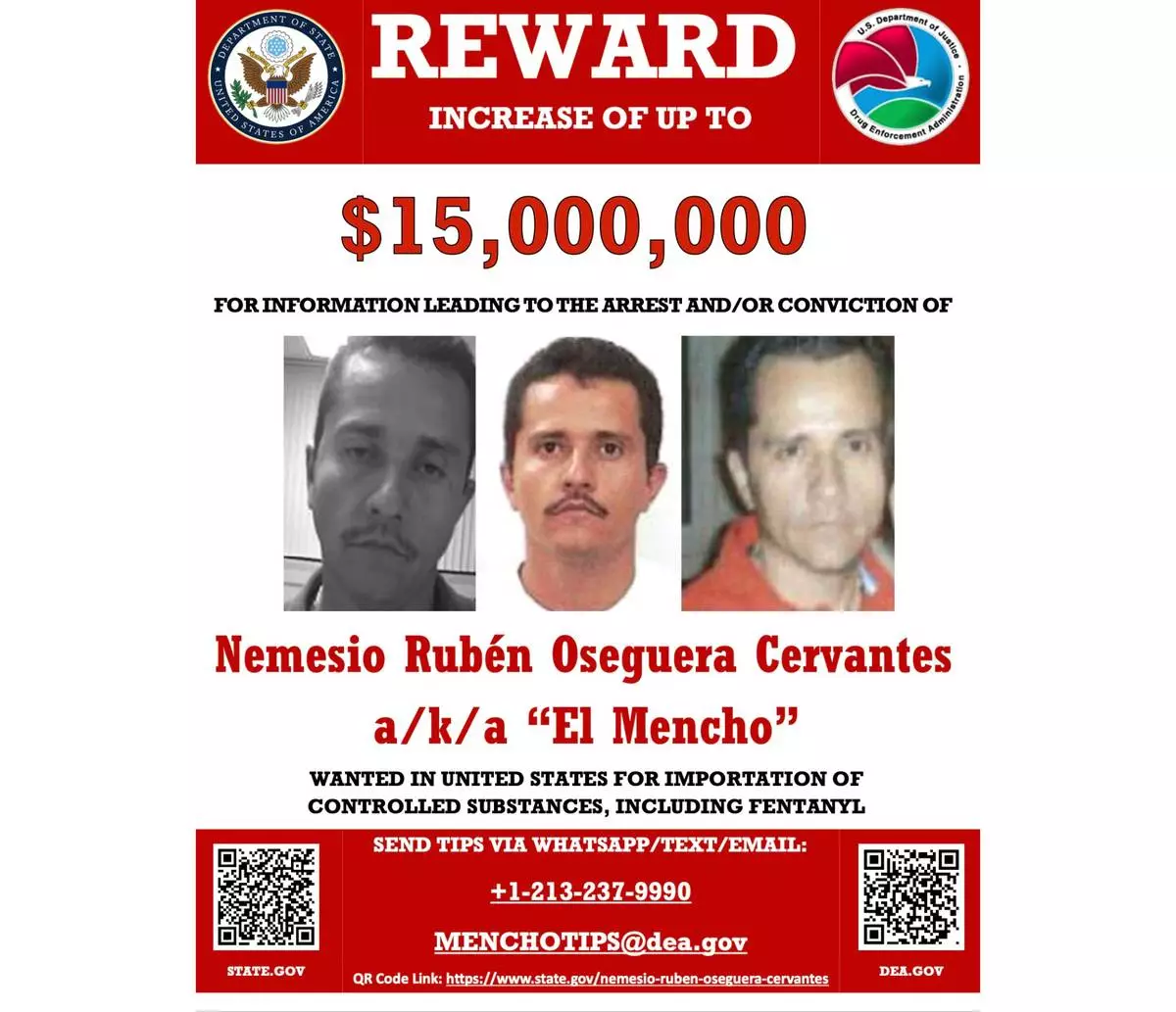
This wanted poster released on Dec. 4, 2024 on the U.S. State Department website shows leader of the Jalisco New Generation Cartel, Nemesio Rubén Oseguera Cervantes, known as “El Mencho.” (U.S. State Department via AP)
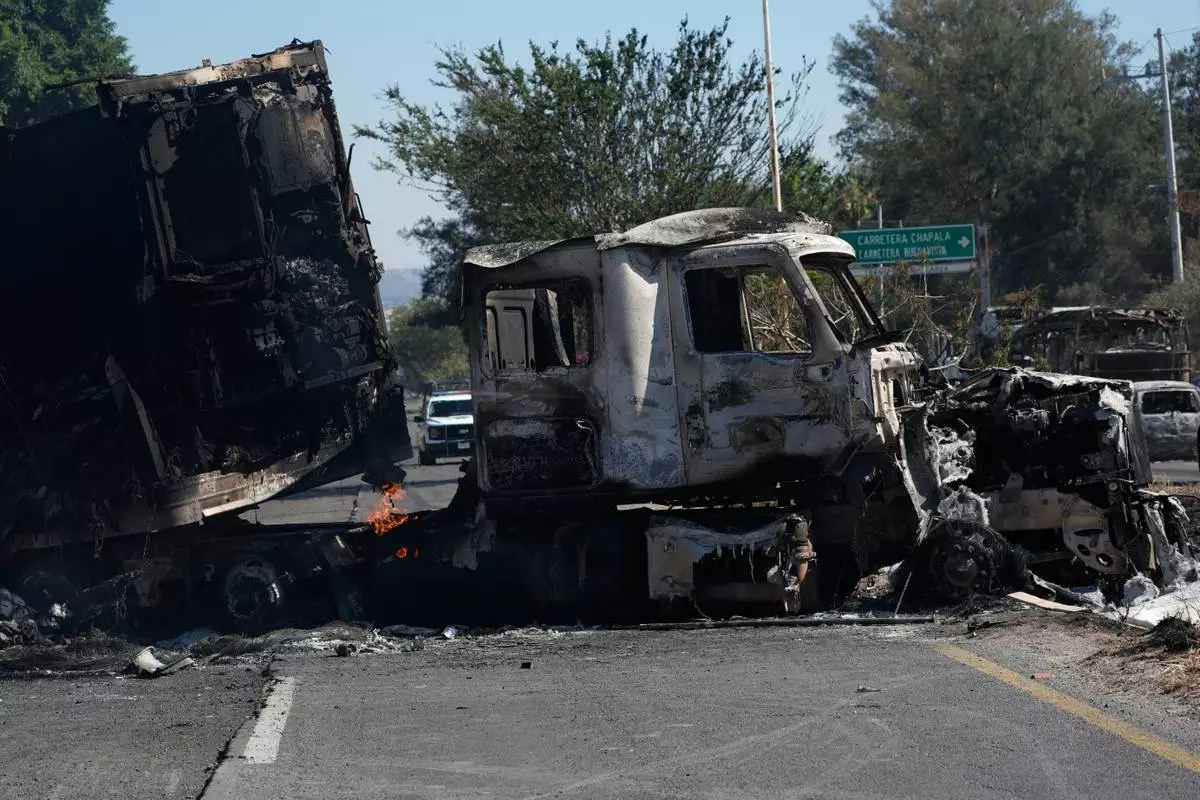
A charred truck blocks a road the day after the Mexican army killed Jalisco New Generation Cartel leader Nemesio Oseguera Cervantes, known as "El Mencho," in Guadalajara, Mexico, Monday, Feb. 23, 2026. (AP Photo/Marco Ugarte)
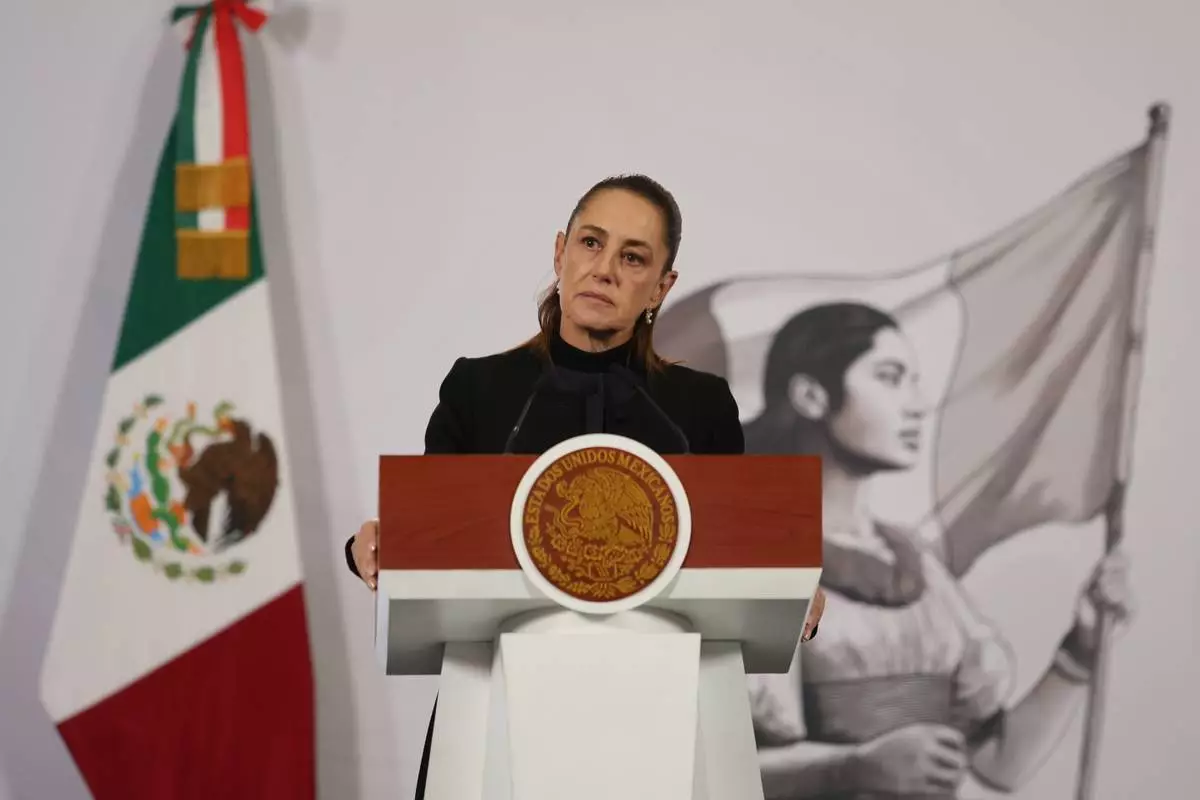
Mexican President Claudia Sheinbaum gives her the daily, morning news conference at the National Palace in Mexico City, Monday, Feb. 23, 2026, the day after the Mexican army killed Jalisco New Generation Cartel leader Nemesio Oseguera Cervantes, known as "El Mencho." (AP Photo/Ginnette Riquelme)
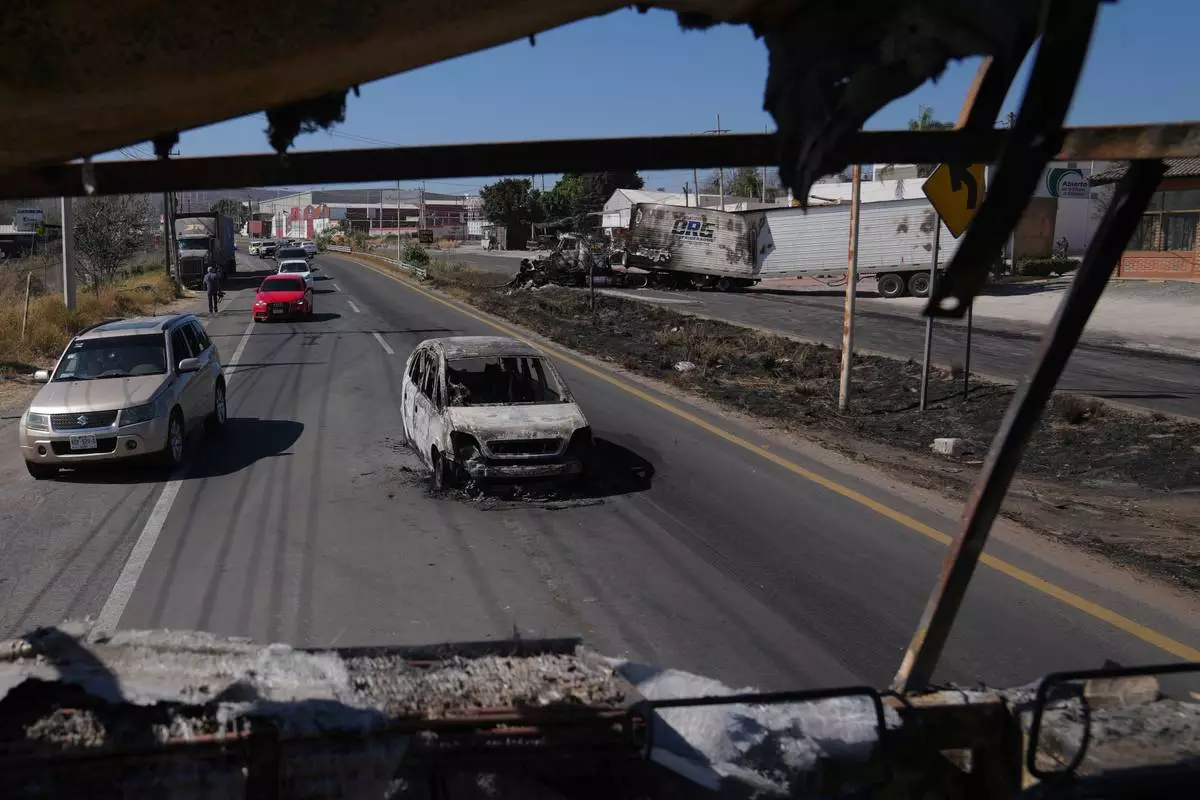
Vehicles pass a burned car a day after the Mexican army killed Jalisco New Generation Cartel leader Nemesio Oseguera Cervantes, known as "El Mencho," in Guadalajara, Mexico, Monday, Feb. 23, 2026. (AP Photo/Marco Ugarte)
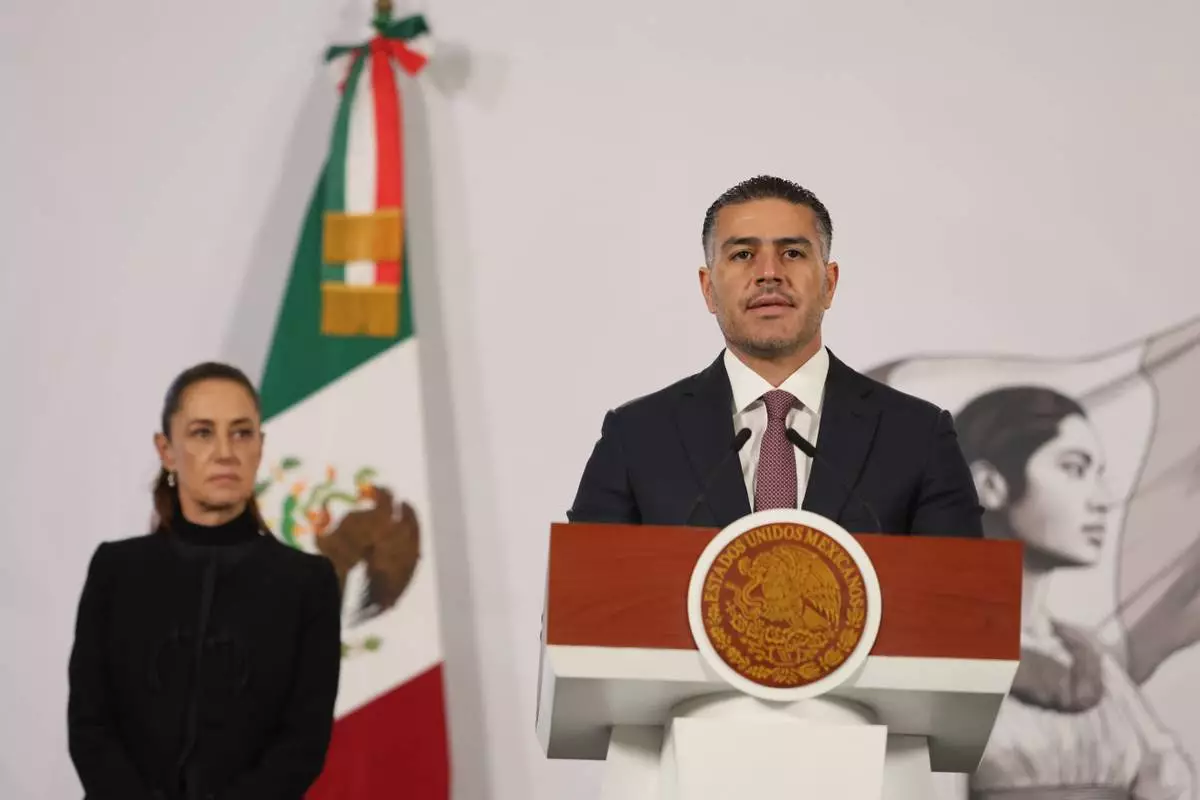
Mexican Security and Citizen Protection Minister Omar Garcia Harfuch speaks as President Claudia Sheinbaum looks on during her daily, morning news conference at the National Palace in Mexico City, Monday, Feb. 23, 2026, the day after the Mexican army killed Jalisco New Generation Cartel leader Nemesio Oseguera, known as "El Mencho." (AP Photo/Ginnette Riquelme)
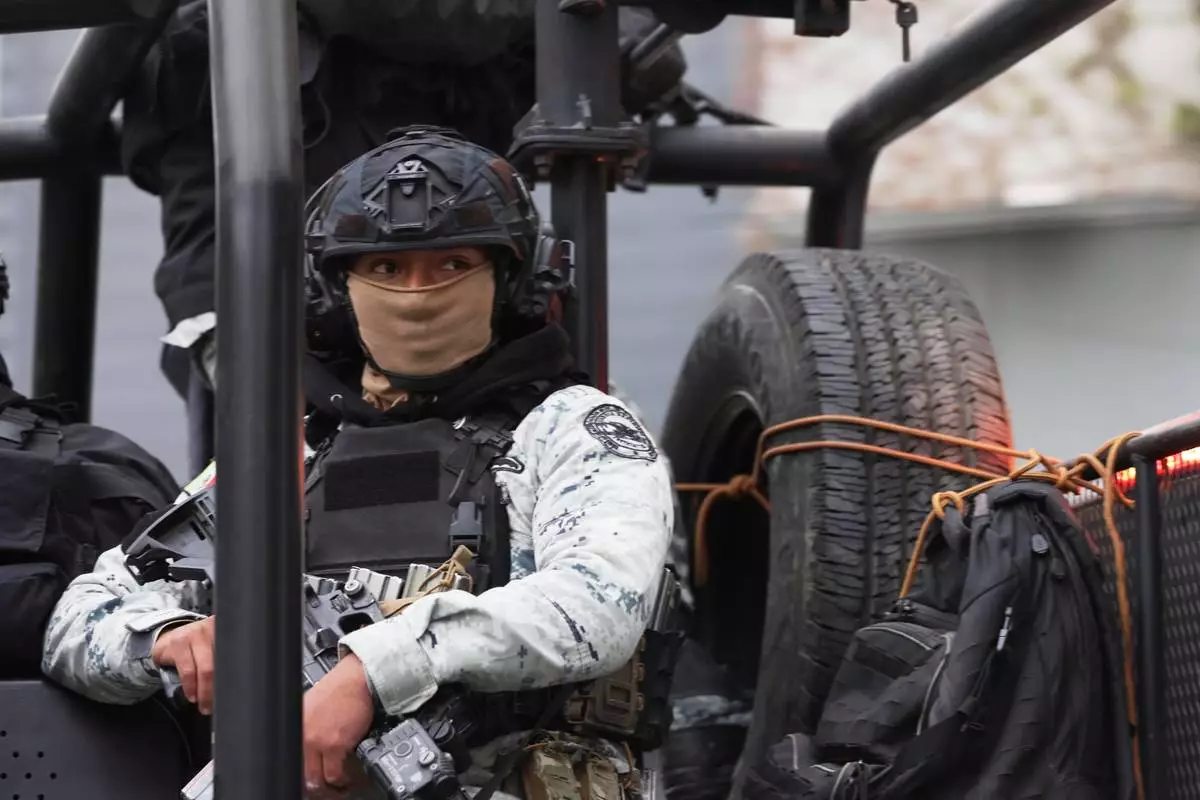
A National Guard patrols the area outside of the General Prosecutor's headquarters in Mexico City, Sunday, Feb. 22, 2026, after authorities reported that the Mexican Army killed Jalisco New Generation Cartel leader Nemesio Oseguera, known as "El Mencho." (AP Photo/Ginette Riquelme)
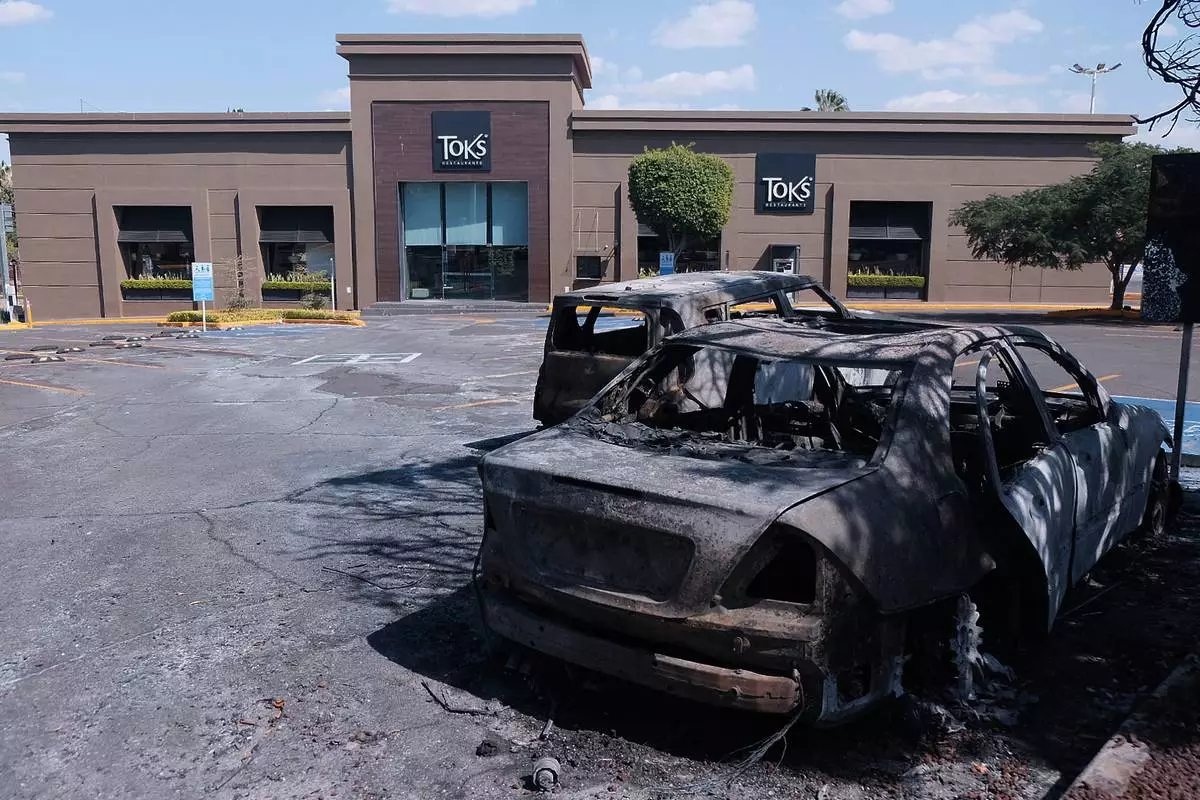
Charred vehicles sit in a parking lot sit outside a shopping mall in Guadalajara, Jalisco state, Mexico, Sunday, Feb. 22, 2026, as authorities reported that the Mexican Army killed Jalisco New Generation Cartel leader Nemesio Oseguera, known as "El Mencho." (AP Photo/Alejandra Leyva)
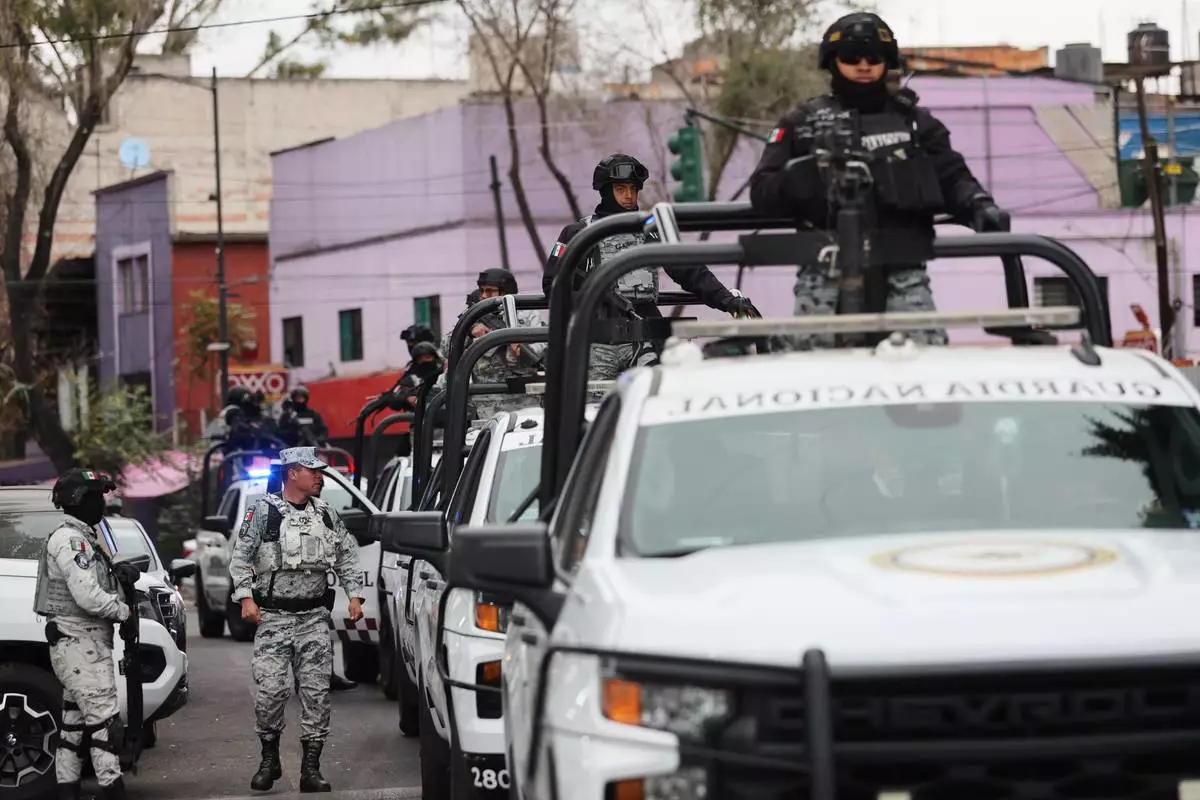
National Guards patrol the area outside of the General Prosecutor's headquarters in Mexico City, Sunday, Feb. 22, 2026, after authorities reported that the Mexican Army killed Jalisco New Generation Cartel leader Nemesio Oseguera, known as "El Mencho." (AP Photo/Ginette Riquelme)
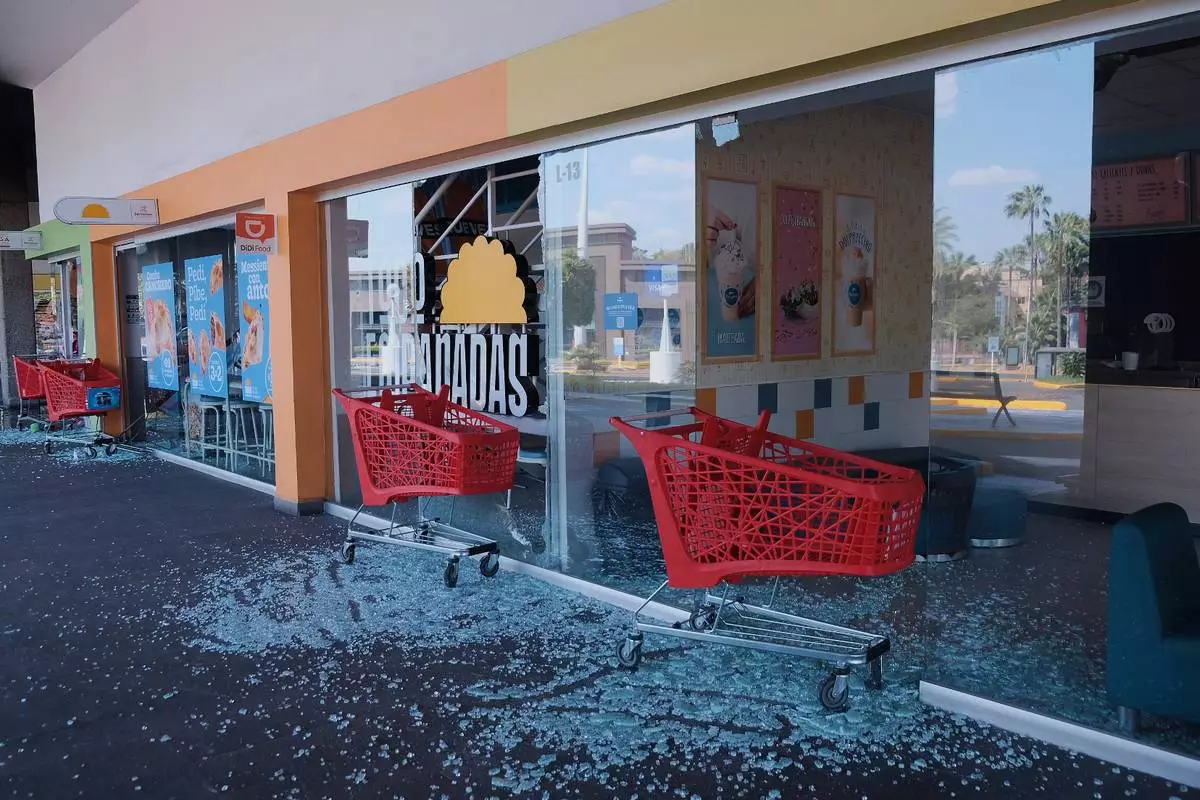
Carts stand outside of a vandalized supermarket in Guadalajara, Jalisco state, Mexico, Sunday, Feb. 22, 2026, after the death of the leader of the Jalisco New Generation Cartel, Nemesio Rubén Oseguera Cervantes, known as "El Mencho." (AP Photo/Alejandra Leyva)
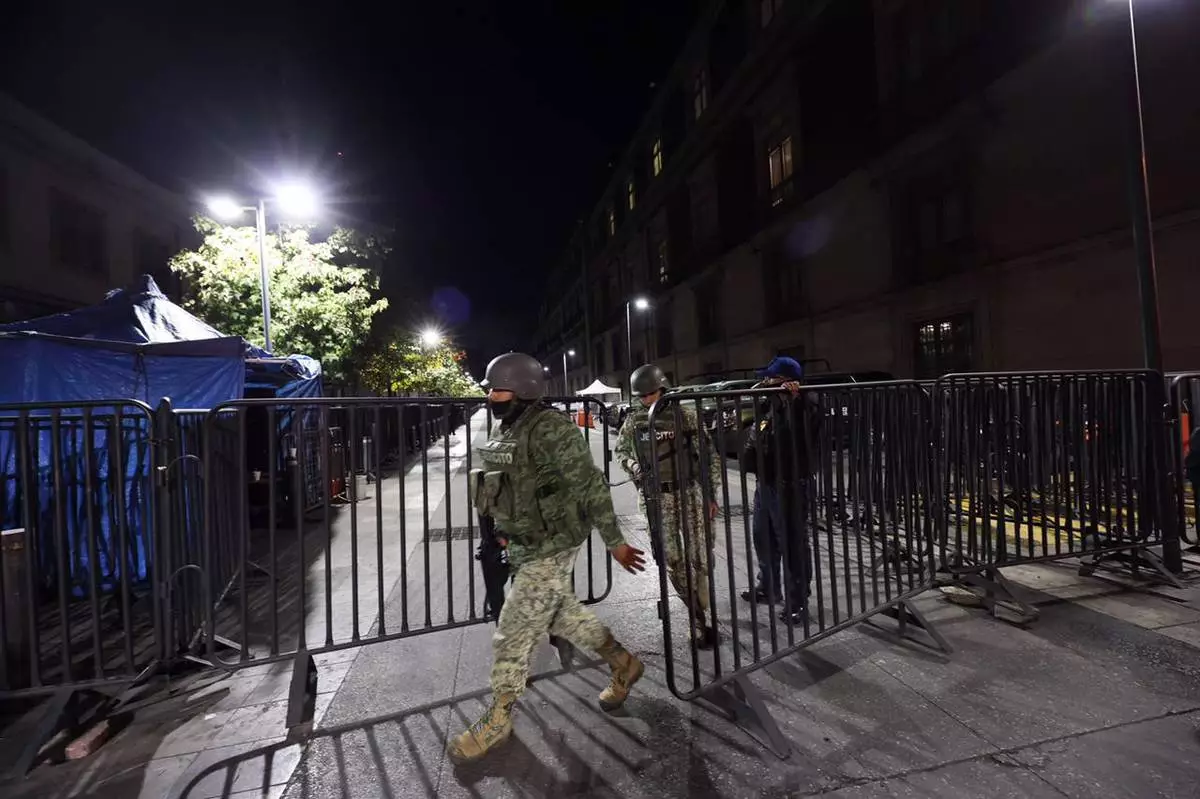
Army soldiers patrol outside the National Palace ahead of the daily, morning news conference by Mexican President Claudia Sheinbaum in Mexico City, Monday, Feb. 23, 2026. (AP Photo/Ginnette Riquelme)
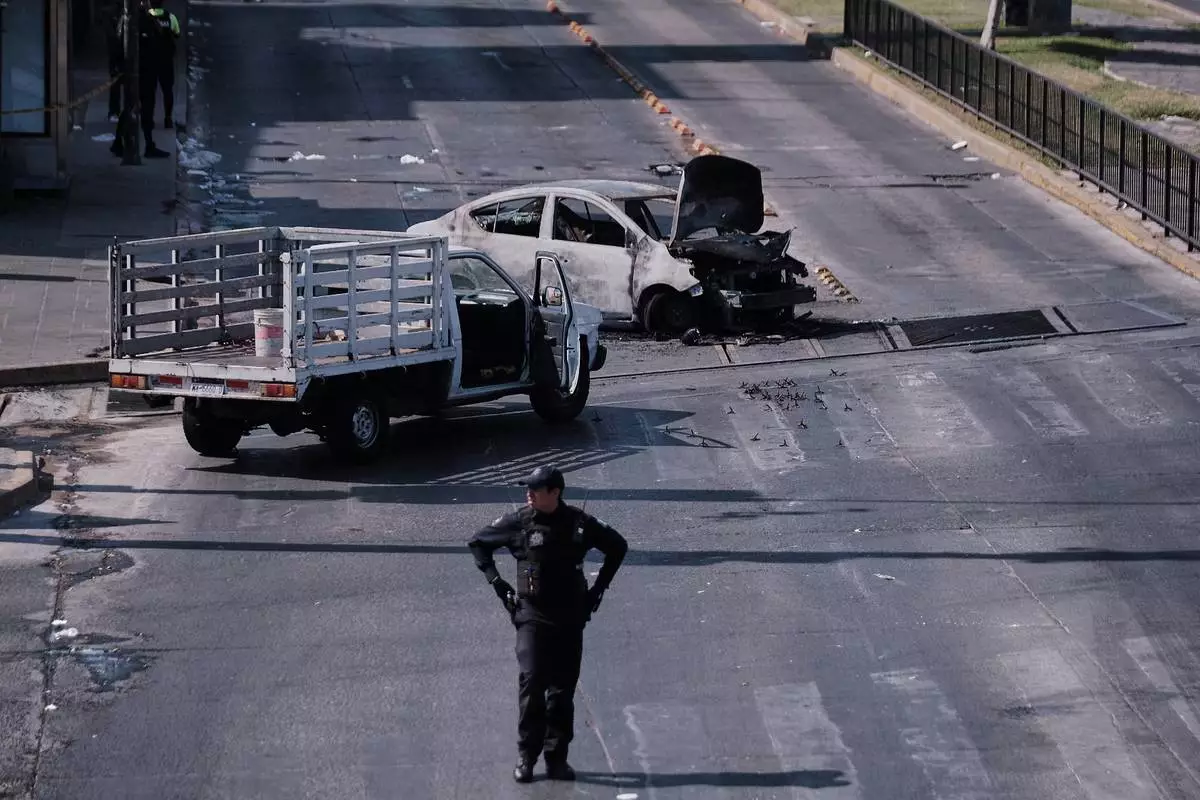
A police officer stands guard by a charred vehicle after it was set on fire, on a road in Guadalajara, Jalisco state, Mexico, Sunday, Feb. 22, 2026, after the death of the leader of the Jalisco New Generation Cartel, Nemesio Rubén Oseguera Cervantes, known as "El Mencho." (AP Photo/Alejandra Leyva)
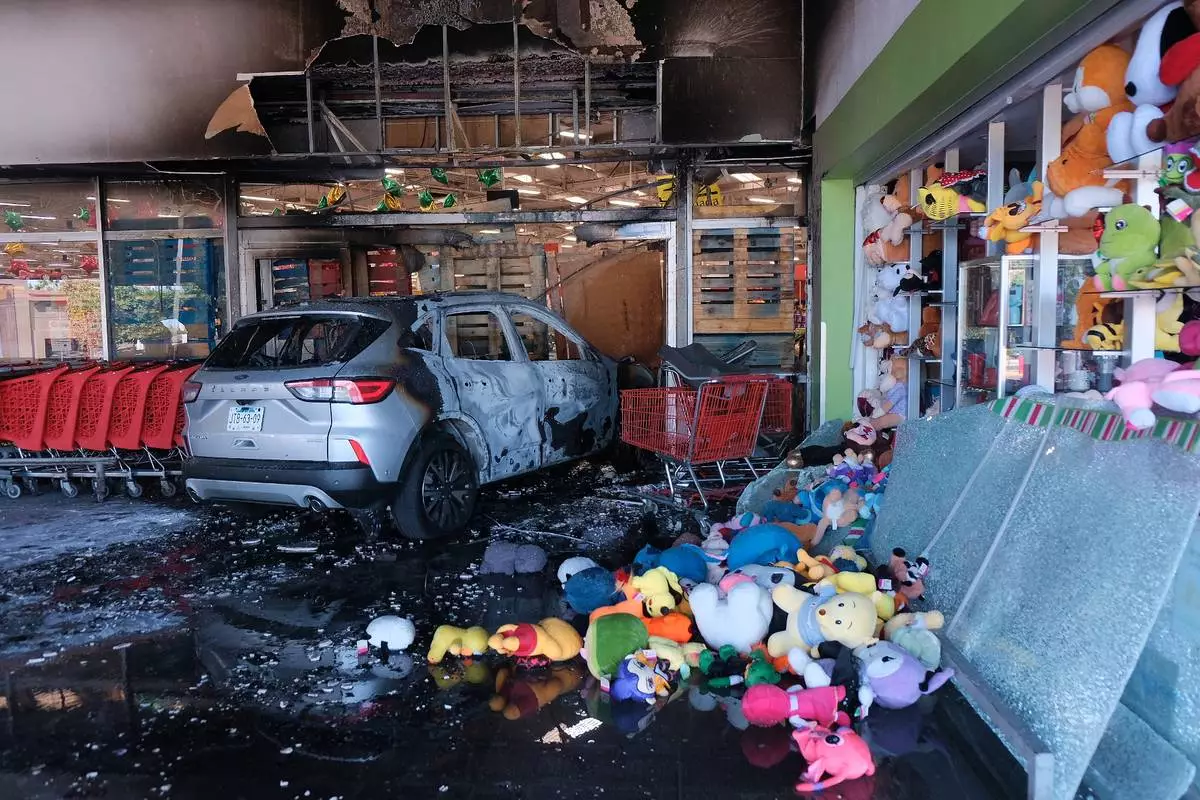
A charred vehicle sits at a damaged supermarket in Guadalajara, Jalisco state, Mexico, Sunday, Feb. 22, 2026, after the death of the leader of the Jalisco New Generation Cartel, Nemesio Rubén Oseguera Cervantes, known as "El Mencho." (AP Photo/Alejandra Leyva)
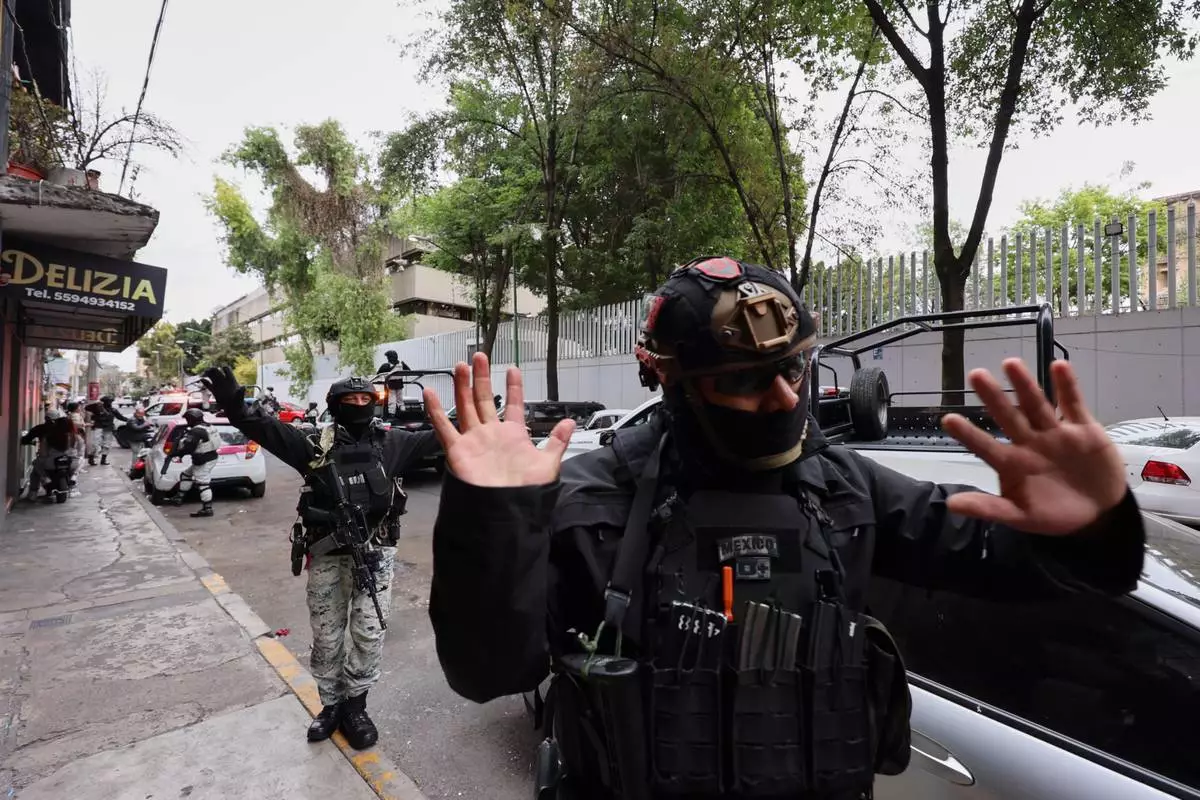
National Guards remove pedestrians by the General Prosecutor's headquarters in Mexico City, Sunday, Feb. 22, 2026, after the death of the leader of the Jalisco New Generation Cartel, Nemesio Rubén Oseguera Cervantes, known as "El Mencho." (AP Photo/Ginette Riquelme)
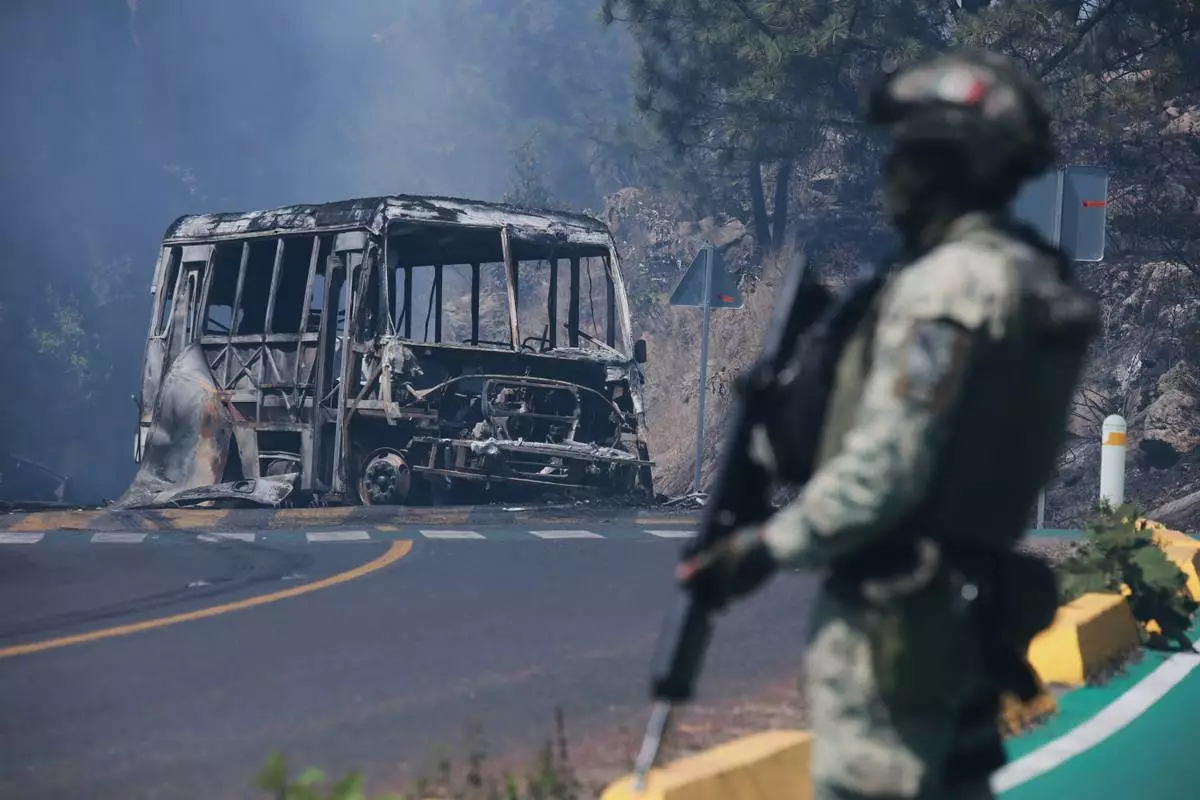
A soldier stands guard by a charred vehicle after it was set on fire, in Cointzio, Michoacán state, Mexico, Sunday, Feb. 22, 2026, following the death of the leader of the Jalisco New Generation Cartel, Nemesio Oseguera, known as "El Mencho." (AP Photo/Armando Solis)
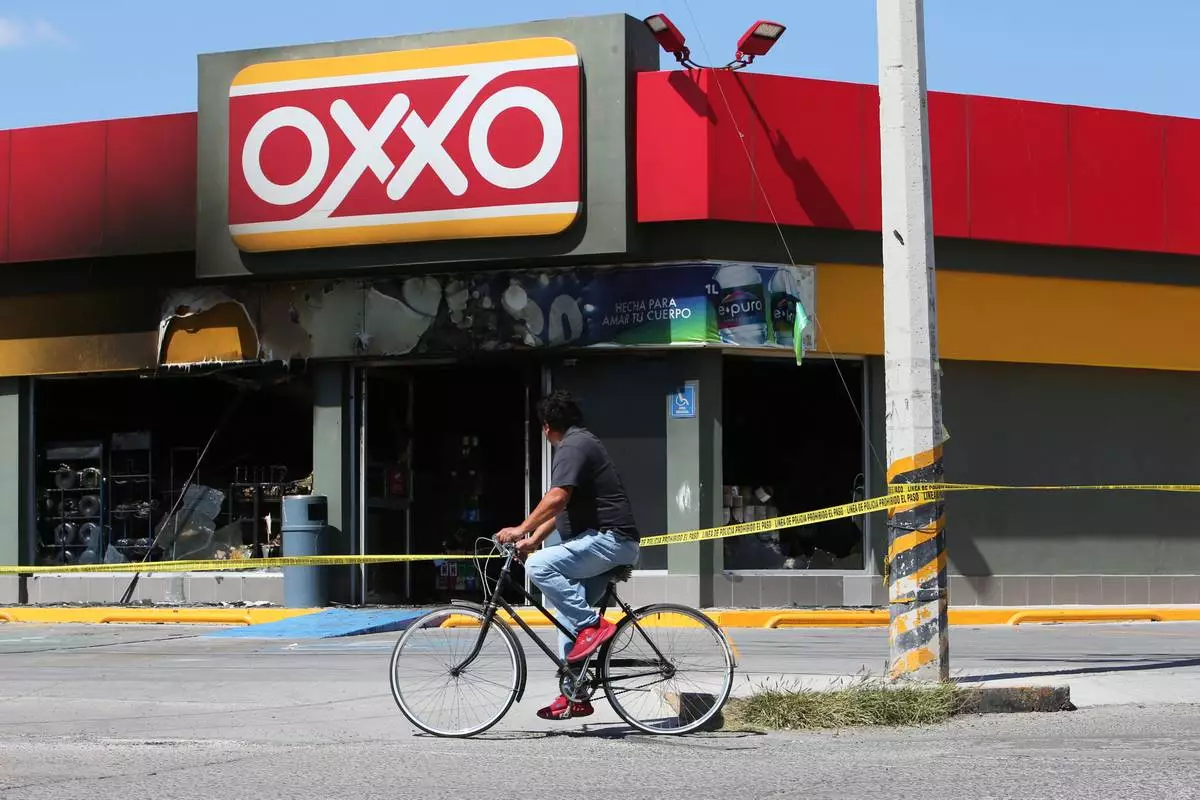
A man rides a bike next to a convenience store that was set on fire, in San Francisco del Ricon, Guanajuato state, Mexico, Sunday, Feb. 22, 2026, after the death of the leader of the Jalisco New Generation Cartel, Nemesio Ruben Oseguera Cervantes, known as "El Mencho." (AP Photo/Alfredo Valadez)