British tour operator Thomas Cook fell victim to multiple setbacks including shifting travel habits, the rise of online booking sites, the sinking pound and even unusually hot weather that encouraged fewer Northern Europeans to travel.
Specific problems of its own, like a 1.6 billion-pound ($2 billion) debt pile, made it less able to react to change.
It all added up to a perfect storm that led the 178-year-old company to cease operations early Monday, stranding hundreds of thousands of travelers.
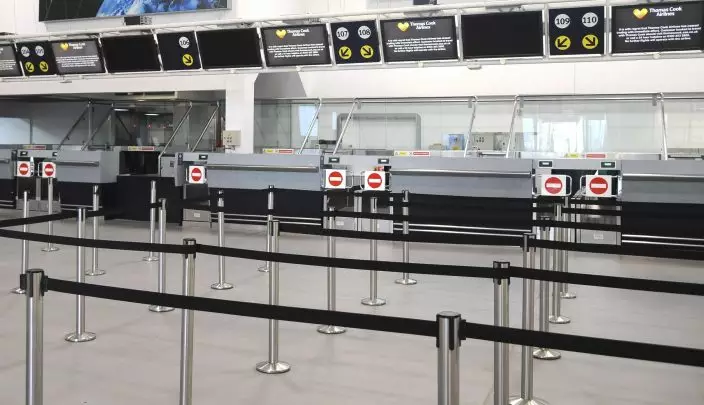
General view of the deserted Thomas Cook check-in counters at Birmingham airport in Birmingham, England, Monday, Sept. 23, 2019. Hundreds of thousands of travellers were stranded across the world Monday after British tour company Thomas Cook collapsed early Monday, immediately halting almost all its flights and hotel services and throwing employees out of work. (AP PhotoRui Vieira)
Analysts said Thomas Cook, which rode a package holiday boom that started in the mid-1980s, was too slow to react as consumers moved away from buying trips at bricks-and-mortar stores.
It has been overtaken by online services like Airbnb and internet travel companies who may separate or combine hotel, rental car and flight offerings, which puts pressure on prices through comparison shopping.
"The company has struggled to adapt to a changing travel and retail environment," said Michael Hewson, chief market analyst at CMC Markets UK.
The company did push into online business, with 48% of its bookings from the internet as of last year. But not fast enough. Online rivals, meanwhile, didn't have to bear the costs of owning 200 hotels, 500 travel agency shops and 105 airline jets, but acted as middlemen.
Thomas Cook Group PLC isn't alone in facing such pressures. Competitor TUI Group AG, based in Hannover, Germany, has shifted its focus from tour operators to its own cruises and hotels.
But other factors laid into the British travel company.
Company officials have cited uncertainty over Brexit, both from consumers worried about its impact on their finances and from the timing, given that one unfulfilled deadline for Britain to leave the EU fell on March 31, just days before the heavy European Easter holiday travel season this year. Travel agents had to issue guidance on what would happen in case of a no-deal Brexit. Brexit has meanwhile sent the pound lower, given British travelers less purchasing power.
After 2010, the Arab Spring revolts discouraged travel to previous U.K. favorites such as Egypt and Tunisia. Travel companies shifted their focus to the Western Mediterranean, such as Spain's Canary Islands, only to see demand for some of those locations then dwindle.
The company's reputation suffered after the 2006 deaths of two customers in Corfu, Greece, from carbon monoxide poisoning. The case dragged out for years and Thomas Cook would end up being told by a coroner it "breached its duty of care."
As the company struggled to reshape its business in the new environment and cut costs it was hit with an unusually warm summer in 2018, which it said led travelers from the U.K. and Scandinavia to put off plans to head for warmer destinations. When they did decide at the last minute, the sector of the market that focuses on late decision makers turned out to be fiercely competitive on price.
"The group, like its peers, has suffered from a perfect storm of turbulence, from political unrest and terrorism at some of its most popular destinations, to unusual weather patterns seeing travelers taking 'staycations' and the ever present Brexit uncertainty devaluing the pound and putting consumers off from booking holidays," said Helal Miah, investment research analyst at The Share Centre.
Heavy debts gave the company less breathing room to maneuver.
"While other travel groups have suffered from these factors, Thomas Cook's pile of debt is the differentiating factor," said Miah.
WASHINGTON (AP) — U.S. forces boarded another oil tanker in the Caribbean Sea on Friday, the U.S. military said, as the Trump administration targets sanctioned tankers traveling to and from Venezuela as part of a broader effort to take control of the South American country's oil.
The predawn raid was carried out by Marines and Navy sailors launched from the aircraft carrier USS Gerald R. Ford, part of the extensive force the U.S. has built up in the Caribbean in recent months, according to U.S. Southern Command, which declared “there is no safe haven for criminals” as it announced the seizure of the tanker called the Olina. The Coast Guard then took control of the vessel, officials said.
Southern Command and Homeland Security Secretary Kristi Noem both posted unclassified footage on social media Friday morning of a U.S. helicopter landing on the vessel and U.S. personnel conducting a search of the deck and tossing what appeared to be an explosive device in front of a door leading to inside the ship.
In her post, Noem said the ship was “another ‘ghost fleet’ tanker ship suspected of carrying embargoed oil” and it had departed Venezuela “attempting to evade U.S. forces."
The Olina is the fifth tanker that has been seized by U.S. forces as part of the effort by President Donald Trump’s administration to control the production, refining and global distribution of Venezuela’s oil products, and the third since the U.S. ouster of Venezuela President Nicolás Maduro in a surprise nighttime raid.
In a post on his social media network later in the day, Trump said the seizure was conducted “in coordination with the Interim Authorities of Venezuela” but offered no elaboration.
The White House did not immediately respond to requests for more details.
Venezuela’s government acknowledged in a statement that it was working with U.S. authorities to return the tanker, “which set sail without payment or authorization from the Venezuelan authorities,” to the South American nation.
“Thanks to this first successful joint operation, the ship is sailing back to Venezuelan waters for its protection and relevant actions,” according to the statement.
Samir Madani, co-founder of TankerTrackers.com, said his organization used satellite imagery and surface-level photos to document that at least 16 tankers left the Venezuelan coast in contravention of the quarantine U.S. forces have set up to block sanctioned ships from conducting trade. The Olina was among that flotilla.
U.S. government records show that the Olina was sanctioned for moving Russian oil under its prior name, Minerva M, and flagged in Panama.
While records show the Olina is now flying the flag of Timor-Leste, it is listed in the international shipping registry as having a false flag, meaning the registration it is claiming is not valid. In July, the owner and manager of the ship on its registration was changed to a company in Hong Kong.
According to ship tracking databases, the Olina last transmitted its location in November in the Caribbean, north of the Venezuelan coast. Since then, however, the ship has been running dark with its location beacon turned off.
While Noem and the military framed the seizure as part of an effort to enforce the law, other officials in the Trump administration have made clear they see it as a way to generate cash as they seek to rebuild Venezuela's battered oil industry and restore its economy.
In an early morning social media post, Trump said the U.S. and Venezuela “are working well together, especially as it pertains to rebuilding, in a much bigger, better, and more modern form, their oil and gas infrastructure.”
The administration said it expects to sell 30 million to 50 million barrels of sanctioned Venezuelan oil, with the proceeds to go to both the U.S. and Venezuelan people. But the president expects the arrangement to continue indefinitely. He met Friday with executives from oil companies to discuss his goal of investing $100 billion in Venezuela to repair and upgrade its oil production and distribution.
Vice President JD Vance told Fox News this week that the U.S. can “control” Venezuela’s “purse strings” by dictating where its oil can be sold.
Madani estimated that the Olina is loaded with 707,000 barrels of oil, which at the current market price of about $60 a barrel would be worth more than $42 million.
Associated Press writers Dánica Coto in San Juan, Puerto Rico, Josh Boak in Washington, and Regina Garcia Cano in Caracas, Venezuela, contributed to this report.
This story has been corrected to reflect that the United States has seized three tankers, not five, since Nicolás Maduro was ousted as Venezuela’s president.
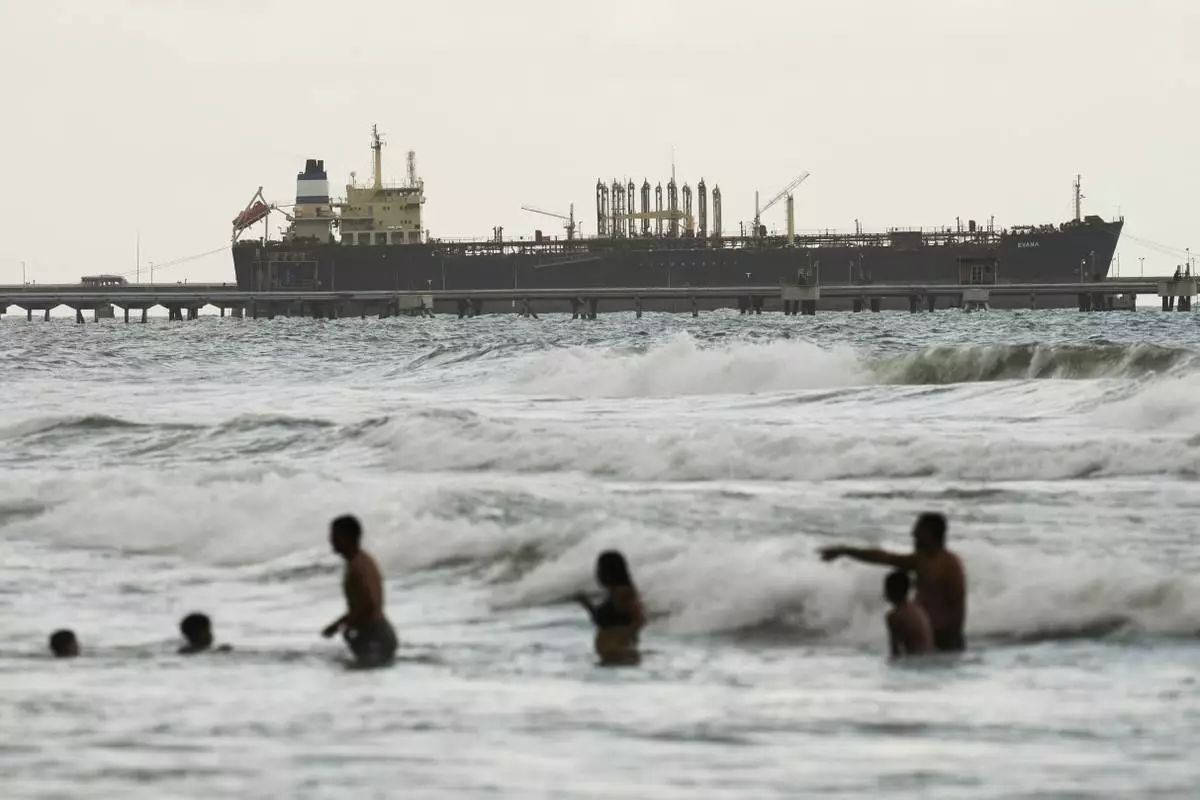
FILE - Evana, an oil tanker, is docked at El Palito Port in Puerto Cabello, Venezuela, Dec. 21, 2025. The U.S. military says U.S. forces have boarded another oil tanker in the Caribbean Sea. The Olina is the fifth tanker seized by U.S. forces. (AP Photo/Matias Delacroix, File)