China's richest businesspeople got richer in 2019 despite a tariff war with Washington and an economic slowdown, a survey showed Thursday.
The average net worth of China's richest 1,800 people rose 10% over 2018 to $1.4 billion, according to the Hurun Report, which tracks the country's wealthy.
Jack Ma, who retired last month as chairman of e-commerce giant Alibaba, was No. 1 for a second year with a net worth of $39 billion. Ma Huateng of Tencent, a games and social media company, was second at $37 billion, up 8%.
The results reflect the importance of China's consumer market at a time when U.S. tariff hikes have battered export-oriented manufacturing.
The number of businesspeople on the list from the tech, pharma and food industries rose while those from manufacturing declined.
"Wealth is concentrating into the hands of those who are able to adapt to the digital economy," said Rupert Hoogewerf, the report's founder and chief researcher, in a statement.
In contrast to the United States and Europe, where the ranks of the richest people are dominated by inherited wealth, almost everyone on the Chinese list is self-made.
Hoogewerf noted that when the survey began two decades ago, mainland China had no dollar billionaires.
Real estate developer Xu Jiayin, No. 1 in 2017, dropped to third place with $30 billion.
Sun Piaoyang and Zhong Huijuan, a married couple, were No. 5 at $25 billion after their drug company, Hansoh, debuted on the Hong Kong stock exchange. Hansoh makes treatments for schizophrenia and bipolar disorder.
Pharma tycoons account for 8% of this year's list, double the share 10 years ago, according to Hurun.
The net worth of Ren Zhengfei, founder of smartphone maker Huawei Technologies Ltd., which is at the center of a struggle between Washington and Beijing over technology development, rose 24% to $3 billion. He climbed 36 places on the Hurun list to No. 162.
Huawei, which also makes network switching gear, said sales rose 23.2% over a year earlier in the first half of 2019. The company has warned, however, that it will "face difficulties" as curbs on its access to U.S. components and technology take effect.
Consumer industries benefited from an 8.4% rise in retail spending in the first half of 2019. That was despite a decline in economic growth to a 26-year low of 6.2%.
Qin Yinglin and Qian Ying, a married couple who own Muyuan Foods, a pig breeder, profited from an outbreak of African swine fever that pushed up pork prices. Their net worth tripled to $14 billion.
The list included 156 people under age 40, an increase of 24 names from last year.
Colin Huang, 39, of e-commerce company Pinduoduo, ranked No. 7 with $19 billion four years after founding his company.
"Nobody in the world has ever made that much from a standing start," said Hoogewerf.
Hurun Report: www.hurun.net
BEIJING (AP) — Breaking with the United States, Canada has agreed to cut its 100% tariff on Chinese electric cars in return for lower tariffs on Canadian farm products, Prime Minister Mark Carney said Friday.
Carney made the announcement after two days of meetings with Chinese leaders. He said there would be an initial cap of 49,000 vehicles on Chinese EV exports to Canada, growing to 70,000 over five years. China will reduce its tariff on canola seeds, a major Canadian export, from about 84% to about 15%, he told reporters.
“It has been a historic and productive two days,” Carney said, speaking outside against the backdrop of a traditional pavilion and a frozen pond at a Beijing park. “We have to understand the differences between Canada and other countries, and focus our efforts to work together where we’re aligned.”
Earlier Friday, he and Chinese leader Xi Jinping pledged to improve relations between their two nations after years of acrimony.
Xi told Carney in a meeting at the Great Hall of the People that he is willing to continue working to improve ties, noting that talks have been underway on restoring and restarting cooperation since the two held an initial meeting in October on the sidelines of a regional economic conference in South Korea.
“It can be said that our meeting last year opened a new chapter in turning China–Canada relations toward improvement,” China's top leader said.
Carney, the first Canadian prime minister to visit China in eight years, said better relations would help improve a global governance system that he described as “under great strain.”
He called for a new relationship “adapted to new global realities” and cooperation in agriculture, energy and finance.
Those new realities reflect in large part the so-called America-first approach of U.S. President Donald Trump. The tariffs he has imposed have hit both the Canadian and Chinese economies. Carney, who has met with several leading Chinese companies in Beijing, said ahead of his trip that his government is focused on building an economy less reliant on the U.S. at what he called “a time of global trade disruption.”
A Canadian business owner in China called Carney's visit game-changing, saying it re-establishes dialogue, respect and a framework between the two nations.
“These three things we didn’t have,” said Jacob Cooke, the CEO of WPIC Marketing + Technologies, which helps exporters navigate the Chinese market. “The parties were not talking for years.”
Canada had followed the U.S. in putting tariffs of 100% on EVs from China and 25% on steel and aluminum under former Prime Minister Justin Trudeau, Carney’s predecessor.
China responded by imposing duties of 100% on Canadian canola oil and meal and 25% on pork and seafood. It added a 75.8% tariff on canola seeds last August. Collectively, the import taxes effectively closed the Chinese market to Canadian canola, an industry group has said. Overall, China's imports from Canada fell 10.4% last year to $41.7 billion, according to Chinese trade data.
China is hoping Trump’s pressure tactics on allies such as Canada will drive them to pursue a foreign policy that is less aligned with the United States. The U.S. president has suggested Canada could become America's 51st state.
Carney departs China on Saturday and visits Qatar on Sunday before attending the annual gathering of the World Economic Forum in Switzerland next week. He will meet business leaders and investors in Qatar to promote trade and investment, his office said.
Associated Press business writer Chan Ho-him in Hong Kong contributed to this report.
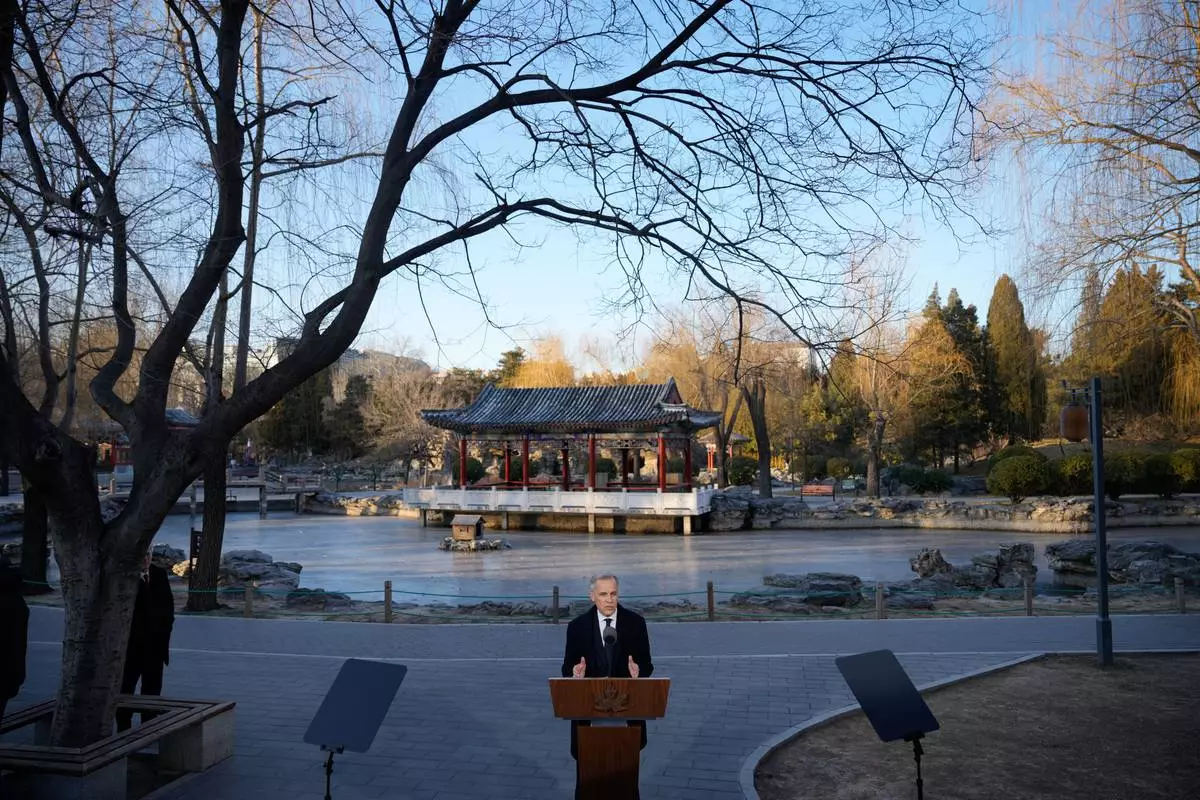
Canada's Prime Minister Mark Carney, speaks to the media at Ritan Park in Beijing, China, Friday, Jan. 16, 2026. (AP Photo/Vincent Thian)
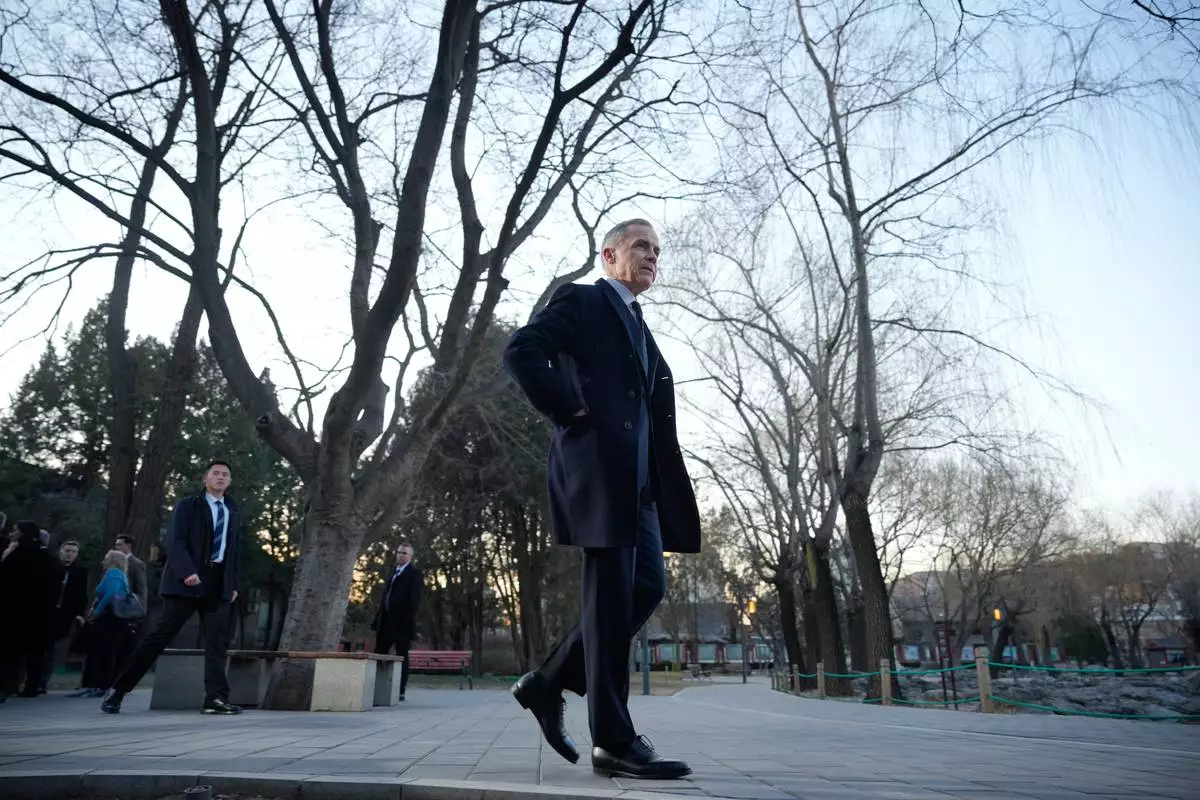
Canada's Prime Minister Mark Carney, leaves after speaking to the media at Ritan Park in Beijing, China, Friday, Jan. 16, 2026. (AP Photo/Vincent Thian)
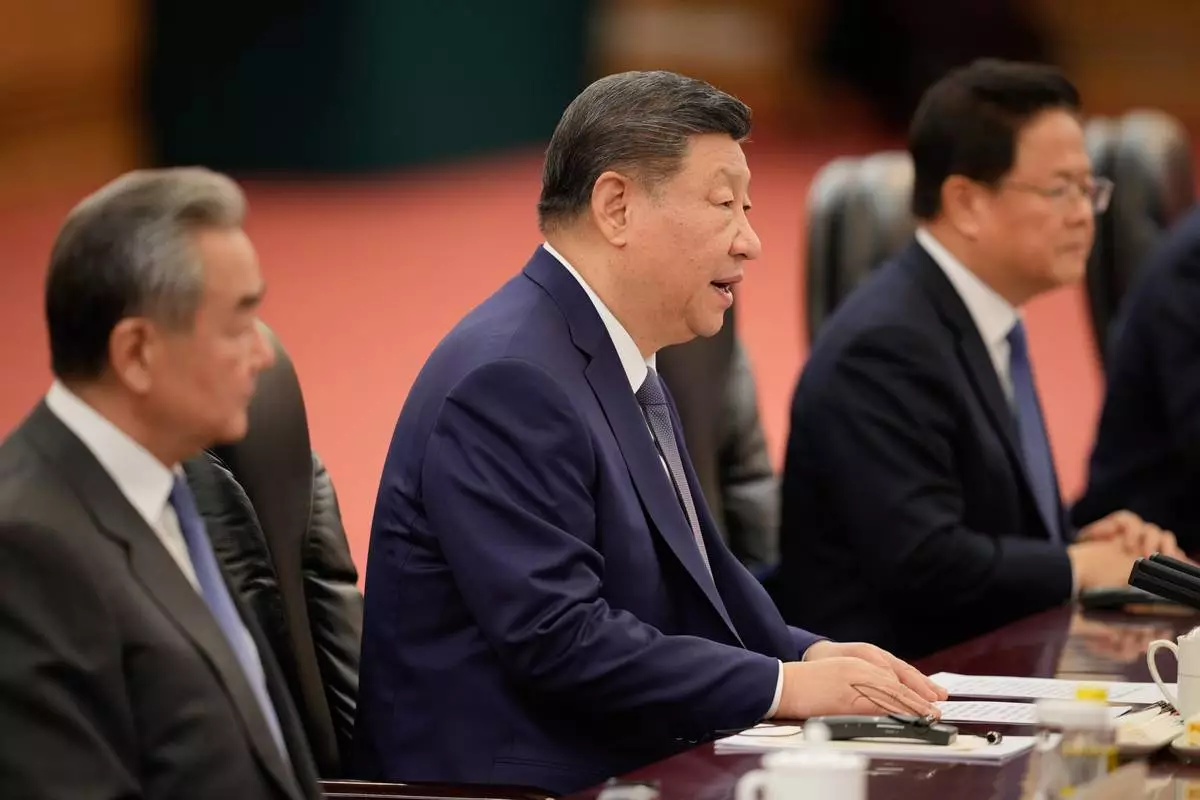
Chinese President Xi Jinping, centre, reacts during a meeting with Canada's Prime Minister Mark Carney (not in the picture), at the Great Hall of the People in Beijing, China, Friday, Jan. 16, 2026. (AP Photo/Vincent Thian, Pool)
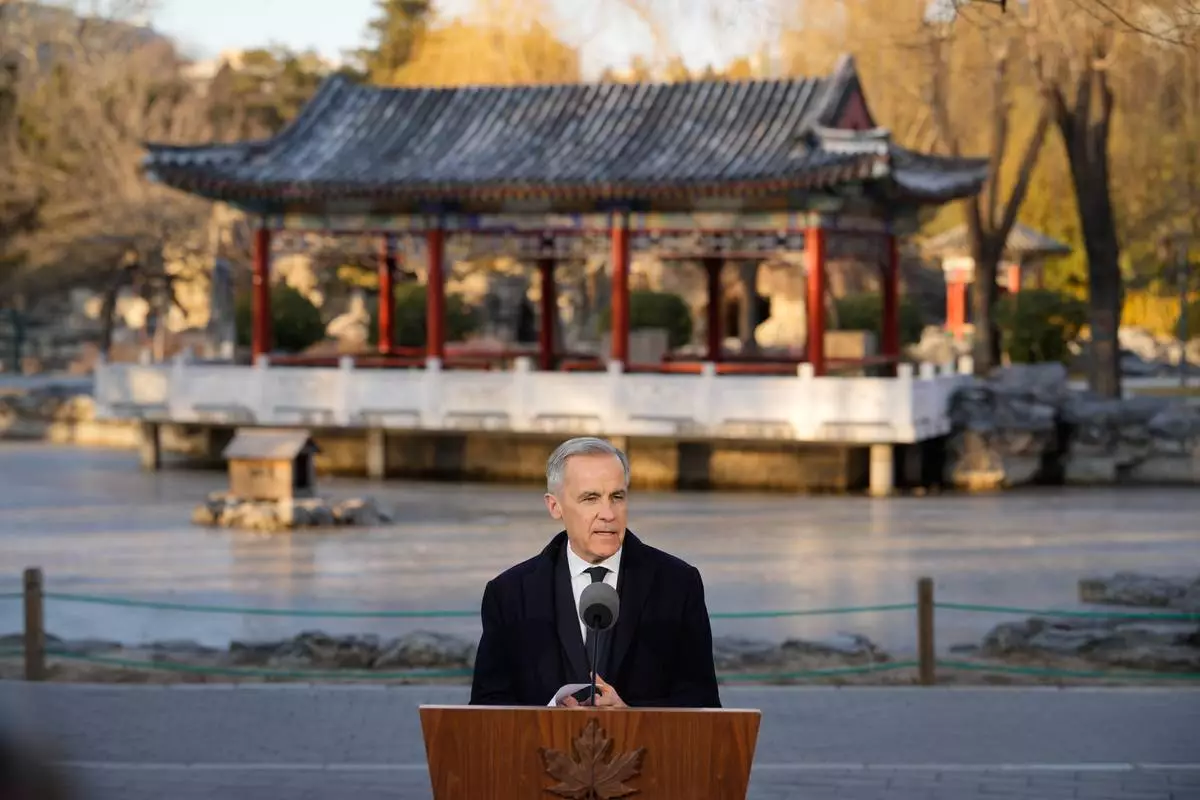
Canada's Prime Minister Mark Carney, speaks to the media at Ritan Park in Beijing, China, Friday, Jan. 16, 2026. (AP Photo/Vincent Thian)

Canada's Prime Minister Mark Carney, center, arrives to meet with Chinese President Xi Jinping, at the Great Hall of the People in Beijing, China, Friday, Jan. 16, 2026. (AP Photo/Vincent Thian, Pool)
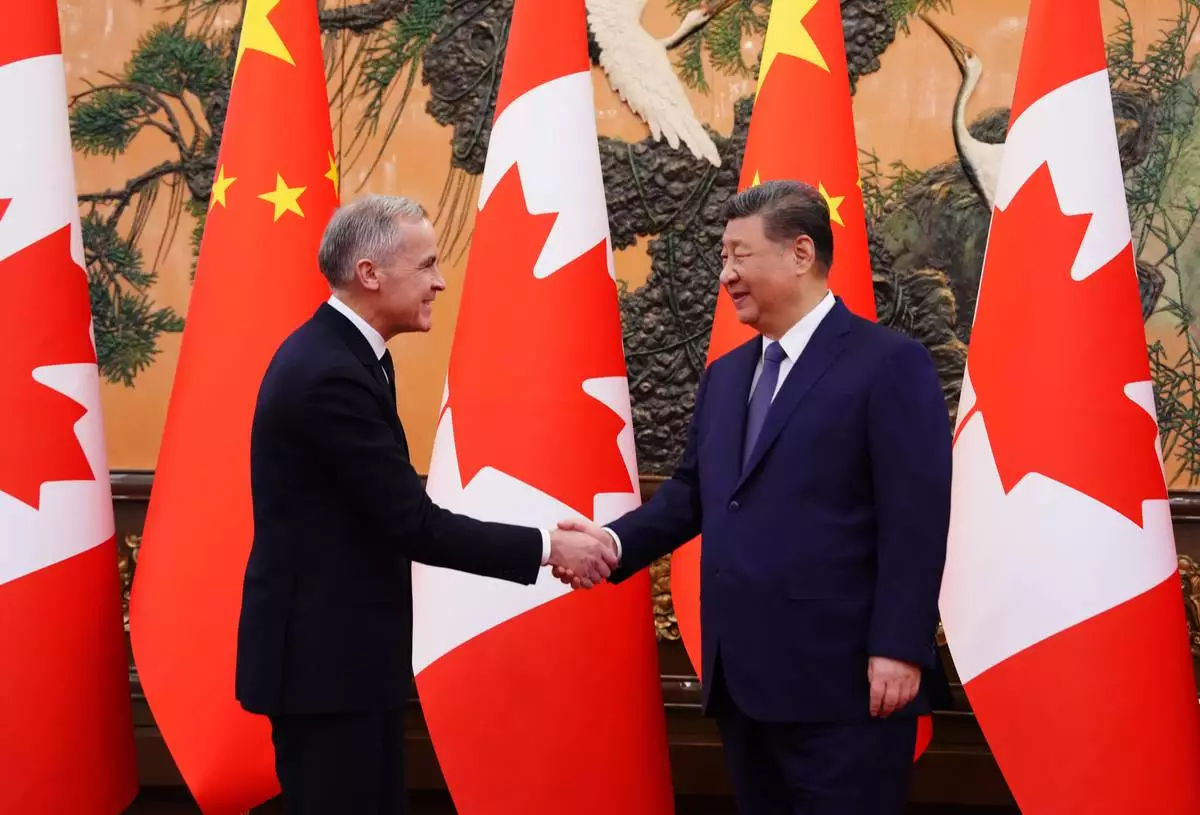
Canada's Prime Minister Mark Carney, left, meets with Chinese President Xi Jinping at the Great Hall of the People in Beijing Friday, Jan. 16, 2026. (Sean Kilpatrick/The Canadian Press via AP)
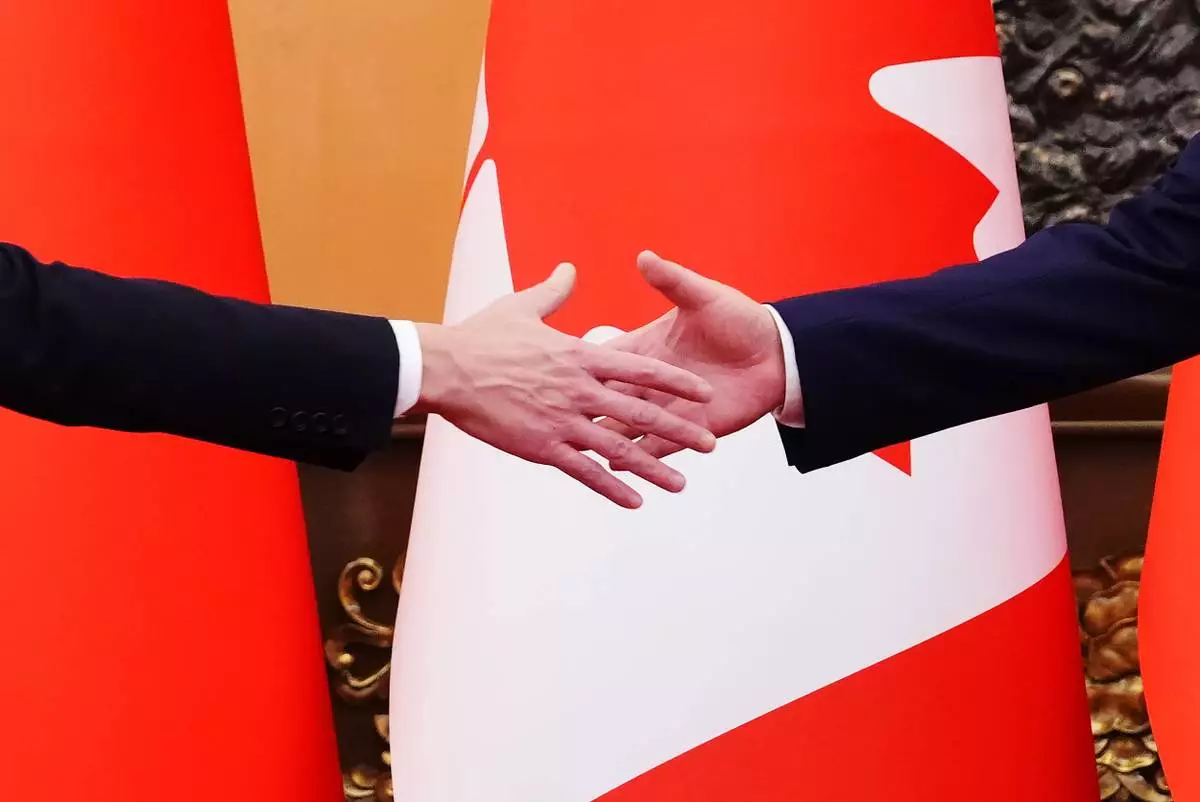
Canada's Prime Minister Mark Carney, left, shakes hands with China's President Xi Jinping at the Great Hall of the People in Beijing Friday, Jan. 16, 2026. (Sean Kilpatrick/The Canadian Press via AP)