The Chicago area’s chief medical examiner starts her day with a numbers problem: how to manage three times the number of deaths as before the coronavirus pandemic with the same number of pathologists.
On a recent morning when The Associated Press got exclusive access to the Cook County Medical Examiner’s Office for the day, Dr. Ponni Arunkumar scanned a list of 62 new death cases. The average last year was 20 a day.
Click to Gallery
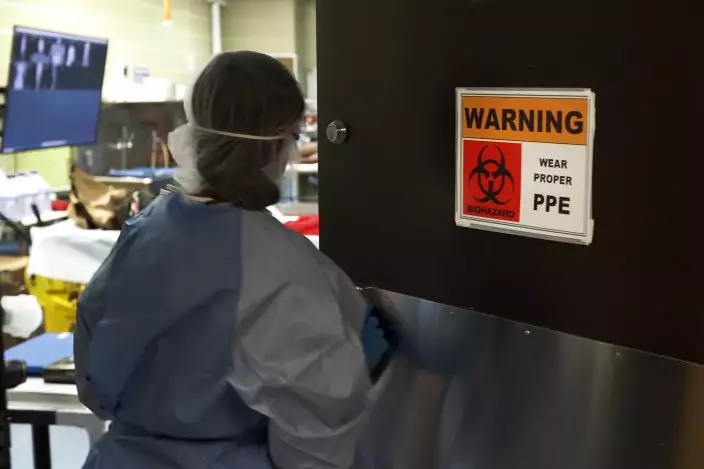
In this Tuesday, May 5, 2020, photo, Cook County Chief Medical Examiner Dr. Ponni Arunkumar, enters an autopsy room where she will personally perform four autopsies in as many hours at the county morgue in Chicago. Arunkumar starts her day with a numbers problem. It's how to manage a tripling of death cases with the same number of pathologists and the same number of hours in a day as before COVID-19. (AP PhotoCharles Rex Arbogast)
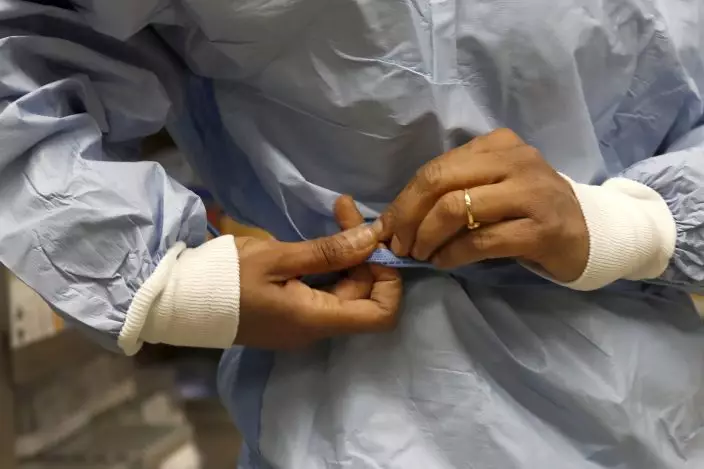
In this Tuesday, May 5, 2020, photo, Cook County Chief Medical Examiner Dr. Ponni Arunkumar, dawns personal protective equipment as she prepares to perform four autopsies in as many hours at the county morgue in Chicago. Arunkumar starts her day with a numbers problem. It's how to manage a tripling of death cases with the same number of pathologists and the same number of hours in a day as before COVID-19. (AP PhotoCharles Rex Arbogast)
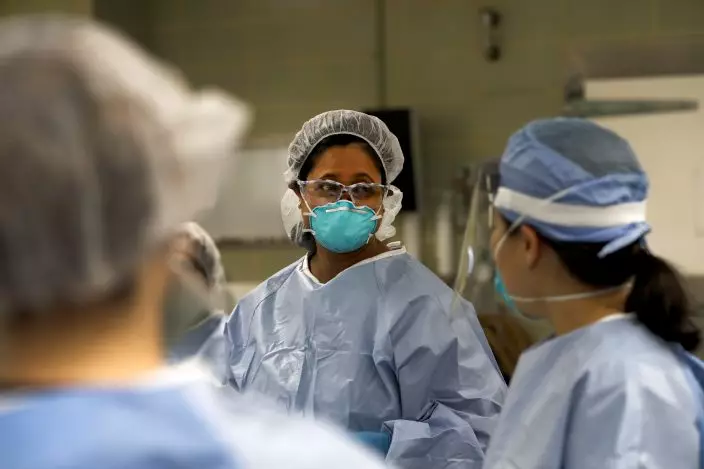
In this Tuesday, May 5, 2020, photo, Cook County Chief Medical Examiner Dr. Ponni Arunkumar, conducts rounds, an overview of cases for the day, with her medical staff of six fellow pathologists who will perform several autopsies on shooting victims and others whose cause of death isn't clear at the county morgue in Chicago. (AP PhotoCharles Rex Arbogast)
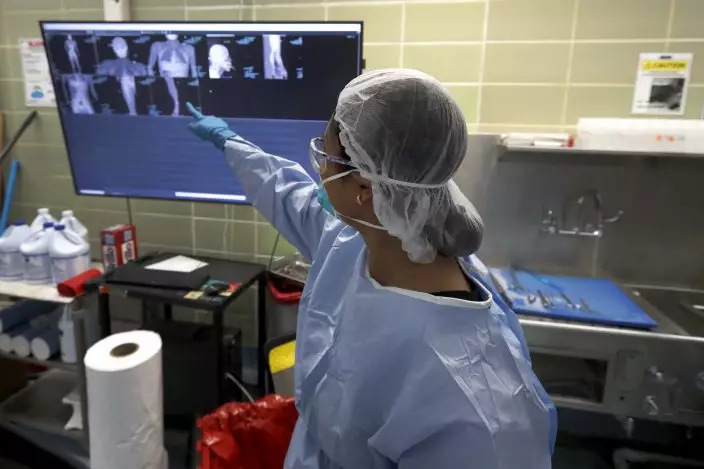
In this Tuesday, May 5, 2020, photo, Cook County Chief Medical Examiner Dr. Ponni Arunkumar, makes reference to digitally projected X-rays of a gunshot victim as she prepares for her share of autopsies at the county morgue in Chicago. Arunkumar starts her day with a numbers problem. It's how to manage a tripling of death cases with the same number of pathologists and the same number of hours in a day as before COVID-19. (AP PhotoCharles Rex Arbogast)
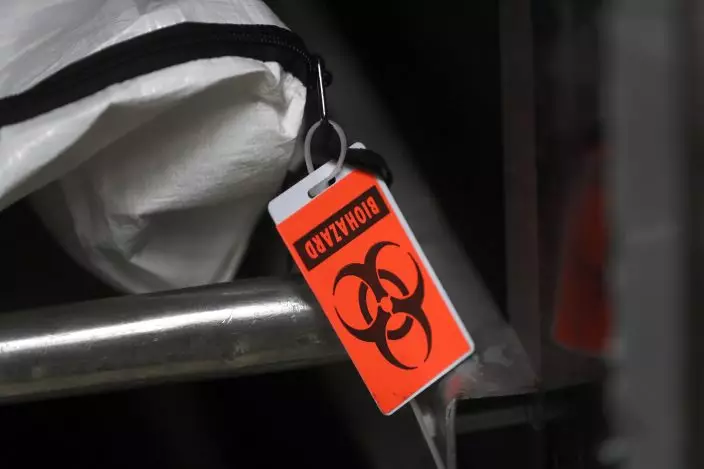
In this Tuesday, May 5, 2020, photo, an orange biohazard tag hangs from a body bag in an isolated refrigerated unit set aside for bodies infected with coronavirus at the Cook County morgue in Chicago. (AP PhotoCharles Rex Arbogast)
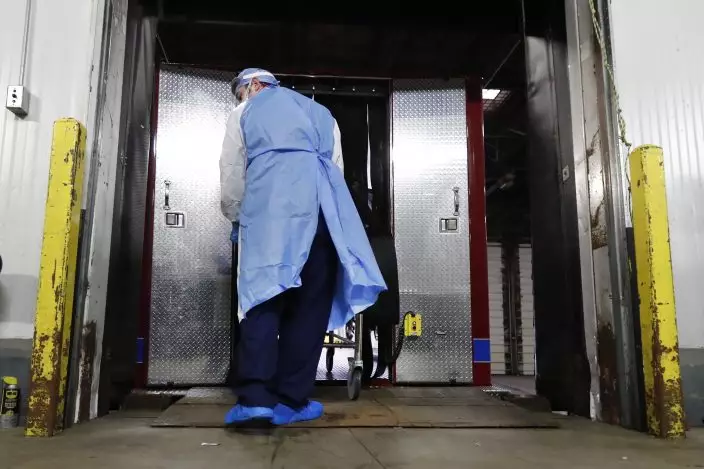
In this Tuesday, May 5, 2020, photo, Cook County Medical Examiner forensic technician Pero Paunovich wheels the body of a COVID-19 victim from an emergency-management truck that just arrived at the medical examiner's auxiliary surge storage center in Chicago. An encouraging sign amid the grimness is that two of the rooms are mostly empty, an indication the medical examiner's system to ensure most bodies are released to funeral homes as quickly as possible is working. (AP PhotoCharles Rex Arbogast)
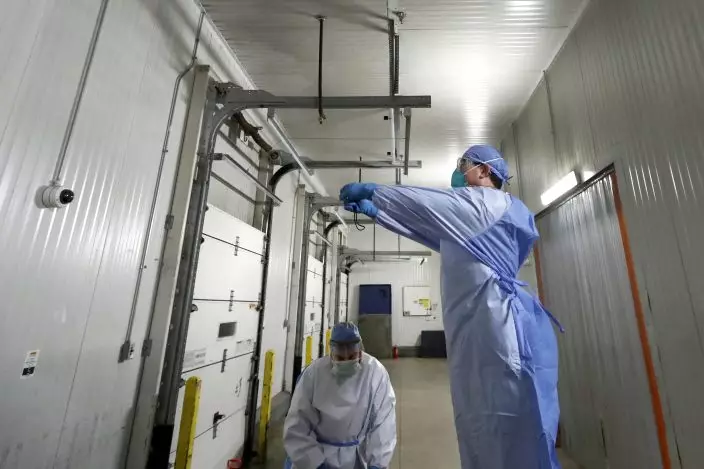
In this Tuesday, May 5, 2020, photo, Cook County Medical Examiner forensic technician William Cherry, right, stands on a small ladder to photograph the body of a COVID-19 victim as his colleague Pero Paunovich, steadies the gurney at the medical examiner's auxiliary surge storage center in Chicago. (AP PhotoCharles Rex Arbogast)
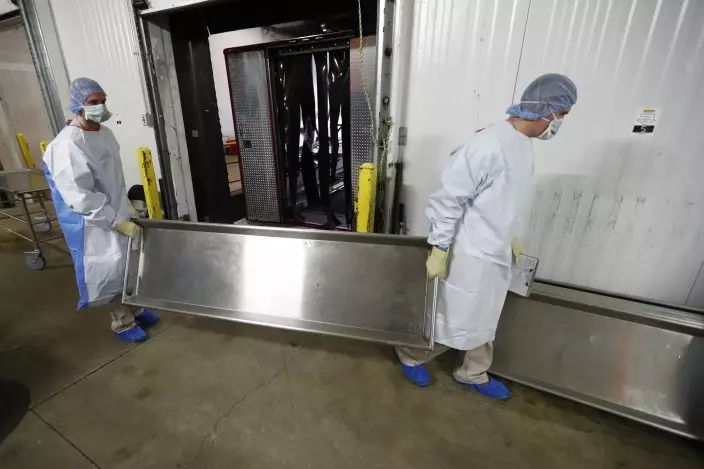
In this Tuesday, May 5, 2020, photo, Illinois National Guard members return a body tray to be sanitized on the loading dock at the Cook County Medical Examiner's auxiliary surge storage center after an emergency-management truck arrived with half-a-dozen bodies in Chicago. Incoming bodies to the surge center, with a capacity to hold 2,000 bodies, are taken to one of three rooms with the combined square footage of a football field. (AP PhotoCharles Rex Arbogast)
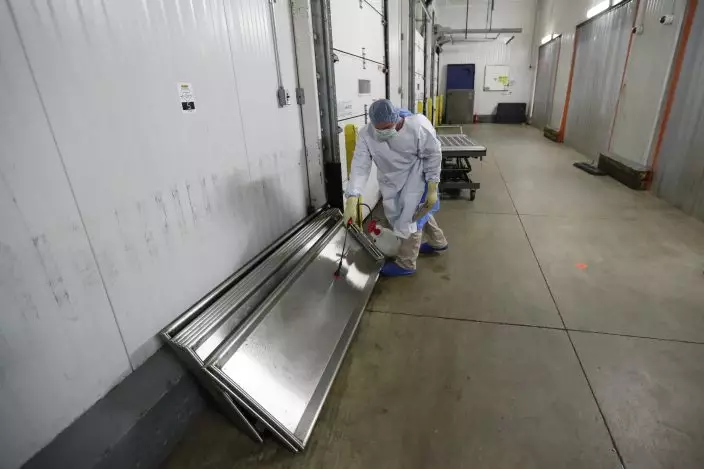
In this Tuesday, May 5, 2020, photo, a member of the Illinois National Guard sanitizes a body tray on the loading dock of the Cook County Medical Examiner's auxiliary surge storage center after an emergency-management truck arrived with half-a-dozen bodies in Chicago. Incoming bodies to the surge center, with a capacity to hold 2,000 bodies, are taken to one of three rooms with the combined square footage of a football field. (AP PhotoCharles Rex Arbogast)
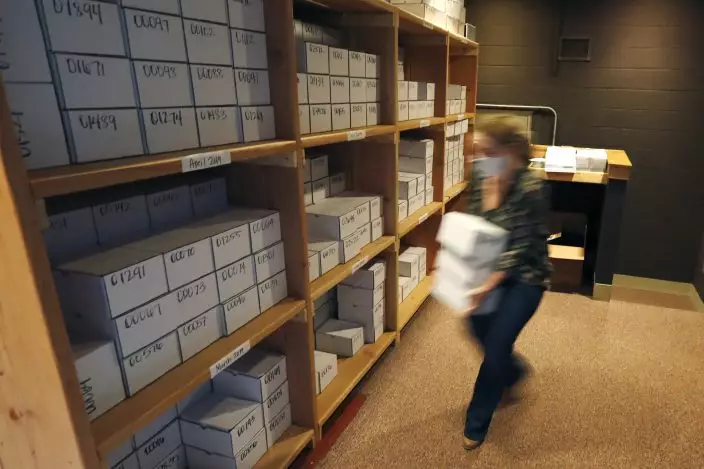
In this Tuesday, May 5, 2020, photo, Cook County Medical Examiner's Indigent Coordinator, Rebeca Perrone, begins placing 24 boxes of unclaimed cremated remains on a shelf, adding to over 500 other boxes at the county morgue in Chicago. Numbers of unclaimed remains are up, Perrone says. Lost wages amid business shutdowns mean some families can't afford the minimal $250 fee to collect the boxes. (AP PhotoCharles Rex Arbogast)
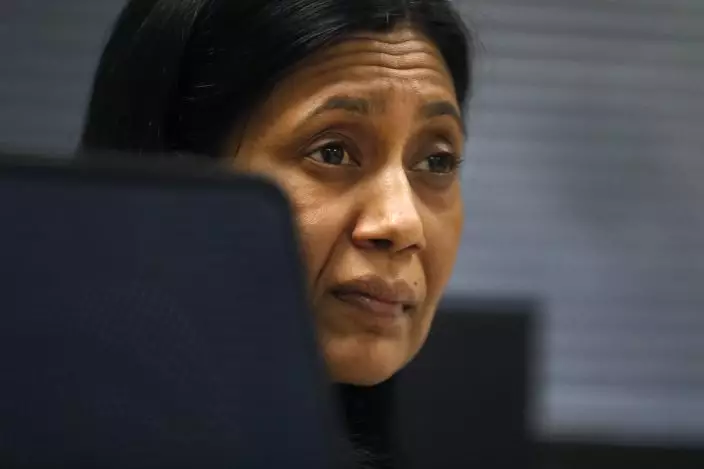
In this Tuesday, May 5, 2020, photo, Cook County Chief Medical Examiner Dr. Ponni Arunkumar studies the screen of data and photographs from the day's cases as she leads a virtual consensus meeting with other participating pathologists phoning in to maintain social distancing. One pathologist on the call says she had more than 80 case records to go through. Many are COVID-19 deaths, including some cases from previous days. "This is absurd," she said. (AP PhotoCharles Rex Arbogast)
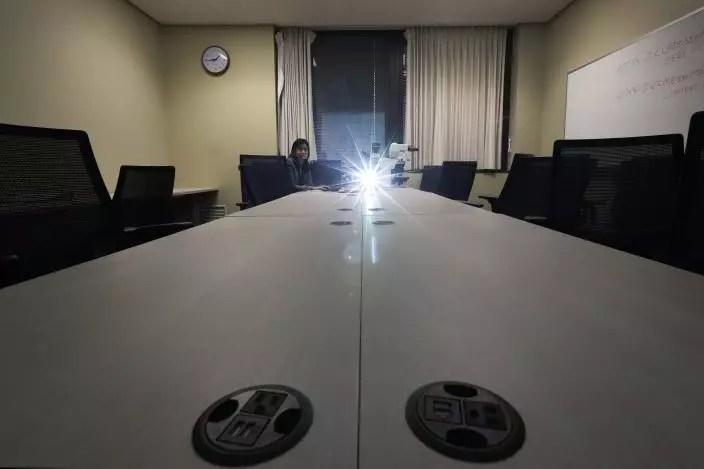
In this Tuesday, May 5, 2020, photo, Cook County Chief Medical Examiner Dr. Ponni Arunkumar sits alone in a conference room usually filled with at least 15 staff members, as she leads a virtual consensus meeting, reviewing the day's cases with other participating pathologists phoning in to maintain social distancing. One pathologist on the call says she had more than 80 case records to go through. Many are COVID-19 deaths including some cases from previous days. "This is absurd," she said. (AP PhotoCharles Rex Arbogast)
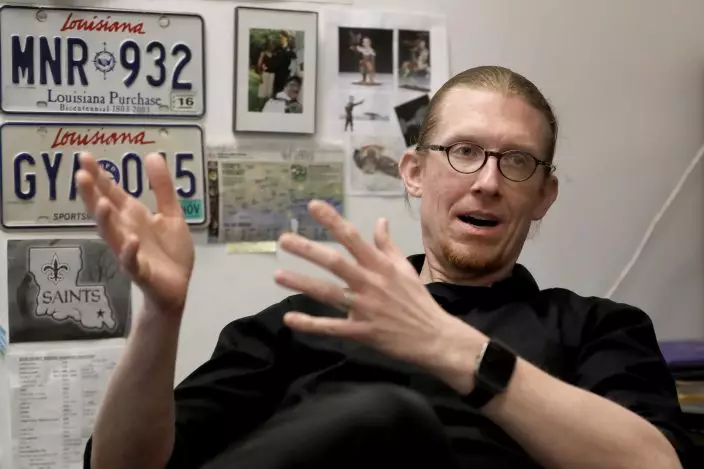
In this Tuesday, May 5, 2020, photo, Cook County Medical Examiner chief investigator Christopher Kalka listens to a question during an interview with The Associated Press. Kalka, started his career as an investigator in New Orleans and was there when Hurricane Katrina devastated the city in 2004. "This," he says about the virus outbreak, "is the most staggering display of death I've seen since Katrina." (AP PhotoCharles Rex Arbogast)
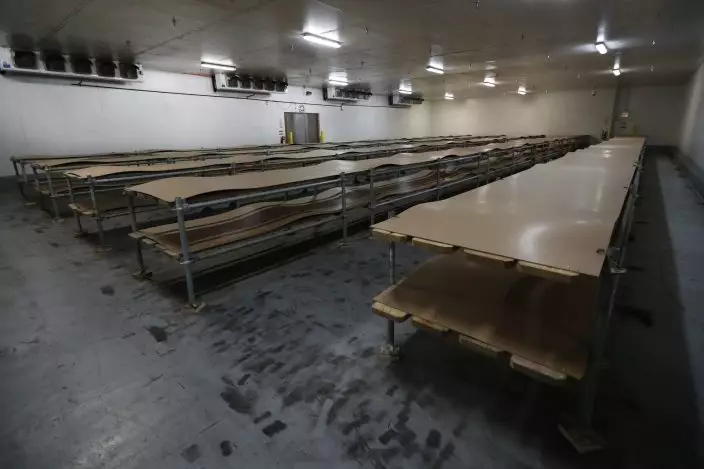
This Tuesday, May 5, 2020, photo, shows one of two rooms at the Cook County Medical Examiner's auxiliary storage facility that has yet to be utilized in Chicago. It is an encouraging indication the medical examiner's system to ensure most bodies are released to funeral homes as quickly as possible is working. The center has the total capacity to hold 2,000 bodies. (AP PhotoCharles Rex Arbogast)
“We’ve never gone through anything like this,” she said of the workloads.
In this Tuesday, May 5, 2020, photo, Cook County Chief Medical Examiner Dr. Ponni Arunkumar, enters an autopsy room where she will personally perform four autopsies in as many hours at the county morgue in Chicago. Arunkumar starts her day with a numbers problem. It's how to manage a tripling of death cases with the same number of pathologists and the same number of hours in a day as before COVID-19. (AP PhotoCharles Rex Arbogast)
Forty of the 62 cases were coronavirus deaths. The oldest to die was a 105-year-old whose obituary described her as a White Sox fan who loved dancing. The youngest was a 53-year-old man who was jailed for allegedly blinding someone in one eye during a barroom brawl.
Medical examiners worldwide face similar challenges, and some are buckling under the emotional strain. But there was no sign of that at the Cook County facility, where employees seemed to be coping well with the historic surge in deaths. The pandemic has only deepened their sense of camaraderie, said the office’s director of fatality management, who oversees a temporary morgue set up off-site to handle the influx of corpses.
“We lean on each other,” Victoria Raspante said.
In this Tuesday, May 5, 2020, photo, Cook County Chief Medical Examiner Dr. Ponni Arunkumar, dawns personal protective equipment as she prepares to perform four autopsies in as many hours at the county morgue in Chicago. Arunkumar starts her day with a numbers problem. It's how to manage a tripling of death cases with the same number of pathologists and the same number of hours in a day as before COVID-19. (AP PhotoCharles Rex Arbogast)
The 45-year-old Arunkumar, who spent part of her childhood in India, has an air of calm about her. Soft-spoken and quick to smile, she has a knack for keeping those she supervises at ease.
According to figures updated Tuesday, her office has handled 5,323 cases already this year, 2,551 of them COVID-19 deaths since the first confirmed coronavirus death in mid-March. It had 6,254 deaths for all of 2019. Her 18 pathologists have sometimes worked 12-hour days, seven days a week.
The hope was that stay-at-home orders would sharply reduce gun deaths in Chicago, which has had more homicides than Los Angeles and New York combined for successive years. A drop-off in killings would help keep caseloads at more manageable levels.
In this Tuesday, May 5, 2020, photo, Cook County Chief Medical Examiner Dr. Ponni Arunkumar, conducts rounds, an overview of cases for the day, with her medical staff of six fellow pathologists who will perform several autopsies on shooting victims and others whose cause of death isn't clear at the county morgue in Chicago. (AP PhotoCharles Rex Arbogast)
That hasn’t happened.
The office has had 111 homicides cases since mid-March when the pandemic began in the county compared to 113 over the same period last year. One of the 22 non-COVID cases this day is a 21-year-old man who was killed in a drive-by shooting as he sat on a porch.
At 8:30 a.m., Arunkumar and six fellow pathologists began autopsies on shooting victims and others whose cause of death wasn’t clear.
In this Tuesday, May 5, 2020, photo, Cook County Chief Medical Examiner Dr. Ponni Arunkumar, makes reference to digitally projected X-rays of a gunshot victim as she prepares for her share of autopsies at the county morgue in Chicago. Arunkumar starts her day with a numbers problem. It's how to manage a tripling of death cases with the same number of pathologists and the same number of hours in a day as before COVID-19. (AP PhotoCharles Rex Arbogast)
She pointed to a bullet hole in the shoulder of the man who was killed in the drive-by, his bloody clothes nearby. Another pathologist retrieved the bullet through the wound.
Between autopsies, Arunkumar walked into the facility’s main morgue, where around 250 bodies lined rows of floor-to-ceiling shelving. It was filled to capacity.
Downstairs, Rebeca Perrone stacked 24 boxes of unclaimed cremated remains on shelves that already had 500 others. Some of those cremated were homeless. Others lived alone, estranged from their families.
In this Tuesday, May 5, 2020, photo, an orange biohazard tag hangs from a body bag in an isolated refrigerated unit set aside for bodies infected with coronavirus at the Cook County morgue in Chicago. (AP PhotoCharles Rex Arbogast)
More remains are going unclaimed these days — a sign that more families can't afford the $250 collection fee because of the economic turmoil caused by the pandemic, said Perrone, who arranges funerals for the unclaimed dead and helps poorer families find resources for burials.
Perrone refused to complain about her heavier workloads. Her job sometimes includes informing relatives that a loved-one has died.
“It’s actually nice to be able to talk to someone on the worst day of their life and say, ‘This is what we can do to help,’” she said.
In this Tuesday, May 5, 2020, photo, Cook County Medical Examiner forensic technician Pero Paunovich wheels the body of a COVID-19 victim from an emergency-management truck that just arrived at the medical examiner's auxiliary surge storage center in Chicago. An encouraging sign amid the grimness is that two of the rooms are mostly empty, an indication the medical examiner's system to ensure most bodies are released to funeral homes as quickly as possible is working. (AP PhotoCharles Rex Arbogast)
On the second floor, investigative-unit chief Christopher Kalka said his 27 investigators were also putting in long hours. People who witness suspicious deaths are now asked whether the deceased complained of losing their sense of smell or taste, which are possible symptoms of COVID-19.
All homicides require an autopsy. Most COVID-19 deaths don’t, as a hospital records review is considered sufficient.
Not all COVID-19 cases are clear cut. Pathologists concluded in one man’s death that the virus didn’t directly kill him, but that it affected his balance. He then fell and broke his hip, causing fatal complications.
In this Tuesday, May 5, 2020, photo, Cook County Medical Examiner forensic technician William Cherry, right, stands on a small ladder to photograph the body of a COVID-19 victim as his colleague Pero Paunovich, steadies the gurney at the medical examiner's auxiliary surge storage center in Chicago. (AP PhotoCharles Rex Arbogast)
Doing fewer autopsies in COVID-19 cases reduces staff exposure to the virus. Risk of infection from the dead is low since it is often transmitted via spray from a sneeze or cough. No one who works at the office has tested positive.
Staff didn’t conduct an autopsy on the inmate who was allegedly involved in the barroom brawl. They gave his body a swab test like the ones given to the living to confirm the presence of the virus, though they did it in a room with reduced air pressure so that viruses can’t seep out.
His body was wheeled into a smaller refrigerated unit for coronavirus deaths, an orange biohazard tag affixed to his body bag.
In this Tuesday, May 5, 2020, photo, Illinois National Guard members return a body tray to be sanitized on the loading dock at the Cook County Medical Examiner's auxiliary surge storage center after an emergency-management truck arrived with half-a-dozen bodies in Chicago. Incoming bodies to the surge center, with a capacity to hold 2,000 bodies, are taken to one of three rooms with the combined square footage of a football field. (AP PhotoCharles Rex Arbogast)
At an afternoon conference call to talk through the day’s cases, Arunkumar sat alone with other pathologists phoning in. Pathologists mostly review records from home these days to reduce the risk of spreading the virus at the office.
One said she had more than 80 cases to review, including many COVID-19 cases.
“This is absurd,” she said without anger.
In this Tuesday, May 5, 2020, photo, a member of the Illinois National Guard sanitizes a body tray on the loading dock of the Cook County Medical Examiner's auxiliary surge storage center after an emergency-management truck arrived with half-a-dozen bodies in Chicago. Incoming bodies to the surge center, with a capacity to hold 2,000 bodies, are taken to one of three rooms with the combined square footage of a football field. (AP PhotoCharles Rex Arbogast)
Upgrades at the office in recent years have helped avert crippling backlogs during the pandemic. Changes included putting records online. That’s enabled staff to work from home and clear cases faster.
A key to operations now is a perishable-goods warehouse that was converted to a temporary morgue. National Guard troops unloaded bodies on the day the AP visited. Medical examiner's office staffers measured and photographed the bodies at the loading dock before soldiers took the body bags to one of three rooms the combined size of a football field. They laid them gently on specially constructed scaffolding.
One room held 130 bodies, but the site can hold up to 2,000. Two of the three rooms were mostly empty — an encouraging sign amid the grimness.
In this Tuesday, May 5, 2020, photo, Cook County Medical Examiner's Indigent Coordinator, Rebeca Perrone, begins placing 24 boxes of unclaimed cremated remains on a shelf, adding to over 500 other boxes at the county morgue in Chicago. Numbers of unclaimed remains are up, Perrone says. Lost wages amid business shutdowns mean some families can't afford the minimal $250 fee to collect the boxes. (AP PhotoCharles Rex Arbogast)
Raspante worked seven-day weeks for several weeks at the makeshift morgue before recently getting days off. When her kids ask about her job, she doesn't tell them she’s among the dead all day, every day.
“I tell them that I help hospitals learn why people get sick,” she said.
Death is in the job description, but that doesn’t mean those who work at the medical examiner's office are unmoved by the surge in dead, Arunkumar said. They cope by checking on each other more. Staff also adhere to a strict rule: Treat the dead with the respect they’d want extended to their own loved-ones.
In this Tuesday, May 5, 2020, photo, Cook County Chief Medical Examiner Dr. Ponni Arunkumar studies the screen of data and photographs from the day's cases as she leads a virtual consensus meeting with other participating pathologists phoning in to maintain social distancing. One pathologist on the call says she had more than 80 case records to go through. Many are COVID-19 deaths, including some cases from previous days. "This is absurd," she said. (AP PhotoCharles Rex Arbogast)
Doing that “makes it easier to handle what we are doing," she said.
Associated Press writer Don Babwin and video journalist Noreen Nasir contributed to this report.
In this Tuesday, May 5, 2020, photo, Cook County Chief Medical Examiner Dr. Ponni Arunkumar sits alone in a conference room usually filled with at least 15 staff members, as she leads a virtual consensus meeting, reviewing the day's cases with other participating pathologists phoning in to maintain social distancing. One pathologist on the call says she had more than 80 case records to go through. Many are COVID-19 deaths including some cases from previous days. "This is absurd," she said. (AP PhotoCharles Rex Arbogast)
In this Tuesday, May 5, 2020, photo, Cook County Medical Examiner chief investigator Christopher Kalka listens to a question during an interview with The Associated Press. Kalka, started his career as an investigator in New Orleans and was there when Hurricane Katrina devastated the city in 2004. "This," he says about the virus outbreak, "is the most staggering display of death I've seen since Katrina." (AP PhotoCharles Rex Arbogast)
This Tuesday, May 5, 2020, photo, shows one of two rooms at the Cook County Medical Examiner's auxiliary storage facility that has yet to be utilized in Chicago. It is an encouraging indication the medical examiner's system to ensure most bodies are released to funeral homes as quickly as possible is working. The center has the total capacity to hold 2,000 bodies. (AP PhotoCharles Rex Arbogast)