The sentencing hearing for a northern Illinois woman who pleaded guilty in the beating death of her 5-year-old son began Thursday with a prosecutor reading statements from neighbors who saw the boy was cut and bruised years before he was killed.
McHenry County State's Attorney Patrick Kenneally began building his argument that JoAnn Cunningham should receive the maximum sentence of 60 years in state prison for what he says was years of physical abuse that ended with first-degree murder.
Cunningham’s sentencing is the latest chapter in the story of AJ Freund, whose battered body was found in a shallow grave in April last year, not far from his Crystal Lake home and just days after his parents reported him missing.
The first witnesses Thursday included a Crystal Lake police officer who saw a bruise on AJ's hip four months before he was killed. An emergency room doctor testified to seeing the bruise the same day, according to the Northwest Herald.
Cunningham, 37, faces a sentence ranging from 20 to 60 years in AJ's killing. Prosecutors have said she must serve her entire sentence, meaning that if she receives the maximum sentence she will die in prison.
The story started with hope that the missing boy in the photograph, a smiling kid, a baseball cap pulled tight on his head, would be found alive. After an intense search of woods near the family's home turned up nothing, hope turned to fear.
Concern for the parents quickly turned to suspicion when it was reported that they had stopped cooperating with investigators. A few days later, Cunningham and the boy's father, Andrew Freund Sr., were arrested and charged with first-degree murder in the death of their son.
Authorities revealed that a video on Cunningham’s cellphone dated March 4, weeks before the boy's death, showed AJ lying naked on a mattress covered in bruises and bandages. On the video, a woman can be heard berating the child for wetting his bed. Authorities believe that woman's voice belonged to Cunningham.
Confronted with that video, Freund led investigators to the spot where his son, his body wrapped in plastic, was buried in a shallow grave.
An autopsy revealed that the boy had been struck multiple times and died from blunt force trauma. Then came the heartbreaking details of the boy's life in the days, weeks and years before he was killed.
According to court documents, Freund — who has pleaded not guilty — told police that it was Cunningham who beat the boy and that he had suggested they punish AJ by making him take cold showers instead.
On the night the boy died, he was put in the shower after Cunningham found soiled underwear that AJ had tried to hide, authorities said. The autopsy showed that bruises on his face matched a detachable shower head, indicating he was not merely forced to stand under freezing water but was beaten in the shower, according to published reports at the time.
Freund told investigators that he put the boy to bed “cold, wet and naked." The father said Cunningham later found their son unresponsive, according to court documents.
Freund admitted that he put AJ's body in a plastic container and stored it in the basement to be buried later. A shopping list included “duct tape, plastic gloves, air freshener and bleach,” according to a photograph contained in a search warrant.
Court documents tell of a boy who was in danger his entire life. Tests at birth revealed he and his mother had opiates in their systems, prompting the state's Department of Children and Family Services to take the baby into custody before returning him to them some 20 months later.
Then came the repeated visits by child welfare workers to the dilapidated house that reeked of dog feces. Those visits typically ended with the child welfare workers determining that the allegations of neglect were unfounded and leaving without the boy, despite what appeared to be pleas by police that they do something, anything.
AJ's death triggered investigations of the child welfare system and the firing of a state child welfare worker and a supervisor.
For months, the family's rundown but otherwise unremarkable home stands as a silent reminder of the little boy's short, painful life.
Finally, in March of this year, work crews arrived and demolished the house, erasing the building if not the memory of what happened there.
MINNEAPOLIS (AP) — A judge on Wednesday gave the Trump administration time to respond to a request to suspend an immigration crackdown in Minnesota, while the Pentagon looked for military lawyers to join what has become a chaotic law enforcement effort in the state.
Plumes of tear gas, bursts of chemical irritants and the screech of protest whistles have become common on the streets of Minneapolis, especially since an immigration agent fatally shot Renee Good in the head on Jan. 7 as she drove away.
Agents have yanked people from cars and homes and been confronted by angry bystanders who are demanding that officers pack up and leave.
“What we need most of all right now is a pause. The temperature needs to be lowered," state Assistant Attorney General Brian Carter said during the first hearing in a lawsuit filed by Minnesota and the cities of Minneapolis and St. Paul.
Local leaders say the government is violating free speech and other constitutional rights with the surge of law enforcement. U.S. District Judge Katherine Menendez promised to keep the case “on the front burner” and gave the U.S. Justice Department until Monday to file a response to a request for a restraining order.
The judge said these are "grave and important matters,” and that there are few legal precedents to apply to some of the key points in the case.
Justice Department attorney Andrew Warden suggested the approach set by Menendez was appropriate.
The judge is also handling a separate lawsuit challenging the tactics used by Immigration and Customs Enforcement and other federal officers when they encounter protesters and observers. A decision could be released this week.
The Department of Homeland Security says it has made more than 2,000 arrests in the state since early December and is vowing to not back down. The Pentagon is preparing to send military lawyers to Minneapolis to assist.
CNN, citing an email circulating in the military, says Defense Secretary Pete Hegseth is asking the branches to identify 40 lawyers known as judge advocate general officers or JAGs, and 25 of them will serve as special assistant U.S. attorneys in Minneapolis.
Pentagon spokesperson Kingsley Wilson appeared to confirm the CNN report by posting it on X with a comment that the military “is proud to support” the Justice Department.
The Pentagon did not immediately respond to emails from The Associated Press seeking more details.
It’s the latest step by the Trump administration to dispatch military and civilian attorneys to areas where federal immigration operations are taking place. The Pentagon last week sent 20 lawyers to Memphis, U.S. Attorney D. Michael Dunavant said.
Mark Nevitt, an associate professor at Emory University School of Law and a former Navy JAG, said there's concern that the assignments are taking lawyers away from the military justice system.
“There are not many JAGs but there are over one million members of the military, and they all need legal support,” he said.
Jonathan Ross, the Immigration and Customs Enforcement officer who killed Good, suffered internal bleeding to his torso during the encounter, a Homeland Security official told The Associated Press.
The official spoke to AP on condition of anonymity in order to discuss Ross’ medical condition. The official did not provide details about the severity of the injuries, and the agency did not respond to questions about the extent of the bleeding, exactly how he suffered the injury, when it was diagnosed or his medical treatment.
There are many causes of internal bleeding, and they vary in severity from bruising to significant blood loss. Video from the scene showed Ross and other officers walking without obvious difficulty after Good was shot and her Honda Pilot crashed into other vehicles.
She was killed after three ICE officers surrounded her SUV on a snowy street a few blocks from her home.
Bystander video shows one officer ordering Good to open the door and grabbing the handle. As the vehicle begins to move forward, Ross, standing in front, raises his weapon and fires at least three shots at close range. He steps back as the SUV advances and turns.
Homeland Security Secretary Kristi Noem has said Ross was struck by the vehicle and that Good was using her SUV as a weapon — a self-defense claim that has been deeply criticized by Minnesota officials.
Chris Madel, an attorney for Ross, declined to comment on any injuries.
Good’s family, meanwhile, has hired a law firm, Romanucci & Blandin, that represented George Floyd’s family in a $27 million settlement with Minneapolis. Floyd, who was Black, died after a white police officer pinned his neck to the ground in the street in May 2020.
The firm said Good was following orders to move her car when she was shot. It said it would conduct its own investigation and publicly share what it learns.
“They do not want her used as a political pawn,” the firm said, referring to Good and her family, “but rather as an agent of peace for all.”
Waving signs reading “Love Melts ICE” and “DE-ICE MN,” hundreds of teenagers left school in St. Paul and marched in freezing temperatures to the state Capitol for a protest and rally.
The University of Minnesota, meanwhile, informed its 50,000-plus students that there could be online options for some classes when the new term starts next week. President Rebecca Cunningham noted that “violence and protests have come to our doorstep.” The campus sits next to the main Somali neighborhood in Minneapolis.
Associated Press reporters Julie Watson in San Diego, California; Rebecca Santana in Washington, D.C.; Ed White in Detroit; Giovanna Dell’Orto in Minneapolis; and Graham Lee Brewer in Oklahoma City, Oklahoma, contributed.
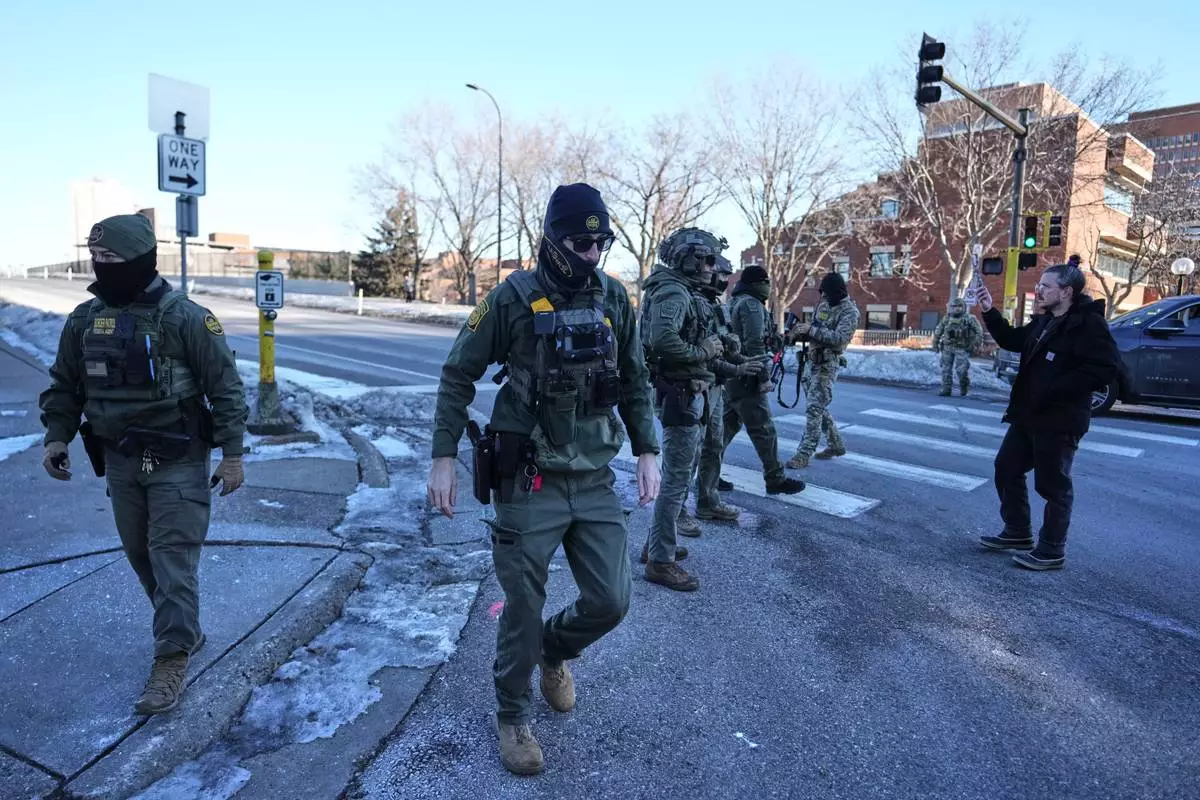
Federal immigration officers are seen Wednesday, Jan. 14, 2026, in Minneapolis. (AP Photo/Abbie Parr)
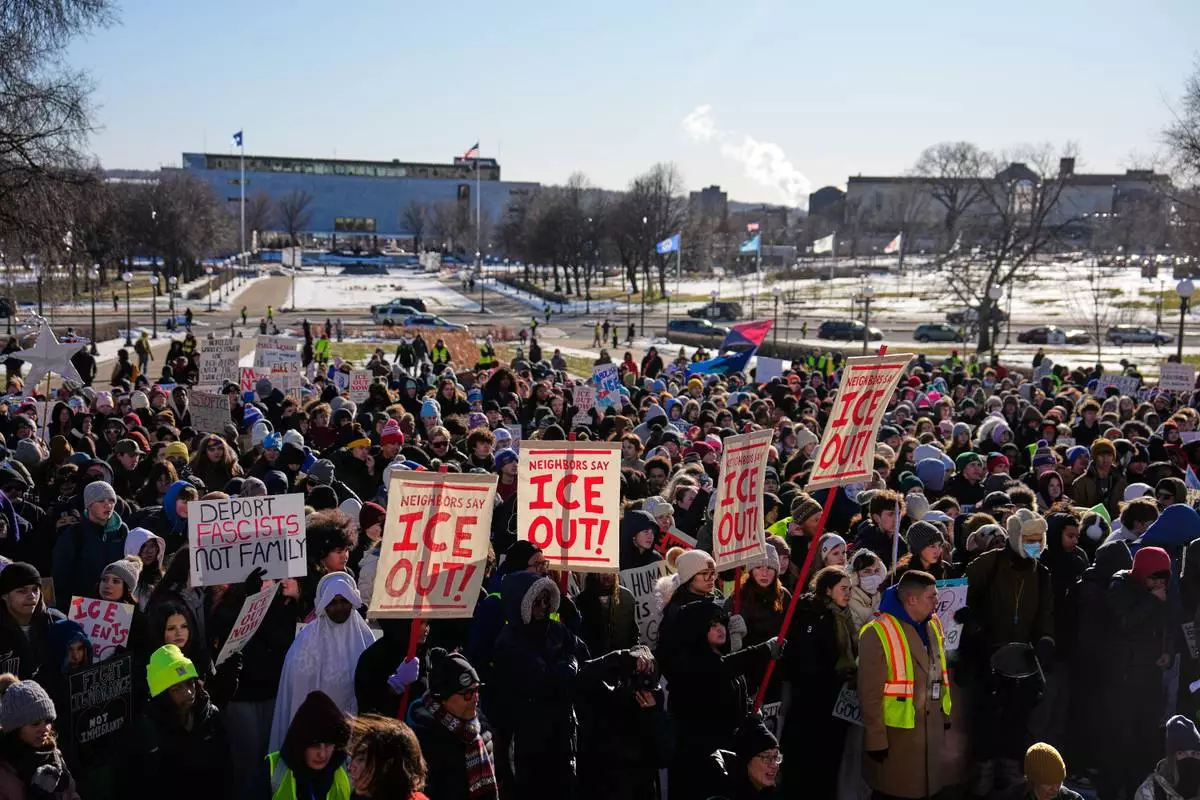
Hundreds of protesters gather in front of the Minnesota State Capitol in response to the death of Renee Good, who was fatally shot by an ICE officer last week, Wednesday, Jan. 14, 2026, in St. Paul, Minn. (AP Photo/John Locher)
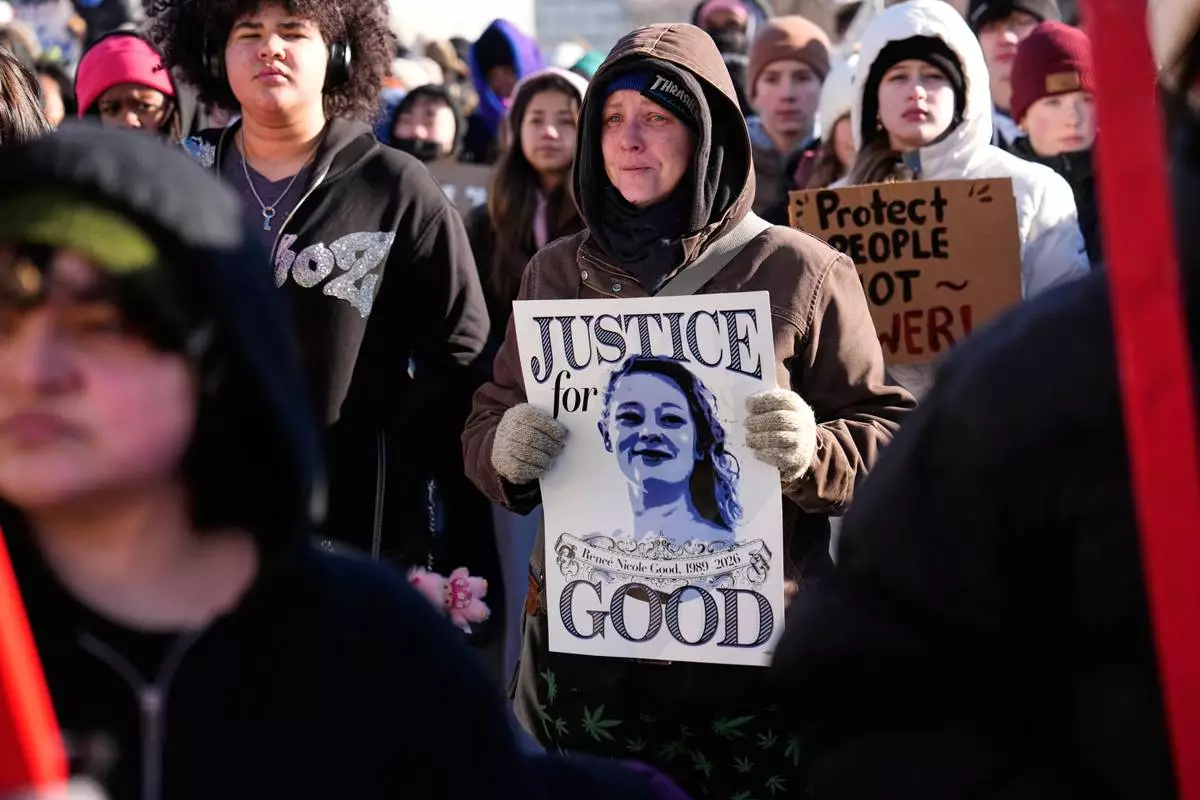
Protesters gather in front of the Minnesota State Capitol in response to the death of Renee Good, who was fatally shot by an ICE officer last week, Wednesday, Jan. 14, 2026, in St. Paul, Minn. (AP Photo/John Locher)
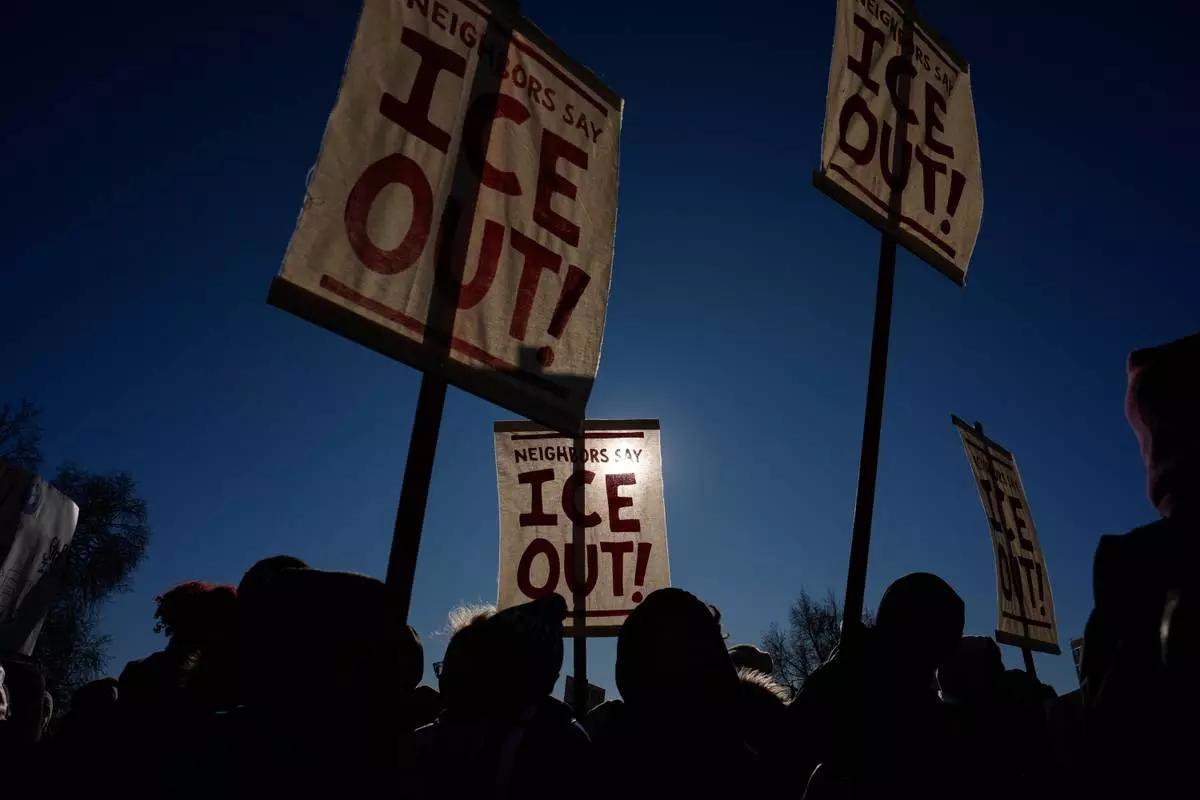
Protesters gather in front of the Minnesota State Capitol in response to the death of Renee Good, who was fatally shot by an ICE officer last week, Wednesday, Jan. 14, 2026, in St. Paul, Minn. (AP Photo/John Locher)
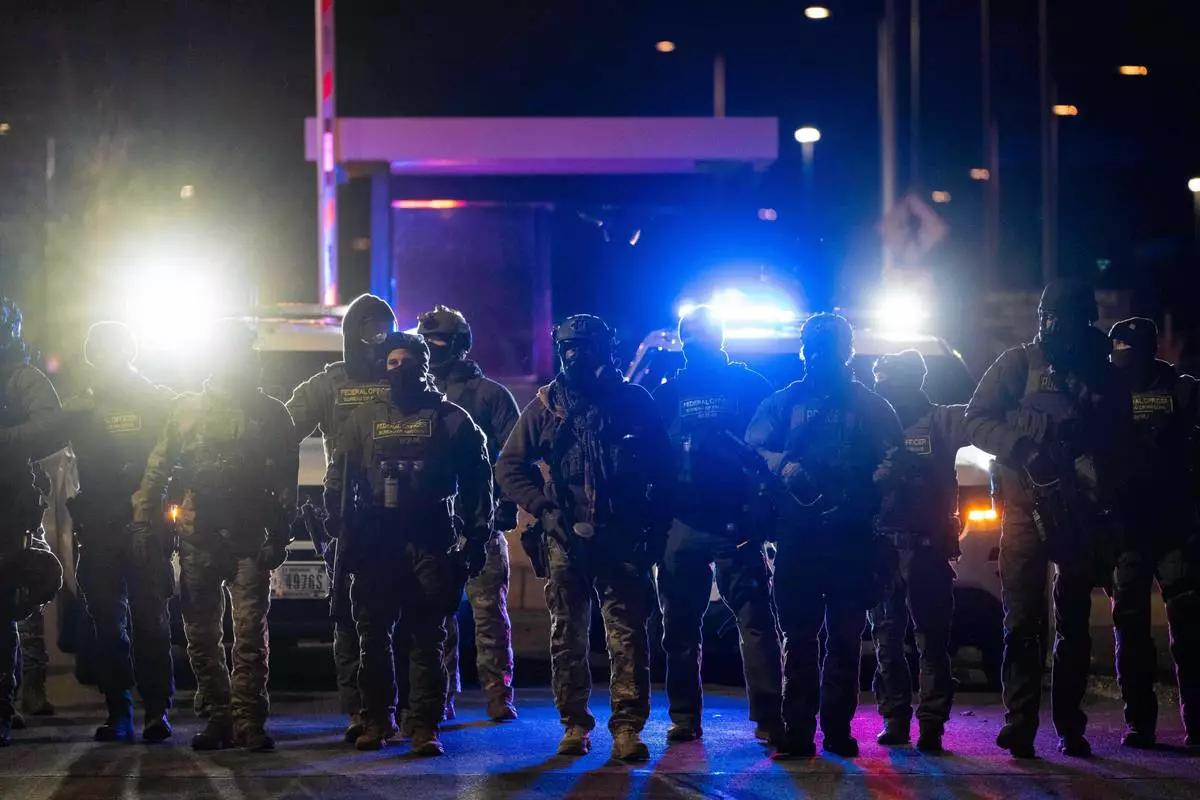
Federal officers stand guard after detaining people outside of Bishop Henry Whipple Federal Building, Tuesday, Jan. 13, 2026, in Minneapolis. (AP Photo/Adam Gray)
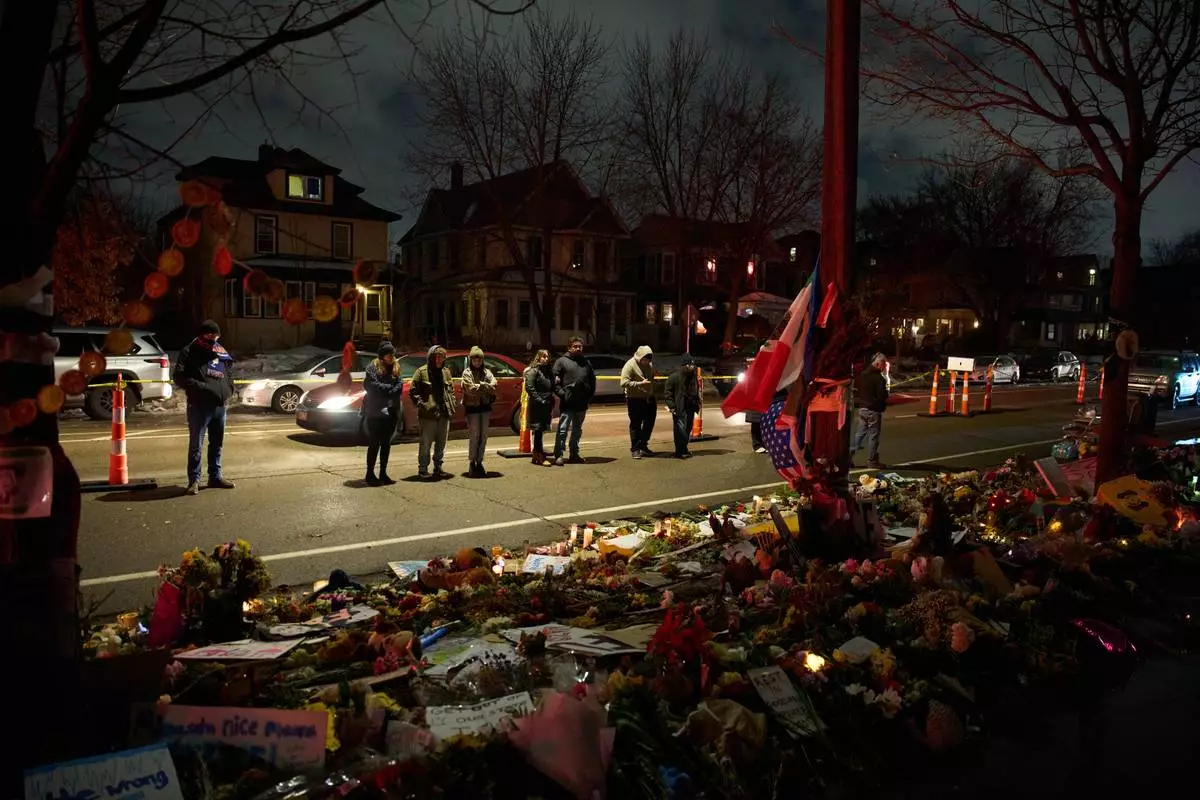
People visits a makeshift memorial for Renee Good, who was fatally shot by an ICE officer last week, Tuesday, Jan. 13, 2026, in Minneapolis. (AP Photo/John Locher)
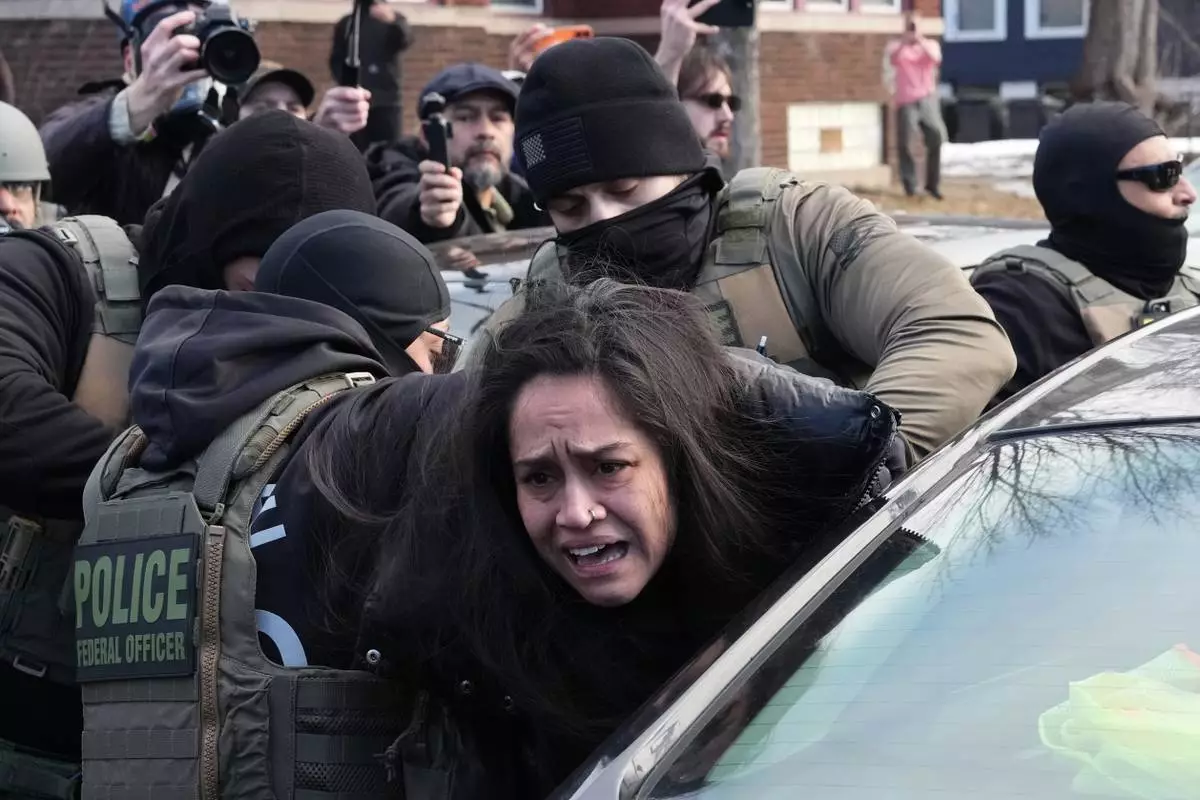
A person is detained by federal agents near the scene where Renee Good was fatally shot by an ICE officer last week, Tuesday, Jan. 13, 2026, in Minneapolis. (AP Photo/Adam Gray)