FBI Director Chris Wray told lawmakers Thursday that antifa is an ideology, not an organization, delivering testimony that puts him at odds with President Donald Trump, who has said he would designate it a terror group.
Wray did not dispute that antifa activists were a serious concern, saying that antifa was a “real thing” and that the FBI had undertaken “any number of properly predicated investigations into what we would describe as violent anarchist extremists,” including into individuals who identify with antifa.
Click to Gallery
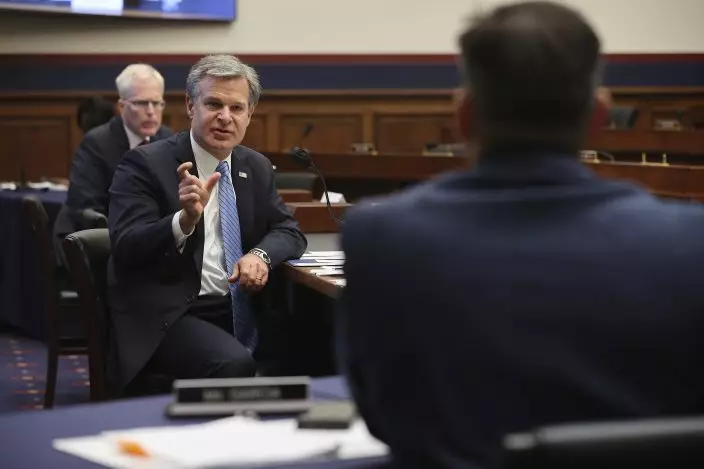
FBI Director Christopher Wray testifies before a House Committee on Homeland Security hearing Thursday, Sept. 17, 2020, on Capitol Hill Washington. (Chip SomodevillaPool via AP)
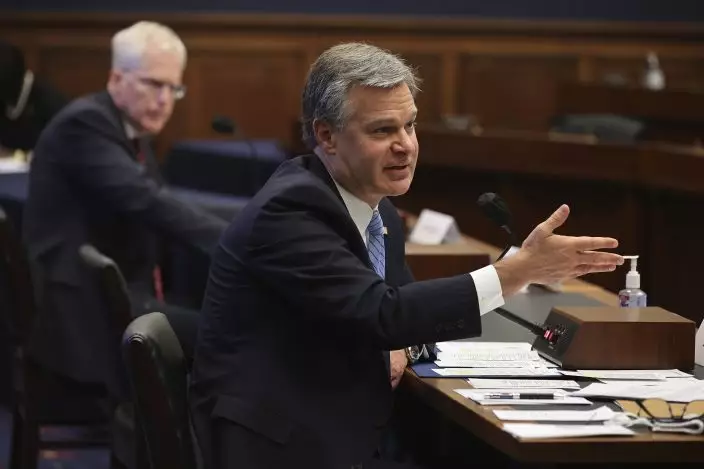
FBI Director Christopher Wray testifies before a House Committee on Homeland Security hearing Thursday, Sept. 17, 2020, on Capitol Hill Washington. National Counterterrorism Center Director Christopher Miller is left. (Chip SomodevillaPool via AP)
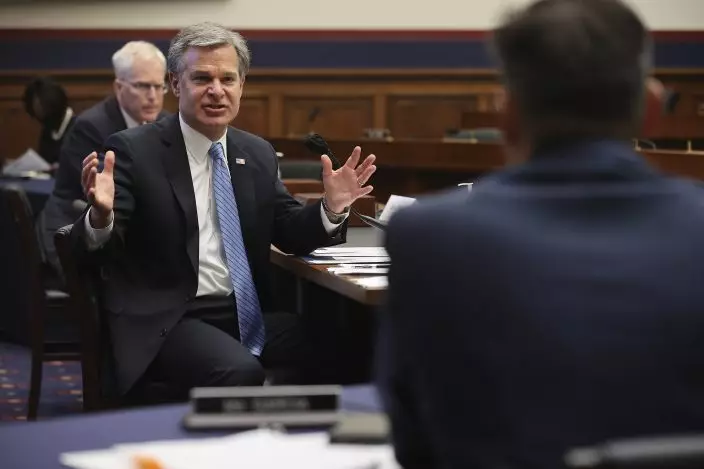
FBI Director Christopher Wray testifies before a House Committee on Homeland Security hearing Thursday, Sept. 17, 2020, on Capitol Hill Washington. (Chip SomodevillaPool via AP)
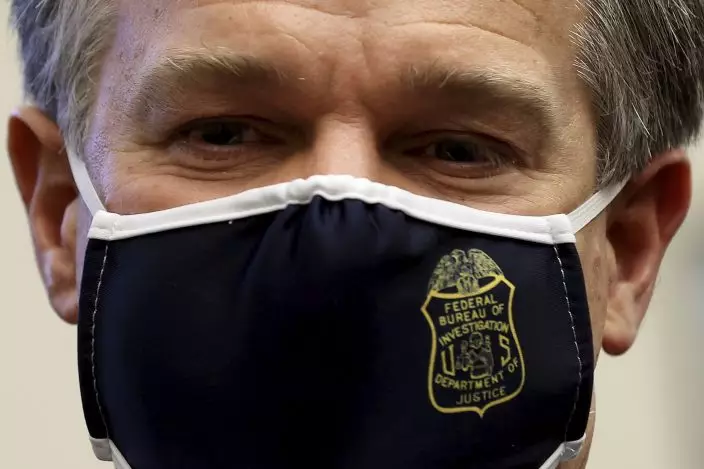
FBI Director Christopher Wray leaves after testifying before the House Homeland Security Committee Thursday, Sept. 17, 2020, on Capitol Hill Washington. (Chip SomodevillaPool via AP)
But, he said, “It’s not a group or an organization. It’s a movement or an ideology.”
FBI Director Christopher Wray testifies before a House Committee on Homeland Security hearing Thursday, Sept. 17, 2020, on Capitol Hill Washington. (Chip SomodevillaPool via AP)
That characterization contradicts the depiction from Trump, who in June singled out antifa — short for “anti-fascists” and an umbrella term for far-left-leaning militant groups — as responsible for the violence that followed George Floyd's death. Trump tweeted that the U.S. would be designating antifa as a terrorist organization, even though such designations are historically reserved for foreign groups and antifa lacks the hierarchical structure of formal organizations.
The hearing before the House Homeland Security Committee — established after the Sept. 11 attacks to confront the threat of international terrorism — focused almost entirely on domestic matters, including violence by white supremacists as well as anti-government extremists. The topics underscored the shift of attention by law enforcement at a time of intense divisions and polarization inside the country.
But one area where foreign threats were addressed was in the presidential election and Russia’s attempts to interfere in the campaign.
FBI Director Christopher Wray testifies before a House Committee on Homeland Security hearing Thursday, Sept. 17, 2020, on Capitol Hill Washington. National Counterterrorism Center Director Christopher Miller is left. (Chip SomodevillaPool via AP)
Wray sought to make clear the scope of the threats the country faces while resisting lawmakers' attempts to steer him into politically charged statements. When asked whether extremists on the left or the right posed the bigger threat, he pivoted instead to an answer about how solo actors, or so-called “lone wolves,” with easy access to weapons were a primary concern.
"We don’t really think of threats in terms of left, right, at the FBI. We’re focused on the violence, not the ideology,” he said later.
The FBI director said racially motivated violent extremists, such as white supremacists, have been responsible for the most lethal attacks in the U.S. in recent years. But this year the most lethal violence has come from anti-government activists, such as anarchists and militia-types, Wray said.
FBI Director Christopher Wray testifies before a House Committee on Homeland Security hearing Thursday, Sept. 17, 2020, on Capitol Hill Washington. (Chip SomodevillaPool via AP)
Wray also affirmed the intelligence community's assessment of Russian interference in the November election, which he said was taking the form of foreign influence campaigns aimed at sowing discord and swaying public opinion as well as efforts to denigrate Democratic presidential nominee Joe Biden.
He said that the U.S. had not yet seen targeting of election infrastructure like in 2016, but efforts to sow doubt about the election's integrity are a serious concern, he said.
“What concerns me the most is the steady drumbeat of misinformation and sort of amplification of smaller cyber intrusions,” Wray said. “I worry that they will contribute over time to a lack of confidence of American voters and citizens in the validity of their vote."
FBI Director Christopher Wray leaves after testifying before the House Homeland Security Committee Thursday, Sept. 17, 2020, on Capitol Hill Washington. (Chip SomodevillaPool via AP)
“I think that would be a perception,” Wray added, “not a reality. I think Americans can and should have confidence in our election system and certainly in our democracy. But I worry that people will take on a feeling of futility because of all of the noise and confusion that's generated."
Trump has resisted the idea of Russian interference aimed at benefiting his campaign and has been eager, along with other administration officials, to talk about intelligence officials' assessment that China prefers that Trump lose to Biden.
Department of Homeland Security Acting Secretary Chad Wolf had been scheduled to appear at the House hearing on worldwide threats but did not testify because of his nomination to be secretary, according to the agency.
The agency said in a statement ahead of the hearing that it would be “contrary to standard practice” to have him testify while his nomination was pending before the Senate.
Acting Deputy Secretary Ken Cuccinelli said in a statement that he was prepared to appear in place of Wolf but that was rejected by the Democratic-controlled committee.
Rep. Bennie Thompson, the committee chairman, began the hearing by noting there is no law prohibiting the testimony of someone facing a confirmation hearing and that Wolf has given multiple media interviews since the president announced his nomination.
The Department of Homeland Security ignored a committee subpoena issued Friday for Wolf's appearance, which the Mississippi Democrat said should “appall” any member of the committee.