
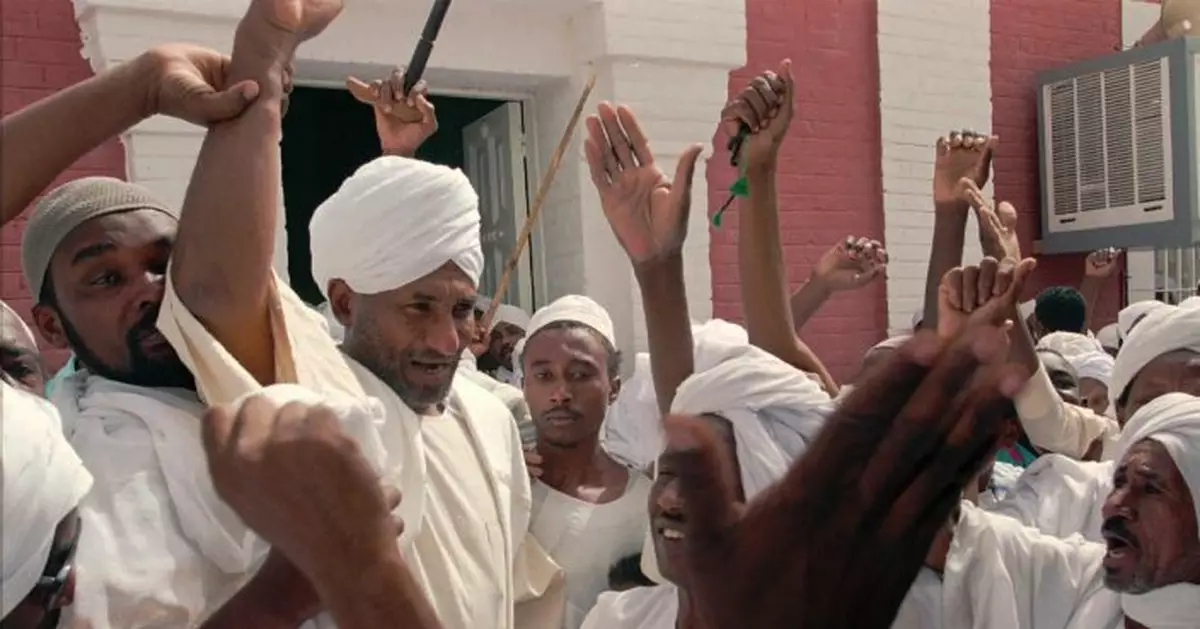
Sadiq al-Mahdi, Sudan’s last democratically elected prime minister and leader of the country's largest political party, has died of COVID-19 in a hospital in the United Arab Emirates, his party said. He was 84.
Al-Mahdi was taken to Abu Dhabi for treatment in early November, and died late Wednesday. His body was expected to arrive in Sudan for burial Friday morning, the National Ummah Party tweeted. It had announced al-Mahdi tested positive for the coronavirus on Oct. 29.
Al-Mahdi was overthrown in a 1989 Islamist-backed coup that brought longtime autocrat Omar al-Bashir to power. Nearly three decades later, Al-Mahdi's party allied with a pro-democracy uprising in Sudan that led the military to overthrow al-Bashir in April 2019.
Sudan has since been ruled by a transitional military-civilian government. Elections could possibly be held in late 2022.
Al-Mahdi was one of the staunchest opponents of Sudan’s recent normalization of ties with Israel, which he dismissed as “an apartheid state” because of its treatment of the Palestinians. He also accused U.S. President Donald Trump of being racist against Muslims and Black people.
Sudan's government declared three days of national mourning starting Thursday. Gen. Mohammed Hamdan Dagalo, deputy head of the country's ruling sovereign council, tweeted that the Sudanese people “lost a part of their history.”
The Sudanese Professionals’ Association, which spearheaded last year's uprising against al-Bashir, mourned al-Mahdi as “an inspiring leader.”
Al-Mahdi was born in December 1935 in Khartoum’s sister city of Omdurman. He was the grandson of Mohammad Ahmad al-Mahdi, a religious leader whose movement waged a successful war against Egyptian-Ottoman rule in Sudan in the second half of the nineteenth century.
Al-Mahdi served as prime minister in 1966-67 before a group of military officers led by Jaafar al-Nimeiri took power.
The veteran politician was jailed several times and forced into self-exile for years. He served as prime minister for a second time from 1986-89.
SEOUL, South Korea (AP) — North Korea said Monday it completed a new housing district in Pyongyang for families of North Korean soldiers killed while fighting alongside Russian forces in Ukraine, the latest effort by leader Kim Jong Un to honor the war dead.
State media photos showed Kim Jong Un walking through the new street — called Saeppyol Street — and visiting the homes of some of the families with his increasingly prominent daughter, believed to be named Kim Ju Ae, as he pledged to repay the “young martyrs” who “sacrificed all to their motherland.”
In recent months, North Korea has intensified propaganda glorifying troops deployed to fight in Russia’s war against Ukraine, such as establishing a memorial wall and building a museum. Analysts see it as an effort to bolster internal unity and curb potential public discontent.
Kim in recent months has sent thousands of troops and large quantities of military equipment, including artillery and missiles, to fuel Russian President Vladimir Putin’s war on Ukraine, as the leaders align i n the face of their separate confrontations with Washington.
South Korea’s National Intelligence Service told lawmakers last week it estimates that about 6,000 North Korean troops were killed or wounded during their deployment in the war, but did not provide a breakdown of fatalities. The agency said last year it believed roughly 600 had died.
The spy agency believes North Korean forces are benefiting from the war by gaining modern combat experience and Russian technical support that could improve the performance of their weapons systems, according to lawmakers who attended last week’s closed-door briefing.
The construction of the new street comes as North Korea prepares to open a major ruling party congress later this month, where Kim is expected to announce his major goals in domestic and foreign policy over the next five years and take further steps to tighten his control.
In this photo provided by the North Korean government, North Korean leader Kim Jong Un, second right, delivers a speech during a completion ceremony of the new street, called Saeppyol Street in Pyongyang, North Korea Sunday, Feb. 15, 2026. Independent journalists were not given access to cover the event depicted in this image distributed by the North Korean government. The content of this image is as provided and cannot be independently verified. Korean language watermark on image as provided by source reads: "KCNA" which is the abbreviation for Korean Central News Agency. (Korean Central News Agency/Korea News Service via AP)
In this photo provided by the North Korean government, North Korean leader Kim Jong Un, second right, attends a completion ceremony of the new street, called Saeppyol Street in Pyongyang, North Korea Sunday, Feb. 15, 2026. Independent journalists were not given access to cover the event depicted in this image distributed by the North Korean government. The content of this image is as provided and cannot be independently verified. Korean language watermark on image as provided by source reads: "KCNA" which is the abbreviation for Korean Central News Agency. (Korean Central News Agency/Korea News Service via AP)
FILE - In this photo provided by the North Korean government, North Korean leader Kim Jong Un, center left, and his daughter, center right, arrive at the East Pyongyang Grand Theatre in Pyongyang, North Korea, June 29, 2025. Independent journalists were not given access to cover the event depicted in this image distributed by the North Korean government. The content of this image is as provided and cannot be independently verified. (Korean Central News Agency/Korea News Service via AP, File)