
Skip to Content Facebook Feature Image

Estonia report: Russia bets on COVID-19 weakening the West

News

Estonia report: Russia bets on COVID-19 weakening the West
News

News

Estonia report: Russia bets on COVID-19 weakening the West

2021-02-18 00:00 Last Updated At:00:10

Estonia’s foreign intelligence agency said on Wednesday that Russia is counting on the COVID-19 pandemic to weaken unity in the West which will help Moscow gain a more prominent role in international affairs and lead to “declining Western influence on the global stage”.

The Kremlin believes that the pandemic will force the West to focus on domestic policy and economic problems and cause among other things populist and extremist movements to emerge, the Estonian Foreign Intelligence Service said in its annual report.

“For its part, Russia is prepared to add fuel to the flames to encourage these trends," the 79-page report said. “Therefore, 2021 will again see Russian influence operations designed to create and deepen divides within and between Western societies, including at the EU (European Union) level."
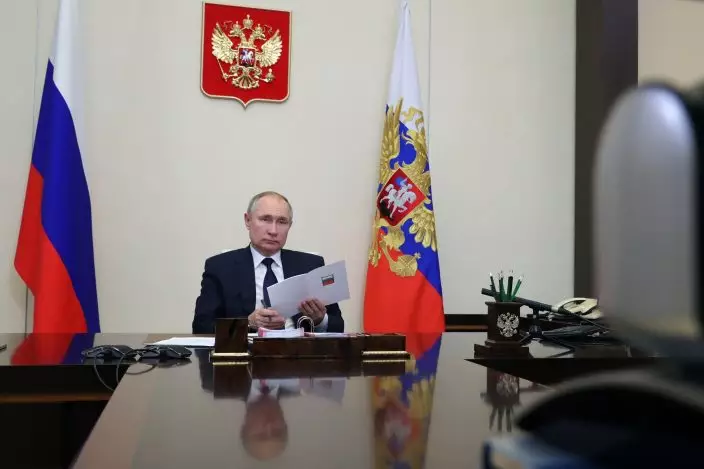
Russian President Vladimir Putin attends a meeting with leaders of the State Duma, the Lower House of the Russian Parliament factions via video conference residence at the Novo-Ogaryovo outside Moscow, Russia, Wednesday, Feb. 17, 2021. (Mikhail Klimentyev, Sputnik, Kremlin Pool Photo via AP)

Russian President Vladimir Putin attends a meeting with leaders of the State Duma, the Lower House of the Russian Parliament factions via video conference residence at the Novo-Ogaryovo outside Moscow, Russia, Wednesday, Feb. 17, 2021. (Mikhail Klimentyev, Sputnik, Kremlin Pool Photo via AP)

It said Russia’s moves will likely include attempts to discredit Western-produced COVID-19 vaccines, especially the one made by the Anglo-Swedish company AstraZeneca which Russian propaganda has labelled as a “monkey vaccine.”

“With these smear campaigns, Russia hopes, on the one hand, to create a more favorable position for its own vaccines on the world market and, on the other hand, to promote its strategic ambition to show itself as being the first among the major powers to provide a solution to the COVID-19,” the report said.

Russia is actively promoting its own Sputnik V coronavirus vaccine in several European nations, including Serbia. Hungary is the first EU nation and so far only EU nation to have purchased quantities of Sputnik V.
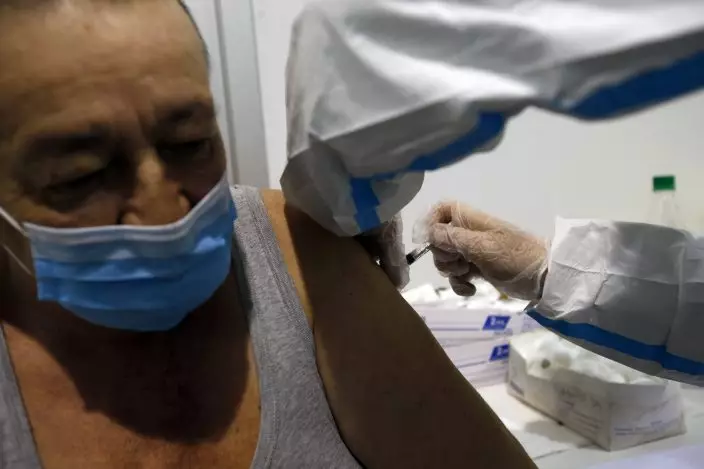
A medical worker administers a shot of COVID-19 vaccine to a man in Belgrade, Serbia, Wednesday, Feb. 17, 2021. Serbia, a country of 7 million, has so far vaccinated some 1 million people, mainly with the Chinese Sinopharm vaccine and Russian Sputnik V, and to a lesser extent with the Pfizer jab. (AP PhotoDarko Vojinovic)

A medical worker administers a shot of COVID-19 vaccine to a man in Belgrade, Serbia, Wednesday, Feb. 17, 2021. Serbia, a country of 7 million, has so far vaccinated some 1 million people, mainly with the Chinese Sinopharm vaccine and Russian Sputnik V, and to a lesser extent with the Pfizer jab. (AP PhotoDarko Vojinovic)

“The coronavirus epidemic hasn’t diminished the actions and ambitions of (Russian President Vladimir) Putin’s regime. On the contrary, we can see how there is an attempt to utilize the pandemic to reap gains for (Russia’s) domestic and foreign policy,” the Estonian agency’s Director General Mikk Marran told reporters during a news conference in Tallinn, the nation’s capital.

Addressing the new U.S. leadership and President Joe Biden, the report said that Russia’s agenda toward Washington isn’t likely to significantly change and will remain “largely confrontational”.

Estonia's relations with neighboring Russia have remained chilly ever since 1991 when the former Soviet republic of 1.3 million and its Baltic neighbors Latvia and Lithuania regained their independence amid the fall of the Soviet Union.
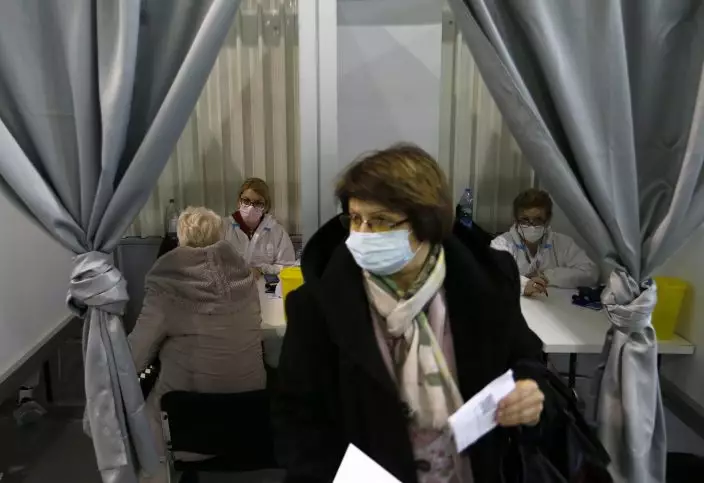
Health workers speak with people at a vaccination center in Belgrade, Serbia, Wednesday, Feb. 17, 2021. Serbia, a country of 7 million, has so far vaccinated some 1 million people, mainly with the Chinese Sinopharm vaccine and Russian Sputnik V, and to a lesser extent with the Pfizer jab. (AP PhotoDarko Vojinovic)

Health workers speak with people at a vaccination center in Belgrade, Serbia, Wednesday, Feb. 17, 2021. Serbia, a country of 7 million, has so far vaccinated some 1 million people, mainly with the Chinese Sinopharm vaccine and Russian Sputnik V, and to a lesser extent with the Pfizer jab. (AP PhotoDarko Vojinovic)

Though focusing largely on events in Russia or that country's immediate neighborhood like in Belarus and Ukraine, the report also noted developments in China. It said Beijing’s ambitious plan to become the world leader in technology “poses major security threats” to the rest of the world.

The new generation 5G mobile networks, advanced satellite navigation technology, cloud services and artificial intelligence were listed in the report as examples of where China either is or hopes to play a key global role.

China’s “leadership has a clear objective of making the world dependent on Chinese technology”, the report said.

The agency warned Estonia's leadership that integrating the country “into China’s autonomous technology ecosystem makes Estonia vulnerable and dependent on China.”

NATO and EU member Estonia had earlier banned China’s Huawei - the world’s leading 5G technology provider - from supplying technology and equipment to the Baltic country’s government, citing security concerns.

PUNXSUTAWNEY, Pa. (AP) — Tens of thousands of people are gathering for Punxsutawney Phil, a groundhog that lives in a tree stump, to predict if the already long and cold winter across much of the United States will go on for another six weeks or if an early spring is around the corner.

The meteorological marmot's predictions on Monday are pretty straightforward, although his top-hatted handlers in the Punxsutawney Groundhog Club insist Phil’s “groundhogese” of winks, purrs, chatters and nods are also being interpreted.

When Phil is said to have seen his shadow upon emergence from a tree stump in rural Pennsylvania, that’s considered a forecast for six more weeks of winter. If he doesn’t see his shadow, an early spring is said to be on the way.

The Latest:

Some well-meaning efforts have sought to determine Phil’s accuracy, but what “six weeks of winter” means is debatable. By all accounts, the furry prognosticator predicts more winter far more often than he predicts an early spring.

And claims that a groundhog has or has not seen its shadow — and that it’s able to communicate that to a human — are also fair territory for skeptics and the humor-impaired.

Among the skeptics is the National Centers for Environmental Information, within the National Oceanic and Atmospheric Administration. The government agency last year compared Phil’s record with U.S. national temperatures over the prior decade and concluded he was right only 40% of the time.

Punxsutawney is an area that Pennsylvania Germans settled — and in the late 1880s started celebrating the holiday by picnicking, hunting and eating groundhogs.

Members of Punxsutawney Groundhog Club, organized in 1899, care for Phil at a customized space beside Punxsutawney Memorial Library — where there’s a window with a view into the creature’s burrow.

The annual ritual at Gobbler’s Knob goes back more than a century, with ties to ancient farming traditions in Europe. Punxsutawney’s festivities have grown considerably since the 1993 movie “Groundhog Day,” starring Bill Murray.

Groundhog Day falls on Feb. 2, the midpoint between the shortest, darkest day of the year on the winter solstice and the spring equinox. It’s a time of year that also figures in the Celtic calendar and the Christian holiday of Candlemas.

Toni Massey, of Bismack, N.D., right, celebrates while waiting for Punxsutawney Phil, the weather prognosticating groundhog, to come out and make his prediction during the 140th celebration of Groundhog Day on Gobbler's Knob in Punxsutawney, Pa., Monday, Feb. 2, 2026. (AP Photo/Barry Reeger)

Toni Massey, of Bismack, N.D., right, celebrates while waiting for Punxsutawney Phil, the weather prognosticating groundhog, to come out and make his prediction during the 140th celebration of Groundhog Day on Gobbler's Knob in Punxsutawney, Pa., Monday, Feb. 2, 2026. (AP Photo/Barry Reeger)

George Morar, of Youngstown, Ohio., celebrates while waiting for Punxsutawney Phil, the weather prognosticating groundhog, to come out and make his prediction during the 140th celebration of Groundhog Day on Gobbler's Knob in Punxsutawney, Pa., Monday, Feb. 2, 2026. (AP Photo/Barry Reeger)

George Morar, of Youngstown, Ohio., celebrates while waiting for Punxsutawney Phil, the weather prognosticating groundhog, to come out and make his prediction during the 140th celebration of Groundhog Day on Gobbler's Knob in Punxsutawney, Pa., Monday, Feb. 2, 2026. (AP Photo/Barry Reeger)

Recommended Articles