Skip to Content Facebook Feature Image

The pioneer of America's embattled global HIV program recalls the hope after years of despair

News

The pioneer of America's embattled global HIV program recalls the hope after years of despair
News

News

The pioneer of America's embattled global HIV program recalls the hope after years of despair

2024-04-01 22:09 Last Updated At:22:20

WASHINGTON (AP) — Through his office window at what was then one of Africa's few modern clinics dealing with HIV and AIDS, the man who now oversees the United States' threatened global AIDS effort used to hear the sound of taxis pulling up throughout the day.

If he turned his head to look out the window, Dr. John Nkengasong said, he knew what he would see: another desperate family carrying a dying loved one — a man or woman already lapsing into a coma, a stick-thin child — and hoping to find help.

It was before the Bush administration started the U.S. President's Emergency Relief Plan for AIDS Relief, known as PEPFAR, in 2004. There was almost no affordable effective treatment anywhere between South Africa and the Sahara, no rapid HIV tests or high-quality government labs, and few beds for AIDS patients.

Nkengasong has spent decades working in Africa on HIV and AIDS, a career intertwined with the U.S. program that since its introduction 20 years ago has transformed care in some of the hardest-hit countries and saved an estimated 25 million lives. He spoke to The Associated Press during a battle over funding in Congress that imperils the AIDS program's future.

Opponents say the HIV/AIDS funding could be indirectly supporting abortion abroad, although the Biden administration and PEPFAR’s defenders say there is no evidence that it does. After a handful of conservative lawmakers threatened for months to block the funding unless restrictions were attached, a compromise was struck in late March that extends the funding for a year.

But advocates of the program warn that without the full five-year renewal, its future remains in doubt as the political debate over abortion and reproductive rights only becomes more combative.

Before PEPFAR, in most cases, Nkengasong's infectious disease clinic in Abidjan, in the Ivory Coast, could offer the families no care. In their loved ones' last hours, the families who came there often were left to crouch outside, in the parking lot.

They would surround “a skeleton of a human being, with a tinge of flesh over their bodies," Nkengasong recalled. "They held their loved ones, giving them the best comfort they could.”

Soon enough, the sound of wailing would rise through his windows. The cries signaled another death to HIV/AIDS, one of millions in Africa by the mid-2000s.

The scene would be repeated “nearly hour by hour,” Nkengasong said. Sometimes he would get up and close the curtains, blocking out the misery of an epidemic he could not then stem.

Two decades later, Nkengasong says, his trips to the region from his offices in Washington bring joyous meetings with men, women and children whose lives were saved through PEPFAR, credited as the biggest government effort ever against a single disease.

In all, the U.S. program has spent more than $110 billion on HIV care and treatment, local medical systems and social programs aimed at stemming infection. The U.S. says it has saved 25 million lives in sub-Saharan Africa and other vulnerable regions, including those of 5.5 million children.

Nkengasong, who was born in Cameroon and did his graduate studies in Belgium, worked in Africa in the 1990s, when the AIDS epidemic was raging all but unchecked.

It made for a “thriving industry of coffins," he said. Visiting cities in Uganda, Rwanda, Kenya and elsewhere for his work on infectious diseases, he would travel streets lined by handmade coffins of all sizes.

Beds of infectious-disease clinics were full of "adults lying there looking like babies, because of what HIV had done. That ugly face," Nkengasong recalled.

With early retroviral medication averaging $10,000 per patient per year, only 50,000 HIV-infected people in sub-Saharan Africa were estimated to be receiving effective treatment in the mid-to-late 1990s. That was out of what the World Health Organization said was 10 million people there living with HIV and AIDS.

One day in spring 2002, as he was in his lab conducting tests, a large American delegation suddenly arrived at the clinic in Abidjan.

Health Secretary Tommy Thompson and other leading U.S. health officials crowded into the facility, along with representatives of businesses and members of faith-based organizations.

“I remember opening the door and the first person who walked through was Dr. Fauci,” Nkengasong recounted. Anthony Fauci, a leading HIV researcher, was then a top official at the U.S. National Institutes of Health and a leader in Nkengasong's field of HIV and AIDS work. “And he said, ‘John, good to see you again.’ And I was so excited."

Unbeknownst to Nkengasong and his colleagues, national security adviser Condoleeza Rice and other officials privately had been making the case to President George W. Bush that the global HIV epidemic was where the U.S. could make a huge difference.

For the Bush administration, the epidemic presented an opportunity to do good at a time when the U.S. was waging war in Afghanistan and later Iraq as well after the Sept. 11, 2001 attacks.

Nine months after the Americans showed up in his lab, “we're watching news on CNN, it was the State of the Union address," Nkengasong recalled. “And President Bush announced the start of PEPFAR.”

That night, the president pledged an initial $15 billion over the next five years to tackle the AIDS epidemic around the world.

Nkengasong called it the “aha moment" for himself and others fighting AIDS in the most vulnerable region of the world.

Two decades later, AIDS deaths globally have fallen nearly 70% from their peak in 2004. Sub-Saharan Africa is still the most vulnerable region and home to two-thirds of the people living with HIV. But the PEPFAR program and others have strengthened health care systems to deal with infectious diseases, made treatment available to millions, and expanded support for the most at-risk populations, including women.

On a trip back to Abidjan, Nkengasong met a healthy 17-year-old girl, one of millions spared from infection at birth thanks to medical treatment that prevented HIV transmission from their infected mothers.

This past summer, he visited a clinic in Namibia where HIV-infected mothers had delivered “super healthy” babies thanks to treatment that saved them from infection.

“I grabbed some of the babies and looked at them,” he said. Holding them, he wondered what would have happened to them without proper care.

“And they just give you that smile," he said.
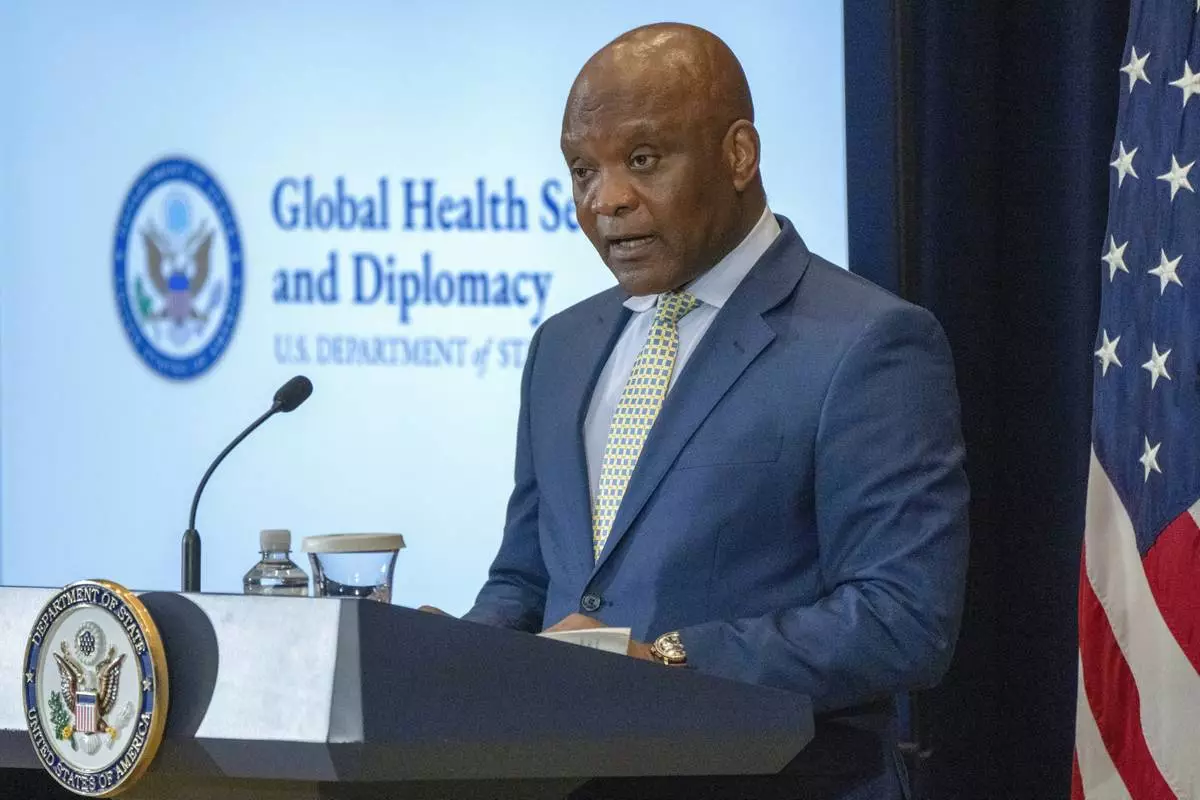
FILE - Ambassador-at-Large John Nkengasong, new head of the Bureau of Global Health Security and Diplomacy at the State Department, speaks during the launch of the new bureau, Aug. 1, 2023, at the State Department in Washington. Nkengasong spoke to The Associated Press about his experience, at a period when challenges by anti-abortion groups and House Republican have made the future of PEPFAR, the U.S. President's Emergency Relief Plan for AIDS Relief, uncertain. (AP Photo/Jacquelyn Martin, File)

FILE - Ambassador-at-Large John Nkengasong, new head of the Bureau of Global Health Security and Diplomacy at the State Department, speaks during the launch of the new bureau, Aug. 1, 2023, at the State Department in Washington. Nkengasong spoke to The Associated Press about his experience, at a period when challenges by anti-abortion groups and House Republican have made the future of PEPFAR, the U.S. President's Emergency Relief Plan for AIDS Relief, uncertain. (AP Photo/Jacquelyn Martin, File)

FILE - John Nkengasong, head of the U.S. President's Emergency Plan for AIDS Relief (PEPFAR), speaks during an interview on Aug. 29, 2023, in Washington. Nkengasong spoke to The Associated Press about his experience, at a period when challenges by anti-abortion groups and House Republican have made the future of PEPFAR uncertain. (AP Photo/Mark Schiefelbein, File)

FILE - John Nkengasong, head of the U.S. President's Emergency Plan for AIDS Relief (PEPFAR), speaks during an interview on Aug. 29, 2023, in Washington. Nkengasong spoke to The Associated Press about his experience, at a period when challenges by anti-abortion groups and House Republican have made the future of PEPFAR uncertain. (AP Photo/Mark Schiefelbein, File)

FILE - John Nkengasong, head of the U.S. President's Emergency Plan for AIDS Relief, or PEPFAR, poses for a portrait on Aug. 29, 2023, in Washington. Nkengasong spoke to The Associated Press about his experience, at a period when challenges by anti-abortion groups and House Republican have made the future of PEPFAR uncertain. (AP Photo/Mark Schiefelbein, File)

FILE - John Nkengasong, head of the U.S. President's Emergency Plan for AIDS Relief, or PEPFAR, poses for a portrait on Aug. 29, 2023, in Washington. Nkengasong spoke to The Associated Press about his experience, at a period when challenges by anti-abortion groups and House Republican have made the future of PEPFAR uncertain. (AP Photo/Mark Schiefelbein, File)

A federal appeals court has restricted access to one of the most common means of abortion in the U.S. by blocking the mailing of mifepristone prescriptions.

Friday's unanimous ruling from a three-judge panel of the New Orleans-based 5th U.S. Circuit Court of Appeals is requiring that the abortion pill be distributed only in person and at clinics, overruling regulations set by the federal Food and Drug Administration.

The ruling, which is likely to be appealed to the U.S. Supreme Court, is the biggest jolt to abortion policy in the U.S. since the 2022 Supreme Court ruling that overturned Roe v. Wade and allowed states to enforce abortion bans.

In the ruling, Judge Kyle Duncan, who was appointed by President Donald Trump, agreed with the state of Louisiana's contention that allowing the drug to be mailed there makes moot the state's ban on abortion at all stages of pregnancy.

“Every abortion facilitated by FDA’s action cancels Louisiana’s ban on medical abortions and undermines its policy that ‘every unborn child is human being from the moment of conception and is, therefore, a legal person,’” the ruling states.

Mifepristone was approved in 2000 as a safe and effective way to end early pregnancies. It is typically used in combination with a second drug, misoprostol.

Surveys have found that the majority of abortions in the U.S. are provided via pills and that about 1 in 4 abortions nationally are prescribed via telehealth.

One survey of abortion providers last year estimated that more women in states where abortion is banned obtained abortions that way than by traveling to other states.

Some Democratic-led states have laws that seek to protect providers who prescribe via telehealth to patients in places with bans.

That rise in prominence is why abortion opponents have targeted the pills in legislation and litigation.

There is little precedent for a federal court overruling the scientific regulations of the FDA, and it wasn’t immediately clear how quickly or completely the decision would impact mailing of the drug throughout the country.

Judges have long deferred to the agency's judgments on the safety and appropriate regulation of drugs.

FDA officials under Trump have repeatedly stated that the agency is conducting a new review of mifepristone’s safety, at the direction of the president.

The judges, all nominated by Republican presidents, noted in their ruling that the FDA “could not say when that review might be complete and admitted it was still collecting data.”

Because of rare cases of excessive bleeding, the FDA initially imposed strict limits on who could prescribe and distribute the pill — only specially certified physicians and only after an in-person appointment where the person would receive the pill.

Both those requirements were dropped during the COVID-19 years. At the time, FDA officials under President Joe Biden said that after more than 20 years of monitoring mifepristone use, and reviewing dozens of studies involving thousands of women, it was clear that women could safely use the pill without direct supervision.

GenBioPro, which makes generic mifepristone, said in a statement the court’s decision “ignores the FDA’s rigorous science and decades of safe use of mifepristone in a case pursued by extremist abortion opponents.”

In a court filing, Louisiana’s attorney general and a woman who said she was coerced into taking abortion pills requested that the FDA rules be rolled back to when the pills were allowed to be prescribed and dispensed only in person.

A Louisiana-based federal judge last month ruled that those allowances undermined the state’s abortion ban but stopped short of undoing the regulations immediately.

Friday's ruling is in effect as the case works its way through the courts and extends beyond Louisiana and states with abortion bans.

Telehealth prescriptions have become common even in states where abortion is allowed — and the ruling blocks them there, too.

“This is going to affect patients’ access to abortion and miscarriage care in every state in the nation,” said Julia Kaye, an ACLU lawyer. “When telemedicine is restricted, rural communities, people with low incomes, people with disabilities, survivors of intimate partner violence and communities of color suffer the most.”

The National Right to Life Committee said the ruling “restores a critical layer of oversight" in women’s health.

“Women deserve better than an abortion-by-mail system that prioritizes ideology over safety," said Carol Tobias, the group’s president.

Danco Laboratories, another mifepristone manufacturer and a defendant in the lawsuit, asked the appeals court Friday after the ruling to put its order on hold for one week to give the company time to “seek relief” from the Supreme Court. If the court does not grant the request, the company said it will file an emergency appeal with the high court.

The conservative-majority Supreme Court overturned abortion as a nationwide right in 2022 but unanimously preserved access to mifepristone two years later.

That 2024 decision sidestepped the core issues, however, by ruling that the anti-abortion doctors behind the case didn’t have legal standing to sue.

“I look forward to continuing to defend women and babies as this case continues,” Louisiana Attorney General Liz Murrill, a Republican, said in a statement.

Representatives for the FDA and the U.S. Department of Justice did not immediately respond to requests for comment Friday evening.

In the meantime, anti-abortion groups are celebrating Friday's ruling. Marjorie Dannenfelser, president of Susan B. Anthony Pro-Life America, applauded the ruling as “a huge victory for victims and survivors of Biden’s reckless mail-order abortion drug regime.” She also criticized the Trump administration for taking time to conduct its own review of mifepristone, saying its slow movement has forced states to take action.

“Women and children suffer and state sovereignty is violated every day the FDA allows abortion drugs to flood the mail,” Dannenfelser said.

Associated Press reporters John Hanna, Matthew Perrone and Lindsay Whitehurst contributed.

FILE - Attorney General Liz Murrill speaks with the news media, Oct. 15, 2025, in Washington. (AP Photo/Cliff Owen, File)

FILE - Attorney General Liz Murrill speaks with the news media, Oct. 15, 2025, in Washington. (AP Photo/Cliff Owen, File)

Recommended Articles