BATON ROUGE, La. (AP) — Louisiana’s congressional primaries won’t be going forward as scheduled in May, as a result of a U.S. Supreme Court ruling that struck down a majority Black congressional district, the state’s top elected officials said Thursday.
Gov. Jeff Landry and Attorney General Liz Murrill, both Republicans, said in a joint statement that Wednesday’s high court ruling effectively prohibits the state from carrying out the primaries under the current districts. Early voting had been scheduled to begin Saturday in advance of the May 16 primary.
“The State is currently enjoined from carrying out congressional elections under the current map," Landry and Murrill said in the statement posted to social media. “We are working together with the Legislature and the Secretary of State’s office to develop a path forward.”
The election suspension was denounced by some Democrats.
“This is going to cause mass confusion among voters -- Democrats, Republicans, white, Black, everybody,” said Louisiana state Sen. Royce Duplessis, a Democrat who represents the New Orleans area. “What they’re effectively doing is changing the rules of the game in the middle of the game. It’s rigging the system.”
Louisiana currently is represented in the U.S. House by four Republicans and two Democrats. A revised map could give Republicans a chance to pick up at least one more seat in the November midterm elections — adding to Republican gains elsewhere in an unusual national redistricting battle.
Voting districts typically are redrawn once a decade, after each census. But President Donald Trump last year urged Texas Republicans to redraw House districts to give the GOP an edge in the midterms. California Democrats reciprocated, and redistricting efforts soon cascaded across states.
On Wednesday, Florida became the latest state to redraw its U.S. House districts, adopting a new map backed by Republican Gov. Ron DeSantis that could give the GOP a chance at winning several additional seats.
The Florida vote occurred just hours after the U.S. Supreme Court's conservative majority issued a ruling that significantly weakened minority protections under the federal Voting Rights Act. The court said Louisiana officials had relied too heavily on race when drawing a congressional district that is represented by Democrat Cleo Fields.
After the 2020 census, Louisiana officials had drawn House voting district boundaries that maintained one Black majority district and five mostly white districts, in a state with a population that is about one-third Black.
A federal judge later struck down the map for violating the Voting Rights Act. And the following year the Supreme Court found that Alabama had to create its own second majority Black congressional district.
In response, Louisiana’s legislature and governor adopted a new House map in 2024 that created a second Black majority district. But that map also was subsequently challenged in court, leading to the most recent Supreme Court ruling.
After the ruling, Landry called U.S. House candidates on Wednesday and told them that primaries would most likely be stalled, according to Misti Cordell, a Republican running in a crowded race to fill U.S. Rep. Julia Letlow’s vacated seat.
“It’s an inconvenience for a candidate for sure, but you know they want to do it right versus having to go through all this again,” Cordell said. She added that she appreciated the heads up before she and other candidates began “spending their war chest” during the final weeks leading up to Election Day.
Delaying an election is unusual but not unprecedented.
During the onset of the COVID-19 pandemic in 2020, several states pushed back elections because of health concerns. Democratic Gov. John Bel Edwards, who led Louisiana at the time, twice postponed Louisiana's presidential primary — ultimately resetting it from April 4 to July 11.
Brook reported from New Orleans and Lieb reported from Jefferson City, Missouri.
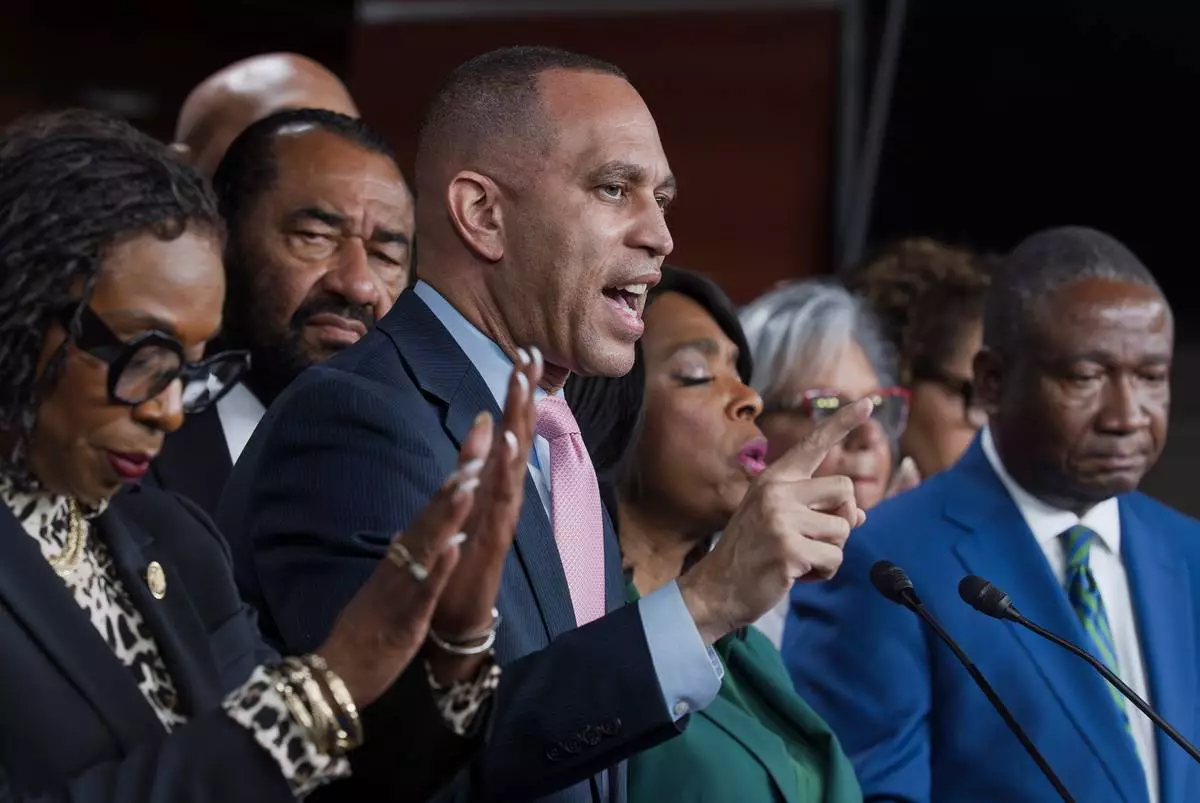
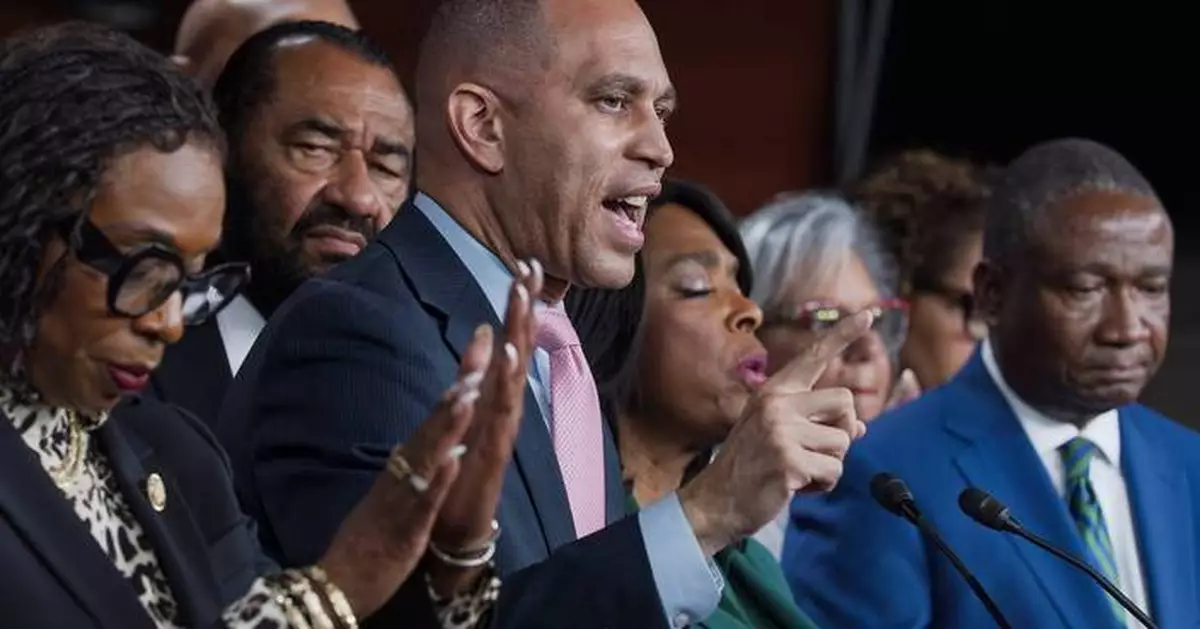
House Minority Leader Hakeem Jeffries, D-N.Y., and members of the Congressional Black Caucus speak to reporters in the wake of the Supreme Court ruling to strike down a majority Black congressional district in Louisiana, at the Capitol in Washington, Wednesday, April 29, 2026. (AP Photo/J. Scott Applewhite)
MUNSTER, Germany (AP) — President Donald Trump has again threatened to pull U.S. troops out of Germany, a key NATO ally and the European Union’s largest economy. Europeans have heard this before.
Trump's threats came after German Chancellor Friedrich Merz said this week that the U.S. was being “ humiliated ” by Tehran in negotiations to end the U.S.-Israel war against Iran.
The mercurial U.S. leader has mused for years about reducing America's military presence in Germany, and has railed against NATO for its refusal to assist the U.S. in its two-month-old war.
Trump wrote Wednesday on social media that the U.S. was reviewing possible troop reductions in Germany, with a “determination” to be made soon. On Thursday, he was still thinking about Merz, posting that the German leader should “spend more time on ending the war with Russia/Ukraine” and “fixing his broken Country” than concerning himself with Iran.
U.S. allies in NATO have braced for a U.S. troop withdrawal since just after the Trump administration took office, with Washington warning Europe would have to look after its own security, and that of Ukraine, in the future.
Depending on operations, exercises and troop rotations, around 80,000-100,000 U.S. personnel are usually stationed in Europe. NATO allies have expected for more than a year that U.S. troops deployed after Russia launched its war on Ukraine in 2022 would be first to leave.
Germany hosts several U.S. military facilities, including the headquarters of its European and Africa commands, Ramstein Air Base and a medical center in Landstuhl, where casualties from U.S. wars in places like Afghanistan and Iraq were treated. U.S. nuclear missiles are also stationed in the country.
Ed Arnold, an expert in European security at the Royal United Services Institute in London, said the U.S. gets a lot out of its presence in Germany — like logistics and support for Middle East combat operations — and was unlikely to withdraw.
Nico Lange from the Center of European Policy Analysis agreed and said there are approximately 36,000 U.S. soldiers in Germany who primarily serve U.S. interests, including “the projection of American power globally,” rather than helping with defense of Germany.
The U.S. has invested “substantial funds” in high-quality infrastructure in Germany which cannot be moved overnight and a different deployment would cost the U.S. a huge amount of money, which would require Trump to get approval from Congress, Lange said.
As early as 2020, Trump announced plan s to withdraw 11,900 U.S. troops from Germany but that didn't happen partly because Congress didn't provide the necessary funds and a withdrawal would have required enormous investments elsewhere.
That's why Trump’s post is most likely “bluster,” Arnold said.
“There is a difference between the military view and the political view,” Arnold said. “The issue with some of these threats is that they are not quite as galling as they were a couple of years ago.”
Merz, visiting troops Thursday at a military training area in Munster, northern Germany, did not directly address Trump’s comments, but alluded to working “shoulder to shoulder for mutual benefit and in deep trans-Atlantic solidarity,” and said his government has “made great efforts to strengthen Germany’s security.”
RUSI’s Arnold said Europe is more concerned about issues like a U.S. redeployment of Patriot missile systems and ammunition from Germany to the Middle East, and notifications to NATO countries such as Estonia and Belgium that orders for American weapons will be delayed as the U.S. government is prioritized.
A senior Western official told The Associated Press they were not aware of any discussions between the U.S. and Germany or other allies regarding the possibility of troop reductions in Germany.
The official, who spoke on condition of anonymity to discuss sensitive matters, noted that Europe and Germany, which recently announced its new military strategy, is taking more responsibility for security on the continent.
Last October the U.S. confirmed that it would reduce its troop presence on NATO’s borders with Ukraine. The move to cut 1,500-3,000 troops came on short notice and unsettled ally Romania where the military organization runs an air base.
The U.S. administration informed the allies early last year that it has been reviewing its military “posture” in Europe and elsewhere. The findings of that review had been due to be made public in late 2025 but still have not surfaced.
However, the U.S. did commit to inform its allies in advance about any changes to ensure that no security gap is created at a time when Russia is increasingly confrontational.
The U.S.-Israel war on Iran only made the prospect of a withdrawal more likely, and a flurry of meetings has been held between administration officials, NATO Secretary-General Mark Rutte and European leaders since the conflict started on Feb. 28.
Over the last year, European allies and Canada have understood that they will have to provide Europe’s conventional defenses. The main U.S. contribution to NATO deterrence going forward will be the presence of American nuclear weapons and some troops.
Beyond the uncertainty over U.S. personnel, the allies have gotten used to Trump’s outbursts, having weathered insults as “cowards” or hearing NATO branded as a “paper tiger” by their most powerful ally in recent weeks.
Repeated threats to leave altogether, or over things like defense spending, have inured them to social media posts that Trump might be considering some action or another.
The real damage to NATO unity was done by Trump’s fixation on Greenland, and his intent to annex the island, which is a semiautonomous part of ally Denmark, including sending family members and administration officials there.
Burrows reported from London and Cook from Brussels. Jamey Keaten in Geneva and Aamer Madhani in Washington contributed to this report.
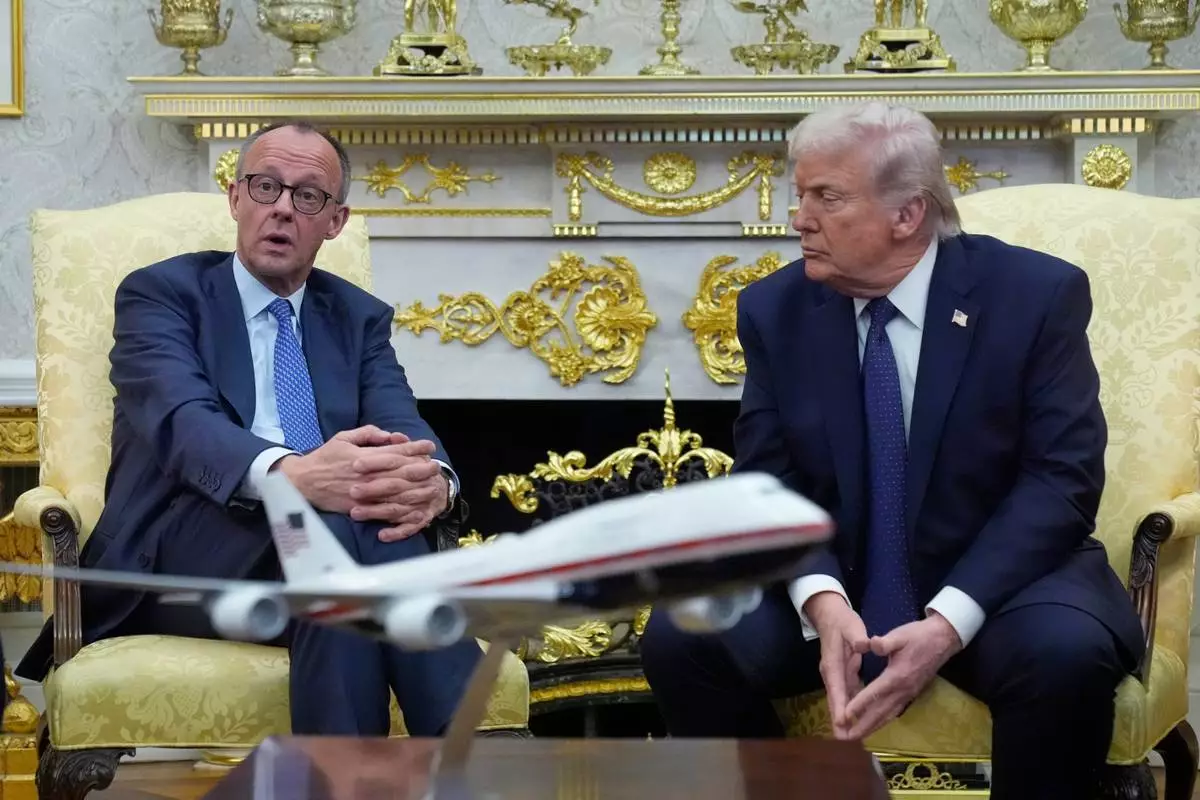
FILE - President Donald Trump meets with German Chancellor Friedrich Merz in the Oval Office at the White House, March 3, 2026, in Washington. (AP Photo/Mark Schiefelbein, File)

German Chancellor Friedrich Merz, left, drives in the armoured fighting vehicle Boxer during his visit to the army at the Bundeswehr base in Munster, Germany, Thursday, April, 30, 2026. (AP Photo/Markus Schreiber, Pool)

German Chancellor Friedrich Merz drives in the armoured fighting vehicle Boxer during his visit to the army at the Bundeswehr base in Munster, Germany, Thursday, April, 30, 2026. (AP Photo/Markus Schreiber, Pool)