PORTLAND, Maine (AP) — Maine Gov. Janet Mills on Thursday dropped her bid for the U.S. Senate, pointing to a lack of campaign funds to keep up in one of the most competitive races in the country that quickly became a reflection of an internal party debate over which candidates can win in high-profile contests.
The move now thrusts political newcomer Graham Platner as the expected Democratic front-runner against longtime Republican Sen. Susan Collins, whose seat Democrats are targeting in their effort to win control of the closely divided Senate.
“While I have the drive and passion, commitment and experience, and above all else – the fight – to continue on, I very simply do not have the one thing that political campaigns unfortunately require today: the financial resources," Mills said in a statement. “That is why today I have made the incredibly difficult decision to suspend my campaign for the United States Senate.”
Mills, a two-term governor and longtime Maine politician, was seen as one of Democrats' top 2026 recruits when she entered the Senate race last year. She had the backing of Senate Minority Leader Chuck Schumer and prominent left-leaning advocacy groups hoping to unseat Collins in the chamber, which has 53 Republicans, 45 Democrats and two independents who caucus with the Democrats.
But Mills struggled to outshine first-time candidate Platner, her opponent in the June 9 Democratic primary. Platner has maintained strong popularity despite facing controversy over past comments he made online and a tattoo he had that is widely recognized as a Nazi symbol.
Mills did not endorse Platner in her campaign suspension announcement but instead promised to keep defending the Constitution and democracy while she's governor for the remainder of her term.
Meanwhile, Schumer and Democratic Senatorial Campaign Committee Chair Sen. Kirsten Gillibrand, both of New York, said they would work with Platner to defeat Collins.
“Our North Star is winning a Democratic Senate majority, and over the past year, Senate Democrats have carved out multiple paths to do that,” their statement said.
The contest between Platner and Mills was part of a broader debate within the Democratic Party over how best to defeat Republicans and win back some power in President Donald Trump's Washington, where the GOP controls the White House and both chambers of Congress.
Platner is backed by Vermont Sen. Bernie Sanders, an independent who caucuses with Democrats, and Democratic Sens. Elizabeth Warren of Massachusetts, Ruben Gallego of Arizona and Martin Heinrich of New Mexico.
Mills had tried to convince voters that she was the best candidate to stand up to Trump, repeatedly noting she told the president she would see him in court, a reference to Maine officials' lawsuit against the Trump administration over federal funding and a dispute over transgender athletes in sports.
Yet the message appeared at times drowned out by the popularity Platner attracted on the campaign trail. His events have attracted thousands of supporters as he pitched his populist message and flooded airwaves with his ads. He consistently outraised Mills every step of the way, raising $4 million while Mills raised $2.6 million in the latest fundraising quarter. Collins raised $3.1 million but has $10 million in the bank.
Age also became an issue in the race, as some Democrats want younger candidates to lead the party going forward. Mills is 78, while Plater is 41. Collins is 73.
So far this year, Democrats have largely avoided messy internal fights in their bid to retake the Senate. The Maine race was an exception, and with Mills’ decision, the Michigan Democratic primary could be the most heated campaign this year. Abdul El-Sayed, U.S. Rep. Haley Stevens and state Sen. Mallory McMorrow are locked in a competitive race there ahead of the August primary.
Many political observers initially anticipated that it would be Platner, not Mills, who would be forced to bow out of the race.
Platner has been dogged by questions about the skull-and-crossbones tattoo recognized as a Nazi symbol that he said he got on his chest during a night of drinking while on military leave in Croatia. He has said the tattoo has been covered to no longer reflect that image. Additionally, there have been lingering questions about inflammatory comments he made in old online postings, which he has since disavowed.
Yet, Platner's willingness to talk about his past mistakes has helped propel his favorability.
Republicans had already begun attacking Platner ahead of Mills' campaign suspension announcement, pointing to the oyster farmer's comments about his old social media posts that were dismissive of sexual assault. Among the comments, Platner once wrote on Reddit that people shouldn’t get so drunk “they wind up having sex with someone they don’t mean to.”
“Now with Chuck Schumer‘s reluctant support, Platner’s attempt at the Senate will be yet another fantasy that will end when Susan Collins grinds this fraudster into dust,” said Alex Latcham, executive director of the Senate Leadership Fund, in a statement.
Kruesi reported from Providence. R.I. Associated Press writer Steven Sloan contributed from Washington.
Follow the AP’s coverage of the 2026 election at https://apnews.com/projects/elections-2026/.
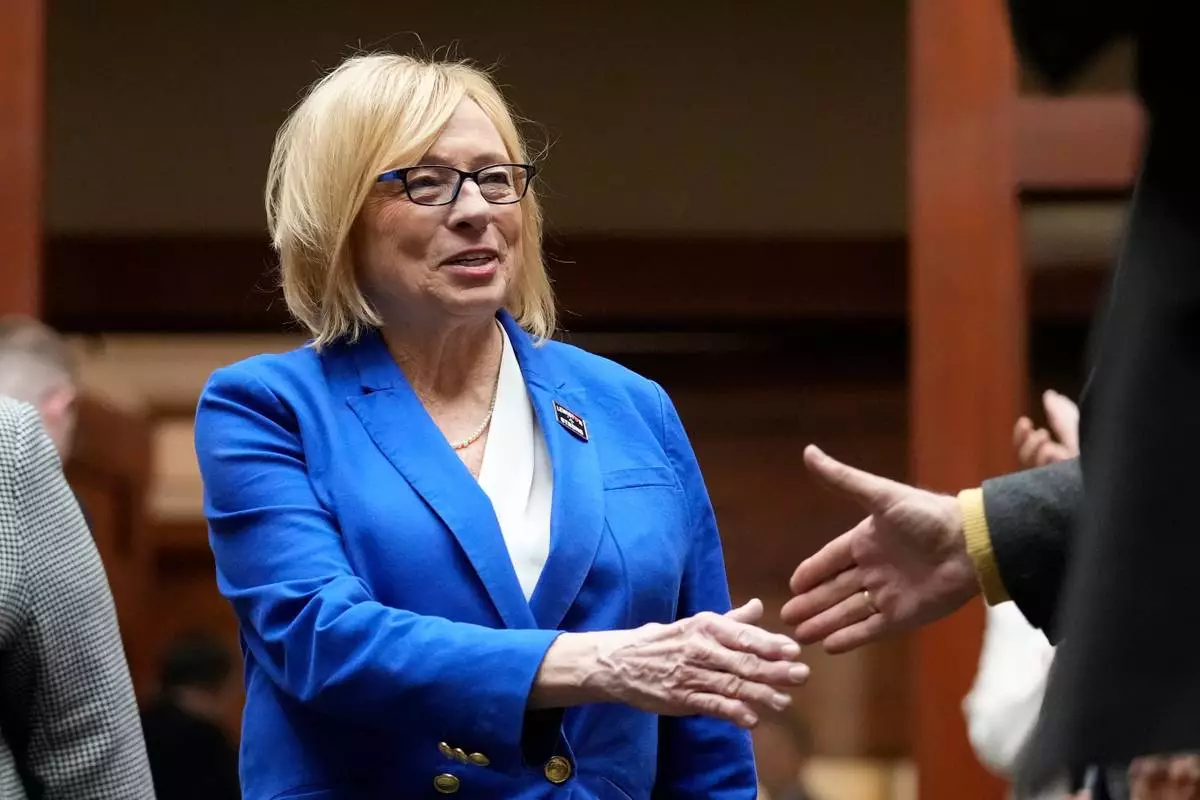
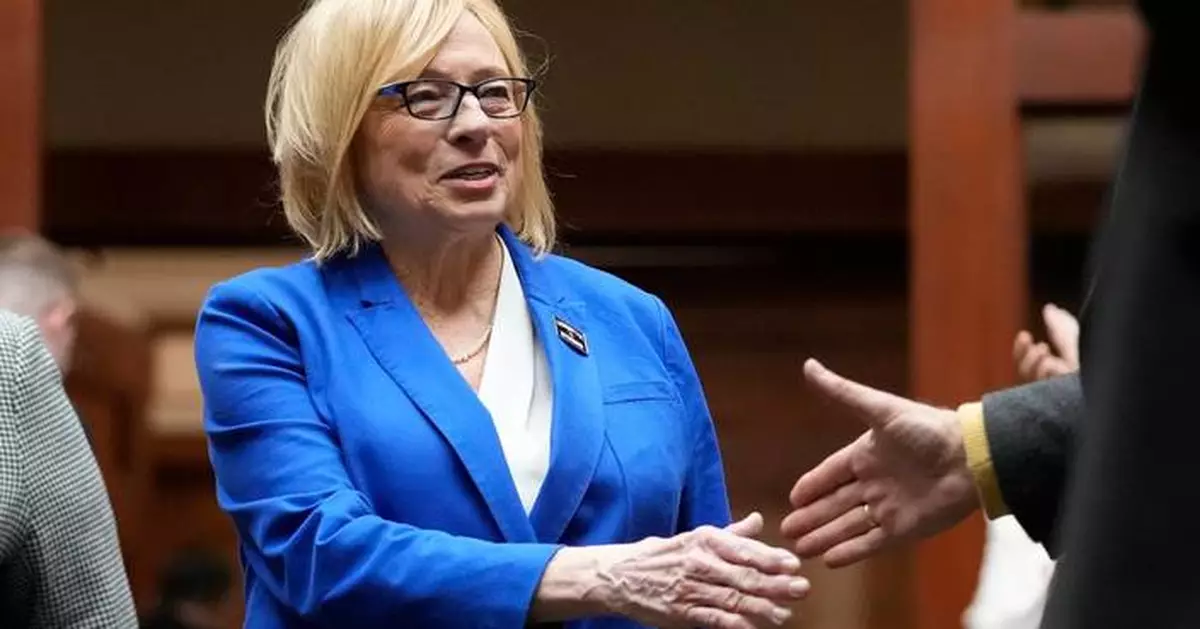
FILE - Democratic Gov. Janet Mills, greets lawmakers prior to delivering her State of the State address, Jan. 30, 2024, at the State House in Augusta, Maine. (AP Photo/Robert F. Bukaty, FIle)
DUBAI, United Arab Emirates (AP) — Iran's supreme leader said Thursday that the Islamic Republic will protect its “nuclear and missile capabilities” as a national asset, likely seeking to draw a hard line as U.S. President Donald Trump presses for a wider deal to cement the war's shaky three-week ceasefire.
Ayatollah Mojtaba Khamenei maintained his defiant tone since taking over following the killing of his father in the war's opening airstrikes. In a written statement read by a state television anchor, Khamenei — who has not been seen in public since becoming supreme leader — said the only place Americans belonged in the Persian Gulf is “at the bottom of its waters" and that a “new chapter” was being written in the region's history.
His remarks come as Iran's oil industry is being squeezed by a U.S. Navy blockade halting its oil tankers from getting out to sea. But the world economy is also under pressure as Iran maintains its chokehold on the Strait of Hormuz, through which a fifth of all crude oil is transported. On Thursday, the global benchmark for oil, Brent crude, traded as high as $126 a barrel.
That shock to oil supplies and prices is putting pressure on Trump, who is floating a new plan to reopen the Strait of Hormuz.
Under the plan, the United States would continue its blockade on Iranian ports, while coordinating with allies to impose higher costs on Iran’s attempts to subvert the free flow of energy, according to a senior administration official.
Trump is weighing multiple diplomatic and policy options to push Iran to end its chokehold on the waterway, said the official, who spoke on condition of anonymity because they were not authorized to comment publicly.
The new proposal, first reported by The Wall Street Journal, is Trump's latest effort to persuade other nations to help reopen the strait.
With a fragile ceasefire in place, the U.S. and Iran are locked in a standoff over the strait. The U.S blockade is designed to prevent Iran from selling its oil, depriving it of crucial revenue while also potentially creating a situation where Tehran has to shut off production because it has nowhere to store oil.
The strait’s closure is also problem for the U.S.'s Gulf allies, which use the waterway to export their oil and gas.
A recent Iranian proposal would push negotiations on the country’s nuclear program to a later date. Trump said one of the major reasons he went to war was to deny Iran the ability to develop nuclear weapons. Iran long has maintained its program is peaceful, though it enriched uranium at near-weapons-grade levels of 60%.
Pakistan on Thursday said it was still facilitating indirect talks between the U.S. and Iran aimed at easing tensions, but Islamabad would also welcome direct communication between the two sides, even by phone.
“If the two parties can engage in real-time conversations, that could ease the sticking points,” said Ministry of Foreign Affairs spokesperson Tahir Andrabi at a weekly news briefing. He declined to share details of any Iranian or U.S. proposals.
Speaking to mark Persian Gulf Day in Iran, Khamenei's remarks signaled that nuclear issues and Iran's ballistic missile program wouldn't be traded away.
“Ninety million proud and honorable Iranians inside and outside the country regard all of Iran’s identity-based, spiritual, human, scientific, industrial and technological capacities — from nanotechnology and biotechnology to nuclear and missile capabilities — as national assets, and will protect them just as they protect the country’s waters, land and airspace,” Khamenei said.
Khamenei referred to America as the “Great Satan,” a long hurled insult by Iranian leaders toward the U.S. since the 1979 Islamic Revolution. He said Americans should have no business in the Persian Gulf.
“Foreigners who come from thousands of kilometers away to act with greed and malice there have no place in it — except at the bottom of its waters," said Khamenei, who was reportedly was wounded in the Feb. 28 attack that killed his father, the 86-year-old Supreme Leader Ayatollah Ali Khamenei,
In his remarks, Khamenei seemed to signal Iran would maintain its control over the waterway, which sits in the territorial waters of Iran and Oman. Iran had been charging some ships reportedly $2 million apiece to travel through the strait.
He said that Iran's control of the Strait of Hormuz will make the Gulf more secure, and that Tehran's “legal rules and new management” of the strait will benefit all the region’s nations.
However, the world considered the strait an international waterway, open to all without paying tolls. Gulf Arab nations, chief among them the United Arab Emirates, have decried Iran's control of the strait as akin to piracy.
Associated Press writers Aamer Madhani in Washington, Munir Ahmed in Islamabad and Amir Vahdat in Tehran, Iran, contributed to this report.
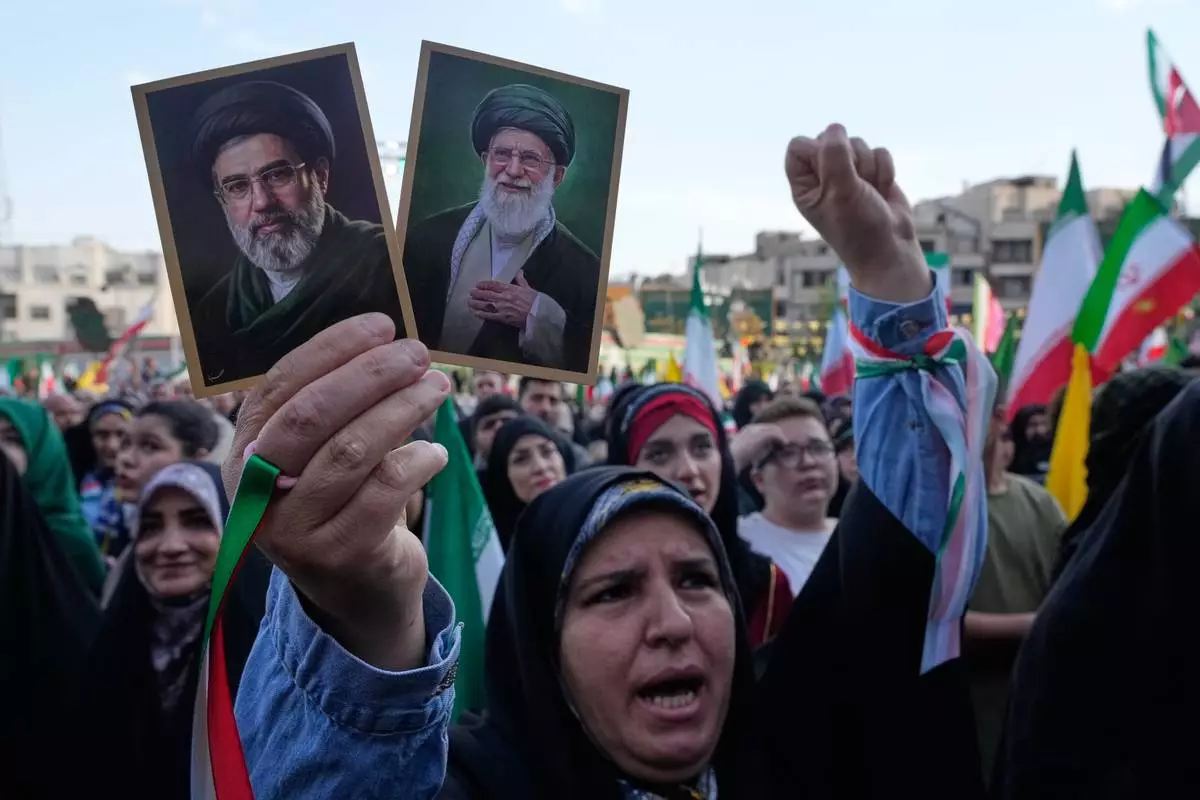
A woman holds up pictures of the Iranian Supreme Leader Ayatollah Mojtaba Khamenei, left, and his father, the slain Ayatollah Ali Khamenei in a state-organised rally celebrating the birthday of Imam Reza, the 8th Shiite Muslims' Imam, and supporting the supreme leader, in Tehran, Iran, Wednesday, April 29, 2026. (AP Photo/Vahid Salemi)
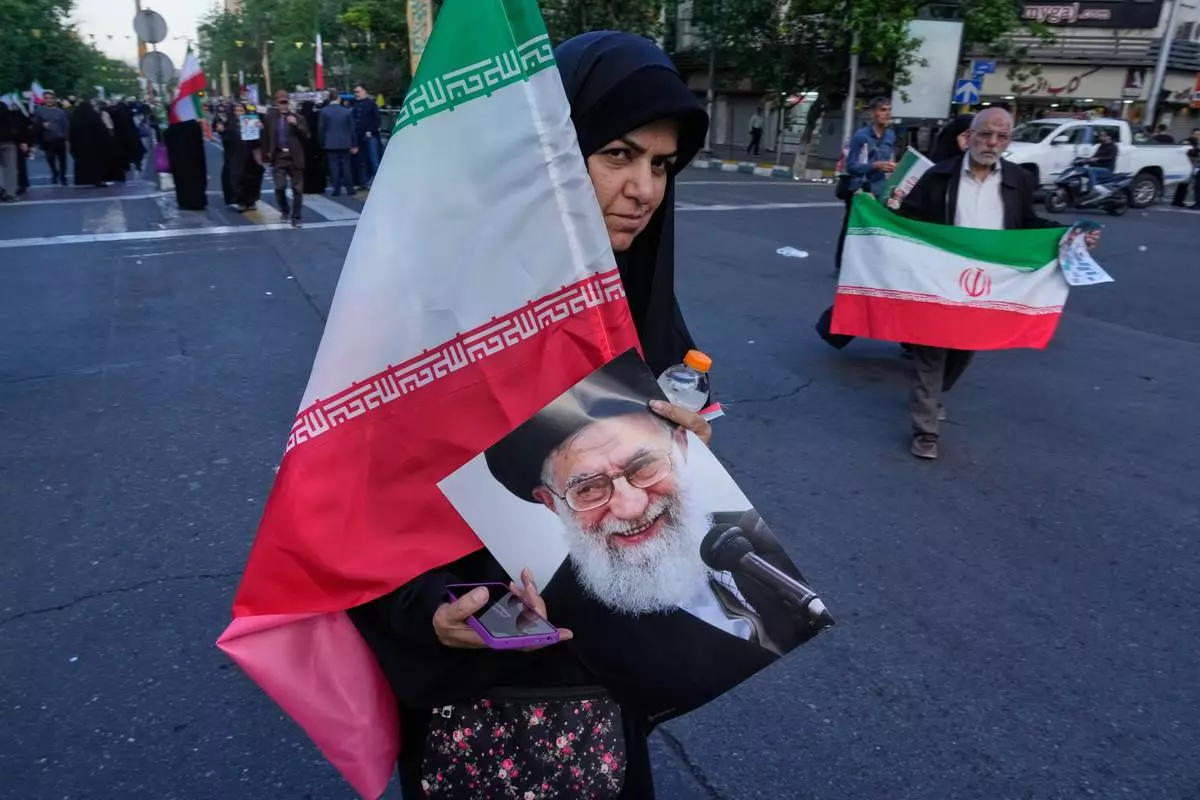
A woman carries an Iranian flag and a poster of the late Supreme Leader Ayatollah Ali Khamenei during a state-organised rally in Tehran, Iran, Wednesday, April 29, 2026, celebrating the birthday of Imam Reza, the 8th Shiite Muslims' Imam, and supporting Supreme Leader Ayatollah Mojtaba Khamenei. (AP Photo/Vahid Salemi)
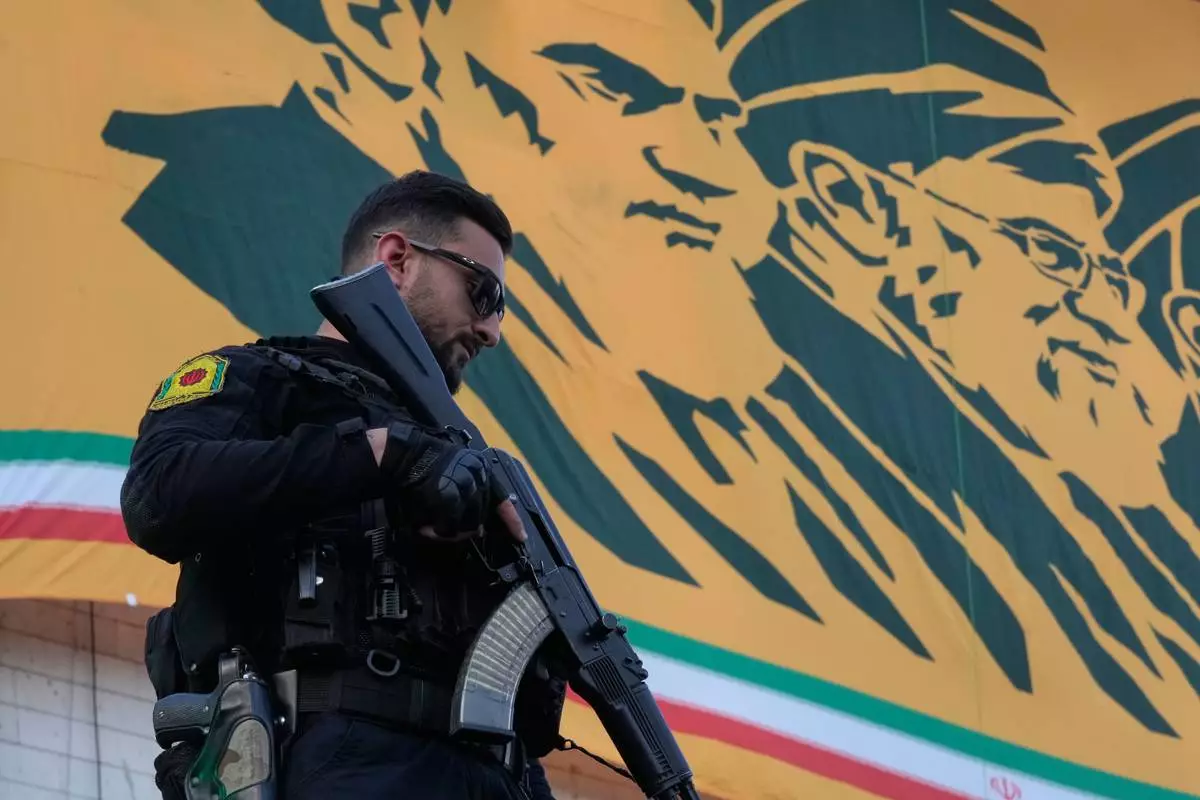
A police officer stands guard in front of a banner with portraits of the late Iranian revolutionary founder Ayatollah Khomeini, left, and late Supreme Leader Ayatollah Ali Khamenei in a state-organised rally celebrating the birthday of Imam Reza, the 8th Shiite Muslims' Imam, and supporting the supreme leader, in Tehran, Iran, Wednesday, April 29, 2026. (AP Photo/Vahid Salemi)
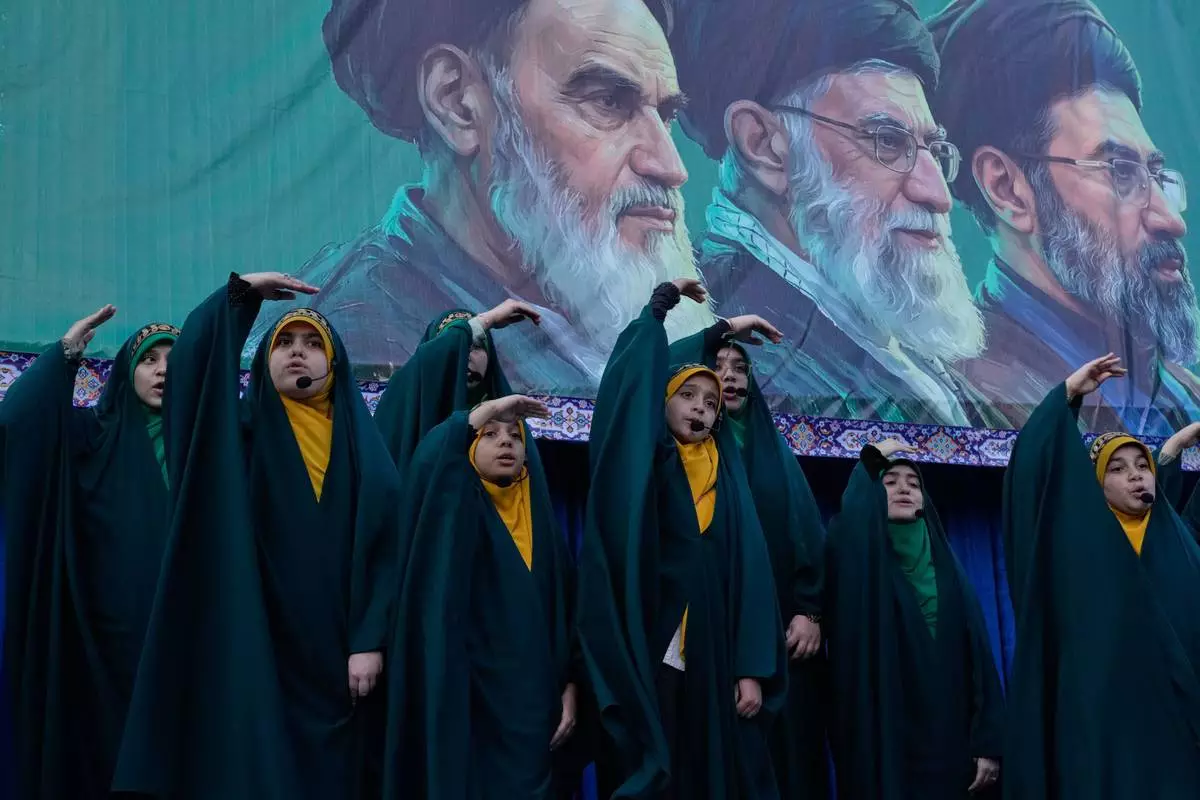
Girls sing a song as they show the movement of missiles with their hands next to the portraits of the late Iranian revolutionary founder Ayatollah Khomeini, left, late Supreme Leader Ayatollah Ali Khamenei, center, and Supreme Leader Ayatollah Mojtaba Khamenei, in a state-organised rally celebrating the birthday of Imam Reza, the 8th Shiite Muslims' Imam, and supporting the supreme leader, in Tehran, Iran, Wednesday, April 29, 2026. (AP Photo/Vahid Salemi)