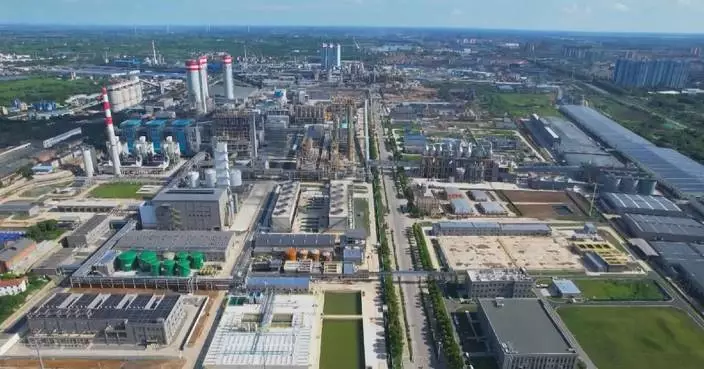
The building of the Green Energy Port -- the world's largest liquefied natural gas (LNG) storage tank cluster so far -- was completed in Yancheng City of east China's coastal province of Jiangsu on Sunday, after three years of independent design and construction.
The Green Energy Port boasts six world's largest 270,000 cubic meter LNG storage tanks and four 220,000 cubic meter storage tanks, totaling 2.5 million cubic meters.
The construction of the Green Energy Port was undertaken by China National Offshore Oil Corp (CNOOC), the country's top offshore oil and gas producer.
In an interview with China Central Television, Li Feng, deputy general manager of CNOOC Gas Power, said the project is crucial to improving energy security in the Yangtze River Delta region in east China and supporting green development in the country.
"As a key project in the country's natural gas production, supply, storage and sales system, the Green Energy Port connects major natural gas transportation networks, including those of natural gas transportation from western to eastern regions and the China-Russia eastern natural gas pipeline," Li said.
"Meanwhile, it also operates the business of gas delivery using tank trucks, keeping supplying natural gas to provinces such as Jiangsu, Henan, Anhui and Shandong, thus contributing to maintaining energy security in the Yangtze River Delta region," he said.
The project is designed to handle 6 million tons of LNG per year, equivalent to 8.5 billion cubic meters of gaseous natural gas, which can be used for approximately 28 months to support the livelihood of the people in Jiangsu Province.
China is expanding natural gas storage capabilities to ensure a reliable and sustainable energy future as part of its "carbon peaking and neutrality" commitment, planning to establish six major gas storage centers across the country, with a total of 50 gas storage facilities and an estimated working gas volume exceeding 100 billion cubic meters.
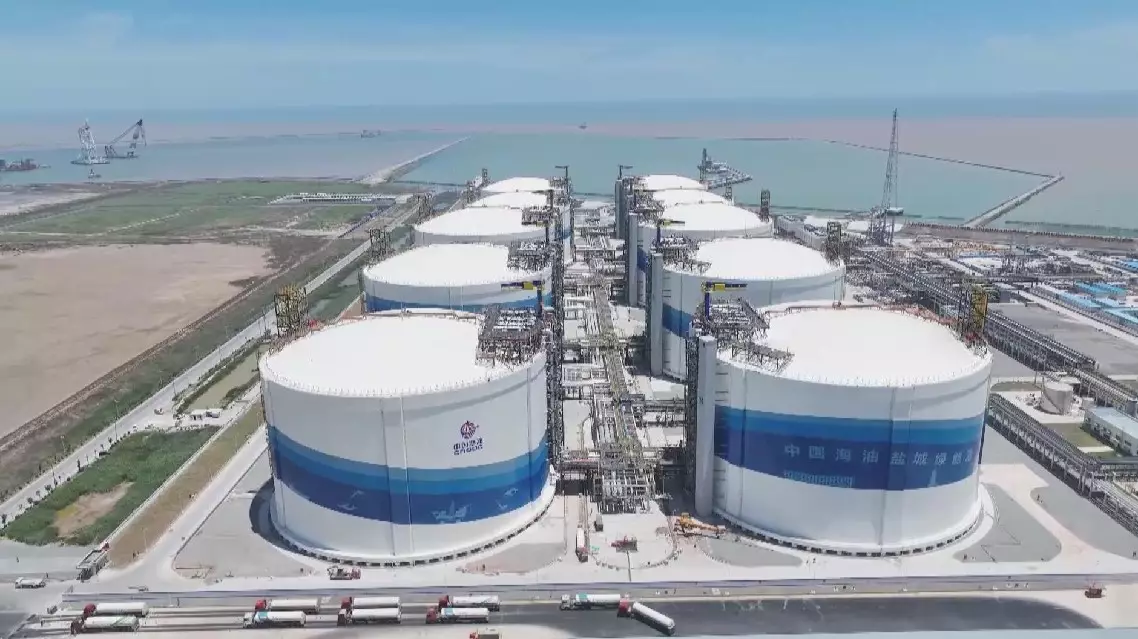
Construction of world's largest LNG storage tank cluster completed in east China's Jiangsu
Holiday cheer is building across China, with seasonal products driving a boom in the consumer market, as the Dragon Boat Festival and its holiday are approaching.
The Dragon Boat Festival, also known as the Duanwu Festival, is celebrated on the fifth day of the fifth lunar month. This year, the festival falls on June 19, with the three-day holiday running through June 21.
In Shanghai, many time-honored food brands have entered their peak sales season. Classic varieties of zongzi, the sticky rice dumplings, with fillings such as pork and red bean remain strong sellers. At the same time, many vendors in the city have also introduced innovative flavors to attract customers. New offerings such as black glutinous rice with red bean paste zongzi have proven particularly popular.
In major grocery stores across Lanzhou City, northwest China's Gansu Province, zongzi incorporating local specialty ingredients, such as lily bulbs and roses, have become top choices for shoppers.
Beyond festive foods, traditional customs are also driving seasonal demand. The Dragon Boat Festival is typically marked by the hanging of mugwort and calamus - a custom believed to ward off illness and evil spirits.
In Qidong City, east China's Jiangsu Province, mugwort farms have entered their busiest harvest period of the year, as they are producing more than 100,000 bundles daily for shipment to major supermarkets across the Yangtze River Delta region.
To the southwest of Qidong, Kunming City in Yunnan Province has seen a growing demand for festival-themed plants, such as calamus, fragrant wood and craspedia. The city's largest online fresh flower wholesale platform reported sales of 295,000 bundles of Dragon Boat Festival flowers so far this month, double the volume recorded during the same period last year.
In addition, local governments across China have also rolled out various service measures to ensure smooth operation of cultural and tourism markets during the holiday period.
East China's Fujian Province will offer more than 350 cultural and tourism activities and over 120 public welfare measures during the Dragon Boat Festival holiday.
Multiple scenic spots in south China's Guangdong Province have activated holiday support mechanisms to extend store operating hours and optimize time-slot reservations to enhance visitor experience.
Up north, in northeast China's Heilongjiang Province, cultural and tourism consumption vouchers worth 15 million yuan (about 2.1 million U.S. dollars) have been issued for key sectors such as major scenic areas, hotels, homestays and cultural entertainment venues to further stimulate holiday spending.
Dragon Boat Festival spurs seasonal sales as festive atmosphere builds