China's major airlines will launch direct flights linking Beijing and Dhaka, the capital of Bangladesh, in July, providing greater convenience for travelers and contributing to the high-quality development of the Belt and Road Initiative (BRI).
For Air China, the national flag carrier, it is set to launch a direct flight route on July 10 from Beijing to Dhaka, with four round-trip flights every week.
In addition, starting from July 15, China Southern Airlines will launch a new direct route from Beijing to Dhaka, China Southern Airlines has said.
According to China Southern Airlines, the service will operate twice weekly, on Mondays and Saturdays.
Bangladesh, located in the northeastern part of the South Asian subcontinent, is the first South Asian country to join the BRI, which aims to improve world connectivity through international cooperation.
In recent years, economic, trade, tourism, and cultural exchanges between China and Bangladesh have been increasing. Next year will mark the 50th anniversary of the establishment of diplomatic ties between the two countries.
According to official data, there are currently over 300,000 passengers traveling annually between China and Bangladesh.

Chinese airlines to launch direct flights linking Beijing, Dhaka
Melting permafrost, increasing geographical disasters, and water shortage triggered by rising global temperatures are affecting the operation of Alpine huts, one of Switzerland's most cherished institutions, according to Schweizer Alpen-Club (SAC).
Alpine huts are central to Switzerland's mountain culture and tourism economy. They provide essential shelter, unique hospitality, and historical preservation across the Swiss Alps.
Originally built in late 19th and early 20th centuries as shelters for scientists and explorers, Swiss Alpine huts are now havens for hikers.
Most Alpine huts sit on permanently frozen ground, which acts like natural concrete stratum to keep mountain terrain stable.
As global temperature keeps rising, melting permafrost is loosening the foundation of roughly 40 percent of mountain huts, according to SAC.
Currently, about half of the Swiss mountain huts still offer spectacular views of snow-capped mountains and glaciers, but scientists predict that most of these glaciers will disappear by the end of this century.
"We can see from our mountain hut that every year, the glaciers in front of us keep melting and are becoming smaller and smaller," said a hut runner.
SAC said mountain regions bear the serious impacts of climate change.
"It's the hut that has also been shut down. You see, this is built on permafrost. You see, here, the cracks and you try to have it together stable with steel, but it didn't work anymore. Mountain regions experience climate change much stronger than global average. You see here, we have had, in the last 60 years, maybe roughly one degree on the global average rising temperatures. But in Switzerland and in the Alps, it's the double," said Philippe Wager, head of huts and environment at SAC.
High-altitude mountain huts are also facing water crisis as they rely primarily on winter snowpack and summer glacial meltwater as the major water source.
Melting glaciers and warmer winters, which bring less snow every year, jointly contribute to less water supplies.
Meanwhile, increasing geological hazards such as rockfalls, landslides and mudflows are also threatening safety of mountain huts and hikers.
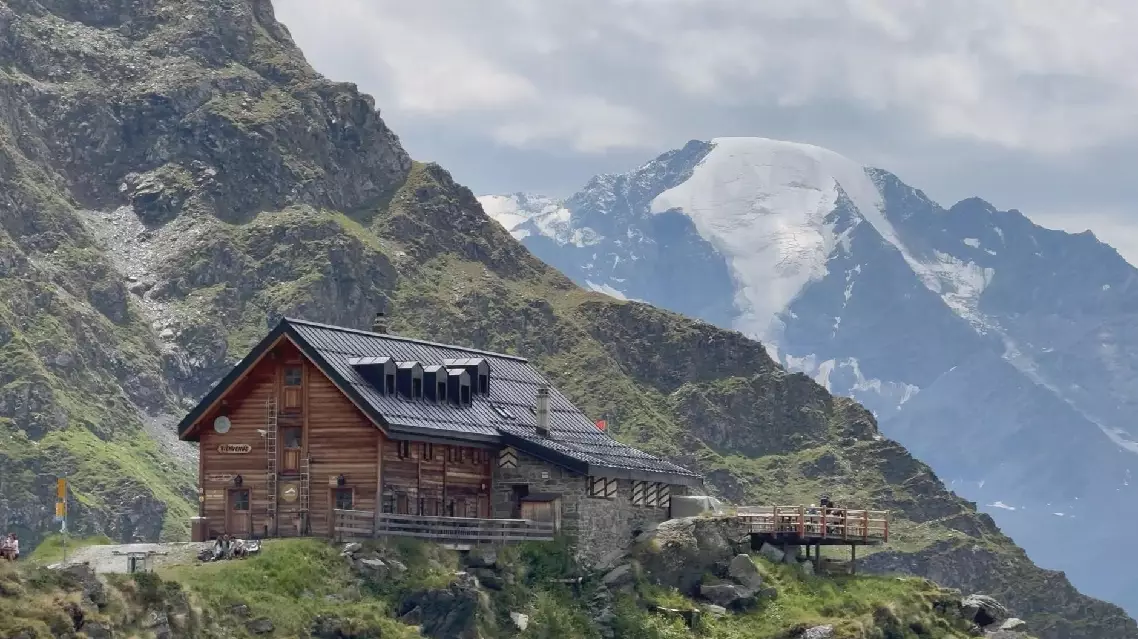
Climate change threatens Swiss Alpine huts