A girl from the Amis ethnic subgroup in Taiwan has traced her genetic connection with the mainland after visiting a cluster of archeological sites, known as Keqiutou, in Pingtan County of east China's Fujian Province.
The story is featured as part of a China Global Television Network (CGTN) special program titled "The Way Home" that aired Monday. It highlights the experiences of young individuals from Taiwan who have ventured to Fujian Province to pursue their dreams.
Lai Shu-jen, or Lailai as she prefers to be called, is from the Amis ethnic subgroup populating mountains in central Taiwan.
In 2017, she left for southern Fujian looking for opportunities. She started in the creative industry before getting involved in rural development, namely revitalizing villages hit by poverty. But tracing the genetic origins of the Amis has always been on her mind.
"We Amis people belong to the Austronesians. As children, we were taught that we originated in Taiwan. But since arriving on the mainland, I found out that we actually come from Pingtan. I wanted to come here and learn more about the story of the Austronesians," said Lailai.
Indigenous peoples populating territories in and around the Pacific and Indian Oceans, including the Amis, are known as Austronesians.
For a long time, Austronesians were believed to have originated in Taiwan. But archaeologists have discovered numerous stone tools at the Keqiutou Neolithic site in Pingtan, dating back to between 5,000 and 6,500 years ago. The artifacts are similar to those found at the Dachakeng ruins in Taiwan which are believed to be the home of the ancestors of the Austronesians.
The findings indicate that the Austronesians didn't originate in Taiwan, but in Fujian Province on the Chinese mainland. In 2020, a DNA study further validated this theory.
"The DNA genome data from the 8400-year-old cranium found in Qihe Cave, central Fujian's Zhangping City, matches the genome data of the Austronesian. This proves the hypothesis of the study, that Austronesians originated from the Chinese mainland," said Taiwan scholar Hsu Kuei-jung who is now the vice director of the Pingtan International Institute of Austronesian Research.
Hsu introduced Lailai to another member of her group, Chiu Yung-Ying, who has been running a souvenir shop featuring Amis culture for a year now.
Lailai was filled with excitement upon stepping into Chiu's shop as they exchanged knowledge on Amis cultural traditions, including the "alofo bag" used by young people to express their love and the feathered adornment worn on important occasions.
Lailai's love for singing and dancing is evident, but as an indigenous person, she is often looked down upon by others in Taiwan.
"In Taiwan, I wasn't a very confident person. I felt that the music I created sounded terrible, and my singing voice wasn't good. But when I came to the mainland, everyone said that my songs sounded great and had my own unique style. All the feedback has been positive, so my confidence level has kept rising," said Lailai.
Now she has a new idea; to tell the Austronesian story in creative and fun ways.
"I'd like to use short videos on social media, to tell the Austronesian story in a creative, fun, and intriguing way. I want to create videos about ethnic minorities on both sides of the Strait, about their stories of integration," said Lailai.
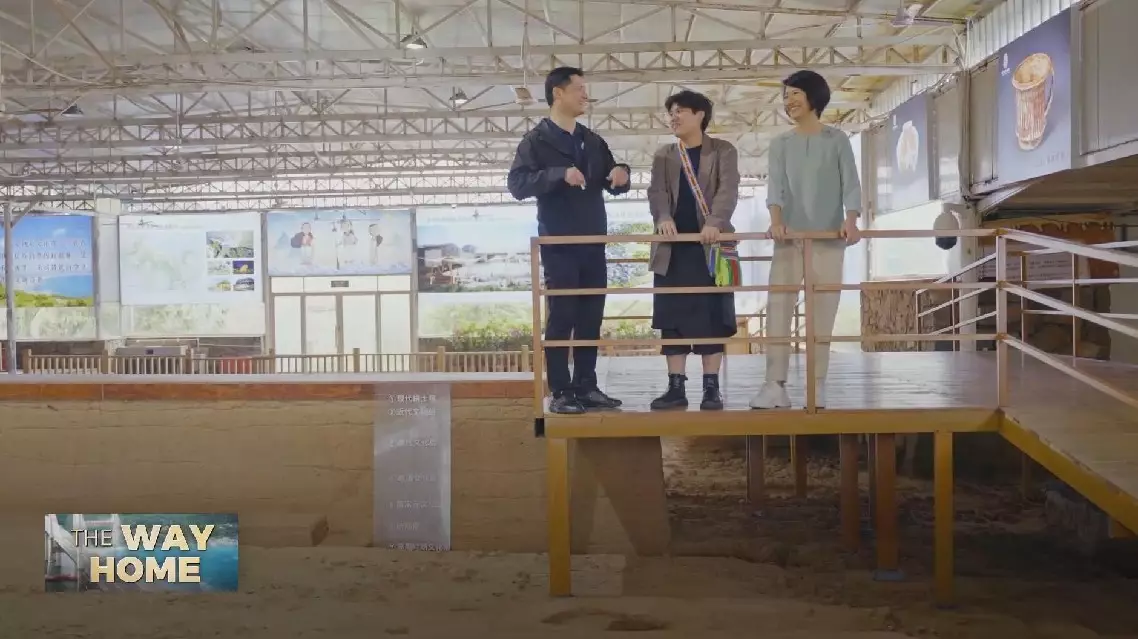
Indigenous girl from Taiwan traces her origins to neolithic site in Fujian