Skip to Content Facebook Feature Image

Japanese protesters denounce US-Japan "2+2" talks, Quad meeting

China

Japanese protesters denounce US-Japan "2+2" talks, Quad meeting
China

China

Japanese protesters denounce US-Japan "2+2" talks, Quad meeting

2024-07-30 05:00 Last Updated At:11:37

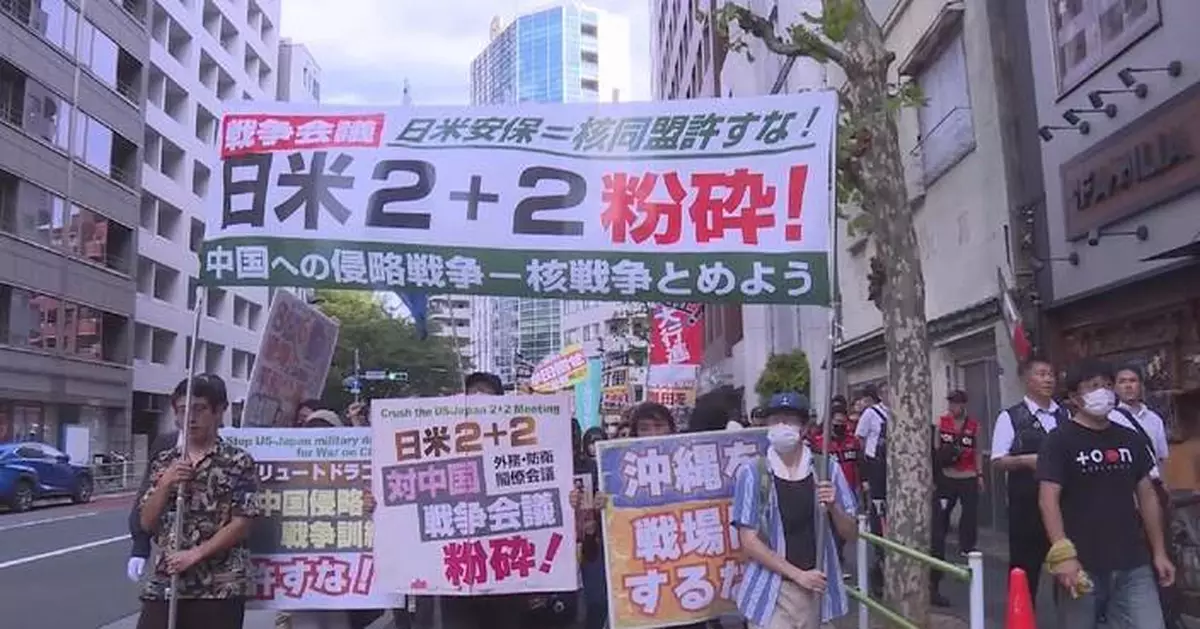
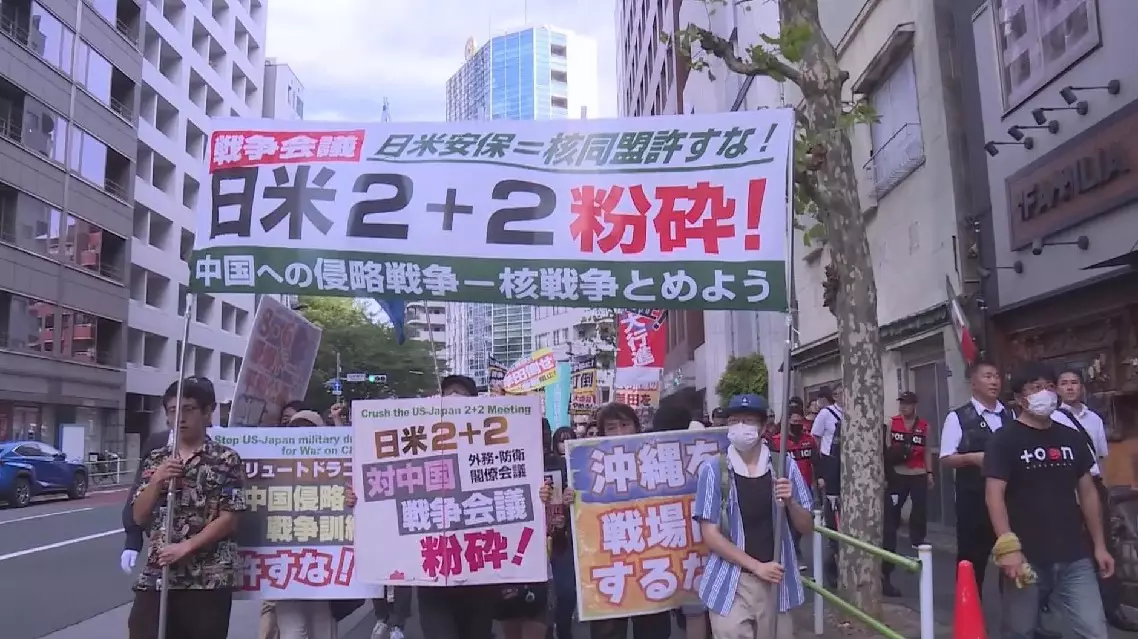
Crowds of activists have marched through central Tokyo to protest against "2+2" security talks between Japan and the United States and a Quad foreign ministers' meeting, saying the U.S.-led military alliance will increase the possibility of war. Top Japanese and U.S. diplomats and defense chiefs held the Japan-U.S. Security Consultative Committee meeting, known as "2+2", in Tokyo on Sunday, followed by a meeting on Monday of the Quad group, where the foreign ministers of Australia, India, Japan and the U.S. discussed maritime security and initiatives to strengthen cyber defenses.

In the "2+2" security talks, the U.S. announced plans for a major revamp of its military command in Japan to deepen coordination with the Japanese forces.

Not far from the meeting venue, the protesters marched to denounce the meetings for fueling tensions in the Asia-Pacific region.

They said strengthening U.S.-Japan military ties will only accelerate the arms race and drive the country closer to war.

"I think this agreement will eventually unify the U.S. military and the self-defense forces, strengthening their cooperation, unifying the chain of command, which clearly has China in mind and is a posturing for war. I strongly object to this," said Tomoko Horaguchi from Suginami Ward Council.

Japanese Foreign Minister Yoko Kamikawa said the Quad grouping was about protecting the foundations of prosperity in the Indo-Pacific region, and achieving co-existence with the international community. But protesters said beefing up the security pact will only fuel tensions in the region, amid ongoing conflicts across the globe.

In an interview with China Central Television (CCTV) on Monday in Tokyo, Ukeru Magosai, head of the East Asian Community Institute, said that the deepening of cooperation in military and other fields between Japan and the U.S. risked inflaming the situation in the Asia-Pacific region and threaten regional security and stability.

"The U.S. will avoid direct involvement in the war as much as possible, but increase its options by using Japan's self-defense forces. It is the biggest goal of the U.S. to utilize Japan's self-defense forces for its strategic purposes. It is said that Japan and the U.S. jointly command the integrated system, but in reality it is the U.S. that judges the situation and makes decisions. In the future, Japan may be automatically drawn into various situations," he said.

Magosai said that the U.S. attempt to strengthen the so-called "extended deterrence" and place its allies under its "nuclear umbrella" will only increase regional tensions and push Japan to the forefront of conflict and confrontation.

Although Japan's security situation has not changed for a long time, he said, the Japanese government has been intensifying its military and diplomatic ties with the U.S. on the grounds of security, helping it intervene in the Asia-Pacific region and stoke regional tensions.

"What the U.S. is doing now is stirring tensions by binding Japan to issues that have nothing to do with Japan's security. Japan's response will further disturb the regional situation," he said.
Japanese protesters denounce US-Japan "2+2" talks, Quad meeting


Japanese protesters denounce US-Japan "2+2" talks, Quad meeting
China’s transport authorities mobilized rail, road, air and waterway resources on Tuesday, the final day of the five‑day May Day holiday, to manage the peak return flow as passenger volumes surged nationwide.

The national railway system expects 23 million passenger trips on the day, with operators adding 2,225 extra trains and deploying capacity on popular routes and peak hours to handle the return flow from smaller cities to major hubs.

In Zhengzhou, central China's Henan Province, 134 trains have been temporarily added for high-demand directions including the Beijing-Tianjin-Hebei region, the Yangtze River Delta, and the Guangdong-Hong Kong-Macao Greater Bay Area.

"Railway return travel peaks today. In light of short stops and high passenger volumes, we have strengthened coordination with intermediate stations and offered guidance to passengers for smooth boarding and alighting to prevent crowding and stampedes," said Ji Yudi, a conductor of China Railway Zhengzhou Group.

Regional operators in Beijing, Chengdu and other cities have also proactively coordinated with local transit authorities to extend bus and subway operating hours, increase nighttime service frequency, and boost taxi and ride-hailing availability to ensure seamless transfers for late-arriving passengers.

With respect to highways, the national highway network is projected to record approximately 61 million vehicle trips on Tuesday. The peak traffic window is between 16:00 and 18:00, with congestion and slow-moving traffic likely around major city entry and exit points, as well as airport expressways in major cities like Beijing, Shanghai, Guangzhou and Chengdu.

To ease holiday congestion, traffic police in south China's Guangdong Province have rolled out tidal lanes and flow control measures at 24 key highway sections in nine cities.

"Using a highway interconnect system, we have conducted remote flow diversion. During this morning's peak return period, traffic efficiency on the Erenhot-Guangzhou Expressway improved significantly, showing no sign of congestion," said Dai Zhouwu, a local traffic police officer.

By water, an estimated 1.035 million passenger trips are expected to be made across the country on Tuesday, marking a 1.4-percent increase year on year.

To ensure smooth strait crossing from south China's Hainan Province, the maritime authorities in Zhanjiang City, south China's Guangdong Province have urged operators to supplement fixed sailings with extra voyages and optimized crew rotations to meet surging vessel demand.

Meanwhile, China's civil aviation sector is projected to carry 2.3 million passengers on Tuesday.

The Chengdu Shuangliu International Airport, one of the country's busiest airports in southwest China's Sichuan Province, are offering free luggage pick-up and delivering services to passengers arriving from Beijing, Shanghai, Guangzhou, and Shenzhen.

China’s transport network braces for record May Day return traffic

China’s transport network braces for record May Day return traffic

Recommended Articles