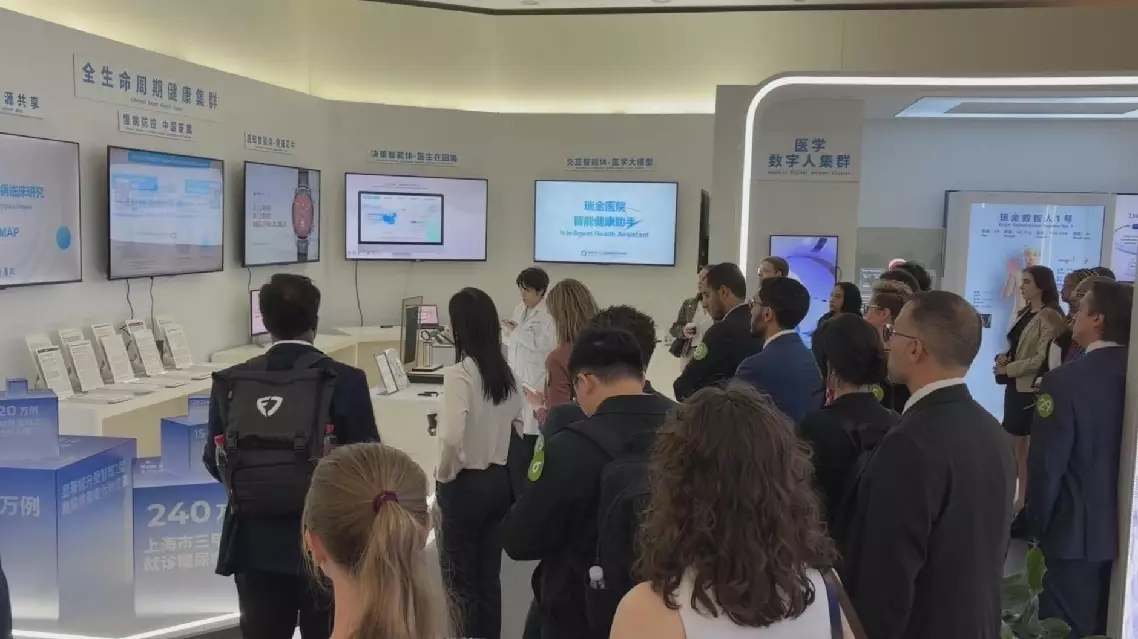
Young medical professionals from China and the United States gathered at Shanghai's Ruijin Hospital for the China-U.S. Youth Health Dialogue, focusing on artificial intelligence (AI) in healthcare and voicing hopes for deeper cooperation in medicine and technology.
Held on April 20-21, the dialogue brought together young medical professionals to explore the integration of Artificial Intelligence into healthcare.
Attendees to the event said that AI is already reshaping the medical field, from smart watches tracking vitals in real time to AI-assisted pathology and digital homo sapiens that let students simulate complex surgeries.
Sylvia Ranjeva of Beth Israel Deaconess Medical Center, who is a guest at the event, highlighted AI's potential to support emergency physicians and ease documentation burdens for critical care providers.
"AI can be incredibly helpful for, for example, early warning detection systems, alerting emergency medicine physicians to patients that may have sepsis. Similarly, AI can be incredibly helpful in reducing the burden of documentation for providers that are managing critically ill patients and helping us to synthesize from the patient chart, the clinical decisions that have been made," said Ranjeva.
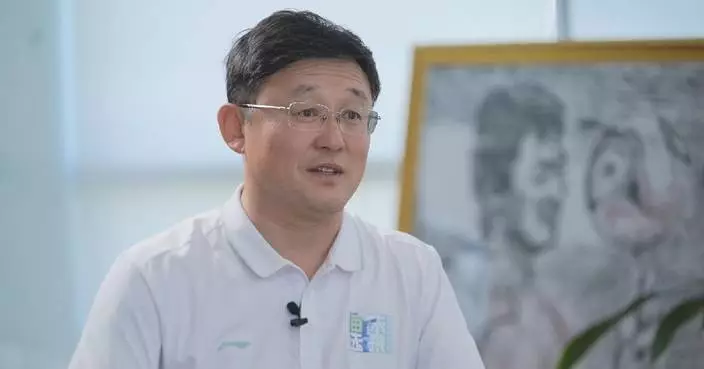
Jin Jiabin, vice president of Ruijin Hospital's Hainan Campus and chief physician of Pancreatic Surgery, underscored AI's role in reducing surgical errors by analyzing large datasets to predict complications and guide safer treatment choices.
"Basically, AI is the calculation from lots of data. And with that, we can decrease our errors during our surgical life. For example, using this calculation, we can predict the potential complication after this kind of procedure. Then I can choose another one. So I think this is something very helpful," said Jin.
In the meantime, some guests said that physicians are still irreplaceable because there are things that AI simply cannot manage at the moment.
Georgios Margonis of Memorial Sloan Kettering Cancer Center and MIT emphasized that even as AI advances, physicians' intuition remains vital, noting its strength in imaging but limits in guiding surgical decisions.
"In radiology, of course, and also pathology, digital imaging pathology. So in those two fields and every field that is mostly about interpreting images, I think AI is superior than, at least superior than the average doctor. But in other fields, actually in my field, it doesn't really help yet, which is the field of guiding clinical decision making in surgical oncology. AI is a great tool but has to be led by the physicians. At this stage, AI does not have the clinical intuition or the creativity that is needed to lead clinical decision making," said Margonis.
Ranjeva added that beyond technology, physicians also play an irreplaceable role in interpreting data within the context of each patient's values and family needs.
"One of my fundamental roles in the ICU dealing with patients and families, is to translate complex medical topics into a patient specific context that takes into account not just their medical condition, but their values and their family's values. So I think that, you know, a physician will always be interpreting these data and applying it to the particular patient. That's a fundamental role of a physician that I think cannot necessarily be taken away by machine learning or AI," said Ranjeva.
While AI tools continue to advance, the dialogue highlighted cooperation as the constant, with Margonis noting the potential for China's blend of tradition and high tech to complement U.S. strengths in biomedical research.
"I'm really impressed by the blend of tradition and high tech in China. On the other hand, U.S. has a long tradition in biomedical research. So I think there could be a blend of sharing data, of sharing ideas, sharing infrastructures to advance precision medicine for both Chinese and US people," said Margonis.
Young doctors on advantages, limitations of AI in health sector
Young doctors on advantages, limitations of AI in health sector