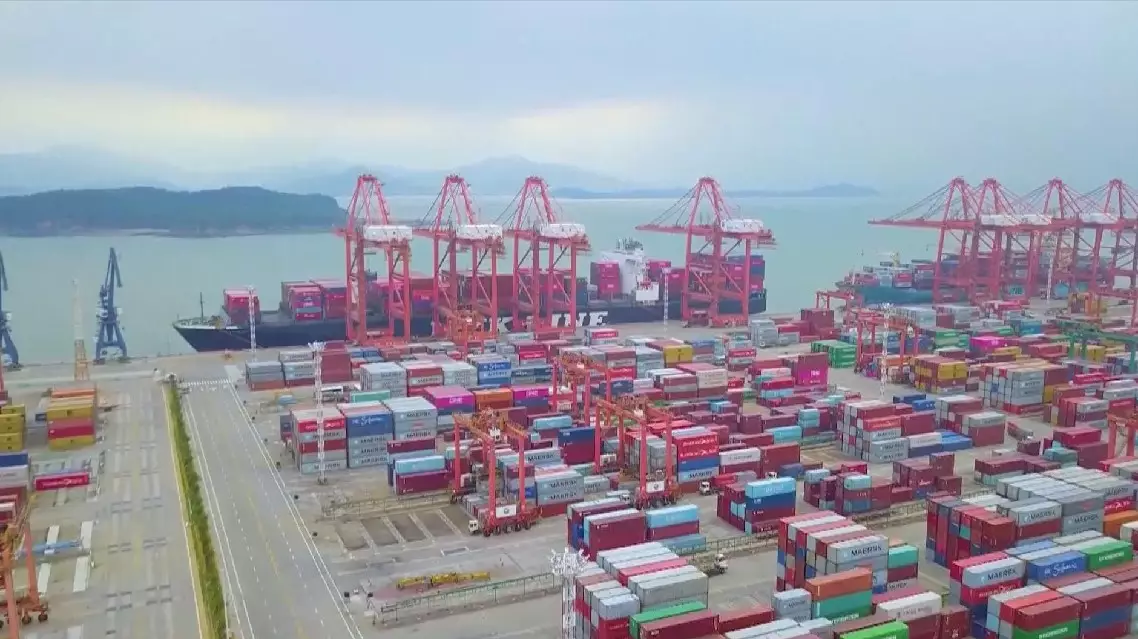
Xiamen Port in east China's Fujian Province has made a fully green and intelligent transformation in recent years, relieving itself of the high energy consumption and emissions typically associated with the port industry.
At the Hairun container terminal of Xiamen Port, which started its upgrading and reconstruction in 2020, all the machinery has accomplished full electrification, resulting in low noise and no black smoke.
Huang Luxu, general manager of the terminal, said that the Hairun container terminal was selected a pilot area to determine the feasibility of a full-port green transformation.
"When we were building an intelligent port in the beginning, especially using the electric stackers, we kept reliability in mind. We began renting the electric stackers rather than buying them. After a half-year trial, we thought it was feasible and we started to promote the mode in all the wharfs of Xiamen Port," said Huang.
The port's facilities have maintained stability and operational costs have been greatly reduced since the transformation.
"The service life for gantry crane engines is 15 years. After using lithium batteries, their power cost is less than half of the cost when using fuel. We estimated that we will reach the break-even point on the engines in six years," said Huang.
Crane operators at the port also benefit from the intelligent innovation as their workplace has shifted from a cabin at an altitude of several meters high to a comfortable control room.
"In the past, we worked in the cabin of the gantry crane, no matter if it was a windy day or rainy day. We work eight hours and I would spend all eight hours up there. Now, the working environment is quiet and comfortable. All I need to do is to control the crane, which is several kilometers away from here, by using a hand shank or pressing the buttons," said Wang Wengeng, a gantry crane operator.
"When I told my friends that I operate the gantry crane remotely in an office, their first reaction was to tell me how cool I am" said Huang Jingrou, another gantry crane operator.
At present, Xiamen Port has completed its full electrification transformation. The port can now reduce diesel consumption by about 2,700 tons per year, save about 2,150 tons of standard coal, and reduce carbon dioxide emissions by about 5,400 tons.
East China port saves costs, emissions with full electrification
After more than three months at sea, members of China's 16th Arctic Ocean expedition have jointly created a painting that captures both the triumphs and trials of polar scientific research.
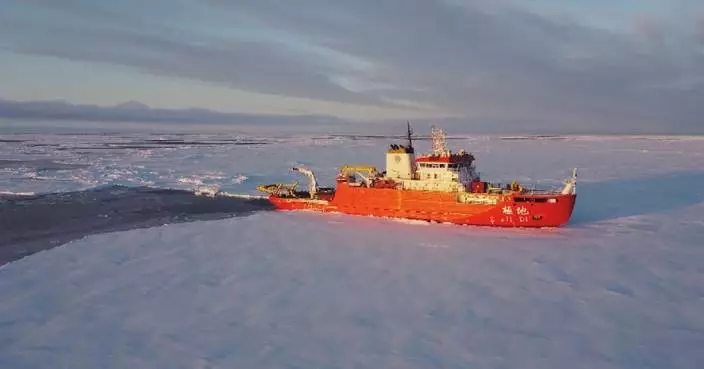
Organized by the Ministry of Natural Resources, the expedition deployed four ships, Xuelong, Xuelong 2, Jidi, and Tansuo 3, to study extreme environmental changes in the Arctic against the backdrop of accelerating global warming. On September 29, Xuelong and Xuelong 2 returned to Shanghai after completing their missions.
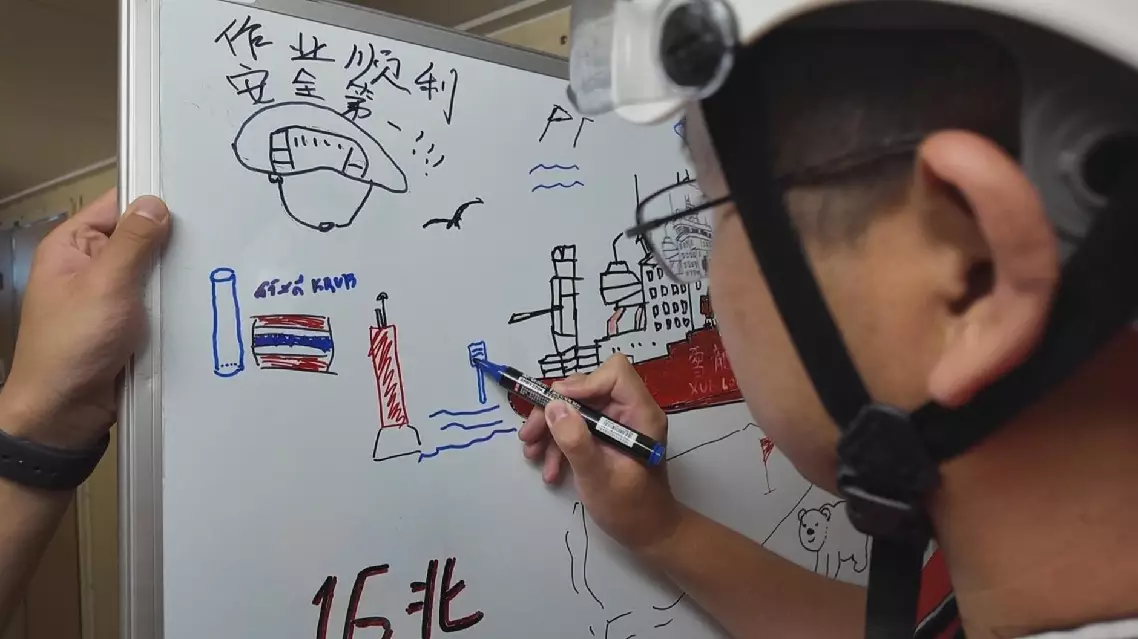
During the voyage, China Media Group (CMG) reporters aboard Xuelong invited nearly 100 crew members to collaborate on a canvas, sharing their experiences. The painting depicts the difficulties and challenges they faced, the honors and expectations of their research, and the images of those dedicated to science.
Before any crew member ever picked up a brush, the Arctic had already sketched the background with its extreme weather. Strong winds, torrents, and a harsh environment posed major challenges for the researchers.
"After staying outside for some five or ten minutes, our hands would already be frozen red. When we reached the trough of the waves [on a boat], it would look as if the waves were coming right over our heads," recalled Zhu Chengwei, an expedition member.
Despite the hardship, the researchers successfully tested and used domestically produced advanced ocean observation equipment in polar research -- one of their proudest moments, which they recorded on the canvas.
Qin Chuan, captain of the Xuelong ocean team, chose to paint a domestically produced monitor float.
"This is an Argo float we deployed, which automatically monitors ocean profiles. It has great significance for understanding the basic marine environment, and it's made in China," he said.
Xie Haixiang, director of the Xuelong laboratory, sketched a fundamental research equipment for the trip.
"I will draw a CTD (Conductivity, Temperature, and Depth instrument). The CTD is the most important equipment for ocean surveys, providing the most basic data and water samples," he said.
"Only by carrying equipment onto the Arctic sea ice yourself and lowering the instruments, can you get what you want. For instance, we take a little ocean water, and analyze what's in it, to understand the changes each year. Global warming needs to be understood through different dimensions," recalled researcher Zhu.
Beyond the canvas, what stands out even more striking are the moments of dedication: veteran members leading newcomers onto the ice, a group holding its ground in level-8 gales and heavy snow, and 30 people relaying to recover equipment stuck in the ice.
The most important element, beyond any record or image in the painting, is this group of expedition members who fear no hardship.
"Whenever I think of the polar spirit, countless images of those standing at the very front would flash before my eyes," Zhu said.
"What we have done today will benefit future generations. Although we are doing something that may seem very insignificant, I believe it will surely prove its worth in the future,"said Ning Wenfeng, another team member.
China's 16th Arctic expedition crews paint portrait of proud polar expedition moments, hardships