China's Shanghai Stock Exchange (SSE) on Tuesday launched the SSE STAR 200 Index to track the performance of companies listed on the STAR market, China's Nasdaq-style sci-tech innovation board.
The SSE STAR 200 Index selects 200 STAR market securities with small-scale market capitalization and good liquidity as index samples. Three other indexes -- the SSE STAR Earnings Quality Strategy Index, the SSE STAR Brand Name Drug Index and the SSE STAR Value 50 Strategy Custom Index -- are scheduled to be unveiled on Friday.
The Earnings Quality Strategy Index measures the performance of securities of listed companies with high earnings quality, the Brand Name Drug Index measures the performance of representative companies in the brand name drug industry, and the Value 50 Strategy Custom Index selects 50 securities with lower operating risks and valuation to measure the performance listed companies with value characteristics, according to the SSE.
Following the release of these four indexes, the STAR market will have 24 indexes tracking domestic and foreign financial products worth a combined total of nearly 160 billion yuan (about 22.4 billion U.S. dollars).
The STAR 50 Index, the STAR 100 Index and the STAR 200 Index will jointly form the market's scale-based index series, reflecting the overall performance of securities from listed companies with varying scales of market capitalization, said the SSE.
"The variety of sci-tech innovation board indexes has been constantly enriched, which can more accurately track the performance of more STAR stocks, especially stocks related to specific market segments considered as the 'new quality productive forces'. At the same time, it provides a feasible way to accommodate the diversified demands of various investors. In the long run, the injection of long-term funds will enable the capital market to better serve the high-quality development of the real economy," said Zhang Gang, chief investment adviser at Southwest Securities.
China has been accelerating the construction of index and product systems. As one of the leading exchanges globally, the SSE, in collaboration with the China Securities Index Company, has been actively enriching the index system and encouraging the development of index fund products. Currently, the combined number of SSE and CSI indexes exceeds 7,000, covering multiple asset classes such as stocks, bonds, commodities and funds, with stock indexes accounting for nearly 70 percent. The index samples span more than 20 major countries and regions worldwide, centering around the markets of Shanghai, Shenzhen, and Hong Kong.
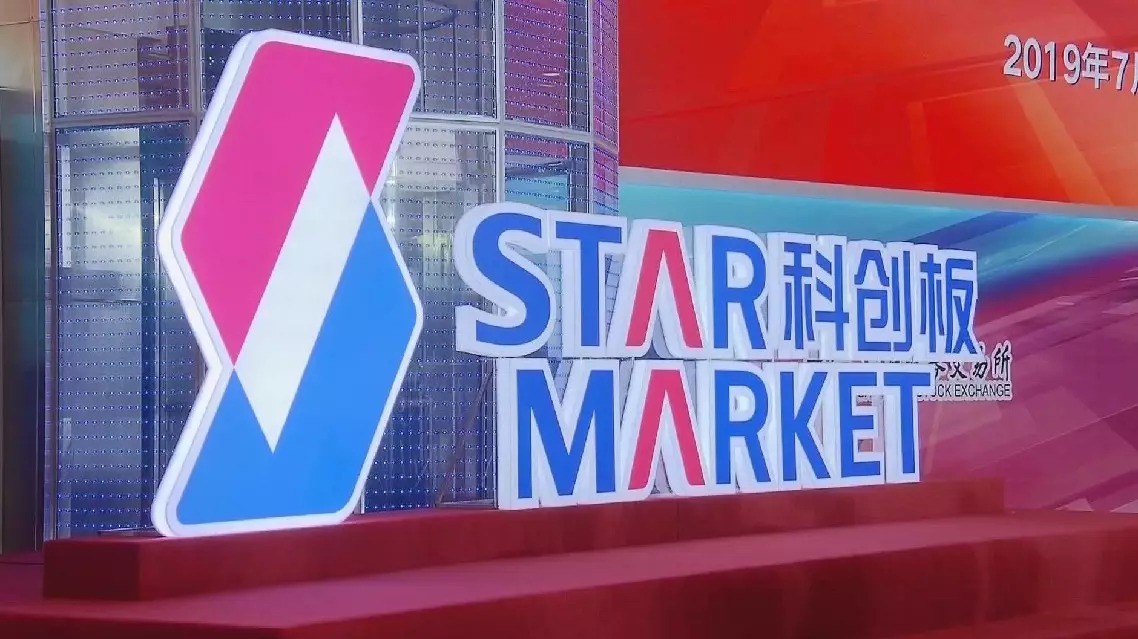
Shanghai Stock Exchange launches new STAR Market index
The 19th Europe-China Business and Technology Cooperation Fair concluded on Friday in Chengdu, the capital of Sichuan Province in southwest China, attracting over 600 enterprises and institutions from more than 20 countries and generating more than 160 preliminary cooperation intentions.
Co-hosted by the China Chamber of International Commerce and the European Union Chamber of Commerce in China, the fair serves as a premier platform for targeted business matchmaking between European and Chinese businesses. It aims to foster meaningful, sustainable cooperation across sectors.
During the three-day event, enterprises from China, Spain, Portugal, and other countries held nearly 400 one-on-one business matchmaking sessions across sectors such as new energy, biomedicine, agriculture and food, and artificial intelligence.
Speaking at the fair, Liu Jiannan, vice chairman of the China Council for the Promotion of International Trade, emphasized the need to explore innovative cooperation models between the two sides.
"We are ready to help enterprises from both sides fully utilize platforms like the Europe-China Business and Technology Cooperation Fair to strengthen sci-tech exchanges, deepen innovative cooperation in areas such as AI, clean energy, and digital economy, and explore new models for cooperation in third-party markets," said Liu.
Business leaders at the event stressed the evolving and deeply integrated nature of Sino-European business ties.
Luigi Gambardella, president of the ChinaEU Digital Association, urged young entrepreneurs to become more involved to deepen mutual understanding.
"I hope that young people, young entrepreneurs, and young startups will start to consider co-creation. I think such kind of cooperation would be much more profound. That's because it will allow entrepreneurs [and] employees to enrich with a different culture, understanding each other," said Gambardella.
Adam Dunnett, secretary general of the European Union Chamber of Commerce in China, underscored the Chinese market's critical importance to Europe, calling for deeper two-way investment and trade.
"China is an important market for us. It's really, really important as a source for our supply chain. [It] really doesn't matter if [European] companies are investing in China or if Chinese companies are investing in Europe, or they're finding ways to trade with each other or to make use of each other's supply chains," said Dunnett.
Since its inception, the event has attracted over 14,000 Chinese and European enterprises. To date, it has successfully facilitated nearly 30,000 business matchmaking sessions, resulting in more than 3,000 cooperation intentions and agreements.
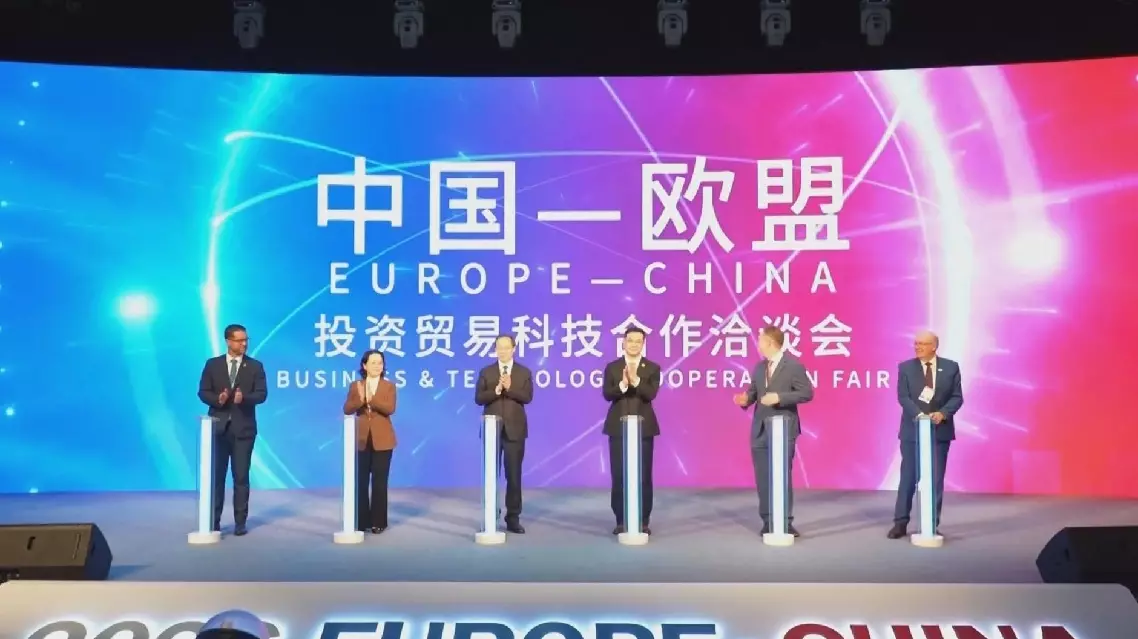
Europe-China fair wraps up in Chengdu with over 160 preliminary deals