How do you know if an artificial intelligence system is so powerful that it poses a security danger and shouldn’t be unleashed without careful oversight?
For regulators trying to put guardrails on AI, it’s mostly about the arithmetic. Specifically, an AI model trained on 10 to the 26th floating-point operations must now be reported to the U.S. government and could soon trigger even stricter requirements in California.
Say what? Well, if you’re counting the zeroes, that’s 100,000,000,000,000,000,000,000,000, or 100 septillion, calculations to train AI systems on huge troves of data.
What it signals to some lawmakers and AI safety advocates is a level of computing power that might enable rapidly advancing AI technology to create or proliferate weapons of mass destruction, or conduct catastrophic cyberattacks.
Those who’ve crafted such regulations acknowledge they are an imperfect starting point to distinguish today’s highest-performing generative AI systems — largely made by California-based companies like Anthropic, Google, Meta Platforms and ChatGPT-maker OpenAI — from the next generation that could be even more powerful.
Critics have pounced on the thresholds as arbitrary — an attempt by governments to regulate math. Adding to the confusion is that some rules set a speed-based computing threshold — how many floating-point operations per second, known as flops — while others are based on cumulative number of calculations no matter how long they take.
“Ten to the 26th flops,” said venture capitalist Ben Horowitz on a podcast this summer. “Well, what if that’s the size of the model you need to, like, cure cancer?”
An executive order signed by President Joe Biden last year relies on a 10 to the 26th threshold. So does California’s newly passed AI safety legislation — which Gov. Gavin Newsom has until Sept. 30 to sign into law or veto. California adds a second metric to the equation: regulated AI models must also cost at least $100 million to build.
Following Biden’s footsteps, the European Union’s sweeping AI Act also measures floating-point operations, but sets the bar 10 times lower at 10 to the 25th power. That covers some AI systems already in operation. China’s government has also looked at measuring computing power to determine which AI systems need safeguards.
No publicly available models meet the higher California threshold, though it’s likely that some companies have already started to build them. If so, they’re supposed to be sharing certain details and safety precautions with the U.S. government. Biden employed a Korean War-era law to compel tech companies to alert the U.S. Commerce Department if they’re building such AI models.
AI researchers are still debating how best to evaluate the capabilities of the latest generative AI technology and how it compares to human intelligence. There are tests that judge AI on solving puzzles, logical reasoning or how swiftly and accurately it predicts what text will answer a person’s chatbot query. Those measurements help assess an AI tool’s usefulness for a given task, but there’s no easy way of knowing which one is so widely capable that it poses a danger to humanity.
“This computation, this flop number, by general consensus is sort of the best thing we have along those lines,” said physicist Anthony Aguirre, executive director of the Future of Life Institute, which has advocated for the passage of California’s Senate Bill 1047 and other AI safety rules around the world.
Floating point arithmetic might sound fancy “but it’s really just numbers that are being added or multiplied together,” making it one of the simplest ways to assess an AI model’s capability and risk, Aguirre said.
“Most of what these things are doing is just multiplying big tables of numbers together,” he said. “You can just think of typing in a couple of numbers into your calculator and adding or multiplying them. And that’s what it’s doing — ten trillion times or a hundred trillion times.”
For some tech leaders, however, it’s too simple and hard-coded a metric. There’s “no clear scientific support” for using such metrics as a proxy for risk, argued computer scientist Sara Hooker, who leads AI company Cohere’s nonprofit research division, in a July paper.
“Compute thresholds as currently implemented are shortsighted and likely to fail to mitigate risk,” she wrote.
Venture capitalist Horowitz and his business partner Marc Andreessen, founders of the influential Silicon Valley investment firm Andreessen Horowitz, have attacked the Biden administration as well as California lawmakers for AI regulations they argue could snuff out an emerging AI startup industry.
For Horowitz, putting limits on “how much math you’re allowed to do” reflects a mistaken belief there will only be a handful of big companies making the most capable models and you can put “flaming hoops in front of them and they’ll jump through them and it’s fine.”
In response to the criticism, the sponsor of California’s legislation sent a letter to Andreessen Horowitz this summer defending the bill, including its regulatory thresholds.
Regulating at over 10 to the 26th is “a clear way to exclude from safety testing requirements many models that we know, based on current evidence, lack the ability to cause critical harm,” wrote state Sen. Scott Wiener of San Francisco. Existing publicly released models “have been tested for highly hazardous capabilities and would not be covered by the bill,” Wiener said.
Both Wiener and the Biden executive order treat the metric as a temporary one that could be adjusted later.
Yacine Jernite, who works on policy research at the AI company Hugging Face, said the computing metric emerged in “good faith” ahead of last year’s Biden order but is already starting to grow obsolete. AI developers are doing more with smaller models requiring less computing power, while the potential harms of more widely used AI products won’t trigger California’s proposed scrutiny.
“Some models are going to have a drastically larger impact on society, and those should be held to a higher standard, whereas some others are more exploratory and it might not make sense to have the same kind of process to certify them,” Jernite said.
Aguirre said it makes sense for regulators to be nimble, but he characterizes some opposition to the threshold as an attempt to avoid any regulation of AI systems as they grow more capable.
“This is all happening very fast,” Aguirre said. “I think there’s a legitimate criticism that these thresholds are not capturing exactly what we want them to capture. But I think it’s a poor argument to go from that to, ‘Well, we just shouldn’t do anything and just cross our fingers and hope for the best.’”
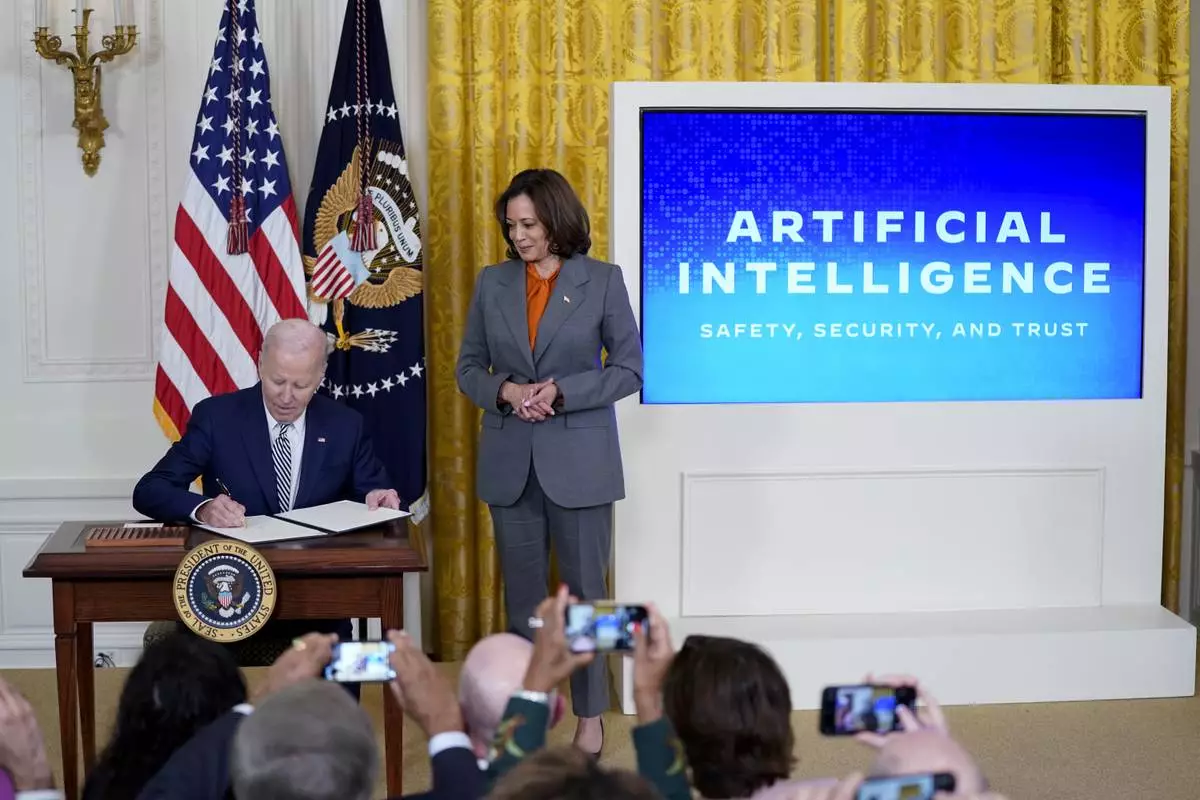
FILE - President Joe Biden signs an executive on artificial intelligence in the East Room of the White House, Oct. 30, 2023, in Washington. Vice President Kamala Harris looks on at right. (AP Photo/Evan Vucci, File)
WASHINGTON (AP) — Democratic voters are showing up for this year’s primaries in numbers not seen in decades, a pattern emerging across several states that has the party optimistic about its prospects in November when control of Congress will be at stake.
In Tuesday's primary, Wisconsin Democrats cast nearly 800,000 ballots, their highest total for a midterm in more than 20 years. That followed 1.5 million Democratic voters in Michigan the week before, a midterm record for the state.
The enthusiasm extends beyond the Midwest. Democratic turnout also surged earlier this year in Texas and Georgia, states that will have competitive Senate races in the fall. It is giving Democrats a string of strong showings heading into the midterms, when the president’s party is normally at a disadvantage. That is compounded this year by President Donald Trump’s weak approval ratings, persistent inflation and an unpopular war with Iran.
“The big news is that Democrats are getting huge turnouts,” said David Axelrod, who was a top adviser to Democratic President Barack Obama. “That’s been a steady story throughout this period.”
Competitive Democratic primaries have helped drive the surge, giving the party’s voters more reason to participate. Republican primary turnout remained closer to historic norms in Michigan, even with a competitive statewide contest.
Voter turnout in primary elections is an imperfect predictor of general election results, especially when one party has the more compelling early contests. Republicans say they are responding with a major effort to turn out their voters in the fall.
GOP leaders say they can energize voters by tapping into a major fundraising advantage over Democrats and sending Trump back out campaigning, including during a midterm convention in Texas next month.
“Primary turnout doesn’t win general elections,” said Mike Marinella, spokesman for the National Republican Congressional Committee. “House Republicans are entering November with the money, momentum, stronger candidates and a battle-tested operation built to turn out voters when it actually counts.”
The scale of the Democratic turnout advantage varied across states, but the pattern extended across much of this year's competitive landscape for House, Senate or governor's races.
In Wisconsin, more than 790,000 people voted in the Democratic primary for governor, putting turnout at about 22% of registered voters. More than 1.5 million people voted in Michigan's recent Democratic Senate primary, which accounted for a little more than 18% of registered voters. It was the state's highest midterm turnout rate in a Democratic primary since at least 2002 — the same as in Wisconsin, according to an analysis of Associated Press election data.
In Minnesota, Democratic primary turnout was on par with the 2018 midterm election, with both years marking the state’s highest Democratic primary turnout in a midterm year so far this century.
For Republicans in Wisconsin and Michigan, turnout in last week’s primary was in line with previous GOP midterm primaries in each state. In Michigan, turnout for the Republican governor’s race was about 11%. In Wisconsin’s Republican primary for governor, it is expected to be about 14%.
“Republicans in Michigan will close the enthusiasm gap by highlighting the massive differences between our nominees and the extreme, out-of-touch politicians the Democrats have nominated,” said Ted Goodman, a spokesperson for the Michigan GOP. “It's one thing to lead in enthusiasm before we know who is running. Now, the differences are clear.”
Other states that held elections earlier this year also saw significant Democratic primary turnout. In Georgia and Texas, the midterm turnout rate in the Democratic primaries was higher than it’s been since at least 2002. In Georgia, just over 1 million people voted in May in the Democratic governor’s race, a little more than 13% of registered voters. In Texas, about 2.3 million people voted in March in the Democratic Senate primary, a little more than 12%.
The robust primary turnout has been a “good sign for Democrats,” said Corwin Smidt, a political science professor at Michigan State University. But he cautioned that it is “not a very solid predictor” of how voters will break in November.
Smidt pointed to several factors behind the numbers, including high turnout in recent elections, which has created a larger pool of regular voters.
“Voting is a lot of habit-forming,” he said.
He also noted that many of the states with high turnout had what he described as “media spotlight candidacies.”
Michigan, Wisconsin and Minnesota all held marquee progressive versus moderate races in August that likely helped drive Democratic participation.
In Michigan, spending in the Democratic Senate primary topped $80 million, making it one of the most expensive races of the year so far, according to AdImpact. Progressive Abdul El-Sayed narrowly defeated Rep. Haley Stevens after a campaign that drew national attention and energized younger voters and university communities.
But Stevens carried Wayne County, the state’s largest source of Democratic votes, and some of the congresswoman's supporters said before the primary that they would not back El-Sayed if he became the nominee.
In Wisconsin, the governor’s primary was repeatedly reshaped as moderate Democrats left and reentered the race while democratic socialist Francesca Hong consolidated progressive support. Hong lost narrowly to Milwaukee County Executive David Crowley, a more moderate candidate.
The races highlight how competitive primaries helped drive attention and also how the winning candidates have work to do to bring their party together for November. Both Wisconsin and Michigan Democrats held unity breakfasts in the days after the primaries.
Sen. Bernie Sanders, a Vermont independent who backed El-Sayed and Minnesota Senate nominee Peggy Flanagan but did not endorse Hong, said in an interview this week that he expects Democratic voters to bridge their differences for the general election.
“At the end of the day, when it comes to taking on Trump and creating a Democratic House and a Democratic Senate, there is going to be unity, because I think everybody knows how important that is,” he said.
Democrats have reason to believe the primary enthusiasm could last. The president’s party has historically lost ground in midterm elections, and Trump enters the fall deeply unpopular amid economic unease and an unpopular war.
Some 33% of American adults approve of his job performance, according to the most recent polling by The AP-NORC Center for Public Affairs.
But a favorable national environment may not be enough. Democrats will need unusually strong turnout to overcome a congressional map that has become more favorable to Republicans.
The number of competitive House races has shrunk considerably this year after Republican-controlled states redrew congressional districts in their favor at Trump’s urging. Some Democratic-controlled states responded, but the new lines are expected to produce a net benefit for Republicans, who hold a slim House majority.
Republicans control the Senate 53-47, with Democrats needing to pick up four seats to win the majority. Democrats will have to generate energy similar to Republicans two years ago, Smidt said.
“If we have a national tide like we had in 2024, suddenly that opens the map a little more,” he said.
Pamela Jo Martin and Samuel Jens of The Associated Press Election Services team contributed to this report from Washington.
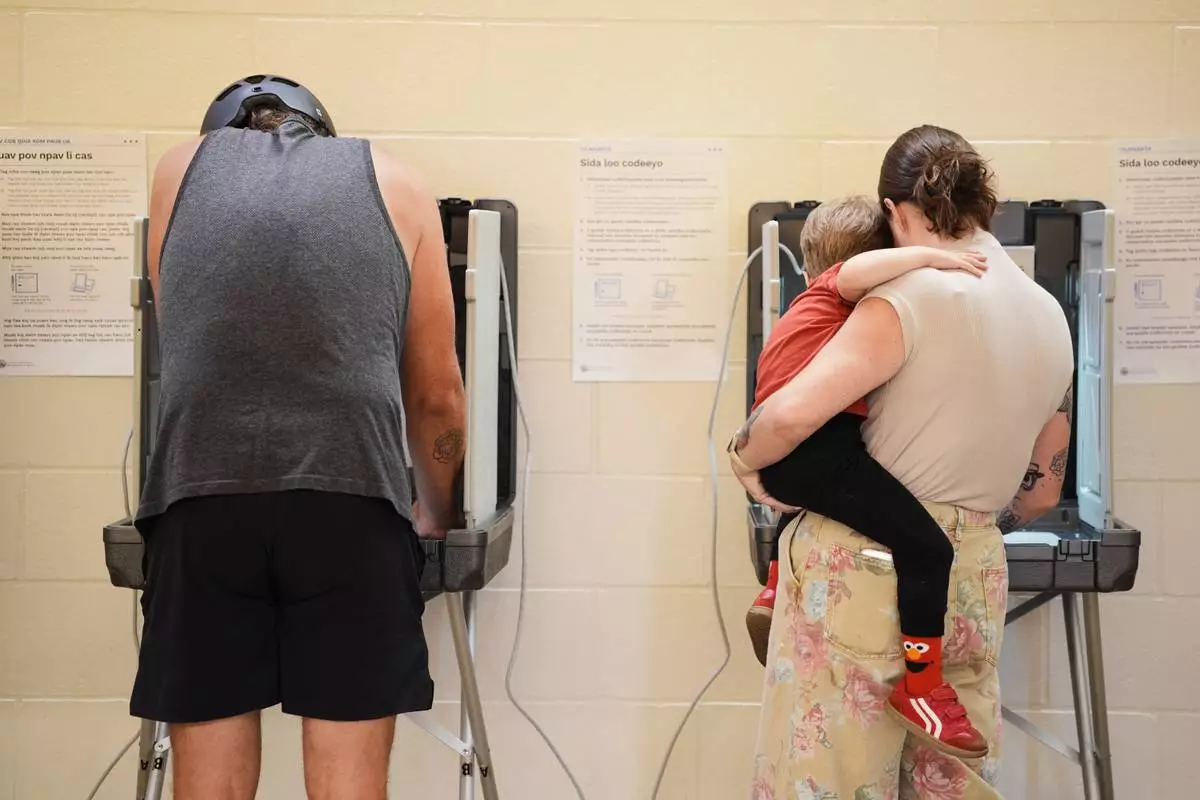
Voters cast their ballots on primary Election Day Tuesday, Aug. 11, 2026, in Minneapolis. (AP Photo/Ellen Schmidt)
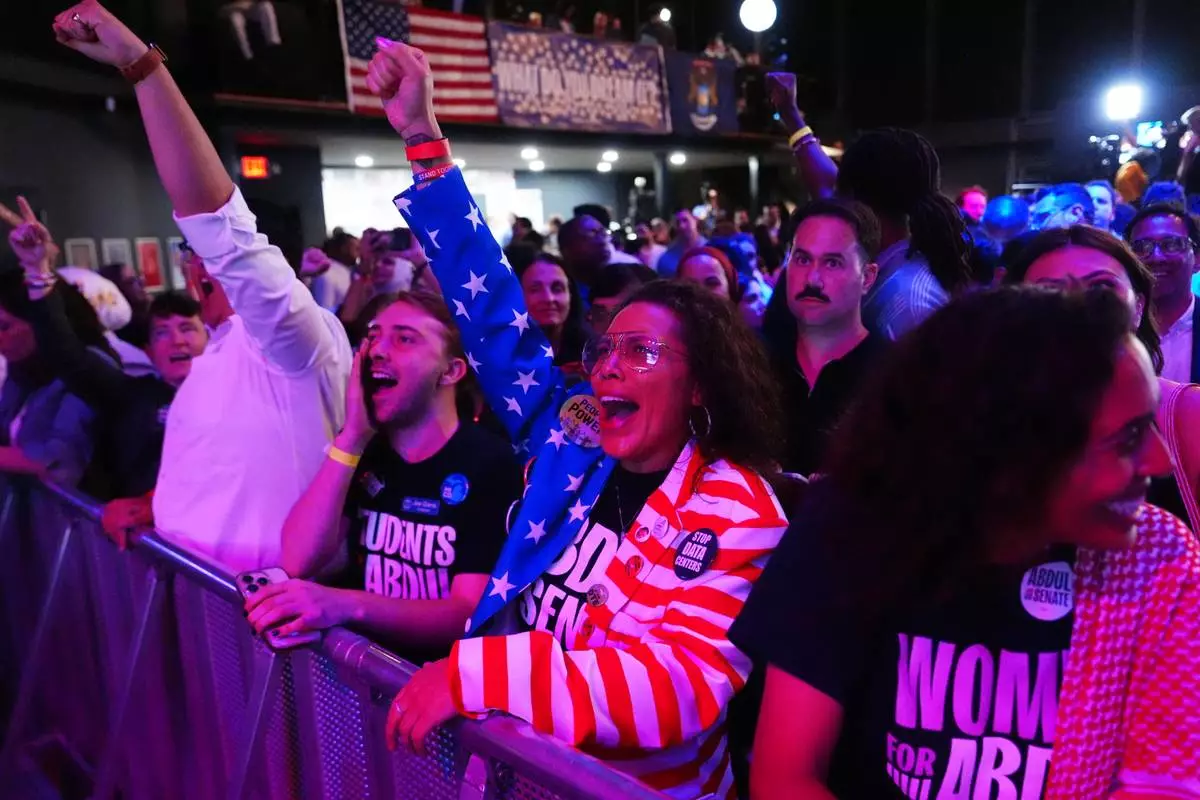
Attendees react to election results during a primary election night event for Abdul El-Sayed, a progressive candidate in the Democratic primary for U.S. Senate in Michigan, Tuesday, Aug. 4, 2026, at the Majestic Theatre in Detroit. (AP Photo/Julia Demaree Nikhinson)
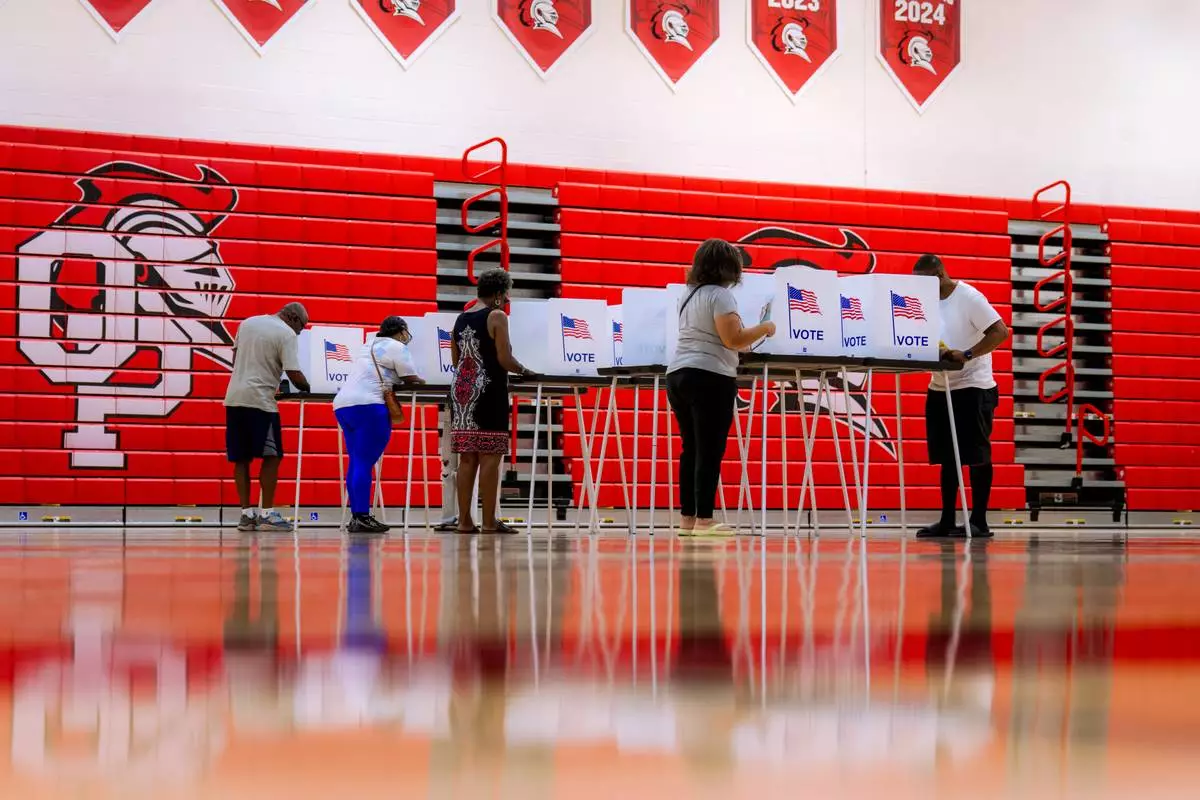
People vote in the primary election at Oak Park High School in Oak Park, Mich., Tuesday, Aug. 4, 2026, (AP Photo/Nic Antaya)