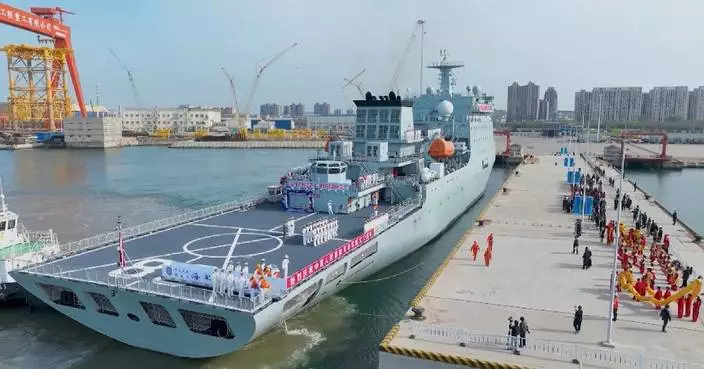
China National Offshore Oil Corporation (CNOOC) announced on Thursday that its two major 'first-in-Asia' projects for offshore oil exploitation will begin operations at the same time -- the continent's first cylindrical floating production storage and offloading (FPSO) unit, Haikui No. 1, and Asia's first deep-water jacket, Haiji-2.
The commencement of operations for both key national projects marks a significant milestone demonstrating China's ability to independently build ultra-large oil and gas infrastructure to world-class standards.
The Haiji-2 has set Asian records for structure height at 428 meters, and in weight at over 50,000 tonnes. It has also set continental records in operational depth and construction speed.
Oil that it collects from deep waters will be sent to Haikui No. 1 for storage and refining. This cylindrical FPSO stands at an impressive height of nearly 30 stories and boasts a weight of 37,000 tonnes. Designed to accommodate full-time crews, it can operate continuously at sea for 15 years without returning to dock.
"The project has overcome multiple key technical challenges, achieving self-reliance in technology and revitalizing the 100-million-tonne deepwater oilfield while reducing both construction and production costs. It also introduces the development model of combining a deepwater jacket platform with a cylindrical oil and gas processing facility, a first in global deepwater oil and gas development. This contributes a Chinese solution for the efficient and economical development of deepwater oilfields," said Yuan Wei, deputy general manager of the CNOOC Shenzhen Branch.
The two platforms are situated in the sea area of the Liuhua Oilfield in the Pearl River Mouth Basin, located more than 320 meters deep and about 240 kilometers southeast of Shenzhen.
The Liuhua is China's first deepwater oilfield, where operations began in March 1996. It has proven geological reserves exceeding 160 million tonnes and has produced over 23 million tonnes of deepwater oil and gas in its 28 years of operation.
Thirty-two new wells are expected to be drilled at the oilfield to boost its peak production to 2,700 tonnes per day.
The launch of the two projects will extend the operational life of the Liuhua Oilfield by nearly 30 years.
Xie Xiulong, director of the Haiji-2 Platform, said the facility is equipped with various sensors to monitor the jacket's load, movement, and corrosion in real-time, helping ensure its safe and stable operation.
"This is our platform's tensioned cathodic protection system, which discharges current to protect the jacket. The protection results are transmitted back to our control center via sensors. We have over 380 sensors across the platform, providing dynamic management of the jacket platform with the data transmitted to our land-based control center via satellite and microwave," he said.
Offshore oil extraction presents significant challenges due to the presence of seawater, which increases costs and risks.
The deeper the water, the greater the challenges. Extracting with the help of the jacket platform is expected to be one of the economical and safe ways to overcome these obstacles.
Xie said his crew will drill 24 wells in a space smaller than half a basketball court to slash the overall oilfield exploitation costs.
The process also requires overcoming underwater internal waves and complex seabed terrain, making it as challenging as threading a needle from 100 meters away.
"By optimizing the drilling parameters and drill tool combination, we can ensure straight boreholes with deviations controlled to less than 0.5 degrees. At the same time, we use micro underwater robots to provide visual guidance for the precise positioning and rapid movement of the drilling tools underwater so that we can achieve efficient and accurate drilling," said Zhang Xin, director in charge of drilling operations on Haiji-2 Platform.
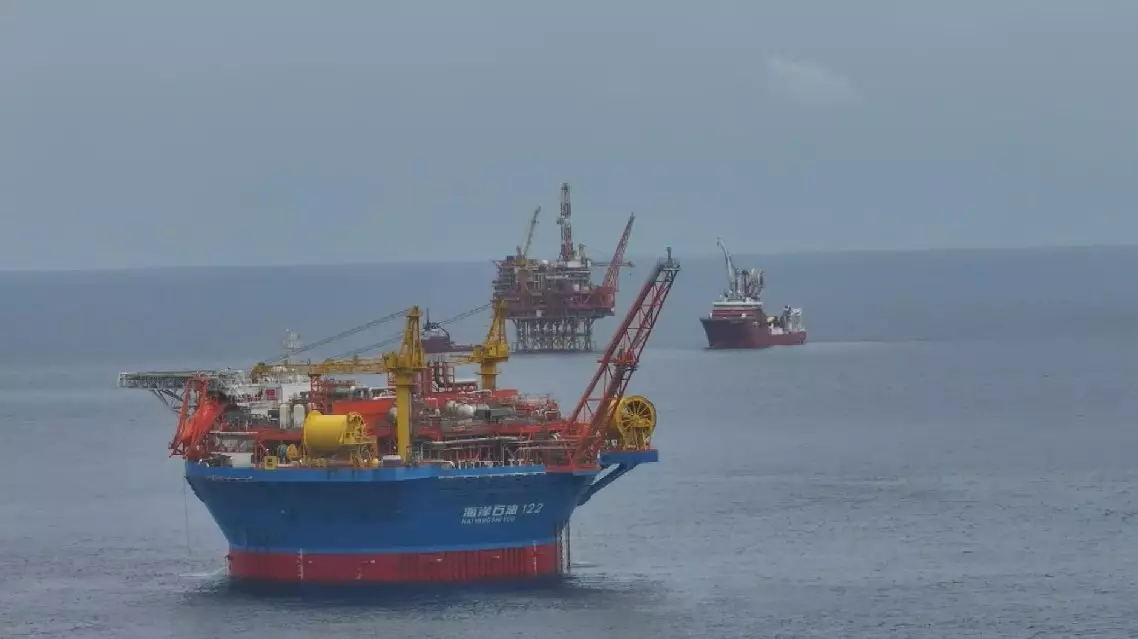
China to launch two major offshore oil extraction projects