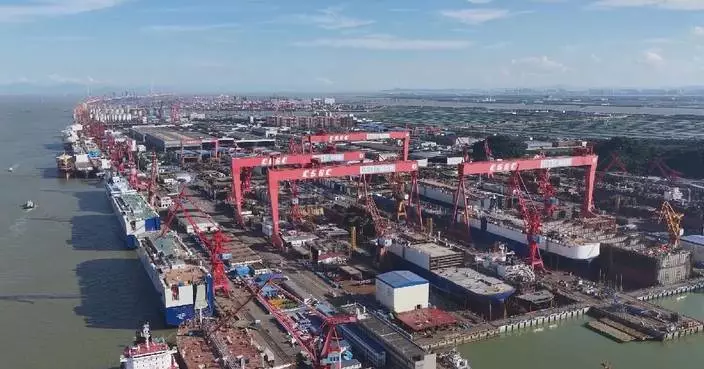
Intelligent "blue farming" has played a role in leading China's marine economy shift, with Guangdong Province which fronts the South China Sea remaining at the forefront of China's marine economy and contributing almost one-fifth of the nation's total over the past nearly three decades.
"Blue Farming" is a strategic vision for sustainable aquaculture production and consumption. In China, deep-sea fish farming as part of "blue farming" is emerging as a crucial solution to providing healthy protein for a growing population.
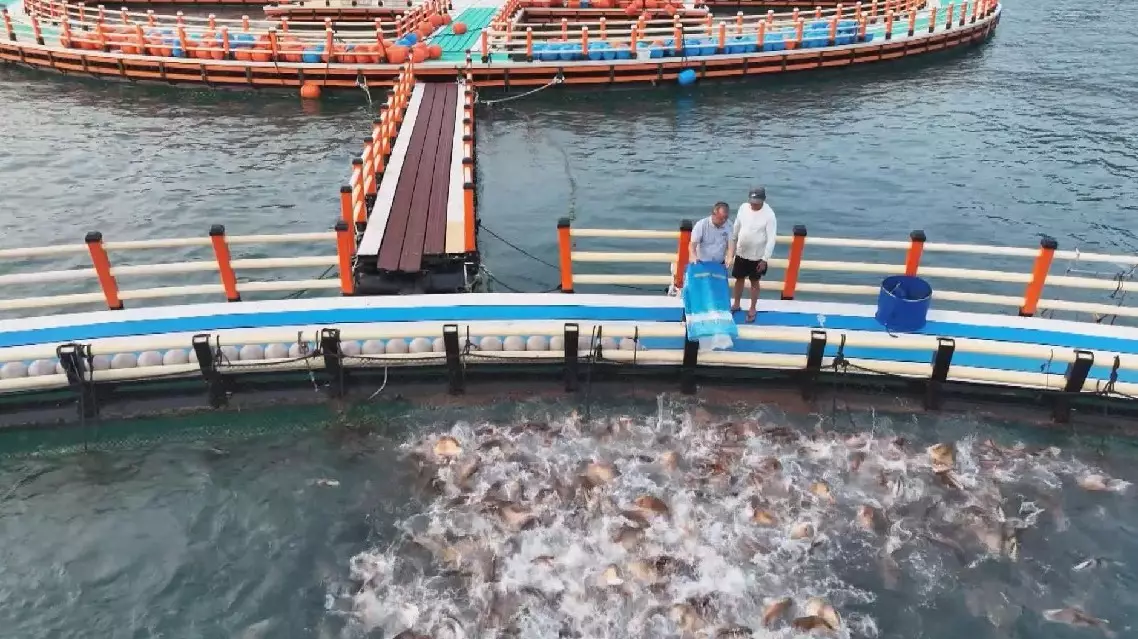
A new semi-submersible breeding platform, located just off the coast of Zhuhai City in the province, is redefining marine aquaculture.
Named Gesheng No.1, the deep-sea platform is the size of seven basketball courts, and is as tall as a five-story building when fully afloat.
With 30,000 cubic meters of aquaculture space, it transforms the open sea into a highly productive "blue farm".
"Traditional offshore breeding is tough because it requires daily trips with a ship, a crane, and a full crew. This platform serves as a sea base, offering ample space for people and supplies while cutting costs significantly. It can even support nearby fisheries, and there's a big market for these platforms," said Sheng Hao, the project's technical manager.
Nearshore fish-farming often concentrates waste and parasites, harming coastal ecosystems.
However, platforms situated further out in the ocean, where currents are stronger and waters deeper, can produce sustainable protein while protecting wild fish stocks.
Big data analysis is aiding companies in making informed decisions.
"We're in the initial phase of building a smart fishery system. By collecting data on factors like pH levels, chlorophyll, water temperature and flow rate, we can identify the ideal fish species and most effective feed. Underwater surveillance monitors fish behavior, allowing us to optimize feeding times," Sheng said.
According to Sheng, this platform is also capable of generating electricity as an additional feature.
Gesheng No. 1 operates entirely on a 24-hour solar panel system.
With plans to collaborate with offshore wind power generation companies, it could soon contribute clean energy to the wider green power grid.
As China's marine economy becomes more sophisticated, intelligent and sustainable, platforms like Gesheng No. 1 are transforming regional economies.
Coastal cities, once reliant on ports, fishing, and shipbuilding, are now harnessing the full potential of marine science and technology, including offshore energy, seawater desalination, advanced materials and biomedicine.
Intelligent "blue farming" leads China's marine economy shift