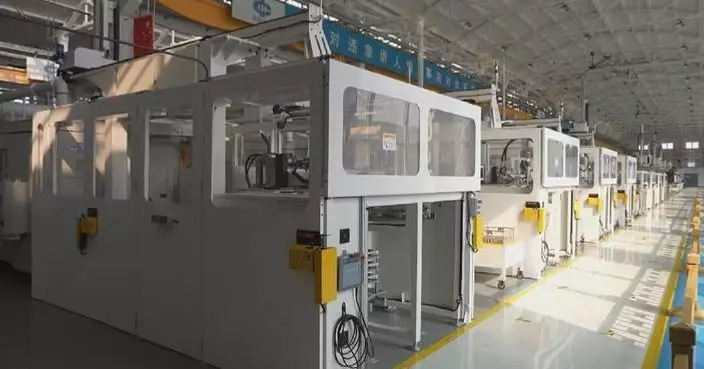
Dongfeng Motor Group, the largest car company in central China's Hubei Province, partnered with a leading ICT infrastructure provider to develop and research vehicle-to-everything (V2X), a vehicular communication system, to improve road safety and traffic efficiency.
V2X is a communication technology that enables vehicles to exchange data with various elements in their environment, including other vehicles (V2V), pedestrians (V2P), infrastructure (V2I), and networks (V2N). By sharing information, V2X aims to improve traffic efficiency, enhance safety, reduce pollution, and enable advanced driver-assistance systems (ADAS) and autonomous driving.
In a road test, cellular vehicle-to-everything (C-V2X) technology enables a rear vehicle to come to an emergency stop after a front car avoids an obstacle. It's a co-production by China Information and Communication Technologies Group Corporation (CICT) in the Wuhan East Lake High-tech Development Zone, or the Optics Valley of China, and Dongfeng Motor in the Wuhan Economic Development Zone, known as China's Auto Valley.
"The secret is that this vehicle uses C-V2X technology whose core part is this white domain controller. It combines the two functions of communication and autonomous driving to create a connected system of the rear car, the front car and the road and help the rear car to obtain a perception beyond visual range," said Zhou Zheren, general manager of the intelligent vehicle division of CICT Connected and Intelligent Technologies Co., Ltd.
This technology integrates vehicles, roads, and clouds into a whole through new-generation information and communication technology, and uses real-time interactive data to achieve safe and efficient operation of intelligent connected vehicles.
"Dongfeng's advantage is still in the vehicle side, while the road and cloud sides are CICT's advantage. Our cooperation can form a linkage and integration between the Auto Valley and Optics Valley from the perspective of the vehicle side, the road side and the cloud side," said Li Honglin, chief engineer of intelligent technology at the Research and Development Institute of Dongfeng Motor Group.
Hubei's automobile industry is moving on a green and low-carbon fast lane. Home to 25 auto enterprises and more than 1,600 parts companies, Hubei is becoming one of the Chinese provinces with the highest degree of automobile industrialization and the most complete industrial chain in the country over the past five decades of development after Dongfeng Motor was established in Shiyan City in 1969.
As the first national-level intelligent connected vehicle testing demonstration zone in central China, provincial capital Wuhan has more than 3,378 kilometers of open testing roads for intelligent connected vehicles in the city. Nearly 200 companies have gradually formed a closed-loop ecosystem of research and development, testing and application for intelligent connected vehicles.
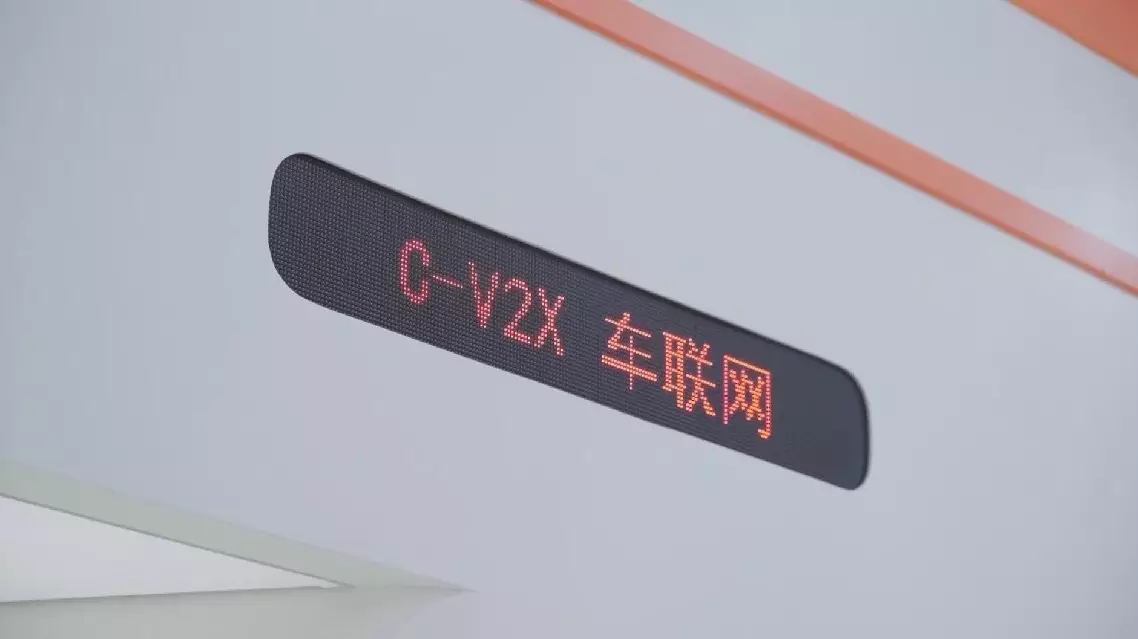
Vehicle-to-everything technology improves traffic safety in autonomous driving