Studying history can sometimes be difficult for students as it involves assessing large amounts of information.

Innovative approach: Award recipient Antonio Kwan says that studying history can cultivate a global vision and cultural respect, and believes students can put lessons from history into practice. Source: news.gov.hk
Antonio Kwan has been working in the field of education for about 20 years, mainly teaching history, and now works for The Methodist Church Hong Kong Wesley College. He believes that understanding history is more than just about reading and memorising facts.
Enriched learning
Mr Kwan uses a variety of creative teaching methods to engage students. He also organises extended activities beyond the classroom to enrich their learning experiences.
Together with his colleagues, Mr Kwan designed a board game that introduces players to the ancient Silk Road and Maritime Silk Road, as well as Arab civilisation. Playing the game helps students to grasp timelines and deepens their understanding of historical materials.
Mr Kwan's dedication to enhancing students’ interest and learning capacities resulted in him becoming a recipient of the Chief Executive's Award for Teaching Excellence, in recognition of his outstanding performance in the Personal, Social and Humanities Education Key Learning Area.
He said the award has motivated him to continue innovating and exploring new methods in his teaching career. He believes that studying history is not only about absorbing information, but also about cultivating students' historical awareness, global vision and cultural respect.
“I hope that students can learn from historical events and put these lessons into practice,” he said.

Crucial stage: Award recipient Wanki Sun believes that early childhood is a critical period for character formation, and that teachers should set a good example and strive to create a positive atmosphere for learning. Source: news.gov.hk
Character development
Alongside imparting knowledge, character development is equally important in teaching.
Wanki Suen, a teacher at the TWGHs Tin Wan (1996-1997 Directors) Kindergarten, believes early childhood is a critical period for character formation and that educators have a vital role to play in influencing its development in students.
“I think teaching by example is always more important,” she said. “Teachers should always set a good example for the children and create a positive learning atmosphere.”
In order to instil a clear idea of good conduct, her kindergarten makes use of picture books, activities and games that encourage children to behave appropriately. Parents are also invited to make picture books with their children at home to reinforce their learning.
To cater to children's interests and learning needs, Ms Suen and her colleagues have also designed their own picture books, highlighting different aspects of Chinese culture, with a subsidy provided by the Quality Education Fund.

Supporting excellence: The Chief Executive’s Awards for Teaching Excellence have been expanded to include two new awards recognising innovative approaches to teaching and the Education Bureau’s Nongyao Vitayatprapaiphan says that the initiative brings together outstanding teachers, promoting a culture of collaboration and the pursuit of excellence. Source: news.gov.hk
Innovative education
Over 950 teachers from different fields have been honoured since the launch of the Chief Executive's Awards for Teaching Excellence in 2003. The Education Bureau said the awards recognise teaching excellence and help to elevate the professional image and social status of teachers.
The bureau’s Chief Professional Development Officer (Teacher Awards & Language Teacher Qualifications) Nongyao Vitayatprapaiphan said that the initiative brings together outstanding teachers, promoting a culture of collaboration and the pursuit of excellence.
The award presentation ceremony is held in July every year. A new round of nominations is currently open. In addition to the existing award categories, two new awards - namely the Award for Budding Teachers and the Award for Education Innovation - have been added.
TALLAHASSEE, Fla. (AP) — At 100 years old, Lee Grant knows the cost of McCarthyism better than almost anyone else on the planet.
One of the last surviving actors to be blacklisted during the anti-communist Red Scare, the Academy Award-winning performer is speaking out against Florida's new social studies teaching standards, which critics have warned are aimed at rewriting one of the most repressive chapters in American history.
“It’s a lie and a distortion of the truth of history,” Grant said in an interview with The Associated Press.
In 1951, Grant's star was on the rise. But just as her career was taking off, it was derailed and she was blacklisted, barred from working in film or television for the next 12 years after she refused to name names in front of the congressional committee that investigated so-called “un-American activities.”
“Me? Turn in friends?” she said, adding “That's not the way I am raised.”
Reflecting on how political persecution changed her own life, Grant said she sees echoes of McCarthyism in today’s politics, pointing to President Donald Trump’s fights with the media and wondering how long his critics will be able to continue speaking out.
“As an old blacklisted actor, director,” Grant said, “I keep worrying.”
The teaching standards approved last week for middle- and high school students by the Florida Board of Education include instruction on the use of “‘McCarthyism’ as an insult” and how using the terms “red-baiter and Red Scare” amounts to “slander against anti-communists.”
Florida's standards soften decades of criticism of former U.S. Sen. Joseph McCarthy, who led a political movement to root out what he labeled as communism in government, the Civil Rights Movement and artistic communities in the late 1940s and early 1950s. McCarthy and others tried to silence political opponents by accusing them of being communists or socialists, using fear and public accusations to suppress basic free speech rights.
The public inquisitions, ideological loyalty tests and firings of that period are seen now as a shameful period that upended the lives and careers of scores of actors, writers, activists and public servants. The term “McCarthyism” became synonymous with baseless attacks on free expression, and the U.S. Supreme Court has referred to the phenomena in several First Amendment-related rulings.
Born Lyova Rosenthal and raised in Manhattan, Grant made her Hollywood debut playing the shoplifter in the film “Detective Story” alongside Kirk Douglas, a role that earned Grant an Academy Award nomination for best supporting actress.
Grant was not herself a member of the Communist Party, a point of contention in her first marriage to screenwriter Arnold Manoff, who was a communist. But Grant spoke out at the memorial service of an actor friend who died of a heart attack six months after being questioned by the congressional committee, saying that “being blacklisted killed him.”
“That was how I was blacklisted. That was the act,” she recalled.
Soon after, Grant's name appeared on a list, alongside artists like Orson Welles, Leonard Bernstein, Arthur Miller and Lena Horne.
“We live in a democracy that was being used as a fascist tool to stop people from thinking,” Grant said of the time.
Despite her yearslong ban in Hollywood, Grant was able to work in theater, which provided a haven for some blacklisted actors, and she continued fighting against the purge.
By 1954, public opinion and McCarthy's fellow senators turned on him, and in the 1960s, the blacklist's hold on Hollywood loosened.
Grant ultimately went on to have a storied career, despite the years lost to being blacklisted. She made a comeback in the 1967 film “In the Heat of the Night" alongside Sidney Poitier, channeling her anger as a distraught woman outraged by the prejudice of local authorities investigating her husband's murder.
She went on to win an Academy Award for best supporting actress for her role in the 1975 film “Shampoo” alongside Warren Beatty. She later became a documentary filmmaker, directing “Down and Out in America," which won the Oscar for best feature-length documentary in 1987.
Florida’s new teaching benchmarks, which will go into effect in the 2026-2027 school year, were prompted by a law signed by Republican Gov. Ron DeSantis last year requiring instruction on communism and the “threat” it's posed to the U.S.
The move followed the Republican-controlled Legislature’s designation of Nov. 7 as Victims of Communism Day in Florida’s public schools, to include at least 45 minutes of instruction on figures such as former Chinese leader Mao Zedong and Cuban dictator Fidel Castro.
Under the new standards, Florida teachers should give instruction on efforts by “anti-communist politicians,” such as McCarthy, and the late Presidents Harry Truman and Richard Nixon.
Teachers are also instructed to identify “propaganda and defamation” used to “delegitimize” anti-communists.
“Instruction includes using ‘McCarthyism’ as an insult and shorthand for all anti-communism,” the new standards said. “Instruction includes slander against anti-communists, such as red-baiter and Red Scare.”
Kate Payne is a corps member for The Associated Press/Report for America Statehouse News Initiative. Report for America is a nonprofit national service program that places journalists in local newsrooms to report on undercovered issues.
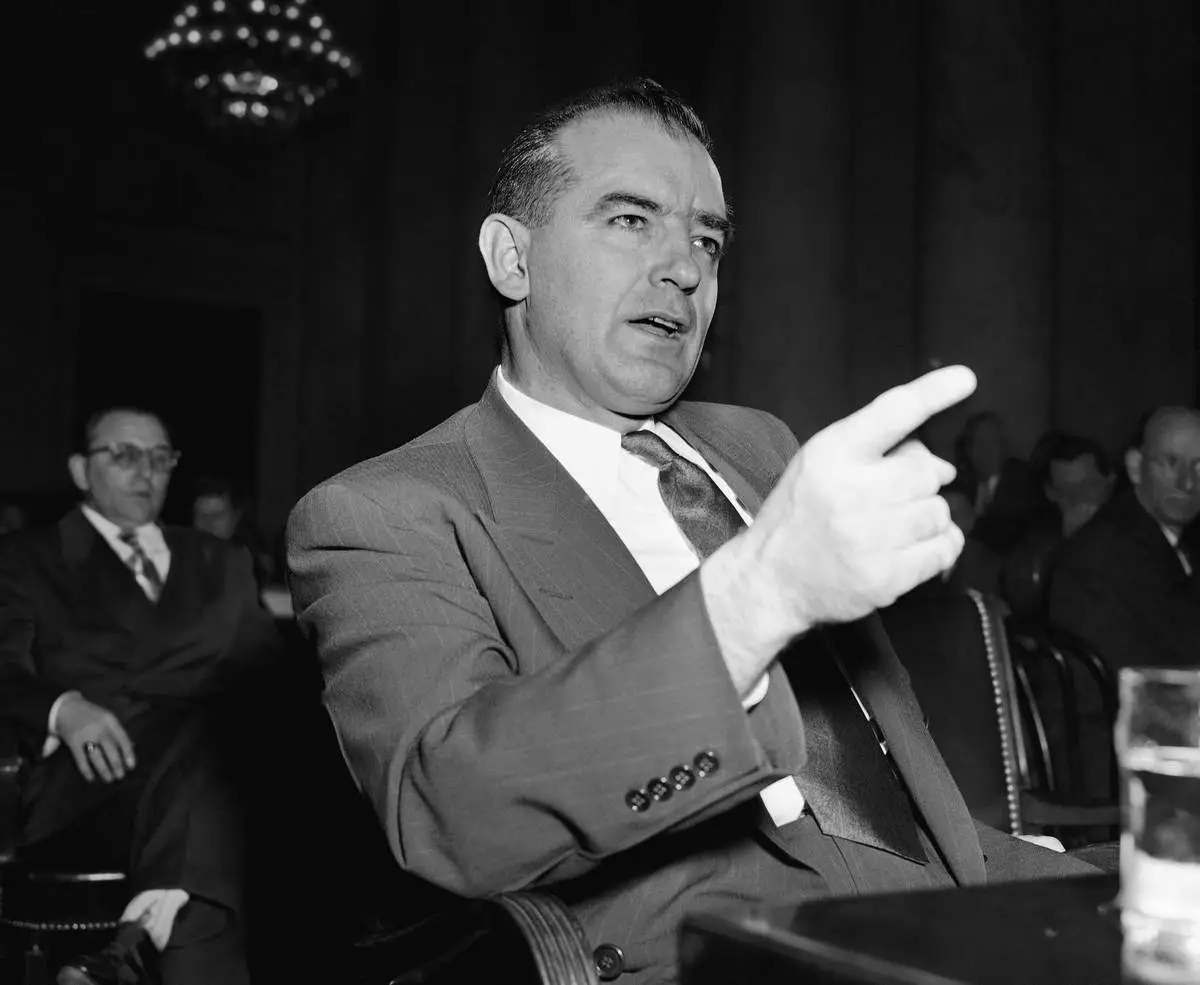
FILE - Sen. Joseph McCarthy gestures during a Senate subcommittee hearing in Washington, D.C., on McCarthy's charges of communist infiltration of the U.S. State Department, March 9, 1950. (AP Photo/Herbert K. White, File)

FILE - Actress Lee Grant arrives with her husband Joe Feury to a screening of "The Company" at the Paris Theater in New York, Dec. 16, 2003. (AP Photo/Louis Lanzano, File)