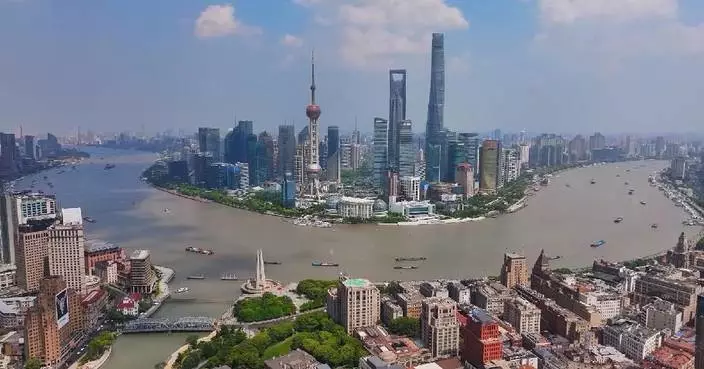
The tiny and glittering gemstones have driven the huge development of Wuzhou City in south China's Guangxi Zhuang Autonomous Region in the past decades, turning the once ordinary industrial city into a globally renowned gem hub.
Wuzhou City is home to the largest artificial gemstone trading center in south China, attracting hordes of global orders.
Remarkably, 70 percent of the world's artificial gemstones are produced in the city.
It's hard to imagine that just decades ago, Wuzhou was an obscure light industrial city.
In the 1980s, a Hong Kong entrepreneur saw the potential of Wuzhou's low labor costs and opened the first gemstone processing company, leading to the rapid growth of the industry.
By the 1990s, out of the city's 300,000 residents, 120,000 engaged in gemstone polishing.
Today, the industry is undergoing significant transformation.
Lu Zeshuang, from Guilin City, has spent over a decade in Wuzhou.
After training as a jeweler in Shenzhen City in the neighboring Guangdong Province, he started his own jewelry processing factory.
"If you ask me what's the biggest change in the past decade, it is 'gemstone processing has met intelligence.' In the past, one person could polish over 200 stones daily while now, a machine can polish over 2 million stones in a single day. I started with a small factory of two or three people and have grown to a factory with more than 100 employees. We are even expanding our production line, and our jewelry is sold globally. Rather than saying I have witnessed the rapid development of Wuzhou's gemstone industry, it is actually the development of Wuzhou's gemstones that has made me successful," he said.
Wuzhou also boasts remarkable technology capable of cutting multiple facets on a gemstone just 1 millimeter in size.
Lu demonstrated this with a rice grain-sized gemstone featuring 57 facets - an impressive feat akin to writing on a grain of rice.
From manual polishing to semi-automated and now fully automated processes, Wuzhou's artificial gemstone industry has undergone a significant upgrade.
With 1,200 gemstone processing companies and 400 jewelry manufacturers, a smart comprehensive industrial chain has formed, covering everything from raw material development to design and processing.
The 21st Wuzhou Gem Festival is approaching and will serve as a platform for the local industry to showcase its achievements and promote cultural and economic exchange on the global stage.
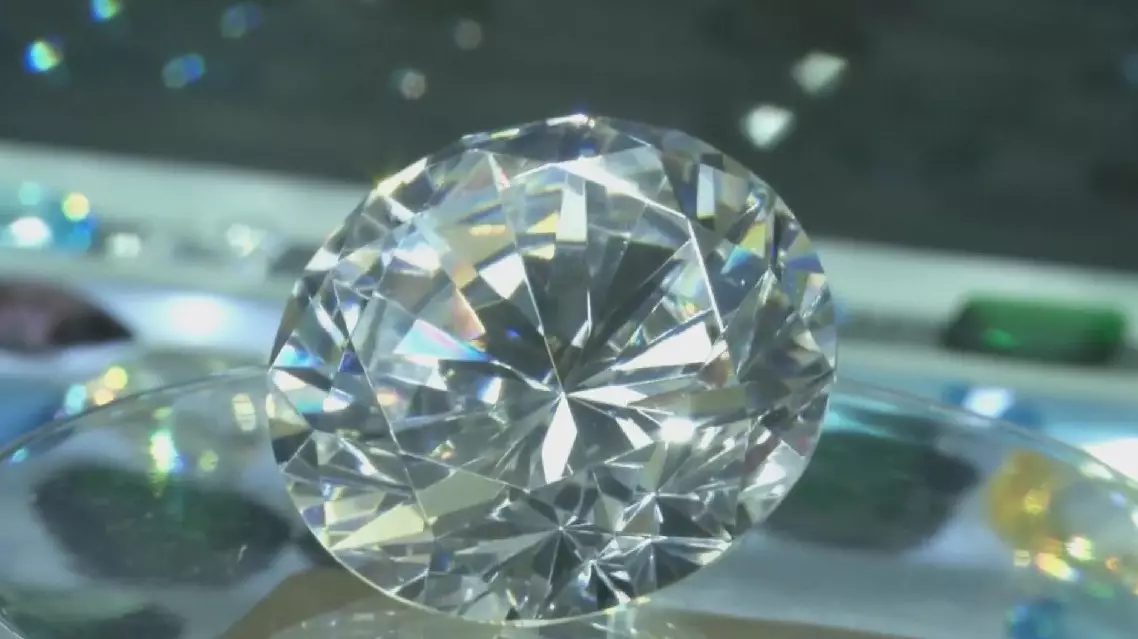
Burgeoning gem industry paves way for prosperity in south China's Wuzhou
A former television host from Taiwan, Zhai Xuan, has made a pivotal decision to leave mainstream broadcasting in order to create content that provides a better understanding of the Chinese mainland and cross-strait relations.
Zhai, a seasoned television host with over a decade of experience in Taiwan's media landscape, recently addressed an audience at an event in Beijing, where she revealed her complete transition into independent online media.
In her remarks, she articulated her aspiration to bridge what she perceives as a significant information gap between audiences on both sides of the Strait, highlighting her commitment to fostering a deeper understanding and connection through her new endeavors.
"I was really surprised by all the fake news. There were stories saying people on the mainland can't afford tea eggs or that they live in mud houses and in Taiwan, this was the main information many people received," said Zhai.
Zhai said she initially began producing online videos to challenge such perceptions while continuing her work as a television host.
In April 2025, she travelled to the mainland with her father to fulfill her late grandfather's wish to return to his hometown. The trip, which reunited family members separated since 1949, was recorded in a video series titled "Journey to Find Our Roots", drawing attention from viewers in both Taiwan and the mainland.
"Many people in Taiwan told me that after watching, they wanted to apply for a mainland travel permit immediately and go looking for their relatives. Some had long forgotten these things, but after seeing my story, they began thinking about their hometowns and family members they had never met and decided to search for their roots," Zhai shared her story at the event.
By mid-2025, Zhai said she began to feel increasing pressure amid rising political tensions and a tightening atmosphere around cross-Strait exchanges in Taiwan.
After more than 12 years in the industry, Zhai resigned from her position, believing it was the right thing to do.
"At that moment, I felt this was a major issue,not just for me, but for Chinese people on both sides of the Strait. If I backed down then, I wouldn’t be standing on the right side," said Zhai.
Since leaving television, Zhai has broadened her online programming to encompass a range of daily-life topics, including practical guidance on applying for a mainland travel permit and using commonly employed mobile applications, in addition to content that delves into historical memory and cultural connections across the Strait.
As the debate over cross-Strait relations continues in Taiwan, Zhai said she remains committed to her current path.
Former Taiwan TV host bridges cross-Strait divide via online media