In the opening scenes of “The Wild Robot,” a chirpy metal android with a state-of-the-art processing unit wanders around a forest asking confused animals if it can help them, offering discount codes and stickers for future customers. “Did anyone order me?” it asks.
We did, it turned out. This adaptation of Peter Brown's winning middle grade novel is an absolute movie triumph, a soulful sweet-sad animated journey that may have your kids asking why you're tearing up so much. It is destined to be ordered and reordered.
Click to Gallery
This image released by Universal Pictures shows a scene from DreamWorks Animation's "Wild Robot." (DreamWorks Animation/Universal Pictures via AP)
This image released by Universal Pictures shows Roz, voiced by Lupita N'yongo, background, and Brightbill, voiced by Kit Connor, in a scene from DreamWorks Animation's "Wild Robot." (DreamWorks Animation/Universal Pictures via AP)
This image released by Universal Pictures shows Roz, voiced by Lupita N'yongo, left, and Brightbill, voiced by Kit Connor, in a scene from DreamWorks Animation's "Wild Robot." (DreamWorks Animation/Universal Pictures via AP)
This image released by Universal Pictures shows a scene from DreamWorks Animation's "Wild Robot." (DreamWorks Animation/Universal Pictures via AP)
Chris Sanders, the writer-director of “How to Train Your Dragon,” “The Croods” and “Lilo & Stitch,” is the writer and director here. The assignment is daunting: Turn a beloved book with a few illustrations into a full-length movie without losing its tangy heart. Sanders didn't just nail it; he lasered it.
“The Wild Robot” is the fish-out-of-water tale of a futuristic helper robot who ends up marooned on an island when a storm sinks its container ship. It learns to adapt and connect with critters it has no programming for, even adopting the cutest gosling you'll ever see (sorry, Ryan).
The robot — ROZZUM unit 7134, or “Roz” for short — is voiced by Lupita Nyong’o in a spectacularly nuanced performance, sprightly robotic at first and eventually natural and wry. The other voice actors — Pedro Pascal, Catherine O’Hara, Bill Nighy, Kit Connor, Stephanie Hsu, Mark Hamill, Matt Berry and Ving Rhames — aren't just hired guns that other animated movies use to entice an audience. Each is wonderfully calibrated.
The movie keeps the basic structure of the book but ups some characters — like elevating the importance of Pascal's red fox — and has a tendency to go a little Hollywood, like sending a robot army after Roz and setting everything on fire. But it never lags, the visual effects are startling, and its soul is intact.
“The Wild Robot” is often a story about programing — natural and artificial — and how that can help and hinder. “I do not have the programing to be a mother," Roz tells a mother possum (a superb O'Hara). She replies: “None of us does.”
Roz has ended up on an island where survival of the fittest and instinct are the rule, where animals don't sing and dance but struggle and hunt each other. “Kindness is not a survival skill,” our robot is told by the fox.
“The Wild Robot” is also a celebration of adoption and found families. The push-and-pull of being a parent is there, as is the celebration of friendship. And there is death, an honest reminder of the struggle to stay alive.
Visually, it is stunning, a textured world that is almost painterly. You can see snowflakes settle on mottled fur, moss on rocks, individual leaves in a den. The images of a tree covered in butterflies is so spectacular it should be a poster we all can frame. No offense to Roz, but regular computer-generated efforts — “Transformers One,” we're looking at you — look lackluster in comparison.
Roz accidentally causes the death of a goose family, save for an unbroken egg. That orphan is now Roz's obligation — she must teach it to eat, swim and fly, culminating in winter migration. And she must face tough questions — about how a robot came to raise a little goose. “He found where he belongs,” Roz says with cheerful sadness when her gosling swims to a group of geese.
What is home is another theme: Roz feels the pull to return to her factory but only out of obligation. Her heart is on this island and the friends she has made, especially after making a safe place for all creatures during a freezing winter. Her kindness changes the way the animals see each other, even if it cannot change their appetites.
Being a mother changes Roz, too, unmooring her from her ones and zeroes, making her improvise and even willing to break some rules, like learning to lie to create a creative bedtime story. A busted-up robot from the shipwreck is stunned by what Roz has become when she stops by to consult: “You should not feel anything at all.”
As for you? You're going to have all the feels. Surrender. Is this the best animated movie of the year? Totally, so far. It might even be the best movie of the year. See you at the Oscars, Roz.
“The Wild Robot,” a Universal release in theaters Friday, is rated PG for action/peril and thematic elements. Running time: 101 minutes. Four stars out of four.

This image released by Universal Pictures shows a scene from DreamWorks Animation's "Wild Robot." (DreamWorks Animation/Universal Pictures via AP)

This image released by Universal Pictures shows Roz, voiced by Lupita N'yongo, background, and Brightbill, voiced by Kit Connor, in a scene from DreamWorks Animation's "Wild Robot." (DreamWorks Animation/Universal Pictures via AP)

This image released by Universal Pictures shows Roz, voiced by Lupita N'yongo, left, and Brightbill, voiced by Kit Connor, in a scene from DreamWorks Animation's "Wild Robot." (DreamWorks Animation/Universal Pictures via AP)

This image released by Universal Pictures shows a scene from DreamWorks Animation's "Wild Robot." (DreamWorks Animation/Universal Pictures via AP)
NEW YORK (AP) — Democratic incumbents are facing spirited challenges Tuesday in at least two of New York's congressional primaries, the latest proving ground in the high-stakes fight between the progressive left and the party establishment over the Democratic Party's future.
U.S. Rep. Dan Goldman and U.S. Rep. Adriano Espaillat are both seeking to stave off candidates backed by Mayor Zohran Mamdani, the 34-year-old democratic socialist who's testing the limits of his growing political muscle in the state's first batch of elections since he took office in January.
Mamdani and his slate are promising to push the Democratic Party further left on key issues, the war in Gaza chief among them, even as establishment Democrats in Washington worry that their policies could alienate swing voters in midterm elections across the country this fall.
Goldman faces former city Comptroller Brad Lander while Espaillat, who chairs the Congressional Hispanic Caucus, faces another Mamdani pick, Darializa Avila Chevalier, a democratic socialist who once helped organize pro-Palestinian protests at Columbia University. Mamdani is also backing his democratic socialist ally, state Assembly Member Claire Valdez, who along with the rest of the mayor's candidates has vowed to abolish U.S. Immigration and Customs Enforcement.
“It’s not just a question of electing more Democrats. It’s a question of electing better Democrats, ” Mamdani said Tuesday. “When I look at these candidacies, I see in them a willingness to also put working people back at the heart of our politics.”
In Washington, House Democratic Leader Hakeem Jeffries downplayed the influence of the Mamdani-backed candidates should they prevail Tuesday, which would make them the overwhelming favorites to win congressional seats in November given New York City's strong Democratic makeup.
“We have agreed to strongly disagree,” Jeffries said of Mamdani on Capitol Hill. “There are 215 members of the House Democratic caucus. A handful of primaries that go in one direction or the other, in a given state or two, aren’t going to reshape who we are as House Democrats.”
Meanwhile, Democrat Jack Schlossberg, the 33-year-old grandson of former President John F. Kennedy, is hoping to write his own chapter in Camelot lore as he competes in a crowded field for a seat being vacated by retiring U.S. Rep. Jerry Nadler. Mamdani has made no endorsement in that race.
The Kennedy scion is running in one of the country's wealthiest congressional districts — covering much of the center of Manhattan — but faces questions about his lack of work experience against more seasoned opponents.
The field includes state Assembly members Micah Lasher, a longtime government hand backed by Democratic leaders, and Alex Bores, whose proposals to regulate artificial intelligence have triggered tech industry blowback. Also running is George Conway, who helped start the anti-Trump group, The Lincoln Project, and has centered his candidacy on impeaching the president.
Mamdani, whose first six months in office have drawn praise from establishment Democrats and even President Donald Trump, has made a big push to promote three congressional candidates who are challenging Democrats supported by the party's leadership.
Two of Mamdani's congressional slate identify as democratic socialists, while Lander has often aligned himself with the movement. All three have repeatedly promised to “abolish ICE,” condemned the “genocide” in Israel and vowed to “tax the rich” if elected.
Mamdani's most polarizing pick is Avila Chevalier, 32, in her race against Espaillat, 71, who was the first Dominican American elected to Congress and represents a district in upper Manhattan and the Bronx.
Avila Chevalier has not held political office and casts herself as an outsider. Around an hour before polls closed, she was standing on a street corner in Harlem with controversial streamer Hasan Piker, chatting with voters in a final Election Day push.
On the next corner, a small truck displayed an ad attacking Avila Chevalier, highlighting a disparaging remark she made on social media about former Vice President Kamala Harris. Avila Chevalier had previously apologized for the post.
Espaillat’s allies have called Avila Chevalier unfit for office, pointing out a history of inflammatory and profane social media posts when she was in her 20s.
In East Harlem, 47-year-old voter Sara Hyler said she flip-flopped several times between Avila Chevalier and Espaillat in the lead up to Election Day, but eventually cast her ballot for Avila Chevalier after learning about AIPAC’s heavy support for the incumbent.
“It was the breaking point, my last straw,” she said of AIPAC’s donations to Espaillat.
Hyler said it was important to elect a new crop of progressive democrats who aren’t beholden to AIPAC and the Israeli government. “As much as I support Israel, I don’t think we should be paying for them,” Hyler said.
Lander, a fixture of the city's progressive Democrats, got the mayor's endorsement in a race against Goldman, a progressive former federal prosecutor who served as lead counsel for Trump’s first impeachment.
The war in Gaza has been a dividing line between the two candidates, both of whom are Jewish. Lander assailed Goldman for not being tough enough on Israel over its military action against Palestinians. Goldman has consistently criticized Israel's government and condemned settler violence but has stopped short of describing the conflict as a genocide, which Lander has done.
Still, Goldman has amped up his criticism of Israel's war posture in response to Landers' barbs and shifting voter sentiments, all while seeking to keep his campaign focused on the high cost of living and such issues as opposing Trump's agenda.
Mamdani has also backed Valdez over Brooklyn Borough President Antonio Reynoso, in the race to succeed retiring U.S. Rep. Nydia Velazquez in a district covering parts of Brooklyn and Queens. Reynoso was Velazquez's handpicked successor, but failed to earn the mayor's backing.
Yvette Sanchez, a 30-year-old preschool teacher who voted for Espaillat, said she was put off by Mamdani's attempts to unseat the incumbent in her district and stifle Velazquez’s preferred successor, arguing that the established candidates are supported by Black and Latino communities.
“Do you just think you can insert anyone you want or do you actually want to listen to us?” Sanchez, who supported Mamdani last year, said of the mayor.
In northern New York state, a Trump acolyte with no previous political experience is facing a conservative state lawmaker in the Republican primary for a seat soon to be vacated by U.S. Rep. Elise Stefanik.
Anthony Constantino, head of the custom sticker company Sticker Mule, showcased his enthusiasm for the president by putting a massive “Vote For Trump” sign atop one of his company buildings. He also released a hip-hop album titled “Thank You President Trump," and commissioned a statue of Trump and gave it to the president in Florida. Trump has endorsed him.
Constantino's opponent, conservative state Assembly Member Robert Smullen, has strong support from local Republicans and has argued that Constantino's antics, which include regular bashing of the state GOP, make him unfit to serve in the House.
Associated Press writers Jake Offenhartz and Larry Neumeister in New York contributed.

A voter casts a ballot during New York’s primary election on Tuesday, June 23, 2026, in New York. (AP Photo/Ryan Murphy)

A person campaigns for Democratic Congressional Candidate Jack Schlossberg during New York's primary election on Tuesday, June 23, 2026, in New York. (AP Photo/Ryan Murphy)

A voter casts a ballot during New York’s primary election on Tuesday, June 23, 2026, in New York. (AP Photo/Ryan Murphy)

Rep. Adriano Espaillat, D-N.Y., takes part in the National Puerto Rican Day Parade, Sunday, June 14, 2026 in New York. (AP Photo/Adam Gray)

Democratic congressional candidates, Claire Valdez, Brad Lander, and Darializa Avila Chevalier gesture on stage with Mayor Zohran Mamdani during a Get Out The Vote rally ahead of New York's primary election, Thursday, June 18, 2026, in the Brooklyn borough of New York. (AP Photo/Ryan Murphy)
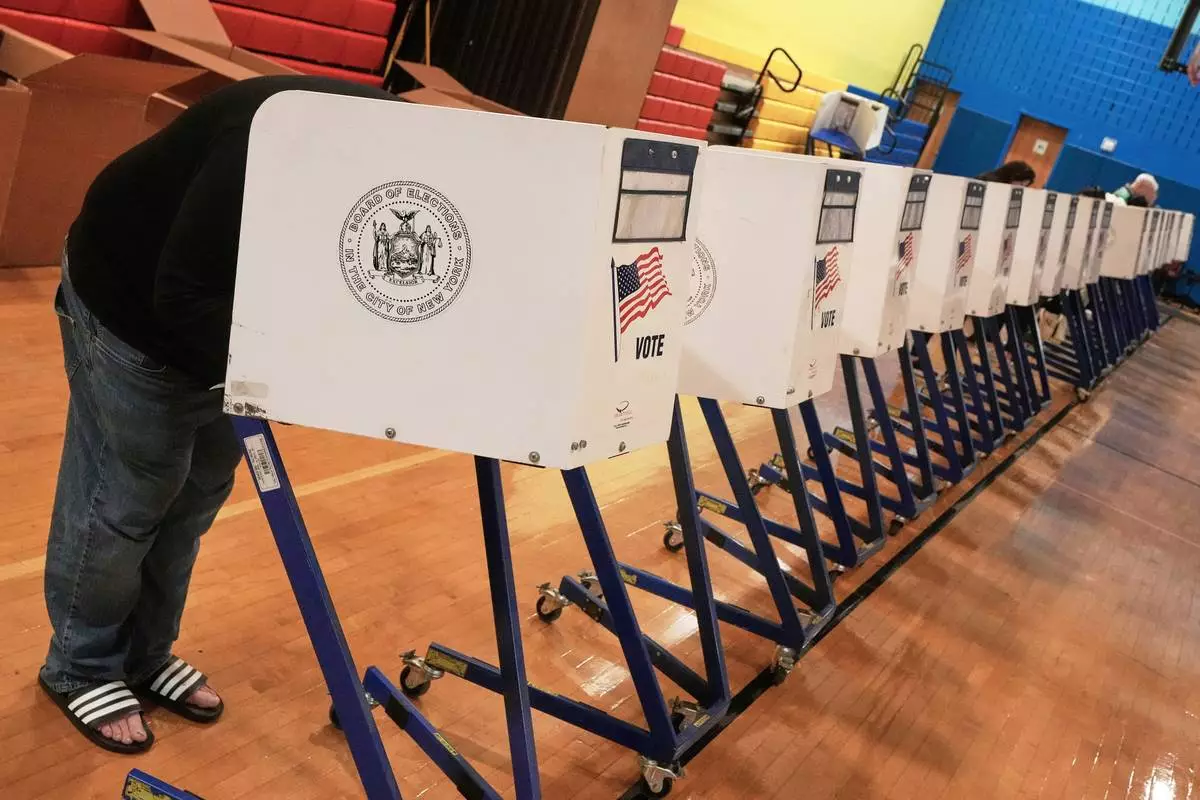
FILE - A voter completes their ballot at a voting site, in New York, Nov. 4, 2025. (AP Photo/Richard Drew, File)