A Belgian video blogger has explored the massive Phase IV operation of the Shanghai Yangshan Deep Water Port, the world's biggest automated container terminal, showcasing its massive scale and high-tech operations which mark China's innovation drive.
Lucas Deckers, 26, has long been fascinated by maritime operations, influenced by his father's work in shipping. His curiosity about the Yangshan Port led him to Shanghai where he explored this cutting-edge facility, often referred to as the "Ghost Terminal." This terminal is the first in China equipped with "Chinese chips" and has become a leader in smart and green port technology, boasting the highest annual throughput and operational efficiency globally.
The automated container terminal, boasting a designed throughput capacity of 6.3 million standard containers annually, already surpassed 6.8 million in 2023 and is projected to exceed 7 million in 2024. This contributes significantly to Shanghai's continued reign as the world's busiest container port for 14 consecutive years, accounting for over 50 percent of its total throughput.
Located at the south of Donghai Bridge, phase IV of the Yangshan Port covers 2.23 million square meters and has a 2,350-meter shoreline.
Zhao Hui, Deputy General Manager for the Yangshan North Project, emphasized that the Donghai Bridge connects Luchao Port in Shanghai's Pudong New District to the Yangshan Deep Water Port, crossing the northern waters of Hangzhou Bay. It is China's first true ocean-crossing bridge, measuring 32.5 kilometers long and 31.5 meters wide.
Out of the ten longest bridges in the world, five are in China, with Donghai ranking fourth nationally and sixth globally. Construction began in June 2002 and was completed by the end of 2005, taking about two and a half years, said Zhao.
"This is offshore wind power. Do you know how much electricity it generates per rotation? A 6-megawatt turbine generates about 10 kilowatt-hours per rotation. To give you an idea, that's enough to power a new energy vehicle on the road for about 50 kilometers," said Zhao.
He pointed out that the bridge's piers, which are typically hidden below the surface, feature a pile foundation equipped with a satellite positioning system capable of millimeter-level accuracy. The Donghai Bridge serves as a crucial link for Yangshan Port, facilitating seamless land-sea transportation and driving regional development.
By connecting Yangshan Port to downtown Shanghai, the bridge establishes a robust supply chain, industrial chain, and value chain.
Upon entering the port, Deckers was immediately captivated by the impressive sight before him.
"We're currently in the control tower for Phase IV of the Shanghai Yangshan Deep Water Port. It's essentially the central control center for the entire terminal. Phase IV covers approximately 2.23 square kilometers. Over by the ocean, you see our gantry cranes—they're specifically for loading and unloading container ships. The terminal currently has 28 gantry cranes. Those shorter cranes on the ground are our rail-mounted gantry cranes—all 121 of them are fully automated and unmanned. They operate continuously, which is why some people call it the 'Ghost Port' or the 'Unmanned Port," said Huang Hua, chief remote operator of Phase IV of the Shanghai Yangshan Deep Water Port.
"Each container has its own unique identification number, just like a person's ID. This number corresponds to its designated location within the terminal. This is one of our automated and unmmaned vehicles," Huang Hua continued.
Huang Hua stressed that the port utilizes a type of autonomous heavy-load horizontal transport vehicle. This vehicle achieves autonomous driving control through a domestically developed line-control chassis technology, multiple sensor inputs, and a communication system for precise positioning. This vehicle has received CE certification from the European Union.
Wu Hao, senior project manager at a Shanghai technology company, added that the vehicle reaches speeds of 36 kilometers per hour when unloaded and 30 kilometers per hour when carrying a 60-ton load—equivalent to two shipping containers. The vehicle's key advantage is its maneuverability, allowing it to easily navigate the port's tight turns and maneuvers.
Wu also introduced another vehicle-- a fully autonomous, electric container truck. This truck uses external sensing units—seven cameras and two lidar sensors—to detect, classify, and identify objects. The cameras act as its "eyes," the lidar as its "ears," and a central processing unit serves as its "brain," controlling the autonomous driving system. This truck model is already in operation at European ports.
The port also uses human-operated vehicles with integrated autonomous driving capabilities to meet diverse customer needs.
"After touring the Phase IV of the Shanghai Yangshan Deep Water Port, I discovered that it truly lives up to its name as an 'unmanned port.' There's no one in the port area—just countless containers, numerous cranes, and autonomous guided vehicles. I also saw many European cargo ships, which really highlighted Shanghai's status as a major international shipping hub. This intelligent port is embracing the world with open arms," said Deckers.
Yangshan Port is not only a microcosm of China's reform and opening-up, but also a prime example of the deep integration of traditional physical economy and modern digital economy—a key element in achieving Chinese-style modernization.
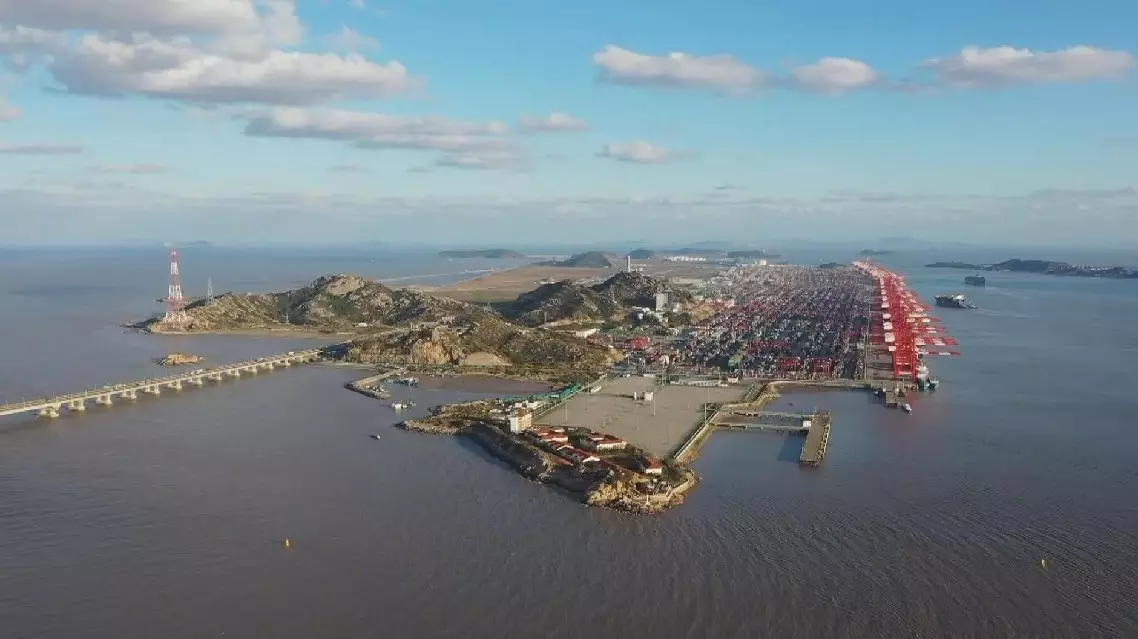
European vlogger explores China's biggest automated container terminal